no. of days between model releases:
OpenAI
GPT-3 → GPT-4: 1,006 days
GPT-4 → GPT-5: 877 days
GPT-5.6 Sol → GPT-6 Astra: 56 days
Anthropic
Claude 3 → Claude 4: 444 days
Claude 4 → Claude 5: 383 days
Claude 5 → Claude 5.1: 84 days
the release cycle compression is insane.
If you want to understand how fast AI is improving, look at intelligence per dollar.
1.5 years ago:
o1 Pro: $150 / $600 per M tokens
Today:
GLM-5.3 Flash: $0.15 / $0.50
That’s a ~1000x collapse in price in under 1.5 years, while GLM-5.3 Flash is more intelligent than o1 Pro.
We already have Opus-4.8 level intelligence sitting right on our desks.
- Deepseek-V4-Flash-Vision
- Qwen3.8-Flash
- GLM5.3-Flash
- Qwen3.8-27b
On top of that, GLM-5.3 running on a 4xDGX Spark delivers performance remarkably close to Fable.
Still think the era of Local AI isn't here yet?
Grok Imagine Video 1.5 agent is now available.
Powered by our newest Image 2.0 model, it delivers higher quality, better storytelling from a smarter agent and excels at connecting multiple shots together with greater continuity.
🚨 TRUMP: “Whoever wins AI, wins.”
“This is bigger than the internet. This is a revolution.”
President Trump goes ALL IN on American innovation, saying the U.S. must beat China in AI as the technology is already driving breakthroughs that are transforming fields like medicine.
Fable 5.1 is 8x better than Fable 5 at controlling robot arms. It puts a block into a bowl 40% of the time, up from 5% (20 runs each), using 1.5x fewer tokens. 🧵
GPT-6 Astra + @threejs is insane. We are way beyond static models. We are engineering living worlds in code now. There are no "3D model files" in this demo. Both trains are generated at runtime from Typescript/Three.js code using dimensions, profiles, and geometry functions. Wheel motion and explode/reassemble animations are also entirely code-driven. Runs super smooth inside the browser.
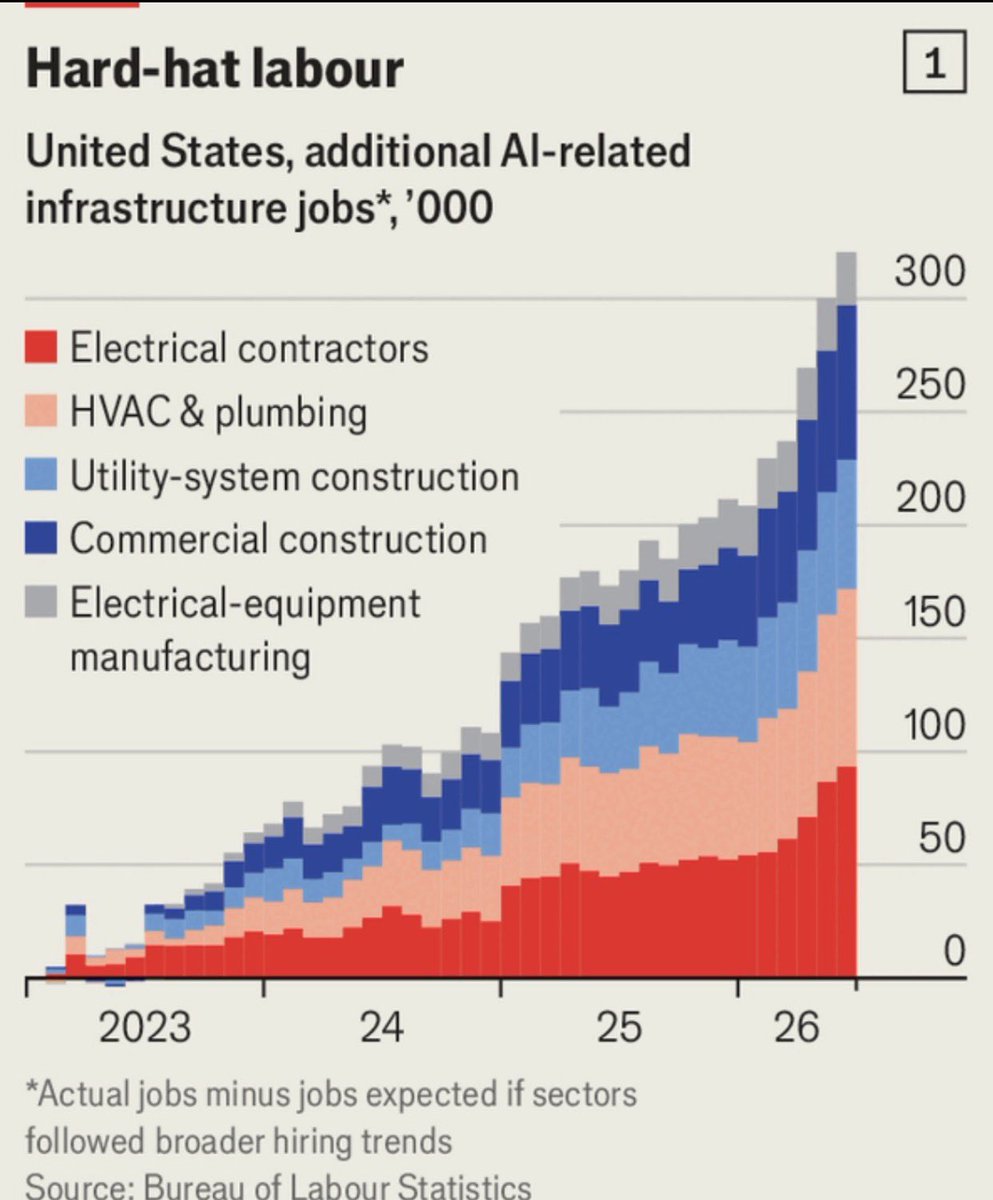
The Economist says AI has added 1 million new jobs in America since mid-2023 (offsetting 200k AI related job losses):
“Roughly 1% of professional jobs are now ‘AI jobs’—on the order of 1m positions in America. In computer occupations and life sciences—including researchers using AI to discover new drugs—the share is 4-5%. LinkedIn’s own analysis points to roughly 640,000 new AI-specific jobs between 2023 and 2025. ‘To date, the evidence suggests that AI has been a net job creator,’ says Kory Kantenga, head of economics for the Americas at LinkedIn.”
“America’s AI infrastructure splurge has created many of them. The spending on the kit needed to make AI run—from chips and servers to data centres, cooling systems and power—is roughly $500bn a year above what it was in 2022, when the world got to know ChatGPT, calculates Goldman Sachs, a bank. Data-centre construction alone is proceeding at an annual rate of more than $75bn, nearly 60% higher than a year ago, according to Census Bureau data. That building spree requires armies of workers: electricians to wire them, HVAC specialists to stop racks from overheating, grid engineers to hook them up to the power supply and technicians to install and maintain the machines.”
“Between 2023 and 2025 employment among paralegals rose by about 11% and among market-research analysts by 6%, compared to a national average of around 2.5% (see chart 3). Despite dire warnings of imminent lay-offs, professional services are projected to keep growing rapidly thanks to demand for AI systems and consulting, according to BLS forecasts.”
Google’s WikiSkill paper points to something important: better AI agents may not come from bigger models alone. If an agent can turn experience into persistent knowledge and reusable skills, a smaller model can outperform a larger but “inexperienced” one. The real race may be shifting from model size to memory + knowledge + skills + tools.
Banger paper from Google.
If you maintain a skill library for your agents, you might want to check this out.
(bookmark it)
This work separates three things that skill-evolution systems usually collapse into one. Raw execution traces, a persistent wiki of accumulated knowledge, and the executable skills themselves.
Experience gets consolidated into the wiki, and every later skill update builds on that wiki instead of on a scattered optimization history.
Ablations confirm the wiki is what carries a lot of the gain. Two results stand out in particular. Smaller models with evolved skills beat substantially larger models without them. And skills evolved by one model transfer across families, where skills evolved elsewhere sometimes beat self-evolved ones.
Paper: https://t.co/6qftGirTpE
Chat with Paper: https://t.co/rrVzkkR1ij