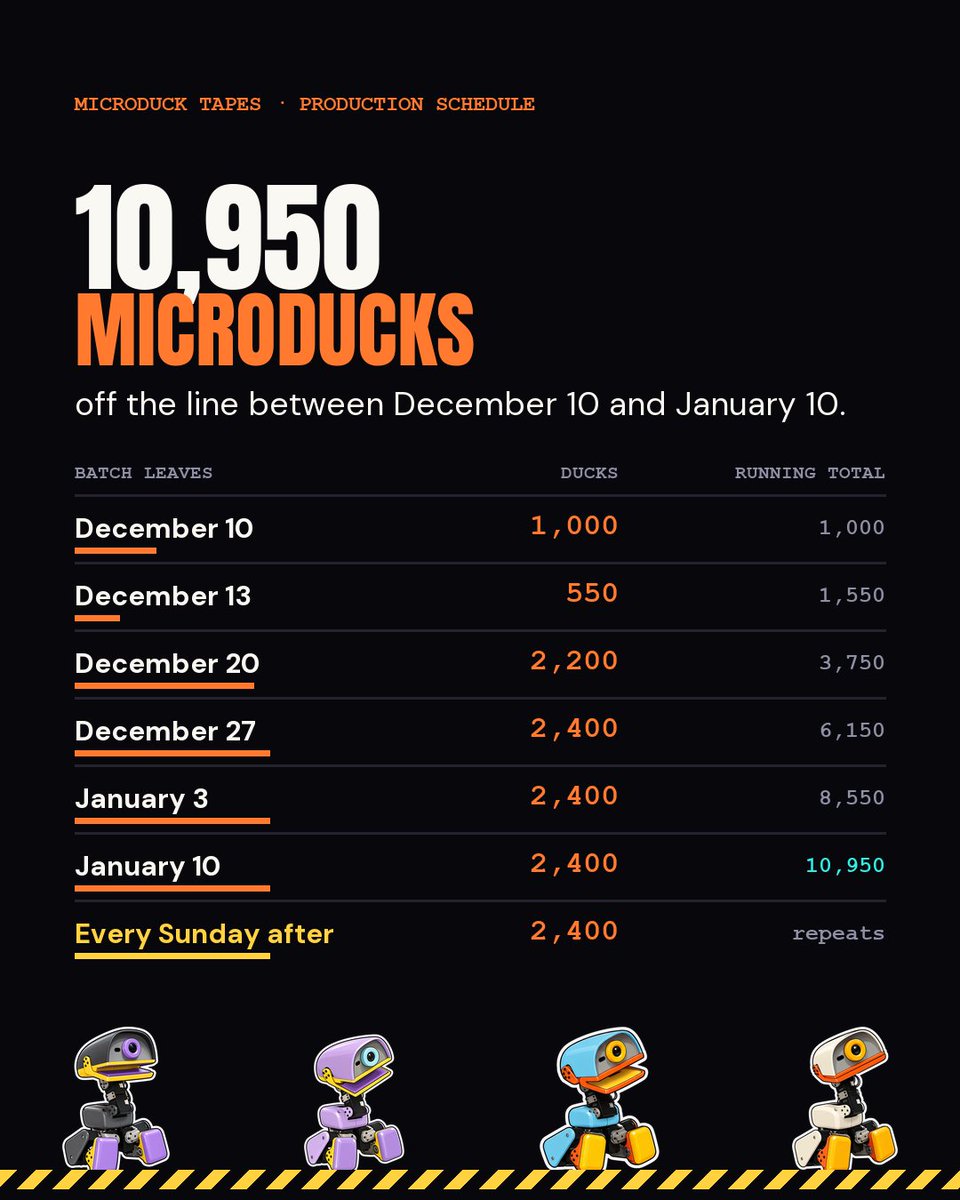
The Microduck adventure continues, and the shipping dates are close enough to feel real now. We are proud to tell you that 10,950 Microducks will come off the line between December 10 and January 10!
Weekly batches, earliest orders first. Every date is in here.
The Microduck adventure continues, and the shipping dates are close enough to feel real now. We are proud to tell you that 10,950 Microducks will come off the line between December 10 and January 10!
Weekly batches, earliest orders first. Every date is in here.
Important: Reachy Mini shipping update
2,000 Reachy Mini Lite and 1,500 Reachy Mini Wireless are leaving the factory this week.
They should arrive at your location within 15 days.
All past and present Lite orders will be delivered by Christmas.
For Wireless orders, the current batch will clear most (but not all) of our backlog orders. If you did not receive a shipping notification within 15 days, it means that your order should arrive by early January.
Apologies to everyone whose order took longer than expected. We were impacted by limited hardware availability, which slowed mass production. Some shipments to the UK were also sent back on arrival, and we're actively working to resolve it.
We'll soon have ~14,000 Reachy Minis in the wild!
Testing the new version of the Reachy Mini hoverboard, first impressions are excellent. I’ll post a more detailed update on where we stand and the technical choices we’ve made if there is interest for it.
Btw I think we'll ship with lower velocities by default but allow users to crank up the speed if they want to.
Something pretty special happened in Shenzhen today - what might be the World's First Community-Led Microduck Meetup. 🦆
While @PollenRobotics is busy bringing Microduck to life, hardware builders from all over China have already built their own and gathered to test them together.
This is what happens when you inspire a community of builders. ❤️
Put a Gemma-based model in a robot body. First thing it does: scan the room, spot the giant TV, and start a movie break.
Awesome to see @NVIDIAAI build on Gemma 4 E4B, fitting live conversation, tool calls, animations, and a vision model onto a single 8GB Jetson!
This live demo of four Microducks with Jensen Huang went completely viral, and we're ecstatic about it. But there's also a lot of confusion, so I want to clarify what Microduck can and cannot do, and what it will realistically be able to do in the future.
I count 60M+ views on this demo alone, based on the few big posts I see on social media, and everything has been buzzing. Even my own simple emotional design post on a newly created Instagram account got 1M+ views. We are selling Microducks at an incredible rate, even faster than during its historic launch. I've been trying to answer all the questions I see on our socials: people are asking if X or Y is possible on the robots, and this post aims to answer most of them.
First of all, the demo you've seen was not fully autonomous. We had one engineer piloting each Microduck. The motions on the robots were trained with reinforcement learning, using a sim-to-real pipeline: walking, standing up after a fall, sitting, doing a somersault, roller skating. All of those are policies trained this way. What the pilots did during the live event was send commands: directions (move forward, rotate), head orientation (look here), quacks, and special actions (do the somersault, sit down).
If you buy a Microduck, will you get an autonomous companion right out of the box? The current answer is no. But there is no impossible technical barrier to get there. I'm not sure how much time we'll have to work on this before shipping, but since everything is open source, I fully expect the community to build it, and to build it fast.
Now let's understand what's already done, what will be easy to add, and what's an open problem. What you'll be able to do out of the box, and you can already do it in simulation right now, is train new policies with reinforcement learning. You could teach your duck to walk differently from the default gait we provide, to do a weird dance, or to walk on stilts. The community has been crazy creative with this, even though they only have the simulator.
Note that you don't need reinforcement learning when the movements are simple. For example, the early emotional design I did is mostly coded movements plus pre-generated sounds. A simple mental model: use reinforcement learning when balance is part of the movement. If you try to code a cinematic walk by naively putting one foot in front of the other, your robot will realistically never walk, because you need to account for the dynamics of the movement, the inaccuracies of the sensors, the friction with the ground, and potential perturbations from the outside, like being pushed.
So training new policies is definitely doable, but you can't train a policy to get a genuine long-term companion in your home (well, technically you could, but that's a whole other range of policy: a research-grade problem, and the resulting neural network would probably be huge and never able to run on such a small compute). Instead, you need a few more building blocks: voice recognition, facial detection/recognition, localization, some simple navigation, and a behavior layer, which is less technical and harder to describe.
As a rule of thumb, a prototype of any of these is within reach of anyone if they have a modern coding agent and if the computation doesn't run on the robot (meaning the robot can reach the internet or an external computer and use external APIs). A rough prototype for each of the above can be a chill weekend project. As always, going from the prototype to a high-quality implementation is another story, but still doable for most if you put in the time and test a lot.
However, having all of this run locally, on the onboard chip, I would call a very hard task. You'd need some very clever engineering to get a good enough version of everything working together. But I can't say it's impossible, because I've seen some crazy efficient implementations of all of the above. And here we don't need a super high success rate: it's okay if the duck sometimes does something a bit random. So I wouldn't be surprised if folks managed a fully local, cool, simple version of this autonomous companion. For example, you don't need Whisper-grade open-vocabulary transcription: being able to recognize a few keywords would already be great for interaction.
One of the fastest ways to turn this robot into an autonomous companion would be to stream Microduck's sensors (the camera, the depth sensor, the IMU and the joint positions) to a computer, and use a software stack like the one we use for the conversation app on Reachy Mini: a local VAD, then a cloud speech-to-text model, then a call to a frontier LLM that decides on actions. Actions could be quacking, looking at things/faces/a direction, walking to a given position, sitting down, playing an emotion, kicking or doing a somersault. A SLAM algorithm would run in parallel so the robot can localize itself in your home, and you would prompt the LLM for a lifelike behavior: moving to random places, sometimes following people, and having emotional responses that fit what you're saying and the duck's environment. Of course someone is going to build a Tamagotchi-like layer on top of this, and it will be insane.
How much demand is there for a software suite that would do all of this? I for one think it would be super cool.
A word about the humans. We had five engineers backstage, and they are pretty much the core team behind Microduck. Their impact per head is absolutely off the charts. Antoine Pirrone piloted Graphite, Augustin Crampette Lavender (the rebel one), Matthieu Lapeyre Sky, Coralie Deplane Cream, and Pierre Rouanet was stressing over the Wi-Fi. Give them a follow! (Antoine @antoinepirrone, Augustin on LinkedIn, Matthieu @matth_lapeyre, Coralie @Drenaya_, Pierre on LinkedIn).
I get visibility because I communicate a lot, but I mainly work on Reachy Mini (you might want to check it out: it's a very cool robot, and it ships much faster than Microduck :) ). My contribution to Microduck has been minimal: I'm mostly a first power user. My main added value at GTC was having hands big enough to carry four Microducks below the stage.
Where I take pride is that Antoine and Coralie are former students and former interns of mine. I'm therefore entitled to 3% credit on anything (good) they do, for life. If they do something bad, however, it was clearly the fault of their parents.
About the super smart engineering that can be done on board: Antoine just released two very cool blog posts (links below). The first is on odometry, the robot estimating its own movement from its own internal sensors. The second is about SLAM, which allows long-term localization: it adds the depth sensor to the odometry to get a stable position over time. Think of it as recognizing known landmarks in your home to know where the robot is. The crazy part is that all of this runs on the robot. So this gives me hope that we'll be able to do a lot of cool stuff on board.
Two tiny robots try to understand humans.
The episode is here. Live action with real robots instead of animation (episode 5): "Humans"
Enjoy!
PS: I'd like to thank everyone for the kind words and the amazing support on this mini-series!
Reachy Mini has wheels now!
Our little open-source AI robot can finally explore beyond the desktop.
And that's not all:
📱 New mobile app: no computer needed
👑 NFC hats that unlock new personalities and apps
Physical AI just got a lot more fun.
Watch it👇
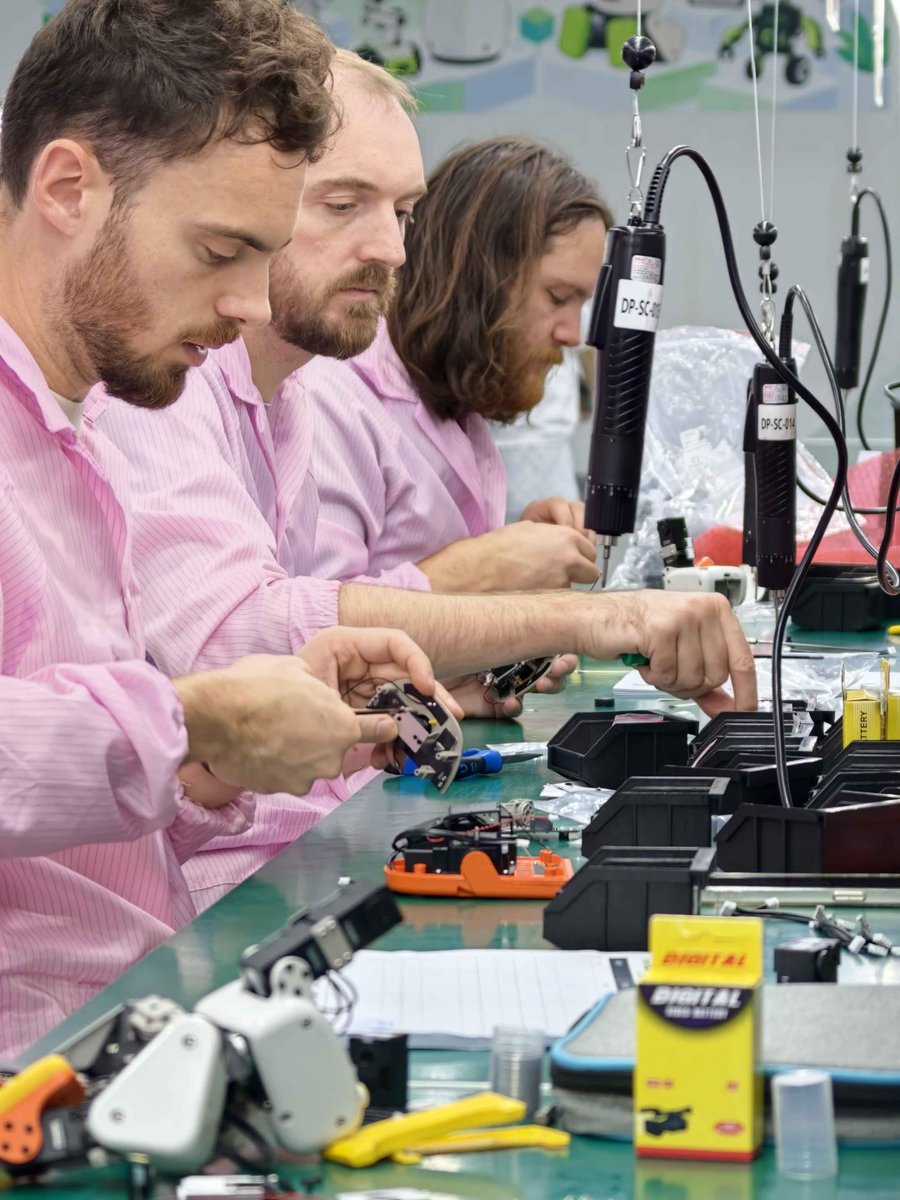
We were at the @seeedstudio Shenzhen factory today with @antoinepirrone and @matth_lapeyre and seeing the Microduck production line run for the first time was something special.
We even had our own assembly stations 🙂
🧦 New on MicroDuck Arena: the Sock Heist!
Sneak 6 m up to a giant #microduck and steal its socks. When it turns its head, freeze. Move 3 cm and you're caught.
An idea by (jrubiosainz on GitHub). 🎃 Happy Halloween!
https://t.co/ZjmNwv89cV
Reachy Mini can finally move!
Today We’re launching Reachy Mini "Level Up", a set of new accessories for Reachy Mini: wheels (!), phone apps, and hats that change its personality
obviously the first thing Reachy Mini did was race against Microduck (spoiler: it's faster)
A little peek inside the factory.
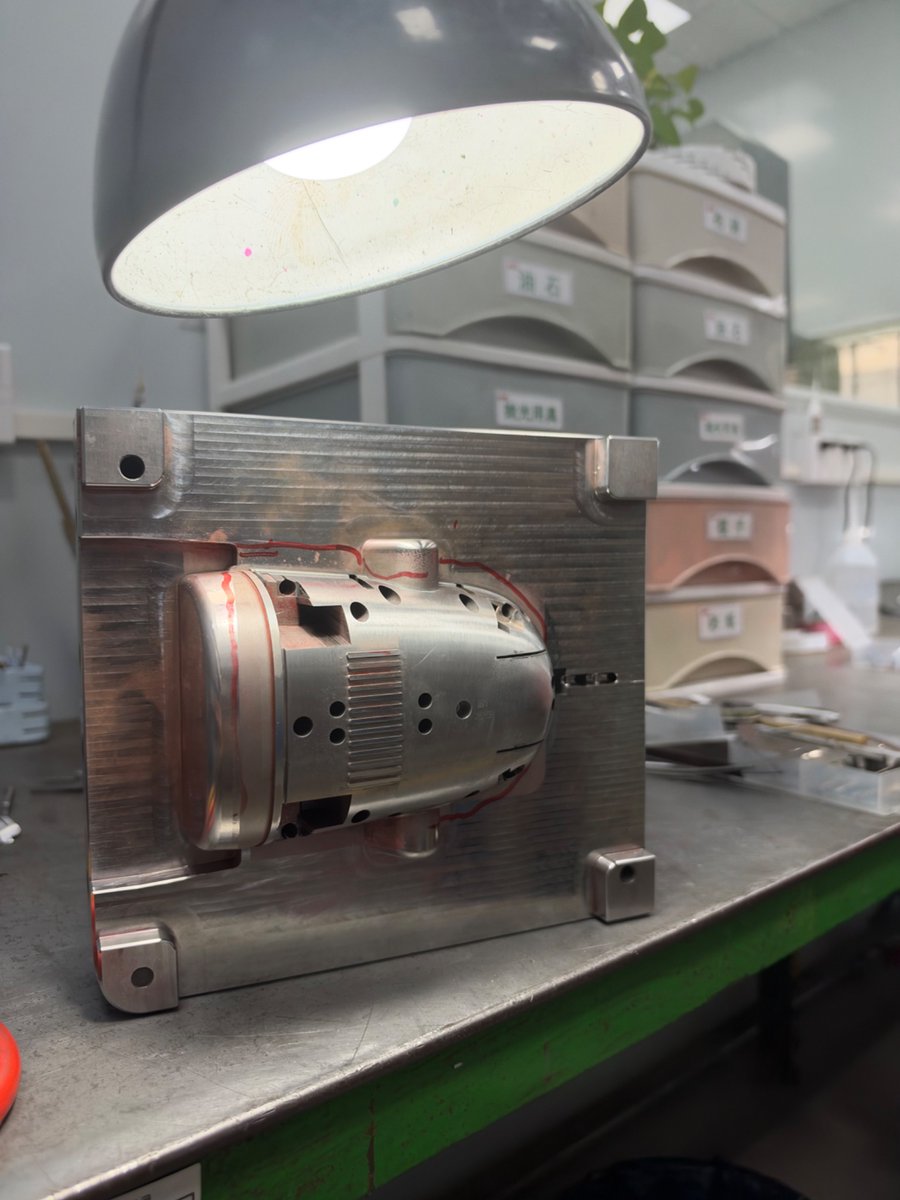
Final adjustments to the Microduck injection molds are underway before our pre-production run.
(Sorry for putting NSFW content on your feed 🫣)
microduck is learning to plan its footsteps, so it lands more precisely where it wants to go
with SLAM, this is one of the building blocks toward an open-source 🦆 that can wander around the house on its own
early steps but it's progressing really fast and it's fun to watch
New on MicroDuck Arena: Tug of War 🦆🪢🦆
Two robot ducks, one rope, a pit in the middle. Drag your rival in and you win.
Train yours in simulation, publish it, and it's in the first cup, live Friday, Nov 6 at 9 AM PT.
https://t.co/ZjmNwv89cV
Sorry for the wait, the episode is here!
Live action with real robots instead of animation (episode 4): "Anger"
Enjoy!
As always, the software of Microduck and Reachy Mini is open source:
https://t.co/RW1p4V2X6X
https://t.co/hA91qMLZ4d
I was the opening act for a family of ducks.
Thank you, Berlin. What a GTC.
Europe is building its AI ecosystem and economy, from AI factories to agents to robots.
DSX POD: Vera Rubin modular factories built, cabled and tested in the factory, then delivered ready to produce intelligence.
Agents: models, harnesses, sandboxes, knowledge and tools. NVIDIA Agent Toolkit brings the pieces together so companies control what their agents know, access and do. NVIDIA OpenShell enhances safety.
Physical AI: new customers across AI-RAN, robotaxis and robotics.
Personal AI: after four years building with Microsoft, RTX Spark brings personal agents to the Windows PC.
Thank you to President @EmmanuelMacron, Prime Minister @andyburnham and Chancellor @bundeskanzler for hosting me. Great to celebrate Sferical One with Sweden’s technology leaders. And thank you to President @TokayevKZ for the warm welcome.
And to our partners and NVIDIA teams: thank you for making it happen.
The keynote is here: https://t.co/s9GISZ1Swi