@02_0279 is @NEETINTEL
This is a dedicated account for NEET INTEL for June 2026-onwards. The other account has an overly large and ridiculous audience.
If you're browsing pages on desktop, press up or down to flip back and forth between the current highlighting rationale and the nextgen test rationale.
The nextgen rationale was meant to outright replace the current rationale, but having the two side by side can be helpful.
The highlight logic on the GitHub heatmaps has been overhauled. Some highlighted cells can be clicked more than once to get insight as to why that cell was highlighted. This could be helpful for some of the more difficult structures.
https://t.co/2dkYWs24KA
One more example. The 'split' for 36 character EAMs is detected, and so (31,36), which appears to be a false positive, is removed.
(And pre-split (12,13), (21,22), and (28,29), though tentative, is identified. Without partitioning, it would've been unable to highlight those.)
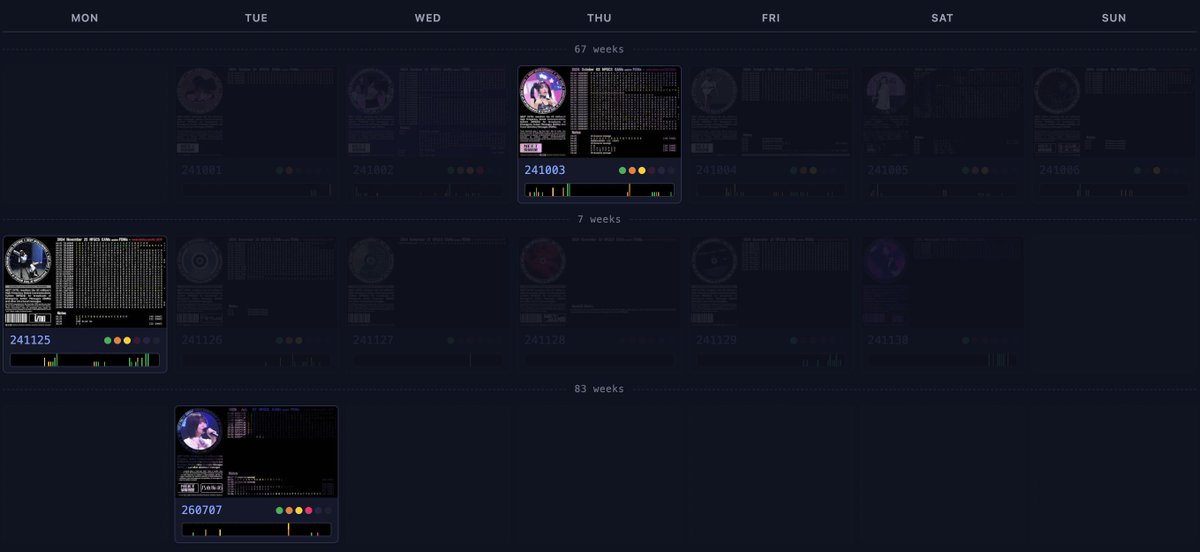
A lot of EAM structures were changed on 241001.
I have a script that can detect the change and subgroup them. However, some structures seem to have had preemptive structures introduced earlier in the year. As a result, the script currently can't neatly detect the subgroups.
For comparison: detecting the 'split' helps reduce the rate of false positives being highlighted and results in a 'less chaotic looking' highlighting system. (Persisting false positives in the edge cases are that much more confusing when contrasted against improvement elsewhere.)
Each of the indicated days has an apparent 25&48 pairing, followed by a 22&32 pairing later in the same day.
There is at least one additional day exhibiting this behavior not currently covered by the DTCP.
https://t.co/mKR1yAPzEl
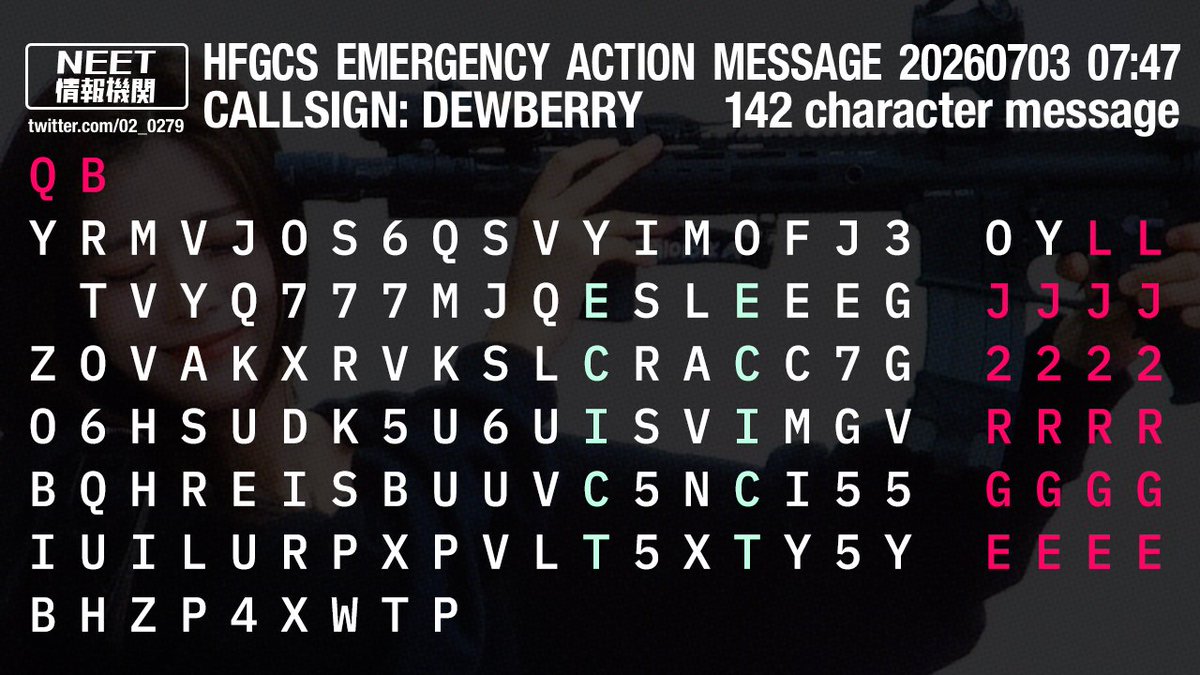
For comparison.
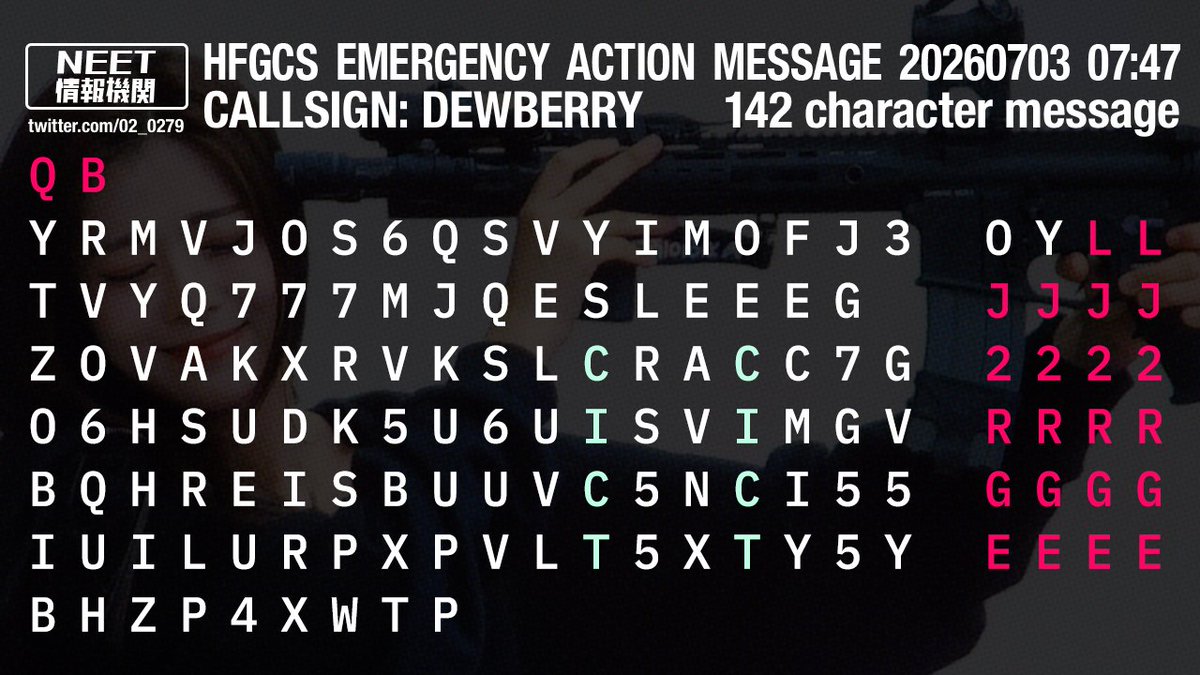
It's possible this message should be partitioned another way (e.g. ZZHH at line 3) but I don't believe so; 142 structure seems 'fixed'. Rather, it seems XXXX, X__X, XX__, and __XX might all be "valid".
https://t.co/ZeNHC8gDR2
https://t.co/XaGG3MqVxy
It seems plausible that the spaces in some lines would suggest they they are meant to be slid or 'moved around'.
For example, the line which is one character short matches the (.)(.)(.)\1 pattern at the same position as the other lines when the line is moved one position right.
(On second thought: 260701 and 260702 are possibilities just to make sure all of Valiant Shield 26 is covered by DTCPs, but I'm not sure any HFGCS activity is related to the exercise, so it's not a priority.)
Unless the HFGCS broadcasts a bunch of long Group 4 EAMs this week, a 260630 DTCP is likely to be the last one for a while.
July 2025 was exhaustively monitored, so July 2026 would be a nice companion, but I'm unlikely to have time to monitor the HFGCS this month. [1/2]
I returned for June specifically to see if the 120 char EAM broadcasting as bookend for an 11-day period would happen again.
Not sure if I'll have time, but I'll do October if I can. (I'll make an effort but am OK with missing Aug, Sept SKYMASTERs. I can't catch everything.)
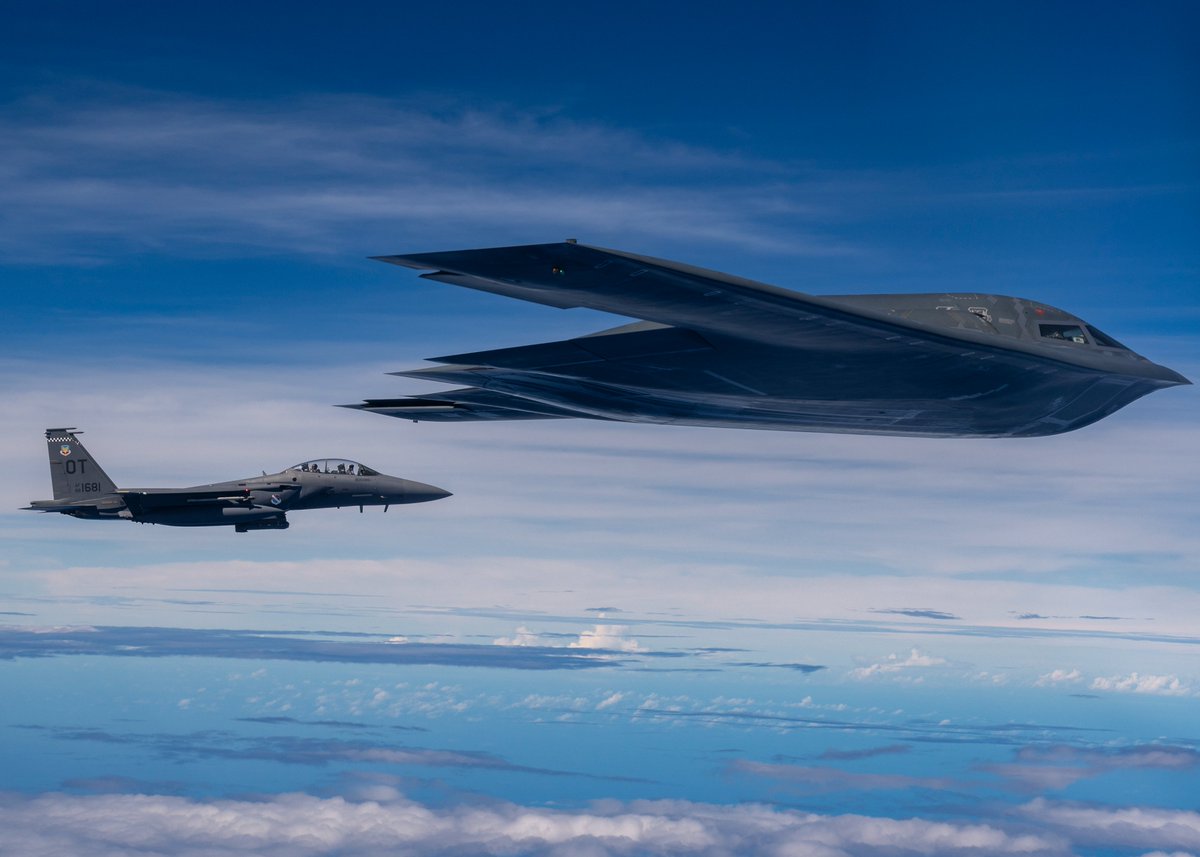
The @PACAF successfully conducted a live-fire Sinking Exercise using the B-2 Spirit north of the Mariana Islands. Deploying the Long Range Anti-Ship Missile - demonstrating enhanced ability to achieve strategic objectives within range of potential threats.
https://t.co/8PPP7bT3Pb
A 24 character EAM broadcast on June 22 and a 24 character EAM broadcast on June 29 have a bunch of characters in common, with a 9 character subset the most notable.
There's also some commonality with the group 4 message using a previous prefix. A surprise if it's significant.
A 224 character EAM broadcast. #EAM224
※ From current dataset, character 103 always = character 204. Since n=3, this may be spurious, so I haven't highlighted it in the diagram.









![02_0279's tweet photo. 260711 ≒ 241106 [?]
https://t.co/3FSdjhqfCv https://t.co/tarr2y9UXo](https://pbs.twimg.com/media/HNAWjZNXUAAJCe8.jpg)

![02_0279's tweet photo. Unless the HFGCS broadcasts a bunch of long Group 4 EAMs this week, a 260630 DTCP is likely to be the last one for a while.
July 2025 was exhaustively monitored, so July 2026 would be a nice companion, but I'm unlikely to have time to monitor the HFGCS this month. [1/2] https://t.co/TaVXZDUsoh](https://pbs.twimg.com/media/HMGVu_sWEAAy4Cj.jpg)


