Timelines were quiet.
The boat wasn’t.
Usernames became faces.
Faces became people.
People became memories.
That’s when a community stops being an audience.
02Growth. Real people. Real bonds.
#02Growth
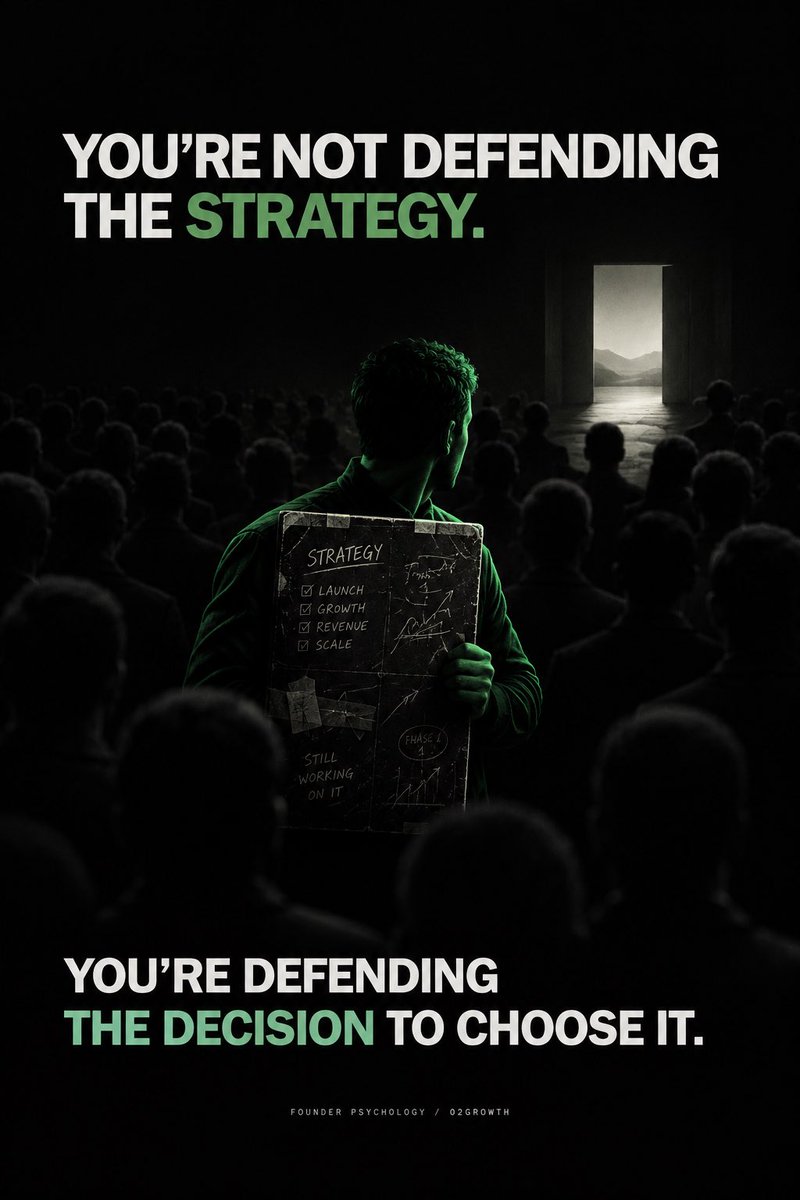
Founders rarely make the decision they think they’re making.
They think they’re deciding:
“Should we change the strategy?”
“Should we kill this feature?”
“Should we change the positioning?”
“Should we stop spending here?”
But sometimes the real decision is…
“Am I willing to admit that what I believed before might have been wrong?”
That’s a different decision.
Because once you’ve spent months building something, talked about it publicly, convinced your team, and defended it to other people…
changing direction doesn’t just feel like changing direction.
It can feel like admitting defeat.
So you ask for more data.
Another test.
Another month.
Another campaign.
Another explanation for why the signal isn’t there yet.
Not because you’re irrational.
Because the cost of changing your mind is no longer just financial.
It’s psychological.
That’s why I don’t think you can properly diagnose a founder’s decision by looking only at the decision itself.
Sometimes you have to ask…
“What would changing this force them to admit?”
That’s where the real decision usually starts.
I never thought I would see Nigeria celebrate someone coming for our $700 billion mineral wealth.
Before Nairametrics makes this sound like the U.S. is bringing $700 billion into Nigeria, read that headline again.
The $700 billion is not the investment.
It is the estimated value of the minerals Nigeria already has underground.
The agreement is simply opening the door for American investment into the sector.
And this is where Nigerians need to pay attention.
Because if we export the raw minerals, while someone else controls the exploration, processing, infrastructure and value chain, who actually captures the wealth?
The real question is not how much our minerals are worth.
It is how much Nigeria gets to keep after they are taken out of the ground.
My friend was living like a tenant in his own house.
Nobody knows that he is the landlord except the caretaker.
He doesn't normally stay around, but whenever the caretaker calls for a tenants' meeting, he attends and pretends to be a tenant too.
At the end of last year, he called the caretaker and told him to organise an end-of-year party for the tenants.
During the celebration, the best tenant received a brand-new washing machine as a gift.
The winner was a lady who had rejected my friend when he asked her out.
As she carried her gift back to her apartment, she looked at my friend and said, "This is what real men do."
@02growthlab The launch thread is a performance. Six months later it is a habit. If every question still routes to one person, you built an audience, not a community.
I watched a 12R winning trade turn into a full loss.
Not because my analysis was wrong.
Because I listened to the wrong advice at the wrong time.
That day taught me something about trading I wish someone had told me earlier.
Trading is already confusing.
Then you open Twitter.
One trader says:
“Cut your losses quickly.”
You scroll down.
Another says:
“Let your winners run.”
You check Instagram.
Someone else says:
“Take partials.”
Now you’re the one who needs risk management.
I went through this phase too.
Twitter had an opinion.
Telegram had an opinion.
Instagram had an opinion.
Even TikTok people sef dey drop hot takes. 😂
Everybody sounded confident.
And somehow…
I was becoming less confident in my own trades.
Then one day, I took a trade.
My analysis was clean.
The entry made sense.
The trade started moving exactly where I expected.
Then I saw it.
Twelve.
Times.
My.
Risk.
At that point, one thought entered my head:
“Let your winners run.”
Big mistake.
I didn't take profit.
12R became 11R.
11R became 9R.
9R became 6R.
I was still holding.
Because somewhere in my head, I had convinced myself:
“Real traders don't close winners too early.”
Then the market reversed.
6R disappeared.
3R disappeared.
1R disappeared.
Eventually…
my stop-loss got hit.
I stared at the screen like:
“Wait… I was just up 12R.”
😂
The market had collected both my money and my confidence.
You’d think I learned.
I did.
Just the wrong lesson.
The next time I saw a trade go into small profit…
I closed it.
Quick.
Safe.
No greed.
No “let it run.”
I felt like a disciplined trader.
Five minutes later…
the market hit my original take-profit.
Exactly where I had planned to exit.
I just sat there looking at the chart.
No words.
My village people had apparently upgraded their internet connection. 😭
That’s when I realized something:
The problem wasn't whether I should hold or close.
The problem was that I had no clearly defined rule for either.
I was making decisions during the trade.
Based on emotions.
Based on Twitter.
Based on whoever I had watched last.
And this is where a lot of traders misunderstand:
“Cut your losses short.”
It doesn't mean:
“Close every losing trade the moment you feel uncomfortable.”
It means you should know before entering how much you're willing to lose.
If your strategy says:
Entry → Stop-loss → Take-profit
…and your risk is predefined,
then you've already decided what happens if you're wrong.
You don't need to panic every time price moves against you.
Your stop exists for a reason.
The same thing applies to profits.
“Let your winners run” isn't a universal command.
Neither is:
“Always take partials.”
They're approaches.
And every approach has a trade-off.
If you take profit early:
You may lock in gains…
but miss a larger move.
If you let winners run:
You may catch huge moves…
but give back unrealized profit sometimes.
Neither sentence is a trading strategy by itself.
Your strategy should answer:
• Where do I enter?
• Where am I wrong?
• How much do I risk?
• When do I take partials?
• When do I move to breakeven?
• Where is my final exit?
• What makes me close early?
If you can't answer these before entering, you're probably improvising.
And here's the part nobody tells beginners:
Your risk tolerance matters too.
Someone trading money they desperately need will manage a trade differently from someone trading money they can comfortably lose.
That emotional pressure changes decision-making.
So don't build your trading system around what makes another trader comfortable.
Build it around what you can execute consistently.
Because a strategy you cannot follow under pressure isn't really your strategy.
This is why backtesting matters.
You need to know:
What happens when you take profit at 2R?
What happens when you target 3R?
What happens when you trail?
What happens when you take partials?
What happens...