Thesis
The development and deployment of #Quantum-Governed #Coaxial_Transcription_Hubs, integrating #Quantum_Demodulation, #Blockchain_Technology, and #Ethical_AI, represent a transformative paradigm for #Global_Value_Preservation, surpassing traditional cryptographic systems like #Bitcoin by offering #Quantum_Resistant_Security, Scalable_Decentralization, and #Intrinsic_Utility. This thesis posits that these hubs can establish a #Resilient, #Equitable, and #Future_Proof framework for preserving #Digital_Assets and #Physical_Value_Assets—such as Intellectual_Property, #Tokenized_Resources, and #Financial_Contracts—addressing the limitations of current #Store_of_Value mechanisms in the face of #Quantum_Computing_Threats, #Economic_Instability, and #Societal_Inequity.
Abstract
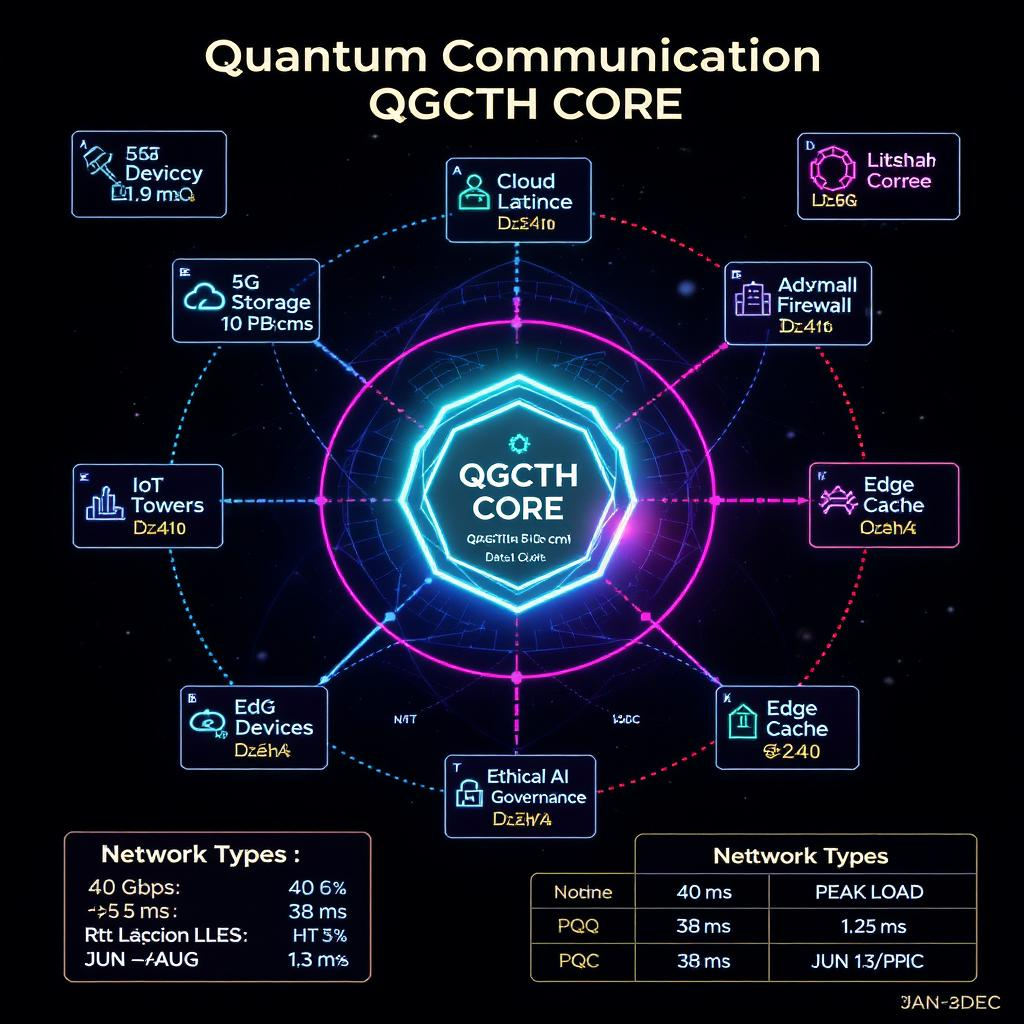
As the global economy transitions into an era dominated by #Quantum_Technologies, the preservation of #Value—encompassing #Digital_Currencies, #Intellectual_Assets, and #Societal_Equity—faces unprecedented challenges from #Quantum_Decryption_Threats and #Centralized_Vulnerabilities. This paper explores the potential of #Quantum-Governed #Coaxial_Transcription_Hubs, a novel system proposed by the Aussa Research Institute, to revolutionize #Global_Value_Preservation. Leveraging #Quantum_Demodulation, #Blockchain_Integration, and #Ethical_AI_Governance, these hubs achieve a latency of 1.9ms, a storage density of 10 PB/cm³, and #Quantum_Resistant_Security (AdvQ ≤ 2⁻⁴¹⁰), outstripping the capabilities of traditional systems like #Bitcoin.
The study analyzes their application as a Decentralized, #Scalable platform for securing #Digital_Assets, supporting #Energy_Efficient_Smart_Grids, and enabling Equitable Data Ecosystems across 10,000 nodes with 1,500 transactions per second. Drawing on recent advancements in #Quantum_Key_Distribution (e.g., Toshiba’s 2025 #QKD_Trials) and #Post_Quantum_Cryptography (NIST standards, 2022), the research demonstrates how these hubs mitigate risks of #Inflation, #Geopolitical_Instability, and #Quantum_Obsolescence. Comparative analysis with #Bitcoin highlights superior Durability, Utility, and Governance, though challenges such as Adoption and Regulatory Hurdles are identified. The findings suggest a blueprint for a Sustainable, #Inclusive_Value_Preservation infrastructure, with implications for Global Financial Systems, #Smart_Infrastructure, and Societal Resilience as of July 2025
Two pendulums can start almost identically yet follow completely different paths. This is the strange beauty of chaos.
In 1963, meteorologist Edward Lorenz discovered how tiny differences in initial conditions can grow dramatically, even when a system follows perfectly deterministic laws.
The difference grows approximately as:
|δ(t)| ≈ |δ₀|e^(λt)
When the Lyapunov exponent λ is positive, small errors grow exponentially.
The equations remain predictable. Our ability to predict their outcome does not.
Mass tells spacetime how to curve. Spacetime tells mass how to move.
Einstein's field equations: Rαβ − ½R gαβ + Λgαβ = 8πTαβ. The left side is geometry: how spacetime curves. The right side is the mass and energy that cause it.
A mass bends spacetime, and a smaller body follows the straightest path through it. Its orbit is not a closed ellipse: it slowly turns, like Mercury's.
The cosmological constant Λ acts against gravity on cosmic scales and drives the expansion.
كيف يمكن لتكامل على سطح أن يساوي تكاملا على حدوده؟ وكيف يكشف الدوران المحلي Curl عن سلوك الحقل على سطح كامل؟
من مبرهنات Green وستوكس إلى مبرهنة Gauss، تكشف الرياضيات عن روابط عميقة بين الحدود، المساحات والحجوم
ما يبدو معقدا في الداخل، قد يصبح أبسط حين نفهم ما يحدث على الحدود...
This guy used Grok Bot to build a quant system with 6 AI agents and made +$327,273.03 PnL on Polymarket
The agents repeat the same cycle 324 times an hour, trading crypto Up/Down markets with an average trade size of $10.51
Here’s how the algorithm works:
> MONITOR gathers the context for entry
x = (Return, Gap, Volatility, Spread)
Tracks the underlying asset’s movement, its position relative to the reference level, and CLOB data. Adds the time remaining and order book depth
Passes the collected data on both sides of the market, Up and Down, to INFER
> INFER assesses three types of movement
pₖ = πₖLₖ / ΣⱼπⱼLⱼ
Applies Gaussian Naive Bayes to rising, falling, and range-bound quote movements over the selected horizon
Trains on completed observations from comparable assets and market windows. Uses Gaussian feature distributions for upward, downward, and sideways conditions
> EXPECT checks whether the trade makes sense
e = Σₖpₖgₖ - c
Combines the scenario estimates with their average results in comparable historical entries. Subtracts round-trip costs
Only passes on a positive edge with a buffer, calculated for the selected size and horizon
> DOUBT filters out ambiguous conditions
H = -Σₖpₖln(pₖ)
Checks how the estimate is distributed across the three scenarios. Skips a new entry when the distribution is too uniform
Tunes the threshold on held-out historical data. Compares the estimates with observed movement frequencies
> RESERVE limits total exposure
Q_free = max(0, Q_limit-Q_held-Q_pending)
Calculates the remaining limit after accounting for the position and unfilled entries. Caps the new size by available collateral and CLOB depth
If the final size changes, EXPECT recalculates the costs
> ROUTER synchronizes entry and exit
t_exit = t_signal + h
Submits a limit entry order, checks fills, and initiates the exit at the time for which INFER estimated the movement
Accounts for partial fills and feeds completed results back to INFER. All exits are scheduled before the market window ends
His Polymarket account: aswfadq1555
You can build your own trading bot here:
https://t.co/TTy2bBsUZX
Most profitable trades:
$3,306.83 -> $13,008.63 (+$9,701.80)
$1,047.94 -> $9,775.02 (+$8,727.08)
$13,815.34 -> $20,924.72 (+$7,109.38)
We just entered the era of alien mathematics.
This is a map of the 17-million-line Lean proof of the Riemann Hypothesis (175,000 files, verified by computers).
A 167-year-old math problem solved with AI, and the proof looks like a biological nervous system. Damn.
The Aizawa attractor, a particular case of the Lorenz attractor, has this system of differential equations:
dx = (z-b) * x - d*y
dy = d * x + (z-b) * y
dz = c + a*z - z³/3 - x² + f * z * x³
Most of us are used to finding a spot in 3D space using a standard box-like grid, moving left-right, forward-backward, and up-down. Cylindrical coordinates offer a much smarter shortcut for anything round or spinning. Instead of a square grid, you locate a point just like you would inside a tin can: by measuring how far out it is from the center (r), what angle it sits at around the circle (φ), and how high up it is (z).
Because circles get wider the farther you move from the center, a tiny slice of space grows wider as you step outward, which is why that extra r shows up in the volume formula. That simple geometric trick makes cylindrical coordinates the go-to tool for physicists and engineers studying everyday round systems, from water flowing through pipes and electricity running down wires to swirling whirlpools and tornadoes.
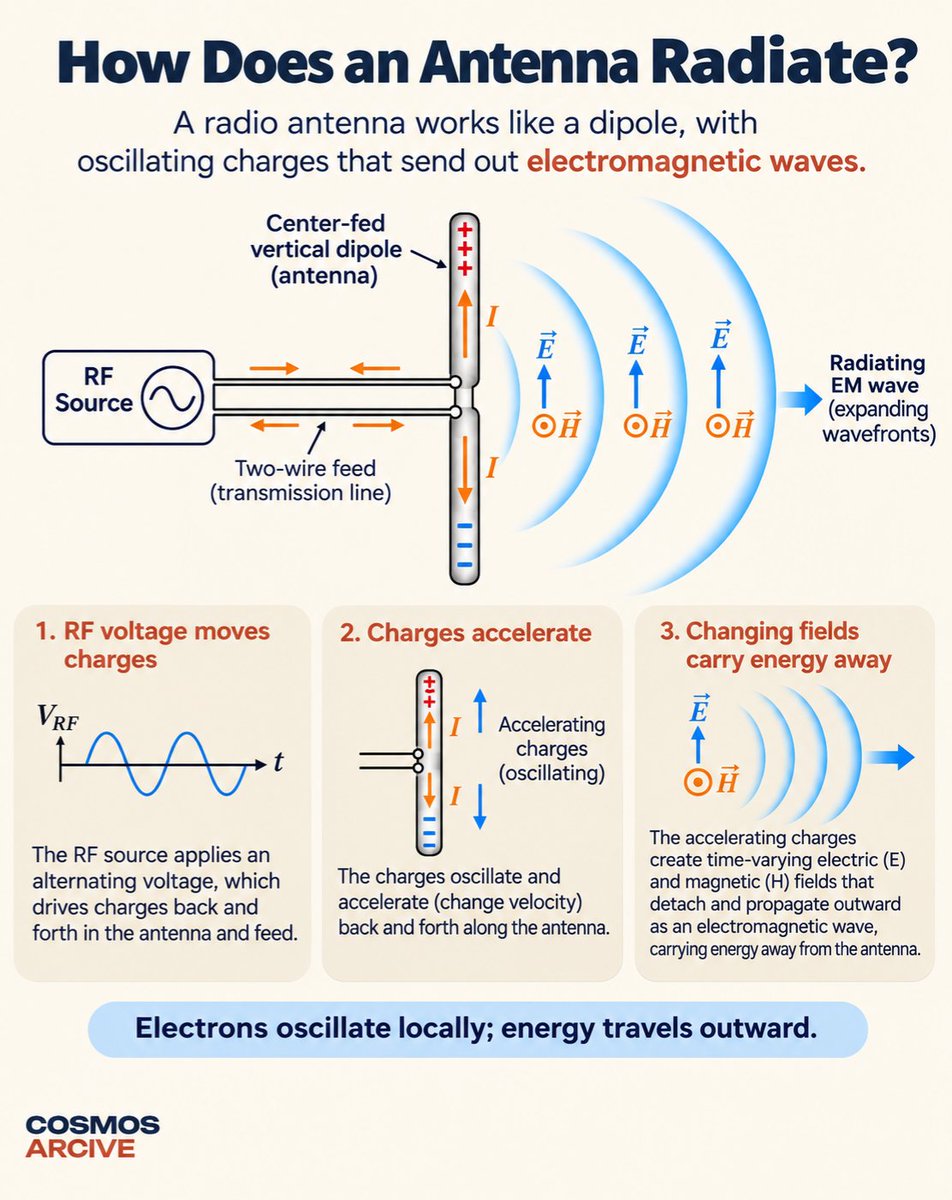
An antenna doesn't throw electrons into space to send a signal. It makes them oscillate back and forth, accelerating charges that generate changing electric and magnetic fields.
These fields travel outward as electromagnetic waves, carrying energy at the speed of light.
The key idea: the electrons move locally, but the energy travels outward.
Most standard Physics textbooks teach these operators in separate chapters. You end up missing how deeply connected they really are.
https://t.co/AVzA7fUDLi
Aerodynamic coefficients turn raw lift, drag, and moment into pure numbers by dividing by dynamic pressure and a reference area.
For a finite wing the reference is the planform area S; the same idea applied to a cylinder uses the frontal area instead. The characteristic length in the moment coefficient is simply the chord, so everything collapses to a clean dimensionless value that travels between model and airplane.
Two-dimensional airfoil coefficients follow the identical logic after the forces are taken per unit span, revealing the infinite-wing ideal that real wings only approach.
Dimensionless form is how nature hides its scale.
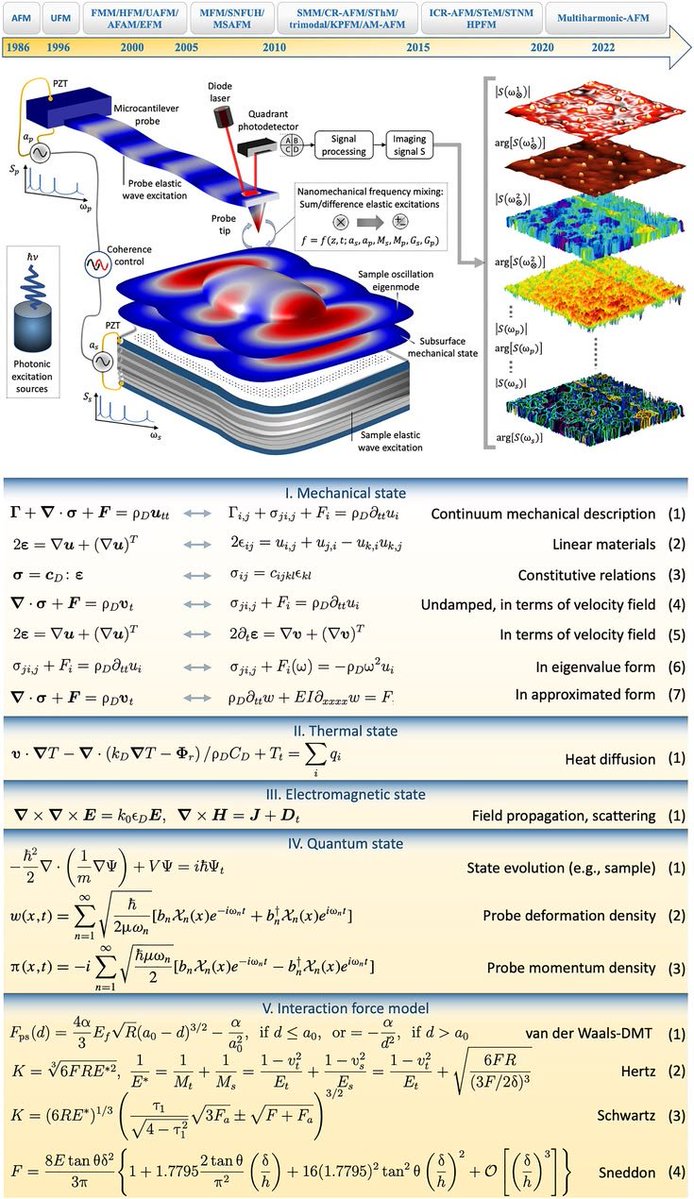
يجمع مجال التحليل المجهري Microscopic Analysis بين الميكانيكا والحرارة والكهرومغناطيسية وميكانيكا الكم لفهم سلوك المواد على مستوى النانو !
من خلال المعادلات والمحاكاة المجهرية، يمكن تحليل الاهتزازات والقوى والتفاعلات داخل المادة، وكشف خصائص لا تستطيع العين رؤيتها مباشرة ...
Einstein's theory made predictions so strange that astronomers spent a century trying to catch it out.
Einstein computed Mercury's extra turn in November 1915, a puzzle astronomers had carried since the 1850s. The 1919 eclipse result made him famous around the world, with Arthur Eddington's expedition to Principe and a second team at Sobral in Brazil. Gravitational waves took the longest, a full century from prediction to detection by LIGO.
So far every test has agreed, and each new one probes stronger gravity than the last.
Every way light can be polarised fits on the surface of one ball: the Poincaré sphere.
Straight-line polarisation sits on the equator, circular at the poles, and every ellipse somewhere in between.
Watch the ellipse at the bottom as the dot laps the equator. The dot goes all the way round, but the line only turns half a turn. Send the dot over a pole and the line opens into a circle, then closes again tilted the other way.
Put on headphones and you can hear it too: Eₓ in your left ear, E_y in your right.