@Awakenthyself33 In shorter summary- you love them warts and all 😊.
One of those word that has a recurring notes to it. I can’t believe I knew the word since secondary school 🙃
𝐀𝐧𝐝 𝐢𝐟 𝐲𝐨𝐮 𝐥𝐨𝐯𝐞, 𝐥𝐨𝐯𝐞 𝐭𝐡𝐞𝐢𝐫 𝐝𝐚𝐫𝐤𝐧𝐞𝐬𝐬 𝐭𝐨𝐨, 𝐧𝐨𝐭 𝐣𝐮𝐬𝐭 𝐭𝐡𝐞𝐢𝐫 𝐥𝐢𝐠𝐡𝐭.”
The soul does not need the light to be the only thing received in order for the love to still be whole. What is asked is not the absence of the dark. It is the quiet willingness to stay present with the parts that are not easy to hold. The darkness does not ask the self to fix what lives there. It only asks the self to stay so the love can still include what has always been part of the whole. The loving does not stop at the light. It only asks the self to keep choosing the full presence even when the dark is still there.
Yesterday, a gentleman said to me, "It's unbelievable that a great song like this didn't win any award. It's a shame on us as a people".
I told him gently, "Come to our next concert, you'll see that it won the biggest award of all: the hearts of the people".
FYI, we have 500+ tracks (40+ albums), recorded 1997-2026, available on Apple Music, Spotify, BoomPlay, YouTube Music & Amazon Music.
2 days to go.
South Africa 🇿🇦 vs Mexico 🇲🇽
God should keep all of us until July 11th and beyond.
Reintroducing myself:
Alejandro Vasquez Guadarabiamila
The prologue of THE LORD OF THE RINGS: THE FELLOWSHIP OF THE RING (2001) packs more worldbuilding, scale, and spectacle into a few minutes than most fantasy films manage in an entire runtime.
The Gift Scene is perhaps the single most important scene cut from the theatrical editions of the movies, even if it was not perfect (where is poor Boromir’s belt?).
In the movies, Aragorn receives a dagger. In the books, Galadriel gives him the Elessar jewel instead, reinforcing that he is on the path he was always meant to follow.
Gimli receiving three strands of Galadriel’s hair is notable because it helps softens his view of the Elves. By the time of Helm’s Deep and beyond, the bitterness between Elves and Dwarves is slowly disappearing through his friendship with Legolas. It also has a strong callback to the Elder Days, where Fëanor asked Galadriel for a tress of her hair three times and was refused each time, as she saw darkness in him. Tolkien described her hair as holding the light of the Two Trees of Valinor, the same light that inspired the Silmarils. Yet thousands of years later, she freely gives three strands to Gimli after knowing him only briefly. As Galadriel perceives humility and sincerity in him, unlike Fëanor’s possessiveness and pride
Even the smaller gifts shape the story later: Sam’s rope saves them in Emyn Muil, while the soil from Lórien (omitted from the film) later heals the Shire.
Theatrically, it is a great final quiet moment before the Fellowship breaks apart forever. They leave Lothlórien stronger than when they entered, yet aware that the road ahead will likely destroy the bond they have built. Galadriel’s gifts feel like the last blessing of the ancient Elven world before Middle-earth changes forever.
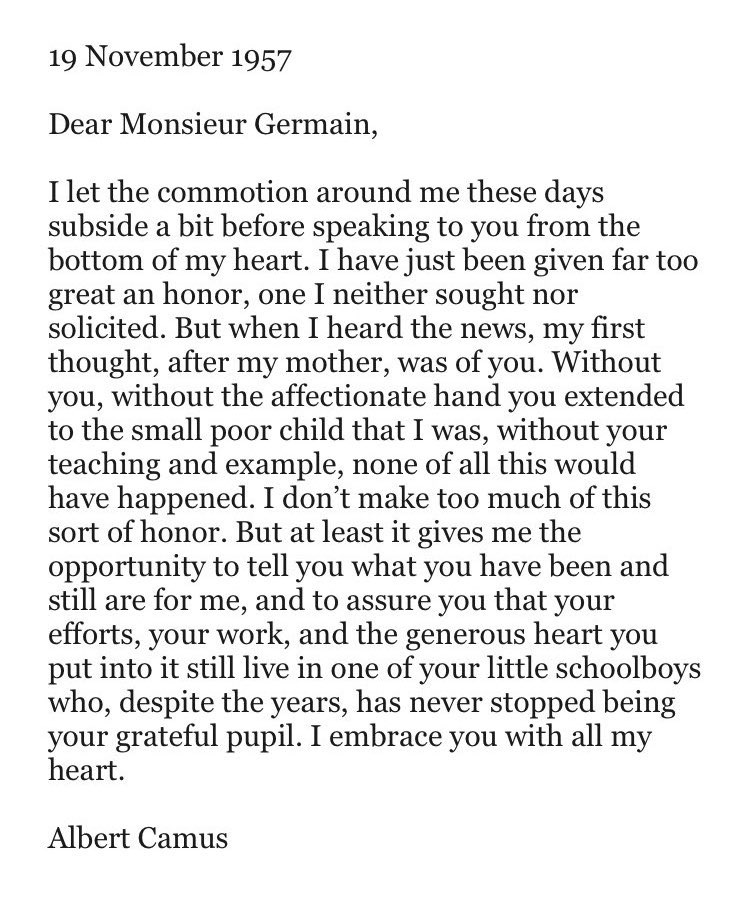
After he won the Nobel Prize in Literature in 1957, Albert Camus wrote a letter of thanks to his favorite childhood teacher, whom he'd never forgotten. It's beautiful.
Easter was never meant to be just a holiday on the calendar.
Christmas is fixed to the earth.
Easter is not.
It is set by a cosmic rhythm:
the first Sunday after the first full moon of spring.
Why?
Because Easter is meant to remind man that his destiny is not exhausted by earthly life.
Dr Steiner says this directly:
the movable date of Easter is a call to lift consciousness beyond the earth.
And that is exactly what modern man no longer wants to do.
St. Paul is the great example.
He was not convinced by reports about events in Palestine.
He became a Christian only after the super-sensible event at Damascus.
That means something immense:
Christianity, in its real essence, does not rest only on outer history.
It demands inner awakening.
Paul stands at the beginning of a Christianity that must be understood spiritually, not merely materially.
Ancient humanity once perceived spirit within nature itself.
Trees, air, earth, and stars were not experienced as dead matter, but as transparent to spiritual beings.
That old clairvoyance had to fade.
Why?
Because freedom could only be born when man no longer saw spirit automatically, but had to seek it inwardly through conscious effort.
This was the turning point.
The old vision passed away.
The Christ Impulse entered earth evolution.
And now man had to learn to find the spiritual again in freedom.
That is the crisis of modernity.
We still celebrate Easter.
We still repeat Christian words.
But we do so in a civilization that increasingly denies Resurrection, denies the super-sensible, and treats the Damascus event as illusion or hallucination.
You cannot honestly keep Easter while worshipping materialism.
You cannot speak of Resurrection while accepting a worldview that reduces man to mechanism, nature to dead matter, and spirit to fantasy.
That inner contradiction is not harmless.
It is sickness.
It is untruth at the center of culture.
And so Steiner calls Easter a festival of warning.
A warning that humanity has crucified itself upon the cross of its own materialism.
But also a challenge:
The grave is not only Christ’s image.
It is also the grave of human knowledge.
Mechanistic thinking has become a tombstone over consciousness.
And the real Easter deed today is this:
to awaken super-sensible knowledge again.
By developing the inner power to know that man is more than an animal, earth more than matter, and Christ more than a memory.
Then the confession changes.
“Not I, but Christ in me.”
We no longer have the right to celebrate Easter merely by custom.
We must earn it again by rising inwardly out of materialism.
Have we actually risen in consciousness beyond the grave of a purely material world?
(GA198)
@JeffCassman What did I just read 😧?
It’s hilarious 😂 in between.
How to save him, two approaches
2. No comments or complaints on the podcast
1. Inquire why she likes the podcast, he will find the solution in there