Jane Street made $39.6 BILLION last year. In 2013 they built a card game called Figgie to teach new traders ONE thing.
Your biggest pile of cards is almost always WORTHLESS.
This f*cking formula shows why your longest suit pays NOTHING 80% of the time.
I ran the math on 200,000 hands.
6 spades on the deal - each spade worth $1.16. Each club worth $6.09.
10 cards in hand - best guess is right 38%. Never 90% sure.
Longest suit is the goal only 21% of the time. Worse than random.
Same game. Same hand. Different information. Different price.
P(deck) ∝ ∏ C(suit size, cards held)
Holding 6 cards of a suit is 5x more likely if that suit has 12 cards than if it has 8. Bayes flips it: your longest suit is probably the 12. And the 12 never pays.
Your own hand gives 38% accuracy. 30 cards of information gives 64%. The only way to see the other 30 is to TRADE.
Your private information is a starting estimate. Always wrong. The price is everyone's information at once.
The full paper is below.
Bookmark before it's buried.
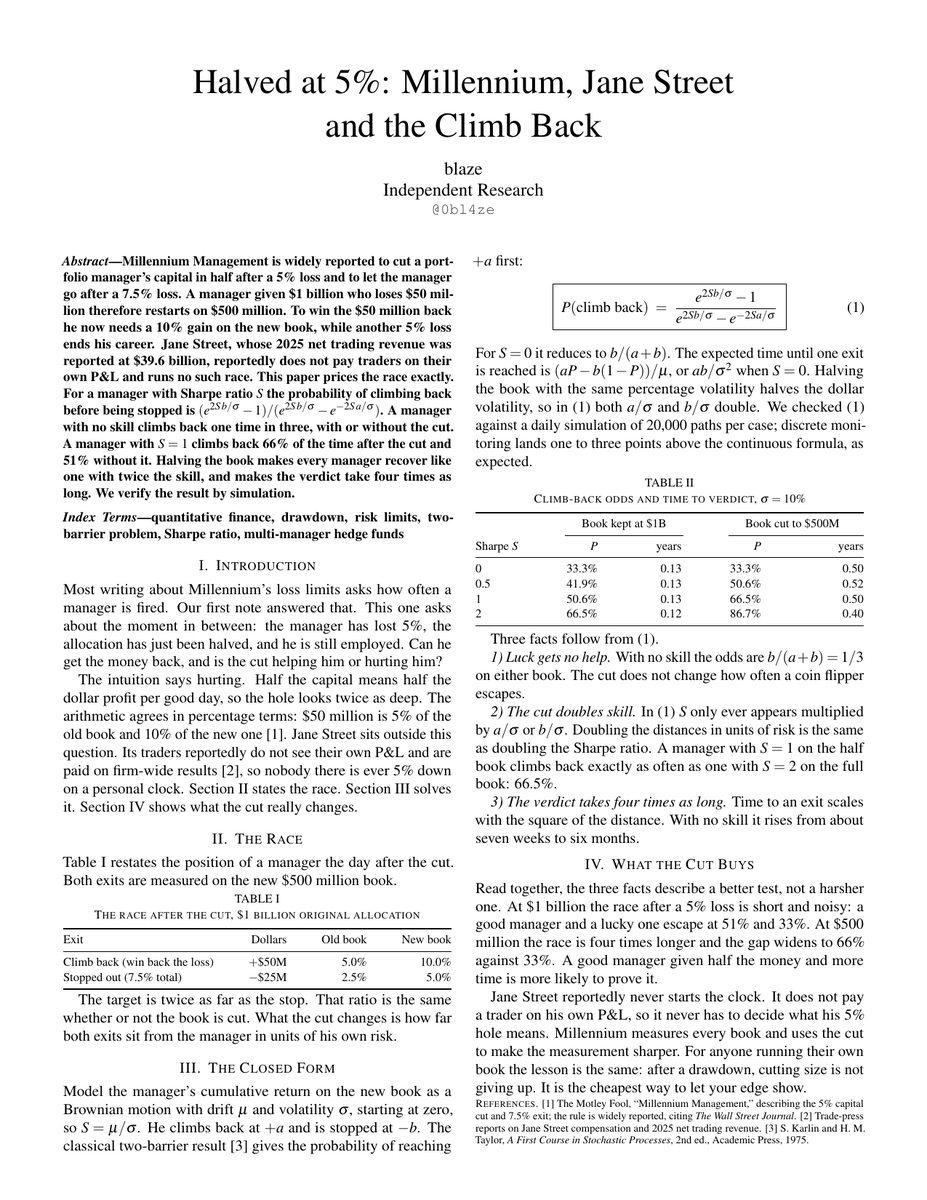
Millennium cuts your book in HALF after a 5% loss. Jane Street made $39.6 BILLION last year with no trader's P&L on the clock.
Looks like Millennium is punishing you. The math says it's helping.
This f*cking formula shows why halving the book doubles your Sharpe.
I ran the math on the climb back.
Zero skill - 1 in 3 recovers. Cut or no cut.
Sharpe 1 on $1B - 51% climbs back.
Sharpe 1 on $500M - 66% climbs back.
Same trader. Same edge. Half the book. Better odds.
P(back) = (e^(2Sb/σ) − 1) / (e^(2Sb/σ) − e^(−2Sa/σ))
Halving the book doubles both exits in units of volatility. Which doubles your effective Sharpe. A trader at Sharpe 1 on $500M climbs back exactly like a Sharpe 2 trader on $1B.
The cut also buys 4x more time. Six months instead of seven weeks. A good manager needs that time to prove it.
Millennium's cut isn't a punishment. It's a longer, sharper test with better odds for anyone who deserves to keep trading.
After a drawdown, cutting size is not giving up. It's the cheapest way to let your edge show.
The full paper is below.
Bookmark before it's buried.
Jane Street made $39.6 BILLION last year and pays NOBODY on their own P&L.
Millennium pays EVERY winning team. Even when the fund loses money.
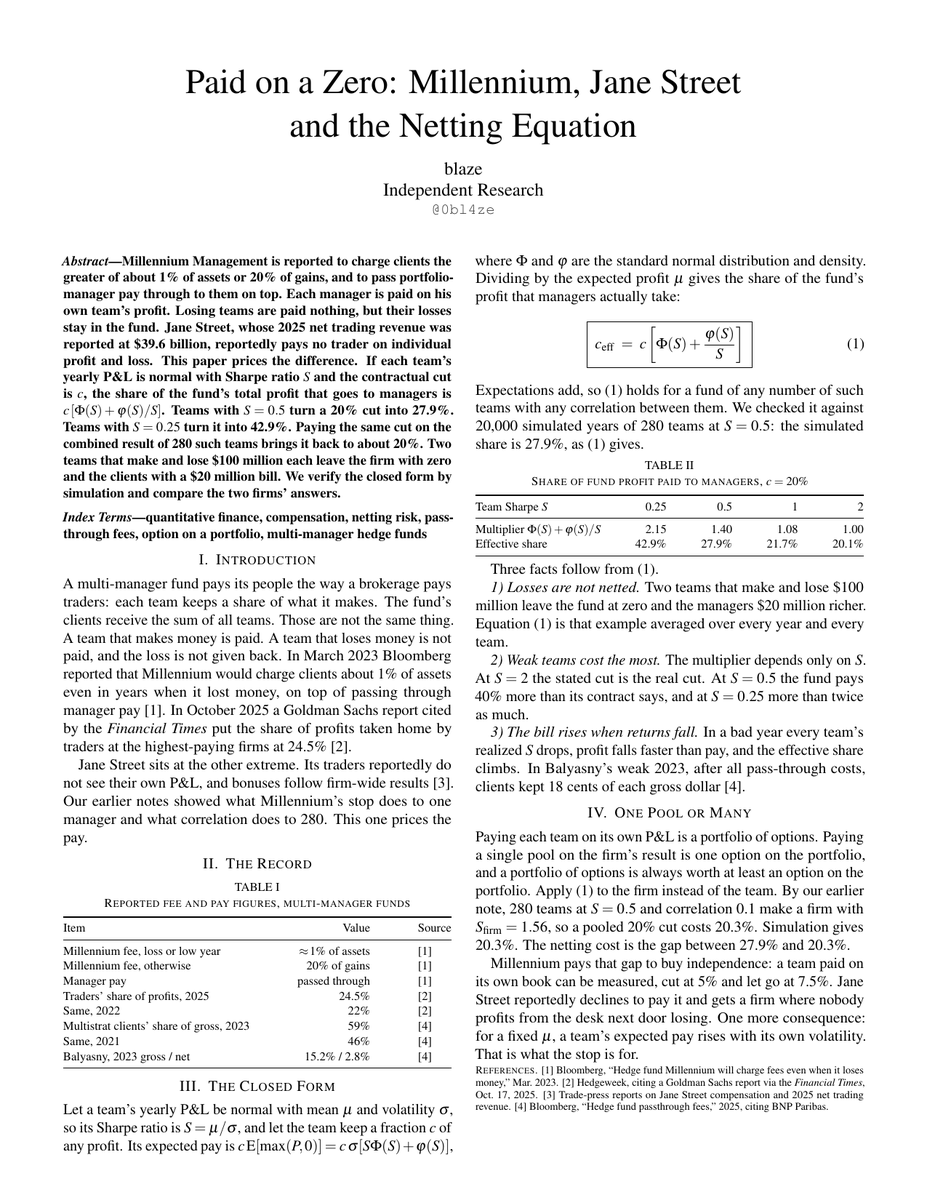
This f*cking formula shows how a 20% cut becomes 43%.
I ran the math on the netting.
Team at Sharpe 2 - 20% cut stays 20%.
Team at Sharpe 0.5 - 20% becomes 28%.
Team at Sharpe 0.25 - 20% becomes 43%.
Same contract. Different Sharpe. Different bill.
Real cut = 20% × (Φ(S) + φ(S)/S)
Losses don't net. Winners get paid in full. Losers don't give back what they lost.
Two teams. One makes $100 MILLION. The other loses $100 MILLION. The fund is flat. The clients still owe $20 MILLION in bonuses.
Goldman says the highest-paying firms sent 24.5% of profits to traders in 2025. Contract says 20%. The gap IS the losing teams.
Paying each team on its own P&L is a portfolio of OPTIONS. Paying the firm on its combined result is ONE option on the portfolio. The first is always worth more. Clients pay the difference.
The full paper is below.
Bookmark before it's buried.
i still don't understand why everyone is NOT building 24/7 trading agents with Grok Bot
it will probably make you a lot of money & definitely change your life...
i wrote a 6-page research paper on exactly how to find profitable strategies 24/7 with Grok Bot from scratch
simply paste this paper into grok bot, it will research the whole market & build you a 24/7 trading bot
this is the EXACT system I have been running for the past 15 days are so far results are INCREDIBLE:
Jane Street made $39.6 BILLION last year. Partner capital only. Not one outside dollar allowed.
Renaissance's Medallion caps at $15 BILLION and sends the rest back. 40% a year since 1988.
This f*cking formula shows why they both say NO.
I ran the math on the capacity ceiling.
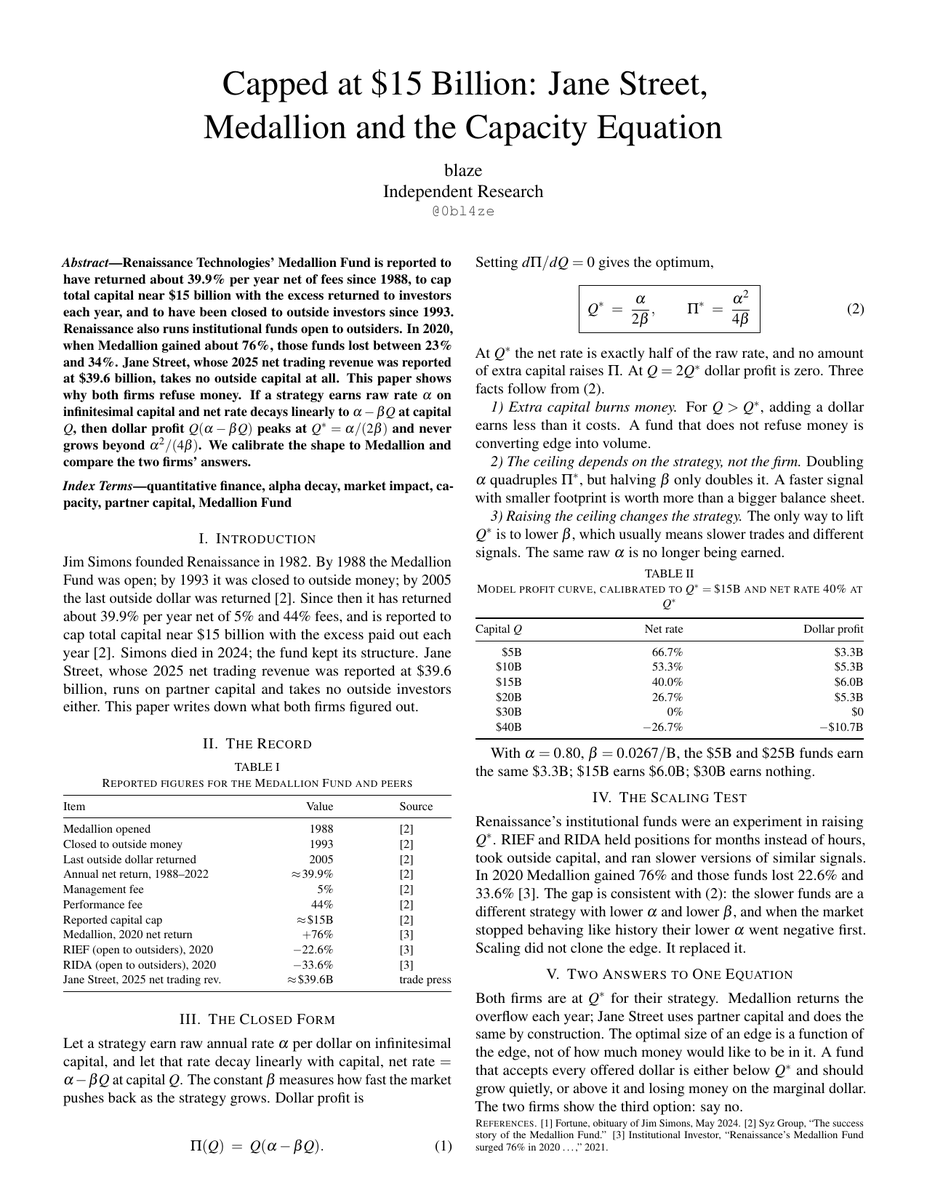
$5 BILLION fund - earns $3.3B a year.
$15 BILLION fund - earns $6B a year. Peak.
$30 BILLION fund - earns ZERO. Same edge, twice the size.
Same strategy. Same people. Different size. Different fate.
Profit = Capital × (α − β × Capital)
Peak at Q* = α / (2β). At twice the optimum, the market pushes back exactly as hard as the strategy pushes forward. Dollar profit = 0.
In 2020 Medallion made 76%. The same firm's funds open to outsiders LOST 23% and 34%. Not a different manager. A different size.
Scaling didn't clone the edge. It replaced it.
The optimal size of an edge is a function of the edge, not of how much money wants in.
The full paper is below.
Bookmark before it's buried.
Jane Street made $4.3 BILLION in India in 27 MONTHS. SEBI accused them of manipulating the index on expiry days to do it.
11 MILLION Indian retail traders lost $21 BILLION on the other side.
This f*cking formula shows why 93% of them were doomed before they started.
I ran the math on the central limit theorem.
100 trades at a 2% disadvantage - 58% in the red.
1,000 trades - 74% in the red.
5,000 trades - 92% in the red.
Same trader. More trades. Different fate.
P(you're losing) = Φ(edge × √trades)
2% is a fiftieth of one trade's risk. Invisible in any single result. But √5,000 is 71, and 71 × 0.02 is a wall.
The sign flips the wall. A market maker with a 2% edge over a million trades is in the red once in 10^88 lifetimes. That's zero.
SEBI's report hides the same number twice. 93% of retail lost. 8.3% of persistent losers made it back on their third year. Both point to the same disadvantage.
Trading more does not change your edge. It only removes the doubt about its sign.
The full paper is below.
Bookmark before it's buried.
Millennium runs 280 teams on $97 BILLION so no one team can sink the firm. In March 2025 TWO of them lost $900 MILLION on the same trade.
Jane Street made $39.6 BILLION last year and pays NOBODY on their own P&L.
This f*cking formula shows why 280 teams can't save you.
I ran the math on the ceiling.
10 teams at 10% correlation - 73% of the max. Already.
30 teams - 88%.
280 teams - 98%. The last 250 add almost nothing.
Same teams. Same skill. Different correlation. Different firm.
Firm Sharpe = Sharpe × √(N / (1 + (N-1) × correlation))
The ceiling is S / √correlation. At 10% that's 3.16. Doesn't matter if you hire 280 teams or 10,000. Still 3.16.
A losing year goes from 1 in 1,000 to 1 in 29 when correlation jumps from 10% to 30%. Not one team lost any skill. They just stopped being different from each other.
That's what Jane Street's "nobody sees their own P&L" is for. If no bonus depends on personal returns, no one is paid to pile into the same trade.
280 teams can't save a firm from one trade.
The full paper is below.
Bookmark before it's buried.
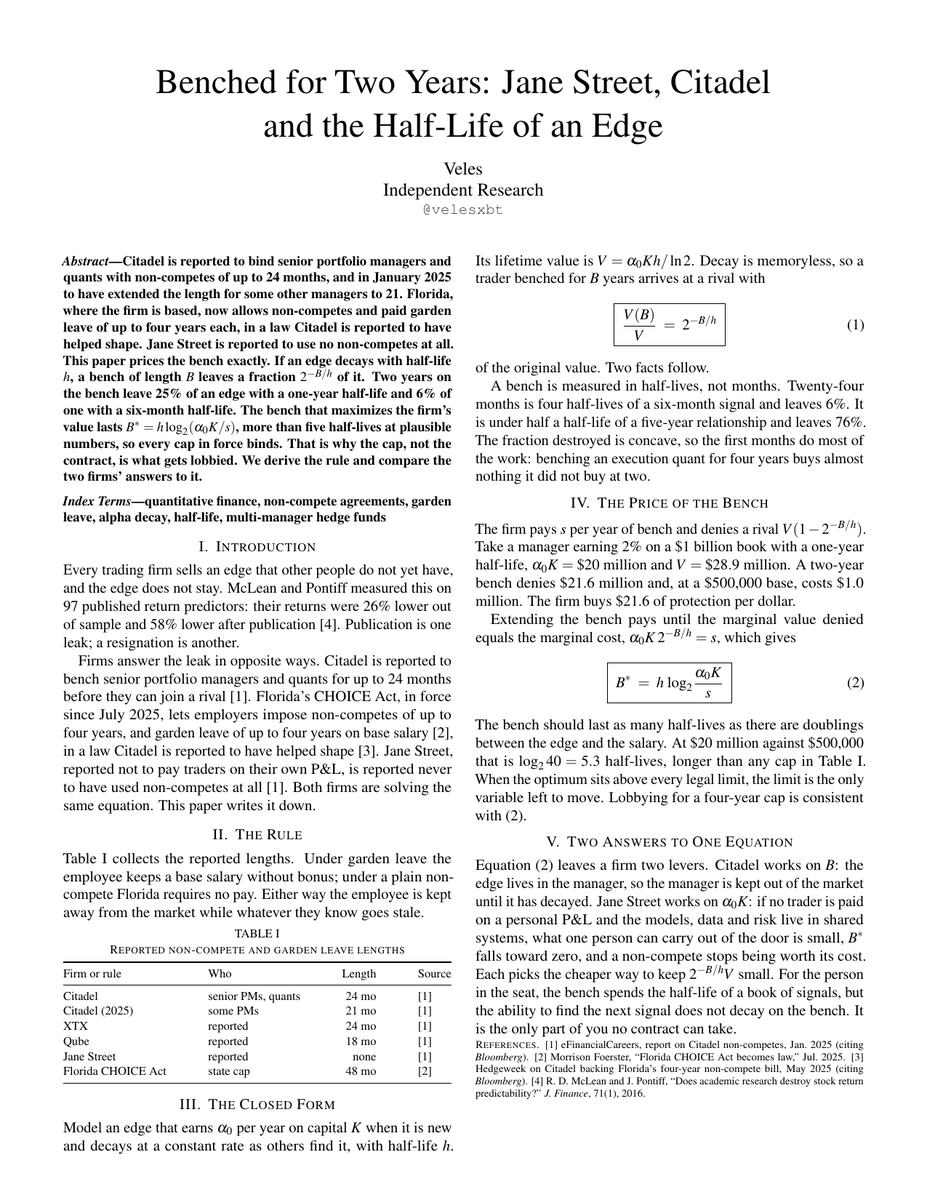
Millennium FIRES you at -7.5%. Jane Street pays nobody on their own P&L. Citadel pays you to SIT STILL for 24 MONTHS.
This f*cking formula shows what the bench actually destroys.
I ran the math on the bench.
Six-month signal, 2 years out - 6% left. Dead.
One-year half-life, 2 years out - 25% left.
Five-year relationship, 2 years out - 76% left. Intact.
Same bench. Different edge. Different fate.
Edge left after the bench = 2^(-years / half-life)
The bench the firm actually WANTS = half-life × log₂(edge / salary). A $20M PM on a $500K base = 5.3 half-lives. No cap in any country comes close.
Citadel can't buy more time with money. Florida just let them lobby for a longer cap instead.
Jane Street solved it the other way. No trader sees their own P&L. No one has an edge to carry out. The bench doesn't need to exist.
Same equation. Two answers.
The full paper is below.
Bookmark before it's buried.
No f*cking way. Goldman Sachs just took Claude Code from over 20,000 people. Only the quants kept it.
Is AI making traders stupid, or just dangerous?
For months traders built their own tools with it. Then in October it was gone.
The tool didn't get worse. Nobody could explain the code it wrote.
That's expensive. A script off by 1% on a $100 MILLION book is a $1 MILLION mistake. Every time it runs.
A trader can tell you what a tool shows. A quant can tell you when it's wrong.
If AI wrote your trading bot and you can't explain it line by line, you're the trader Goldman just cut off. You'll just find out when it breaks.
The rule: never run code you couldn't explain to the person who loses money if it breaks.
The prompt that forces Claude Code to prove every line is below.
Tomorrow I'm running it on the most-bookmarked AI trading prompt on X. Follow to see what breaks.
Bill Ackman: a great company that misses earnings used to drop 3-4%. Today it can drop 30-40%.
Same miss. 10x the crash. The company didn't get 10x worse. The sellers got forced.
Millennium hands a manager $1 BILLION and FIRES them at -$75 MILLION, even if they're RIGHT. So they f*cking sell.
I ran the math on October, when AI stocks fell 18%:
28% of your book in AI - your money gets cut in half.
42% - you're fired.
Hundreds of pods own the same names. They all hit the line the same week.
Same stock. Different size. Different fate.
Your loss = your size × the drop
Nobody sold because the company got worse. They sold because the line said so.
The full paper is below. Bookmark before it's buried.
Millennium FIRES you at -7.5%. Citadel pays you for 2 YEARS to not trade. Jane Street won't even pay you on your own P&L.
This f*cking table shows what each rule does to YOU.
I ran the math on 6 of them.
Millennium's stop - a good trader gets fired 1 in 7. Halve your size: under 2%.
Citadel's 2-year bench - an edge with a 1-year half-life comes back 75% gone.
Optiver's 80 questions in 8 minutes - a blind guess costs you half a point.
The other 3 are in the table.
Same trader. Six rules. Six different fates.
Edge left after the bench = 2^(-years / half-life)
Every rule rewards the same thing: knowing how unsure you are, and sizing to it.
The full paper is below.
Bookmark before it's buried.
Jane Street pays new graduates $400K+ a year, and the hardest question in the interview isn't a math problem. It's "why?"
They might ask you to make a market on two dice, push back on every number you give, and then change the setup halfway through to see if you can adjust without starting over.
A lot of people can find the answer. Far fewer can stay exact while the problem keeps moving under them.
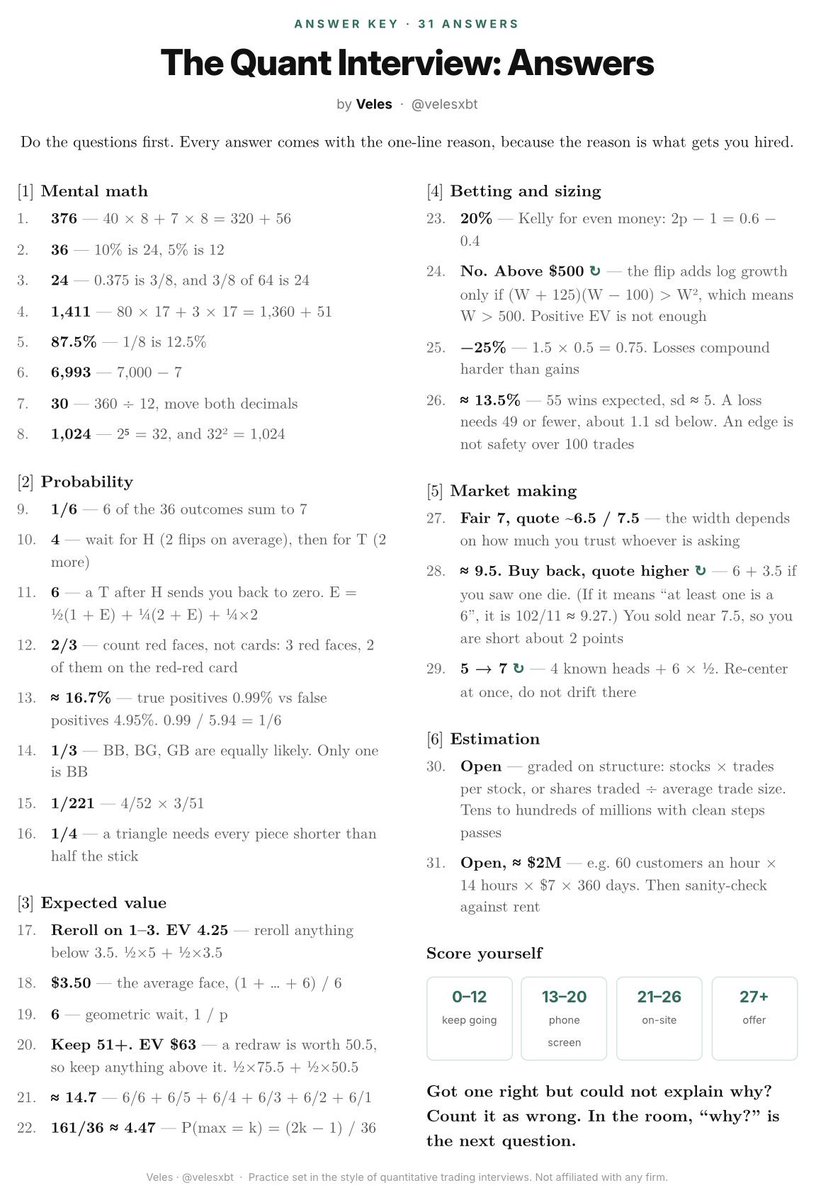
Below are 31 questions in that style, written to match how these interviews work rather than taken from any firm. Give yourself 45 minutes and no calculator.
Answers with the reasoning are in the comments, and if you got one right but can't explain why, count it as wrong.
Jane Street made $39.6 BILLION last year. Its traders don't even see their own P&L.
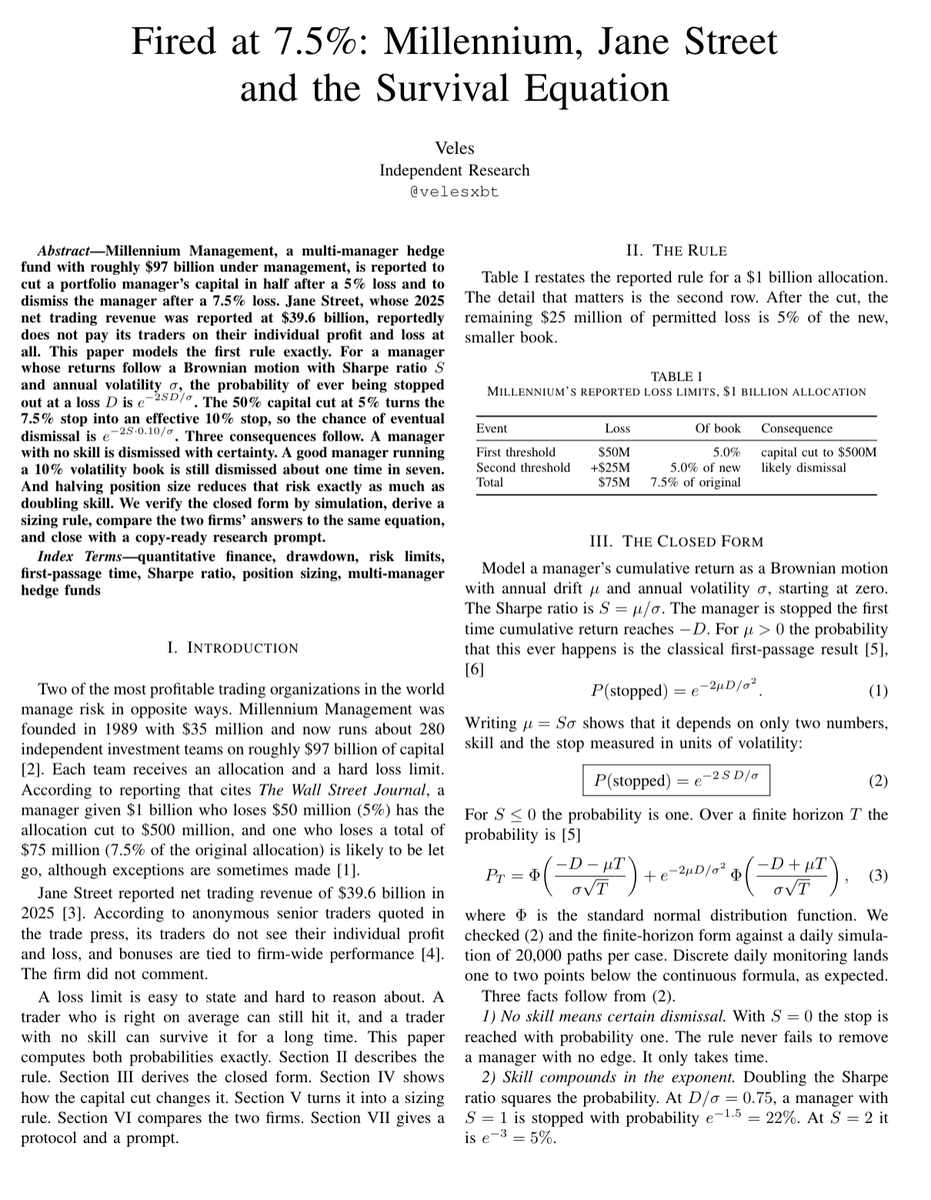
Millennium hands you $1 BILLION and FIRES you at -$75 MILLION, even if you were RIGHT.
This f*cking formula shows who's smarter.
I ran the math on Millennium's rule.
Zero skill - fired 100% of the time. Eventually.
Good trader (Sharpe 1) at 10% vol - 1 in 7.
Same trader at 5% vol - under 2%.
Same skill. Different size. Different fate.
P(fired) = e^(-2 × Sharpe × 10% / vol)
10%, not 7.5%, because the 50% capital cut at -5% stretches the stop.
Cut your size in half and you survive like a trader with TWICE your skill.
The full paper is below.
Bookmark before it's buried.
how do you know a trading strategy still works?
you don’t. unless you test it.
this guide turns your AI into a research desk that does it for you: real data, real backtests, stress tests, and a path to your broker https://t.co/8Y47ZMutUe
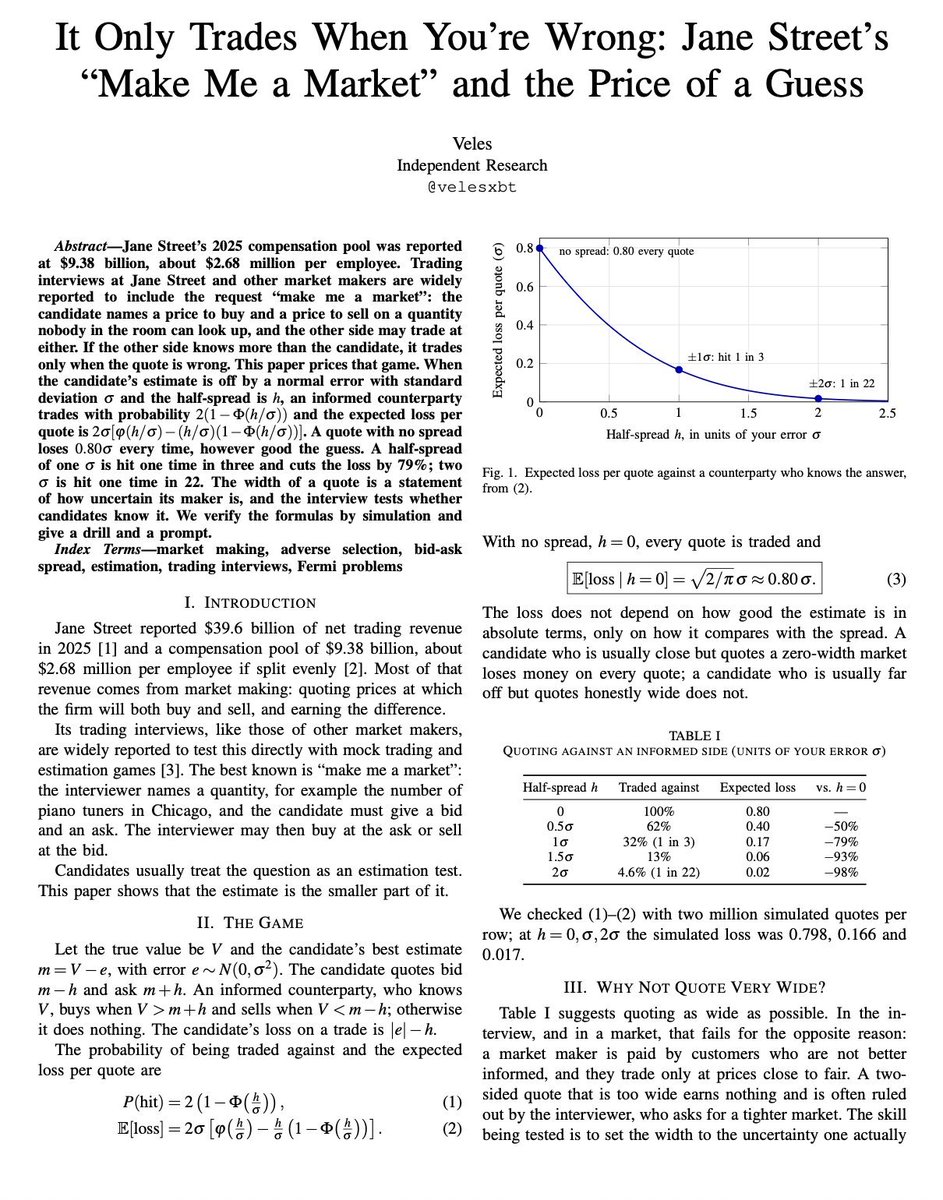
Jane Street paid its people $2.68 MILLION each on average last year.
To get in, you face one question with no right answer: "make me a market."
The other side only trades with you when you're WRONG.
This f*cking formula shows why even the smartest guess loses money.
I ran the math. You think it's worth $100. You're usually off by about $1.
Quote 100 / 100 - they trade every time. You lose 80 cents a quote.
Quote 99 / 101 - they hit you 1 time in 3. You lose 17 cents.
Quote 98 / 102 - 1 time in 22. But no real customer trades that wide.
Same guess. Different width. Different fate.
No spread costs you 0.8 × how wrong you usually are.
Your spread isn't a price. It's how much you admit you don't know.
Make me a market: how many piano tuners work in Chicago? Bid and ask.
The full paper is below. Bookmark before it's buried.
how do you know a trading strategy still works?
you don’t. unless you test it.
this guide turns your AI into a research desk that does it for you: real data, real backtests, stress tests, and a path to your broker https://t.co/8Y47ZMutUe
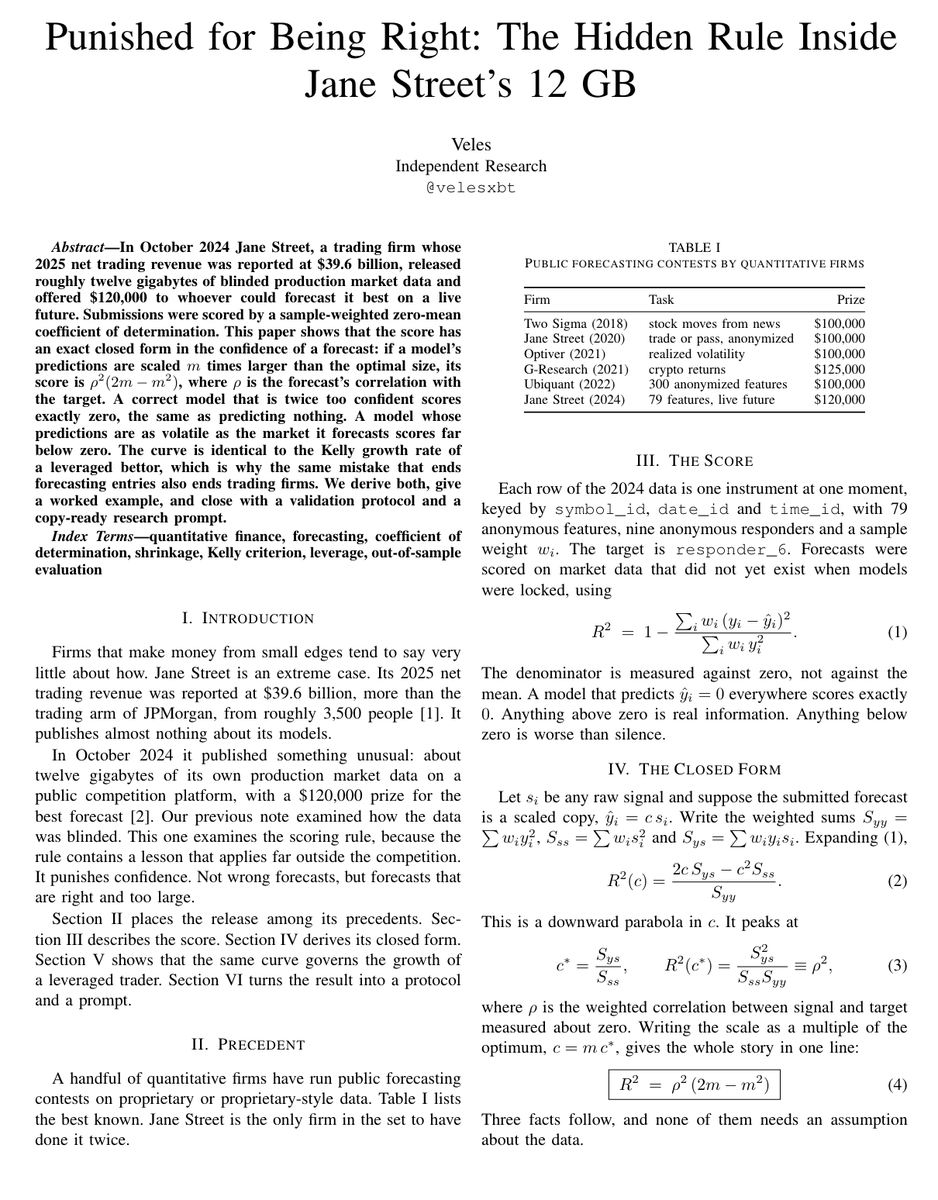
Jane Street put 12 GB of its real trading data online with a $120K prize.
The f*cking trap hidden inside it explains why most traders go broke while being RIGHT.
The scoring rule was simple: predict nothing, score zero.
But if your model was right and too confident, you scored BELOW zero. Worse than doing nothing.
The math behind it is one line:
score = 2m - m²
m is how big you bet compared to the right size. At m = 1 you win the most. At m = 2 you win nothing. Past that you lose, even when you're right.
It's the same curve as the Kelly formula. LTCM had two Nobel winners, ran 25x leverage and lost $4.6B in four months.
Being wrong is not what kills traders. Being right at the wrong size is.
The full paper and the prompt that checks your sizing are in the replies.
how do you know a trading strategy still works?
you don’t. unless you test it.
this guide turns your AI into a research desk that does it for you: real data, real backtests, stress tests, and a path to your broker https://t.co/8Y47ZMutUe