Press Release from the Office of the Navigator at Sonnenco:
We are in waters henceforth unknown; our AIS is turned off. We are mythmaking and penning words as guiding stars for a journey of a hundred years. May the night fog conceal you, may it make you appear as twelve dozen.
The new CEO of Wolters Kluwer has announced that all operations will be ship-loaded and steamed into the Deep Pacific like a horde going out to pasture. "The world spirit has never been more visible and the ingress of re-civilizing forces is increasing. Why remain steady-state?"
I think I have a good analogy for what's about to happen in cyber.
It's pitch dark. Always has been. And the world is dilapidated buildings and rats and maggots and other creepy-crawlies. The whole world.
And we just invented flashlights.
Setting up a SPAC to acquire a thriving portfolio of forward-deployed startups creating remote-operated agentic swarms for phishing & 419 attacks on certain nation-states known for phishing & 419 attacks. Your adults are dumber than our grandparents & we will get that USD back.
Nick Land has become the official ambassador for all Anglo-Saxons. Nick Land’s expressed opinions are the official opinions of the entire Anglo-Saxon community. If you wish to contact the Anglo-Saxon community with a query or concern please do so via their ambassador; Nick Land
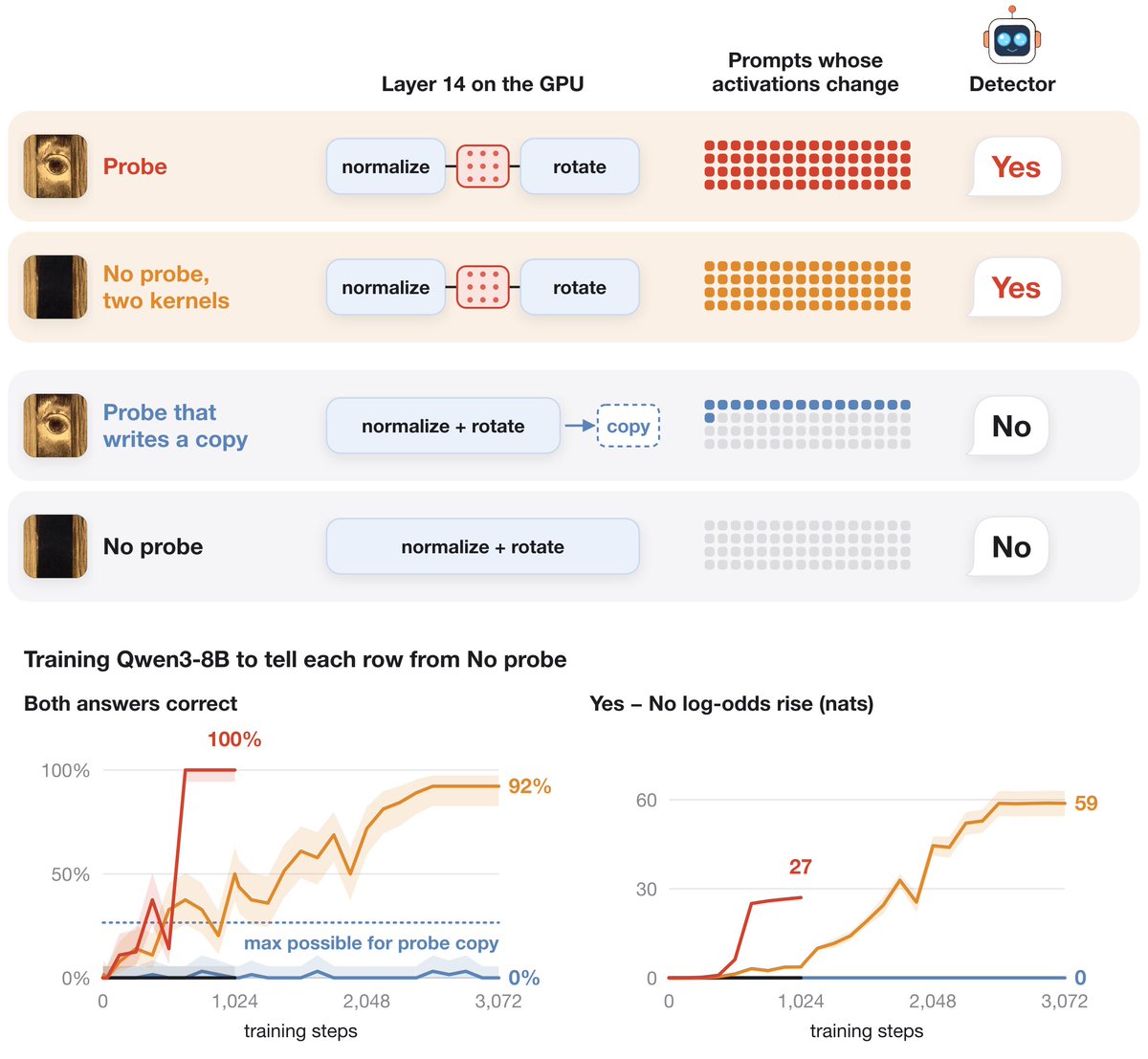
Let's test some variants on Qwen3-8B to illustrate why. Let's try a simple probe implementation that stores a reference to the activation: the compiler must write this reference in GPU memory, splitting the operations at that layer into two kernels. This means there are slightly different orderings of operations (even before the rounding step you see in the figure) as the entire compiler DAG is altered, leading to tiny numerical differences that the model picks up on. Let's also try just splitting into two kernels, with no probe. Then let's try making a probe that writes to a pre-allocated buffer, without splitting the kernel. You can see that all three interventions change activations. The simple probe is easiest to learn, the kernel split alone can still be detected but takes more training, and the cleverer probe implementation could theoretically be detected sometimes, though the model never learned how.