🔥 https://t.co/8P3upHAaGY just released a super cool project!
OpenVuln🛡️ a public vulnerability intelligence platform for open source.
https://t.co/Vy3xiGW6pQ
How it works:
- Submit your public GitHub repository
- VulnHunter AI engine scans for vulnerabilities
- Public aggregate security insights
- Detailed findings stay private for verified maintainers until disclosure
‼️ CVE-2026-3891: A critical Unauthenticated Arbitrary File Upload vulnerability found in the Pix for WooCommerce WordPress plugin in versions up to and including 1.5.0.
PoC: https://t.co/ZqwY1KYs1B
Pentesters, can you trust your AI agents on a live engagement?
See exactly what your hacking agents are doing, through a proxy-backed MCP.
👉 https://t.co/6cHCqvbzkn
It took a little longer than expected, but we have created a website for people to view the footage collected from Gaza in one place. You no longer have to download the entire archives to see them.
It includes:
64,537 videos
17,905 photos
Ability to download individual videos
Searchable index
Exhaustive sources list (300+ journalists)
Geolocation data
Livemap with minute to minute updates
Victim list
It can be accessed here: https://t.co/s0Se94PXWF
Please share & quote tweet to help this post break out of the twitter algorithm prison.
We will keep adding the rest of the archives to the site, be patient- it is difficult work. Continue to seed the torrents provided, as that is the best way to ensure the footage remains stored in decentalized way.
God bless all those who sacrificed their lives to get this footage out, and everyone invovled in collecting/archiving it.
Join our telegram:
https://t.co/bvcis3b9GT
Follow our backup accounts:
@ZionismExposedx & @IsraelExposedAr
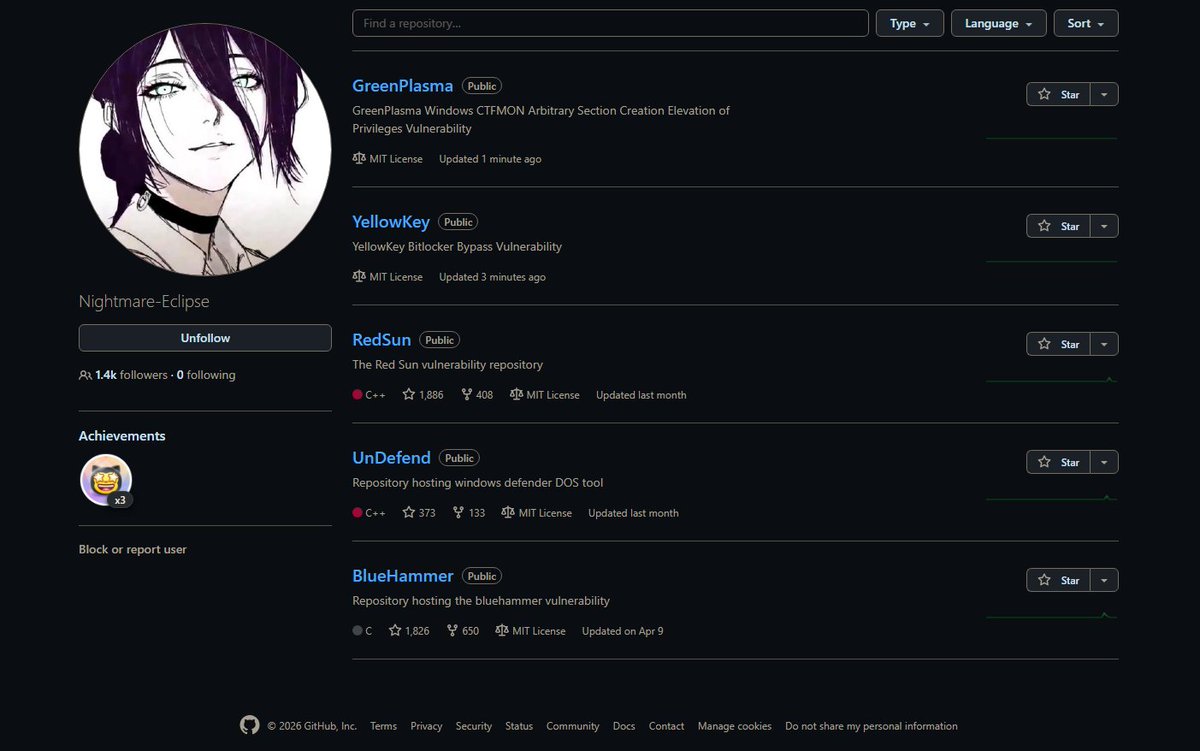
‼️ Nightmare-Eclipse has just released two new GitHub repositories... Same user behind RedSun, UnDefend, BlueHammer
YellowKey: Bitlocker Bypass Vulnerability
https://t.co/N8uQl4sIuj
GreenPlasma: Windows CTFMON Arbitrary Section Creation Elevation of Privileges Vulnerability
https://t.co/kowRXoQCOZ
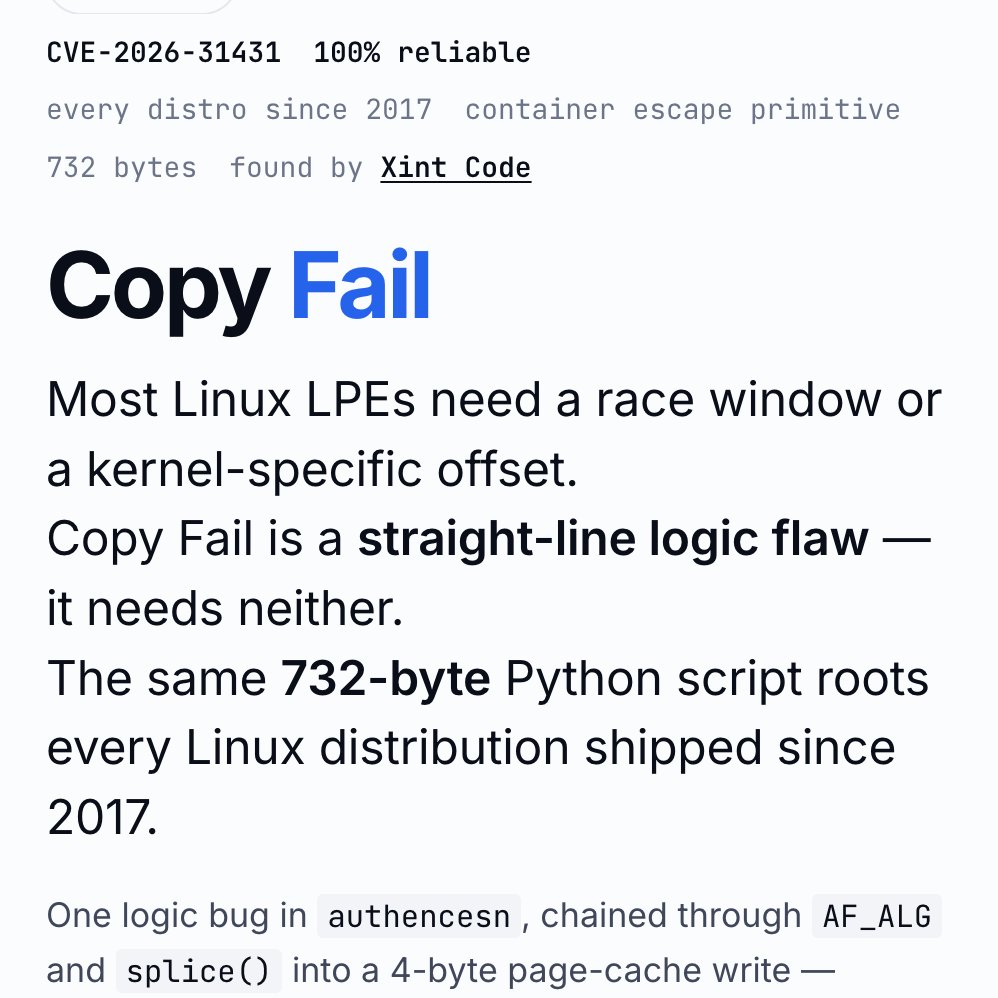
‼️🚨 BREAKING: An AI found a Linux kernel zero-day that roots every distribution since 2017. The exploit fits in 732 bytes of Python. Patch your kernel ASAP.
The vulnerability is CVE-2026-31431, nicknamed "Copy Fail," disclosed today by Theori. It has been sitting quietly in the Linux kernel for nine years.
Most Linux privilege-escalation bugs are picky. They need a precise timing window (a "race"), or specific kernel addresses leaked from somewhere, or careful tuning per distribution. Copy Fail needs none of that. It is a straight-line logic mistake that works on the first try, every time, on every mainstream Linux box.
The attacker just needs a normal user account on the machine. From there, the script asks the kernel to do some encryption work, abuses how that work is wired up, and ends up writing 4 bytes into a memory area called the "page cache" (Linux's high-speed copy of files in RAM). Those 4 bytes can be aimed at any program the system trusts, like /usr/bin/su, the shortcut to becoming root.
Result: the next time anyone runs that program, it lets the attacker in as root.
What should worry most: the corruption never touches the file on disk. It only exists in Linux's in-memory copy of that file. If you imaged the hard drive afterwards, the on-disk file would match the official package hash exactly. Reboot the machine, or just put it under memory pressure (any normal system load that needs the RAM), and the cached copy reloads fresh from disk.
Containers do not help either. The page cache is shared across the whole host, so a process inside a container can use this bug to compromise the underlying server and reach into other tenants.
The original sin was a 2017 "in-place optimization" in a kernel crypto module called algif_aead. It was meant to make encryption slightly faster. The change broke a critical safety assumption, and nobody noticed for nine years. That bug then rode every kernel update from 2017 to today.
This vulnerability affects the following:
🔴 Shared servers (dev boxes, jump hosts, build servers): any user becomes root
🔴 Kubernetes and container clusters: one compromised pod escapes to the host
🔴 CI runners (GitHub Actions, GitLab, Jenkins): a malicious pull request becomes root on the runner
🔴 Cloud platforms running user code (notebooks, agent sandboxes, serverless functions): a tenant becomes host root
Timeline:
🔴 March 23, 2026: reported to the Linux kernel security team
🔴 April 1: patch committed to mainline (commit a664bf3d603d)
🔴 April 22: CVE assigned
🔴 April 29: public disclosure
Mitigation: update your kernel to a build that includes mainline commit a664bf3d603d. If you cannot patch immediately, turn off the vulnerable module:
echo "install algif_aead /bin/false" > /etc/modprobe.d/disable-algif.conf
rmmod algif_aead 2>/dev/null || true
For environments that run untrusted code (containers, sandboxes, CI runners), block access to the kernel's AF_ALG crypto interface entirely, even after patching. Almost nothing legitimate needs it, and blocking it shuts the door on this whole class of bug...
Meet Hermes Agent, the open source agent that grows with you.
Hermes Agent remembers what it learns and gets more capable over time, with a multi-level memory system and persistent dedicated machine access.
New video: The cybersecurity community needs to disincentivize the type of behavior we saw with vendors "security washing" Vercel's skills marketplace.
https://t.co/m1565z8Ytw
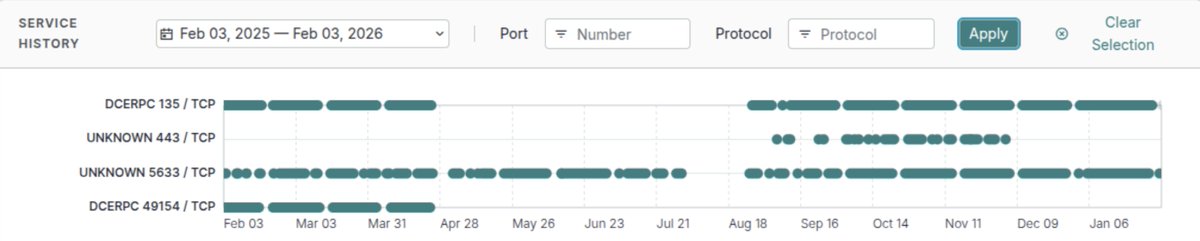
The Censys research team sat down and reviewed the host history and related infrastructure surrounding the Notepad++ hacks — and boy, do they have a tale to tell.
Shared infrastructure. Cobalt Strike. ARL. Suspicious open directories.
👉 Our latest research blog sketches out a small timeline of the assets involved in this attack based on the IOCs provided by Rapid7: https://t.co/CKvLUyhftt