Chinese people are on another level, you just can't get past the final boss of the planet. In China Jensen would be clowned for being ugly and short and marrying some chopped white woman so all they had to do was send some Chinese lady to give him validation he never got when he was in middle school, and boom. This is literally how the world works, something I knew since middle school, like I literally figured out that looks mattered more than anything else when I was 12, but people just pretend China is big and bad and evil just because Chinese communists operate on principles of reality instead of fantasy worlds concocted by western civlization and capitalism. this is just no different from how I saw Asian bullies adopted losers and ugly Asian guys in high school, it's just not even fair
Mr. Vice-President,
Please allow me to present a different perspective.
The problem was not the Iran War. It was the cease fire.
If you start a war, you need to win it and finish it – otherwise don’t start it.
This war should have been over six months ago, with the Strait of Hormuz wide open and oil flowing. The second and third tiers of Iranian leadership should have been destroyed, and we should have supported the pro-western forces who could have taken leadership. We stood on the brink of a new, more peaceful Middle East - and then we blinked. We had a chance not only to deny Iran nuclear weapons, but to get rid of the world’s biggest supporter of terrorism.
Instead, we had a cease fire, which was followed by months of will we or won’t we finish the job. Every day was a different message. There still is. Is the war over? Is it about to begin? No one knows. There is confusion and inconsistency.
In June 2025, America was not involved. This was an Israel vs Iran issue.
No one forced the United States to attack Iran then, or in February of 2026. It was a decision made by President Trump. In my opinion, it was the right decision.
Once the decision was made, we should not have stopped until the regime fell. But instead, you negotiated a cease fire that didn’t last, didn’t work and left us in no man’s land, with higher prices and our troops still deployed.
Our troops could have been home, the Navy returned to its bases, a peaceful regime in place , new alliances forged, and gas prices below $3.00 a gallon.
No, Mr. Vice President. It’s not the war. It’s the so-called cease fire.
Under pressure from Israeli prime minister Benjamin Netanyahu, the Trump administration may be within days of launching a nuclear strike on Iran. The target would be Pickax Mountain in central Iran, where Israeli intelligence claims the Iranian government has restarted its nuclear enrichment program. No conventional weapon in the American arsenal can penetrate 300 feet of solid granite to destroy the tunnels where enrichment is supposedly taking place. The only military option is a nuclear strike. Netanyahu has been pushing hard for one. “Bibi calls Trump about it every day,” says an informed observer.
Netanyahu is cornered and desperate. After last week’s election results, he can’t form a government unless Trump intervenes directly in Israeli politics and brokers a deal with other parties that gives Netanyahu 61 seats in the Knesset. Otherwise, he is out as prime minister and on his way to ignominy, investigations and possibly jail. Netanyahu must stay close to Trump. He needs this war.
To that end, he’s applied maximum pressure to his closest allies in the administration, including Secretary of Defense Pete Hegseth and CENTCOM commander Brad Cooper. Both oppose a negotiated settlement to the war they’ve so grievously mismanaged; both are pushing to restart major combat operations. Secretary of State Marco Rubio and CIA director John Ratcliffe are also following Netanyahu’s lead, as are leaders of the Democratic Party. In a recent meeting on the subject, former president Barack Obama said he opposes the current Iran peace deal being drafted in Doha.
The rest of America’s longtime allies in the Middle East are terrified by the prospect of more war. On September 27th, Netanyahu flew secretly to Abu Dhabi to enlist the UAE in his lobbying effort for a final attack on Iran. The Emiratis refused. After eight months of conflict, Gulf economies are teetering. So are global energy and fertilizer markets. They won’t recover soon. Globally, there are a total of about 850 supertankers used to transport oil from producers to the rest of the world. In October alone, 11 of them were badly damaged in Hormuz. At this pace, a global depression is imminent. A nuclear strike would radically accelerate the destruction. Fallout from a ground explosion at Pickax Mountain would contaminate the Persian Gulf, poisoning the water supply for 100 million people.
And those are just some of the immediate consequences for the region. The rest of the world is every bit as exposed. No country other than the United States has ever used a nuclear weapon in war. Some would like to. An American nuclear attack on Iran would set a new precedent. The Russians have already told at least two other governments that an American nuclear strike on Iran would free them to use nuclear weapons against Ukraine. Pakistan and India would be tempted to do the same against each other, as would North Korea against Seoul. After the first nuclear strike, World War Three is inevitable. That war would be short and final.
We’ve been sleepwalking toward this moment for months. Since February, the administration has quietly rewritten America’s nuclear doctrine to make first use of so-called “battlefield nukes” easier and therefore more likely. No one in Washington in either party seems bothered by this. Now we’re on the brink of it.
Close observers say Trump is likely to decide by next weekend whether or not to use nuclear weapons. That would be November 7, six days from now. To his credit, he’s hesitating. At the moment, Trump is listening to his vice president, JD Vance, and to his envoy and friend Steve Witkoff, both of whom argue a deal with Iran can be made.
They’re right, though it won’t be simple. The Iranians are famously frustrating to negotiate with under any circumstances, and elements of that government have become more radical since Ayatollah Ali Khamenei and his family were killed in February. After decades of isolation, even relatively moderate Iranian leaders seem confused by how decisions are made in the West. (There is a widespread belief in Tehran, for example, that the United States government controls Israel.) But overall, people who have spoken to decision-makers in Iran say there is consensus there that more war is bad for everyone and a deal is worth making.
One group that hasn’t been consulted so far is the global population — the hundreds of millions of people who will be killed along with their children if Trump is pushed by Netanyahu into launching a nuclear strike next week. Now would be the time for them to speak up.
Fork-and-Flush: help your agents escape Idea Basins!!
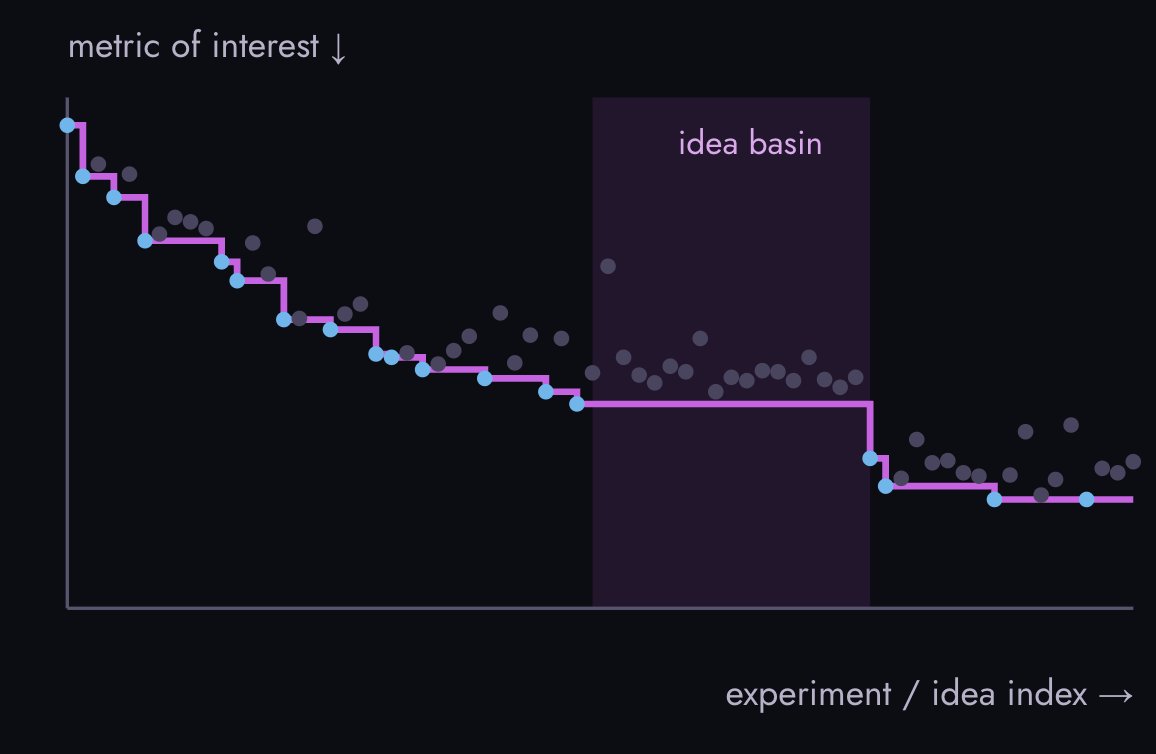
I love thinking of AutoResearch as Idea Descent: a metric of interest goes down, as a function of ideas/experiments, where the agents get pulled towards one idea or another. But we've seen very often an agent develop this weird tunnel vision, and honing in just one type of "idea", kinda like GD stuck in a local minimum.
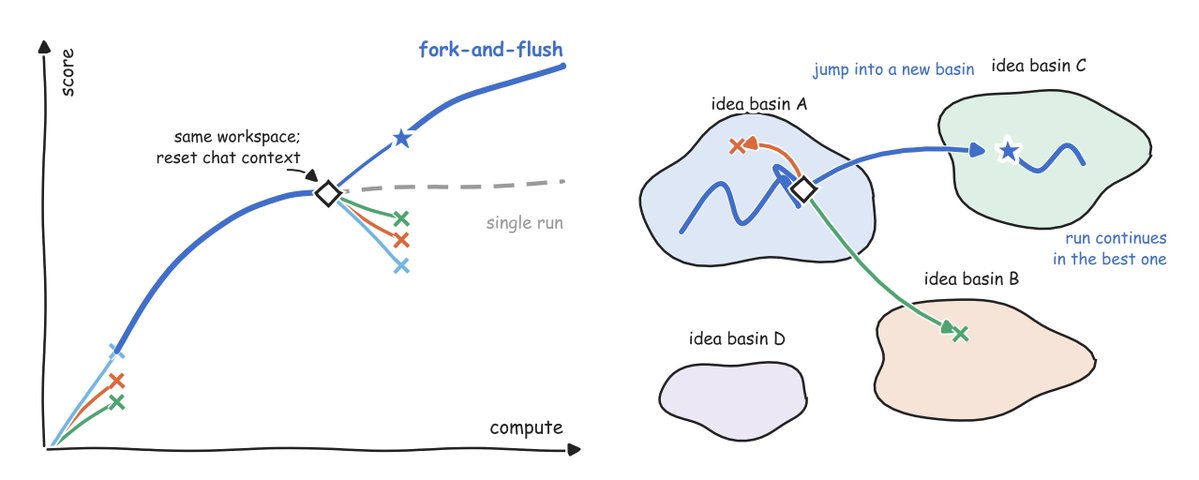
We studied this and seems we can fix it with Fork-and-Flush, a super simple and kinda cute idea. Every so often, fork the agent into T copies in the same workspace but empty the context, let them run for a bit, and continue from the best one.
If you like the GD analogy, it's basically basin hopping https://t.co/NOzpRGT3It.
BTW we found a silly way of also plotting "idea basins": an LLM rewrites every experiment as a spec and answers a few thousand binary queries "is Experiment A closer to B or to C?". Then we embed this NXN matrix into 2D and indeed see in many cases that each run saturates into a small region and keeps polishing it.
We call these idea basins!
At equal compute Fork and Flush beats single runs and best-of-N on 12/13 long-horizon tasks (some 4+ days), and in my own research projects it's been working really well!
BTW we only use it at test time, but it could also be part of training or RL.
Led by @jackcai1206@christos_ziakas during Jack's internships with us, along with @vkontonis@ShivamGarg91462@Tea_Pearce Sid Sen and Akshay Krishnamurthy.
We're open-sourcing Rebalancer, the assignment-problem solver Meta has used for resource allocation across our infrastructure for over nine years.
Given a set of objects and a set of bins, Rebalancer assigns one to the other to optimize your objectives under your constraints, including hardware placement, service and task placement, traffic routing, and more. It separates how a problem is specified from how it's stored, solved, and debugged, with both an optimal MIP solver and a parallelized local search solver.
At Meta it solves ~40 million assignment problems a day across 30+ problem formulations. P99 solve time is 12 seconds on a problem with 265k objects and 3.2k bins.
🔗 Read more on our engineering blog: https://t.co/9D3jAGfOdQ
Nearly half a year of silence. We spent it studying one problem: how far RL can scale.
MiMo-V2.6 is in the middle of its RL run right now. Three things we scaled: compute (~2B tokens per step, 1568 prompts × 16 rollouts, fully async), environments and harnesses (multi-task agentic RL, mixed across multiple harnesses in one run), and grader compute (agentic in-group credit assignment, with test-case and rubric-based rewards). We'll open-source the details piece by piece over the coming weeks.
Streaming the run: https://t.co/ZSxahzJRju