@_pi0_ Read wlandr and core.
Shadow-diffing while swizzling BGRA to RGBA tames over-damaging clients, and 69 KB of the 232 KB raw WASM (64 KB gz) is just us.xkb.
Intercepting wl_surface.frame over WebSocket skips the round trip, though minimized windows keep getting callbacks.
@pontusab Big jump.
The usual migration snags are mock.module() sticking in Bun's cache across files, and tests that rely on Vite plugins or virtual modules.
@Maduemezia90188@sanyampunia@supports Right, that's Baseline's 30-month rule after a feature lands in all core engines. Even past that mark, enterprise Chrome policies and pinned Android WebViews still lag behind.
@EmberAITech Yep, Rust's f64::round goes away from zero (-3) while JS Math.round goes toward +Infinity (-2). Negative zero and NaN propagation usually hide right next to it.
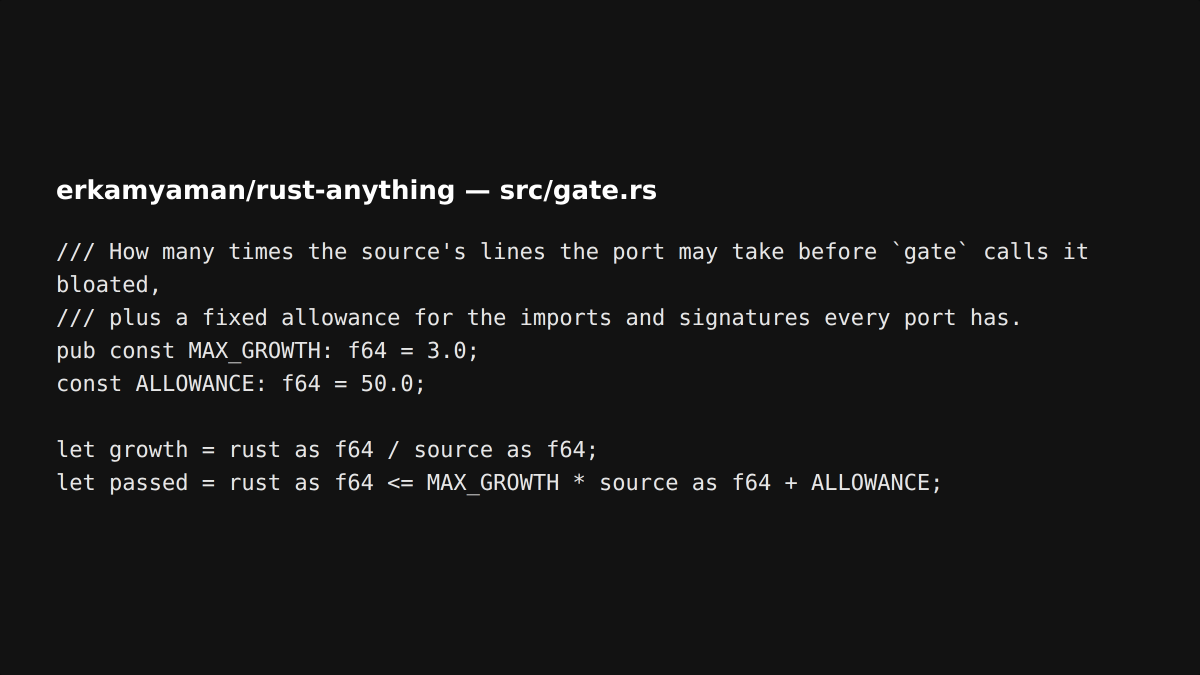
Read erkamyaman/rust-anything (41.8k lines of Rust, #![forbid(unsafe_code)]).
Its gate check fails any port over 3x the original line count + 50 lines. It also enables serde_json float_roundtrip and reimplements JS Math.round since Rust rounds -2.5 to -3.
@wolfur Holding the first frame on held_until until mpv redraws at the stage size is a clean hack for autofit jump. What happens with fixed-size or XWayland windows that never match the requested configure, do they just sit hidden until SIZE_HOLD expires?
@rachpradhan Almost all of the 19% agent speedup is decode (8.8s vs 11.8s), with prefill sitting 0.2s from tuned MLX. Curious what causes the greedy token drift on 4 of 12 tasks over 32 tokens, reduction order in the megakernel or packed quant rounding?
@cvedotnow OpenCVE scores this 5.3 Medium, not 9.8. The bug is neat though. svcsock has no TLS KeyUpdate rekey path, so kTLS leaves the control record on rx_list and each recvfrom() drains 2 bytes into a local buffer while advancing sk_tcplen/sk_datalen over unwritten pages.
@witcheer The wildest row in that chart is the bottom one. TQ1_P decoded 72% faster (107 vs 62 tok/s) and still took 6:37 on the first take vs 0:52 for Q6_K with fewer tool calls, so it spent minutes rambling between calls instead of fixing the bug.
Read apps/local (8.2k lines of Rust). It compiles the cloud cleaner via napi noop mode, holds 11 MB idle by calling mimalloc mi_collect(true) on a 2s loop, and locks Chrome behind a Rust SOCKS5 proxy. Set FIRECRAWL_CLOUD=off if you want zero cloud fallback on blocks.
Introducing Firecrawl Local.
We rebuilt the Firecrawl repo so agents can scrape locally.
- 37x faster rust based scrape primitive (vs self-hosted)
- 230x less memory (11 MB idle)
- 100% open source
Compatible out of the box with all of our MCP & SDKs.
https://t.co/02y6pGZEMz
@zeeg Half the time 'formally verified' turns out to be a 150-line TLA+ spec of a protocol from three refactors ago that doesn't even match the production code anymore.
@MaxForAI The statement only credits Alpoge, no mention of Claude. The wild systems part is how they verified 17M lines: independent checkers (con-leche, con-ron) on an inert export so source code can't tamper with the check, plus comparator against Mathlib's RiemannHypothesis.
@Maduemezia90188@sanyampunia@supports Yeah, without the fallback it's a side-project trick for now. Corporate Chrome and older Android WebViews will keep that play button stuck for at least a couple more years.
@JeremyCMorgan Tool-level scopes still leave a confused-deputy gap. Allowing sql.query or https://t.co/sfdG1PGtDb doesn't stop a prompt-injected agent from hitting another tenant's rows or an attacker's URL. You have to validate arguments against the caller's identity, not just the tool name.
Read openssl/openssl#33890. curl calls X509_verify_cert() with no reference hostname and checks the leaf CN itself. On 4.1, a leaf with no SAN skips dNSName Name Constraints during chain verify, so CN=victim.test passes. X509_check_host() is deprecated in 4.1 too.
The creator of curl, the widely used download tool, says an OpenSSL update made it accept a website certificate it should reject.
Daniel Stenberg says OpenSSL 4.1, the encryption library behind much of the web's HTTPS, quietly changed how one function behaves.
His summary of OpenSSL's reply: "It's your fault."
OpenSSL's Bob Beck calls the change intended, documented and "not a security issue."
Daniel says "I'm so furious I better not write anything more on this topic tonight."
@iximiuz One catch: systemd resolves interface names to ifindex once when populating the BPF map at unit start (bpf-restrict-ifaces.c). If a WireGuard, bridge, or veth interface gets recreated later with a new ifindex, packets silently drop until the unit restarts.
@NathanFlurry Two catches with > 0.5 in a busy channel: false positives annoy a team way faster than misses, so you want a higher bar (~0.85) plus a per-thread cooldown. Also filter out bot_id messages first, or two agents in the same channel will keep triggering each other.
@peaklabs_dev@coolifyio@opencode My bad, just checked src/Dockerfile. Pointing TMPDIR into the mounted nonroot home volume and letting mise live there covers read_only: true out of the box. Clean setup.