@MitchellAmador@0xMSF14@immunefi@code4rena The kyc requirement has to be fixed as well . Immunefi was one of least platforms that didn't have this , there are protocols on immunefi those which don't force kyc to encourage more hackers to participate, but a kyc requirement for submitting report does the opposite
Amazing how reality punches straight through the narrative.
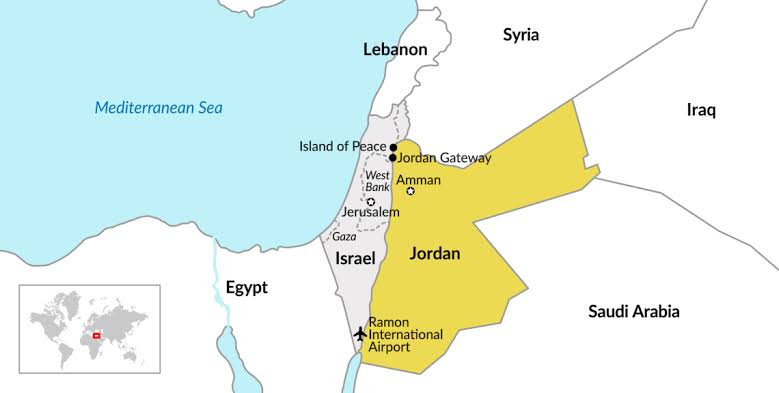
A country that literally shares a border with Israel…
Has a majority population of Palestinian origin…
Sits in one of the most unstable regions on Earth…
And yet - it’s still standing.
That country is Jordan.
Let’s get brutally honest about why.
PEACE OVER CHAOS
In 1994, Jordan signed a peace treaty with Israel.
Not protests. No chaos.
A real agreement.
Secure borders
No staging attacks from either side
Intelligence + counterterrorism cooperation
Result?
While neighbors burned -
Syria collapsed into civil war,
Iraq got ripped apart by insurgency and militias -
Jordan stayed intact.
STABILITY ISN’T FREE — IT’S BUILT
Jordan isn’t some rich powerhouse.
▶️ ~11.5 million people
▶️ ~50–70% of Palestinian origin
▶️ Lower-middle income
▶️ No oil wealth
By every “activist logic” metric… it should have fallen.
It didn’t.
Why?
Because it made strategic deals that actually work.
HARD REALITY: MUTUAL BENEFITS
This is what cooperation looks like in the real world:
WATER
One of the most water-scarce countries on Earth
Receives 50–100+ million cubic meters annually from Israel
ENERGY
Israeli natural gas powers ~60% of Jordan’s electricity
TRADE
Industrial goods, agriculture, infrastructure support
SECURITY
Joint intelligence
Border control
Counterterrorism coordination
Translation:
No rockets. No terror launchpads. No chaos spillover.
THE RESULT?
No ISIS takeover.
No Iranian proxy domination.
No collapse into failed-state status.
While others chose ideology…
Jordan chose survival and stability.
HERE’S THE PART PEOPLE DON’T WANT TO SAY
Jordan has a massive Palestinian population.
Yet instead of turning itself into a frontline battlefield,
it built a system that keeps its people alive, functioning, and sovereign.
That’s not betrayal.
That’s leadership.
FINAL THOUGHT
You can scream slogans all day.
Or…
You can build agreements that deliver:
Water
Power
Security
Stability
One path gets people killed.
The other keeps a country standing.
Jordan chose correctly.
If you’re not Iranian… maybe take a breath before you lecture us.
Iranians are celebrating in the streets.
Not because Netanyahu told them to.
Because they buried brothers. Sisters. Fathers.
They remember the massacres.
They remember the prisons.
They remember the funerals.
And now they look at the dam that is broken thanks to the bravery of Trump and Netanyahu.
You don’t have to like it.
But don’t discredit the voices celebrating in Iran.
-Iranian American
🤍💚❤️
bro is vitalik butterchicken
1) bro born in Russia and moved to Canada at 6
2) bro discovered btc at 17
3) bro co founded bitcoin magazine
4) bro got a $100,000 grant from Peter Thiel and dropped out of university
5) bro published eth whitepaper
6) bro raised 31,529 btc from the ethereum ico
7) bro donated over $1b+ worth of shib tokens to india’s cryptorelief fund
8) bro donated millions of dollars worth tokens to many projects
9) bro's a heavy supporter of zero knowledge proofs
10) bro encourages defi activities
11) bro advocates for open source projects
12) bro sells ethereum regularly to fund research and other projects
Recently I have been starting to worry about the state of prediction markets, in their current form. They have achieved a certain level of success: market volume is high enough to make meaningful bets and have a full-time job as a trader, and they often prove useful as a supplement to other forms of news media. But also, they seem to be over-converging to an unhealthy product market fit: embracing short-term cryptocurrency price bets, sports betting, and other similar things that have dopamine value but not any kind of long-term fulfillment or societal information value. My guess is that teams feel motivated to capitulate to these things because they bring in large revenue during a bear market where people are desperate - an understandable motive, but one that leads to corposlop.
I have been thinking about how we can help get prediction markets out of this rut. My current view is that we should try harder to push them into a totally different use case: hedging, in a very generalized sense (TLDR: we're gonna replace fiat currency)
Prediction markets have two types of actors: (i) "smart traders" who provide information to the market, and earn money, and necessarily (ii) some kind of actor who loses money.
But who would be willing to lose money and keep coming back? There are basically three answers to this question:
1. "Naive traders": people with dumb opinions who bet on totally wrong things
2. "Info buyers": people who set up money-losing automated market makers, to motivate people to trade on markets to help the info buyer learn information they do not know.
3. "Hedgers": people who are -EV in a linear sense, but who use the market as insurance, reducing their risk.
(1) is where we are today. IMO there is nothing fundamentally morally wrong with taking money from people with dumb opinions. But there still is something fundamentally "cursed" about relying on this too much. It gives the platform the incentive to seek out traders with dumb opinions, and create a public brand and community that encourages dumb opinions to get more people to come in. This is the slide to corposlop.
(2) has always been the idealistic hope of people like Robin Hanson. However, info buying has a public goods problem: you pay for the info, but everyone in the world gets it, including those who don't pay. There are limited cases where it makes sense for one org to pay (esp. decision markets), but even there, it seems likely that the market volumes achieved with that strategy will not be too high.
This gets us to (3). Suppose that you have shares in a biotech company. It's public knowledge that the Purple Party is better for biotech than the Yellow Party. So if you buy a prediction market share betting that the Yellow Party will win the next election, on average, you are reducing your risk.
Mathematical example: suppose that if Purple wins, the share price will be a dice roll between [80...120], and if Yellow wins, it's between [60...100]. If you make a size $10 bet that Yellow will win, your earnings become equivalent to a dice roll between [70...110] in both cases. Taking a logarithmic model of utility, this risk reduction is worth $0.58.
Now, let's get to a more fascinating example. What do people who want stablecoins ultimately want? They want price stability. They have some future expenses in mind, and they want a guarantee that will be able to pay those expenses. But if crypto grows on top of USD-backed stablecoins, crypto is ultimately not truly decentralized. Furthermore, different people have different types of expenses. There has been lots of thinking about making an "ideal stablecoin" that is based on some decentralized global price index, but what if the real solution is to go a step further, and get rid of the concept of currency altogether?
Here's the idea. You have price indices on all major categories of goods and services that people buy (treating physical goods/services in different regions as different categories), and prediction markets on each category. Each user (individual or business) has a local LLM that understands that user's expenses, and offers the user a personalized basket of prediction market shares, representing "N days of that user's expected future expenses".
Now, we do not need fiat currency at all! People can hold stocks, ETH, or whatever else to grow wealth, and personalized prediction market shares when they want stability.
Both of these examples require prediction markets denominated in an asset people want to hold, whether interest-bearing fiat, wrapped stocks, or ETH. Non-interest-bearing fiat has too-high opportunity cost, that overwhelms the hedging value. But if we can make it work, it's much more sustainable than the status quo, because both sides of the equation are likely to be long-term happy with the product that they are buying, and very large volumes of sophisticated capital will be willing to participate.
Build the next generation of finance, not corposlop.
I’m convinced ily2 just hard-forked the universe.
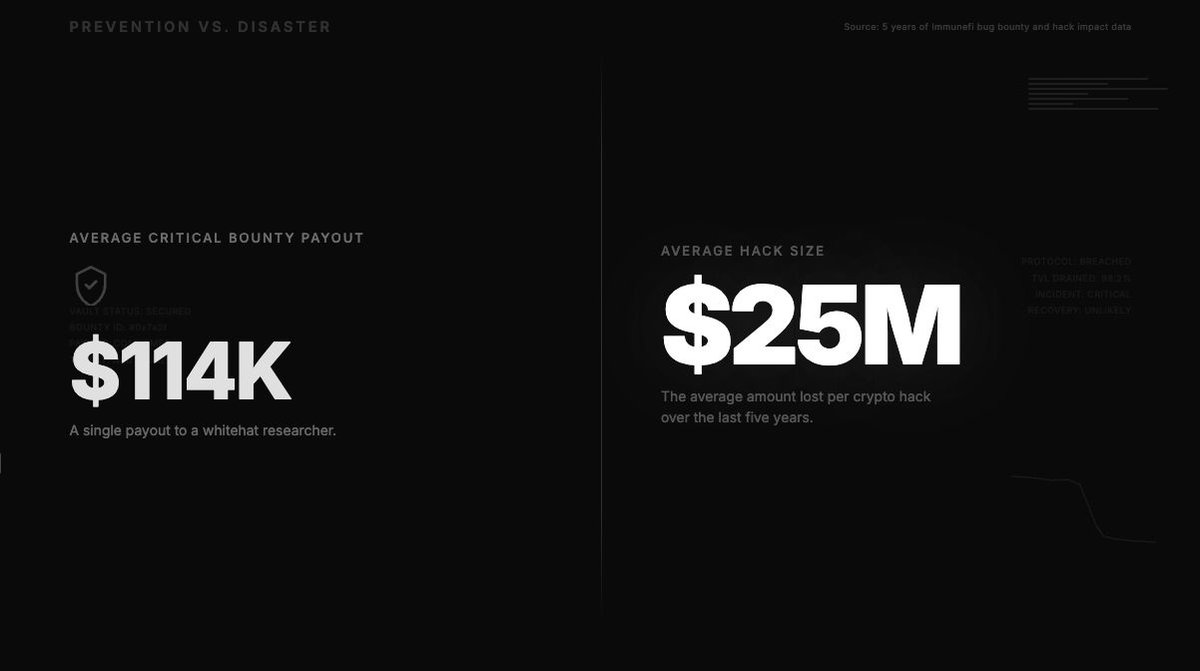
In some parallel timeline, the protocol got drained for $100M, the team is frantically negotiating a 10% "bounty" with the hacker. All charts are in absolute free fall. Half the auditors are busy shilling their AI tools, loudly claiming they would have “detected the bug,” while the other half are triumphantly announcing they’ve already found the root cause.
Luckily, that’s not our universe.
Because in this one, we have ily2 – a real whitehat ❤️
🔥 VITALIK WARNS OF A CRYPTO “DOOMSDAY” SCENARIO
Vitalik Buterin says his greatest fear is if crypto becomes "just speculation with no real applications."
He warns that if people only gamble, “this industry will die."
To avoid that, he says we must build real value — true DAOs, dApps with real use, & more open DeFi.
so crypto[.]com had their system breached and never disclosed it (thx @zachxbt for making me aware of this). So many data breaches over the last years. Listen now carefully: KYC is the most fucking scam ever. It's the most stupid security & compliance theatre and a _loaded_ gun aimed at us users. They basically steal your data in the name of fucking retarded laws, leak it to hackers, and many times don't even admit when breaches happen. You can change a password easily, but _not_ your passport and they fucking know it well. We're basically the collateral in their surveillance racket. So fuck you, you fucktard regulators everywhere thinking this is the way to go. We as an industry need to do better guys. No-KYC by default. Look I'm so fucking pissed. Crypto has failed its promise of freedom by bowing to clown KYC infra instead of making it obsolete. We need anti-KYC systems (=> using ZK systems) that are built and scaled now.
As a veteran of the audit contest industry, I will tell you how deals like these are made.
> Be protocol with money and do 3+ collaborative audits
> Know that the codebase probably doesn't have significant bugs
> Want to signal to the community, investors and other stakeholders that you care about security
> Have no intention to spend any more money on security
> "Contest" platform has solution
> Set up a rug contest guaranteeing the High/Crit pots won't be unlocked
> Make Med pot super small
> If High found then downplay the sumission otherwise client unhappy (remember Euler?)
> Both "Contest" platform and you get free marketing
> SRs rugged but you don't care
> Repeat but make the next rug contest announcement even more bullish.








![pcaversaccio's tweet photo. so crypto[.]com had their system breached and never disclosed it (thx @zachxbt for making me aware of this). So many data breaches over the last years. Listen now carefully: KYC is the most fucking scam ever. It's the most stupid security & compliance theatre and a _loaded_ gun aimed at us users. They basically steal your data in the name of fucking retarded laws, leak it to hackers, and many times don't even admit when breaches happen. You can change a password easily, but _not_ your passport and they fucking know it well. We're basically the collateral in their surveillance racket. So fuck you, you fucktard regulators everywhere thinking this is the way to go. We as an industry need to do better guys. No-KYC by default. Look I'm so fucking pissed. Crypto has failed its promise of freedom by bowing to clown KYC infra instead of making it obsolete. We need anti-KYC systems (=> using ZK systems) that are built and scaled now.](https://pbs.twimg.com/media/G1XRHKOXEAAVAca.jpg)





