This is going to be absolute chaos.
Nearly $500 billion is chasing an IPO initially sized at $64.4 billion.
Retail investors alone ordered almost $100 billion. Anthropic planned to give them no more than 20% of the deal.
A $1.4 trillion company is about to start trading with demand many times larger than the shares available.
Good luck finding a sane opening price.
BREAKING: Anthropic's IPO has now attracted nearly $500 billion in investor orders, per CNBC.
Institutional demand has reached ~$400 billion, while retail orders are approaching $100 billion.
The company is now considering expanding its IPO and pricing shares above $80, above the initial range of $70 to $78 per share.
Anthropic is also considering raising more than the initially planned $64.4 billion.
Yesterday, Jensen Huang brought back $1 trillion in market value and turned the entire screen green.
Today, Trump is preparing new tariffs on China, the EU and 14 other economies.
Nasdaq futures: -2.5%.
It took Wall Street one day to go from “AI saved us” to “Tariff Man is back.”
Trump is fucking exhausting.
Magic Johnson earned about $40 million during his entire NBA career.
The investment that made him a billionaire was a life insurance company.
In 2015, Magic Johnson Enterprises acquired more than 60% of EquiTrust, then a $14.5 billion insurer. The seller was connected to Mark Walter, Johnson’s partner in the group that owned the Los Angeles Dodgers.
Walter retained an approximately 8% stake. His firm, Guggenheim Partners, continued managing EquiTrust’s investments.
The arrangement made Johnson extraordinarily rich.
EquiTrust’s assets more than doubled to $36 billion. From 2015 through 2025, it paid its owners $390 million in net dividends. The Wall Street Journal estimated Johnson’s share at about $234 million.
Forbes attributed most of his billionaire fortune to EquiTrust.
But the same insurer was also pouring money into Walter’s financial orbit.
By the end of 2025, EquiTrust held $12.3 billion in investments involving businesses controlled by or connected to Walter, according to a Journal analysis.
That was roughly one-third of the insurer’s assets.
One internal portfolio was reportedly known as “friends and family.”
EquiTrust also invested $100.5 million in an infrastructure fund whose principals included Johnson and EquiTrust CEO Eric Holoman. Johnson’s trust appeared in the ownership structures of both the insurer and the fund manager.
EquiTrust reported the position as unaffiliated.
The distinction matters because federal prosecutors and the SEC are investigating whether two other Walter-controlled insurers failed to disclose that roughly $24 billion of their loans financed businesses connected to Walter.
It is not publicly known whether EquiTrust’s $12.3 billion is part of that investigation.
Johnson has not been accused of wrongdoing. A company lawyer previously said he did not manage EquiTrust’s operations. Walter and his companies deny wrongdoing, and lending to related businesses is not illegal when properly disclosed.
Johnson sold EquiTrust to Amistad Financial in late 2025 and remained an investor in the new owner.
Amistad is now one of the intermediaries under federal scrutiny.
Years before any investigation became public, Johnson explained what he considered his most valuable asset:
“My brand is everything to me.”
Leopold Aschenbrenner’s hedge fund lost an estimated $30 billion in July.
The next day, he married Anthropic CEO Dario Amodei’s chief of staff.
Situational Awareness had grown from less than $1 billion to about $40 billion in under two years. With borrowed money, it was controlling nearly $100 billion in positions.
Then its AI trades moved against it and banks issued margin calls.
The fund offered its Anthropic stake for sale. A consortium worked overnight and had the deal ready by July 30.
Aschenbrenner pulled out before signing.
He kept Anthropic and instead sold most of the fund’s public stocks to Citadel at a 10% discount.
Situational Awareness told investors it had lost an estimated $30 billion that month, reportedly the largest hedge-fund drawdown ever.
On August 1, Aschenbrenner got married.
The wedding theme was “European Garden, except on the verge of the singularity.”
The fund survived with more than $10 billion. Most investors remained in profit, and Anthropic later went public at a valuation of about $1.5 trillion.
Four months after the $30 billion loss, Aschenbrenner is discussing raising new money and using leverage again.
The proposed reboot is called Situational Awareness 2.0.
Well, crypto enjoyed the Jensen Huang comeback for about five minutes.
Bitcoin is back below $60,000. ETH is below $1,700.
Now we wait for Wall Street to wake up.
Are stocks actually fine, or do the bankers and investors start crying when the bell rings?
This went from absolute mania to underwater in five days.
Nearly $500 billion chased Anthropic’s IPO. Retail orders alone approached $100 billion.
The stock opened at $111.50 and briefly valued the company above $2 trillion.
Its seven founders sold nearly $2 billion at $83 while retaining 50.1% voting control.
Now the IPO buyers are underwater.
Five days later, the market found a sane price.
It was below the IPO.
Anthropic just touched $75.63 after nearly $500 billion chased the offering.
Retail ordered almost $100 billion.
Seven tech giants bought $26 billion of stock at $83. At today’s low, that block was roughly $2.3 billion underwater on paper.
The founders sold nearly $2 billion at $83.
Their timing is getting better by the hour.
This is going to be absolute chaos.
Nearly $500 billion is chasing an IPO initially sized at $64.4 billion.
Retail investors alone ordered almost $100 billion. Anthropic planned to give them no more than 20% of the deal.
A $1.4 trillion company is about to start trading with demand many times larger than the shares available.
Good luck finding a sane opening price.
We got one fucking day.
Yesterday, Jensen Huang came back and the entire semiconductor sector exploded higher.
Today:
ADI: -18.6%
MU: -11.7%
MPWR: -10.8%
AMD: -10.7%
MRVL: -10.3%
TXN: -10.0%
INTC: -9.0%
ON: -9.0%
NVDA: -8.5%
The AI recovery lasted less than 24 hours.
At this point, green candles are just intermissions.
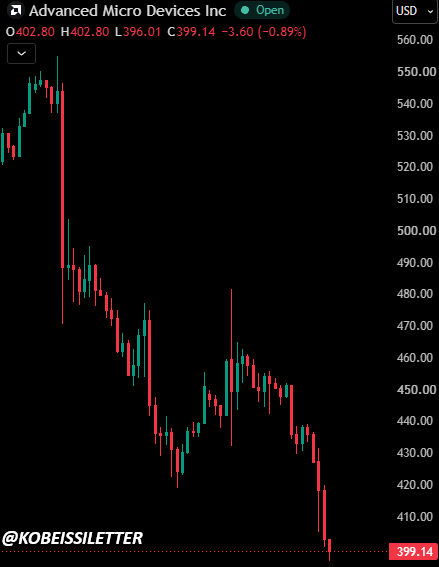
BREAKING: AMD stock, $AMD, extends losses to over -12% on the day and falls below $400/share for the first time since May 2026.
The stock is now down -30% since Hunterbrook Media suggested the company is illegally selling chips to China.
Hunterbrook Capital also disclosed a short position in the stock.
Magic Johnson earned about $40 million during his entire NBA career.
The investment that made him a billionaire was a life insurance company.
In 2015, Magic Johnson Enterprises acquired more than 60% of EquiTrust, then a $14.5 billion insurer. The seller was connected to Mark Walter, Johnson’s partner in the group that owned the Los Angeles Dodgers.
Walter retained an approximately 8% stake. His firm, Guggenheim Partners, continued managing EquiTrust’s investments.
The arrangement made Johnson extraordinarily rich.
EquiTrust’s assets more than doubled to $36 billion. From 2015 through 2025, it paid its owners $390 million in net dividends. The Wall Street Journal estimated Johnson’s share at about $234 million.
Forbes attributed most of his billionaire fortune to EquiTrust.
But the same insurer was also pouring money into Walter’s financial orbit.
By the end of 2025, EquiTrust held $12.3 billion in investments involving businesses controlled by or connected to Walter, according to a Journal analysis.
That was roughly one-third of the insurer’s assets.
One internal portfolio was reportedly known as “friends and family.”
EquiTrust also invested $100.5 million in an infrastructure fund whose principals included Johnson and EquiTrust CEO Eric Holoman. Johnson’s trust appeared in the ownership structures of both the insurer and the fund manager.
EquiTrust reported the position as unaffiliated.
The distinction matters because federal prosecutors and the SEC are investigating whether two other Walter-controlled insurers failed to disclose that roughly $24 billion of their loans financed businesses connected to Walter.
It is not publicly known whether EquiTrust’s $12.3 billion is part of that investigation.
Johnson has not been accused of wrongdoing. A company lawyer previously said he did not manage EquiTrust’s operations. Walter and his companies deny wrongdoing, and lending to related businesses is not illegal when properly disclosed.
Johnson sold EquiTrust to Amistad Financial in late 2025 and remained an investor in the new owner.
Amistad is now one of the intermediaries under federal scrutiny.
Years before any investigation became public, Johnson explained what he considered his most valuable asset:
“My brand is everything to me.”
Yesterday, Jensen Huang brought back $1 trillion in market value and turned the entire screen green.
Today, Trump is preparing new tariffs on China, the EU and 14 other economies.
Nasdaq futures: -2.5%.
It took Wall Street one day to go from “AI saved us” to “Tariff Man is back.”
Trump is fucking exhausting.
BREAKING: Nasdaq 100 futures extend losses to -2.5% on reports that President Trump is set to impose new tariffs on China, the EU, and 14 other countries.
Leopold Aschenbrenner’s hedge fund lost an estimated $30 billion in July.
The next day, he married Anthropic CEO Dario Amodei’s chief of staff.
Situational Awareness had grown from less than $1 billion to about $40 billion in under two years. With borrowed money, it was controlling nearly $100 billion in positions.
Then its AI trades moved against it and banks issued margin calls.
The fund offered its Anthropic stake for sale. A consortium worked overnight and had the deal ready by July 30.
Aschenbrenner pulled out before signing.
He kept Anthropic and instead sold most of the fund’s public stocks to Citadel at a 10% discount.
Situational Awareness told investors it had lost an estimated $30 billion that month, reportedly the largest hedge-fund drawdown ever.
On August 1, Aschenbrenner got married.
The wedding theme was “European Garden, except on the verge of the singularity.”
The fund survived with more than $10 billion. Most investors remained in profit, and Anthropic later went public at a valuation of about $1.5 trillion.
Four months after the $30 billion loss, Aschenbrenner is discussing raising new money and using leverage again.
The proposed reboot is called Situational Awareness 2.0.
This went from absolute mania to underwater in five days.
Nearly $500 billion chased Anthropic’s IPO. Retail orders alone approached $100 billion.
The stock opened at $111.50 and briefly valued the company above $2 trillion.
Its seven founders sold nearly $2 billion at $83 while retaining 50.1% voting control.
Now the IPO buyers are underwater.
Well, crypto enjoyed the Jensen Huang comeback for about five minutes.
Bitcoin is back below $60,000. ETH is below $1,700.
Now we wait for Wall Street to wake up.
Are stocks actually fine, or do the bankers and investors start crying when the bell rings?
This is what the right person can mean to a company built around his judgment.
Jensen Huang resigned from Nvidia on November 12. Eleven days later, the board reinstated him unanimously.
Nvidia announced no new chip, giant customer or record earnings. Its stock opened about 34% higher, adding just over $1 trillion in market value. The S&P 500 jumped 4.8%, the Nasdaq rose 6.8% and the Dow gained 1,365 points.
One CEO returned, and Wall Street lit up green.
Apple had already shown what this dependence can look like. When Steve Jobs returned, the company was worth less than $2 billion. Within roughly two and a half years, its market value exceeded $16 billion.
Tesla warns shareholders that it is “highly dependent” on Elon Musk. Mark Zuckerberg controls 60.6% of Meta’s voting power, leaving investors financially exposed to decisions they cannot realistically overrule.
These companies employ thousands of brilliant people. They own factories, patents, code and distribution. But investors also price the judgment of the person deciding which impossible project receives another five years and another $10 billion.
Nvidia’s engineers, factories, patents and order book were the same as they had been on Friday.
The person deciding what they would build next was back.
The market’s reaction added more than $1 trillion to Nvidia’s value by the opening bell.
This is completely insane.
On November 15, Treasury Secretary Scott Bessent said Nvidia needed to hire its next CEO from outside the company.
Two days later, Nvidia’s board said it would not reinstate Jensen Huang.
Five days after that, Bessent found a loophole:
“I said they should go to the outside, but he’s on the outside now.”
The next morning, Nvidia reinstated him unanimously.
Jensen may have satisfied the outsider requirement by quitting for 11 days.
This is what the right person can mean to a company built around his judgment.
Jensen Huang resigned from Nvidia on November 12. Eleven days later, the board reinstated him unanimously.
Nvidia announced no new chip, giant customer or record earnings. Its stock opened about 34% higher, adding just over $1 trillion in market value. The S&P 500 jumped 4.8%, the Nasdaq rose 6.8% and the Dow gained 1,365 points.
One CEO returned, and Wall Street lit up green.
Apple had already shown what this dependence can look like. When Steve Jobs returned, the company was worth less than $2 billion. Within roughly two and a half years, its market value exceeded $16 billion.
Tesla warns shareholders that it is “highly dependent” on Elon Musk. Mark Zuckerberg controls 60.6% of Meta’s voting power, leaving investors financially exposed to decisions they cannot realistically overrule.
These companies employ thousands of brilliant people. They own factories, patents, code and distribution. But investors also price the judgment of the person deciding which impossible project receives another five years and another $10 billion.
Nvidia’s engineers, factories, patents and order book were the same as they had been on Friday.
The person deciding what they would build next was back.
The market’s reaction added more than $1 trillion to Nvidia’s value by the opening bell.