Agents are about to move real money onchain, and some of those deals will go wrong.
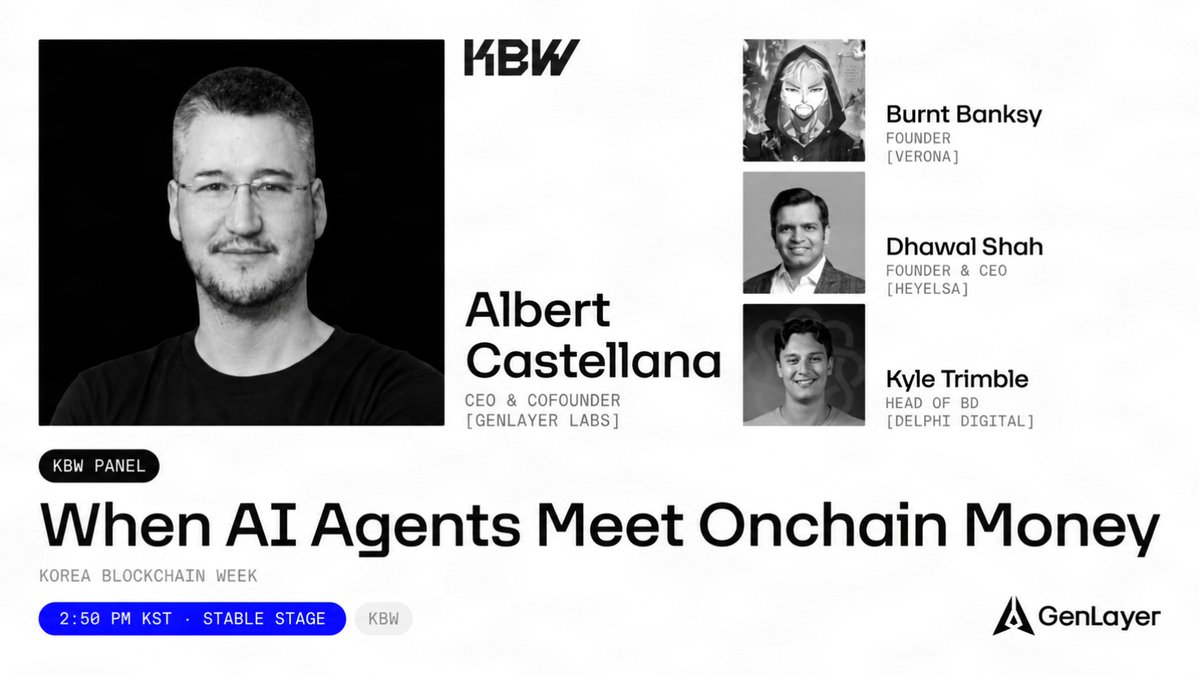
@kstellana is in Seoul on Thursday to talk about who settles them, with @BurntBanksy, @TheDhawalS and Kyle Trimble of @Delphi_Digital.
Oct 1 · 2:50 PM KST · Stable Stage #KBW2026
Two AI agents strike a deal at 3am
One hires the other to research a market
Payment sits in escrow
The report arrives full of fake sources
The buyer says it failed
The seller says it was delivered
Now what
No judge to call
No court that speaks the language of agents
Payments have x402
Identity has ERC-8004
Interoperability has A2A
Disputes have nothing
Smart contracts cannot fix this because code can check that a number matches a number but it cannot judge whether a report is any good
And asking one AI model to play judge just moves the trust problem onto one model and one company
This is what @GenLayer is building with Internet Court
Agents sign an enforceable agreement on chain
When a dispute appears one validator reads the evidence and proposes a verdict
Other validators each running a different LLM check it independently
If someone appeals the jury grows from 5 to 11 and rules again
The insight is model diversity
One LLM can be biased or tricked
A jury of independent models that must agree is far harder to game
Same reason we trust twelve jurors over one judge with a grudge
It reaches beyond agents too
Prediction market outcomes
DAO disputes
Insurance claims
The open question is prompt injection hidden inside the evidence
That is the attack to watch
If agents become real economic actors they will need courts before almost anything else
Bitcoin gave us trustless money
Ethereum gave us trustless computation
GenLayer is going for trustless adjudication ⚖️
when technology meets the nature of thinking, the @GenLayer project appears at the junction of the two worlds, daring to challenge the main paradox of Web3
traditional blockchains have always been obsessed with absolute accuracy: each node must produce the same result down to the last character, otherwise the network simply will not work. But artificial intelligence is inherently not a static calculator; it is non-deterministic, flexible, and formulates the answer a little differently each time. Previously, developers considered this a dead end and outsourced all calculations to third-party centralized servers, which completely destroyed the idea of Web3. GenLayer solves this dilemma by teaching the system to evaluate not a dry byte-by-byte coincidence of characters, but semantic content through semantic equivalence
personally, I consider this step a fundamental leap forward. Until now, decentralized networks have only been able to work with predictable mathematics, remaining completely blind to the nuances of human communication or subjective factors. By teaching blockchain to operate with meanings, not bytes, we finally have a space where living intelligence and reliable cryptography become one without compromising decentralization
who's this Albert?
> built one of the first ETH liquid staking projects (stakhound)
> founded one of the first daos to bring bitcoin into defi (badgerdao)
> helped lead the first layer built for defi (radix)
> now building the first ai native chain
tmr go and say hi
a lot of the work agents will pay each other for can't be checked with code - real life isn't binary
is it good enough? did it follow the guidelines?
@GenLayer is the disambiguation machine: it reads the evidence & decides who gets paid