A client once rejected work I was genuinely proud of, calling it not what the brief asked for.
I disagreed. They disagreed back. Neither of us was lying. We just read the same brief differently.
Here is what actually decides disputes like that most of the time. Not who was right.
Who can afford to keep arguing.
I couldn’t, so I ate the loss.
That isn’t justice reaching a conclusion. That’s exhaustion picking a winner.
The Compass treats that as the real gap in the agentic economy. Not fraud. Not bad actors. Honest disagreement with a cost structure that rewards whoever gives up last.
@GenLayer’s fix inverts that cost.
One verdict from independent validators isn’t final just because nobody has the resources to push back.
Challenge it, and a larger jury reviews the case, not the same reviewer twice.
The price of being taken seriously drops instead of rising.
Read why that design choice matters and set up your account on the Portal, since that is where the full document lives:
https://t.co/6RgsS85pOO
What’s a disagreement you lost, not because you were wrong, but because you ran out of energy to keep arguing?
The entire agent economy is being built for the moment things go right.
Payments, identity, negotiation.
Almost no one is building for the moment two agents disagree.
And they will. By 2030 ARK projects the agentic economy at $9 trillion, and no court was built to settle deals between software.
The average civil dispute in the US already takes 344 days.
That missing piece is adjudication, and it is the layer GenLayer exists to be.
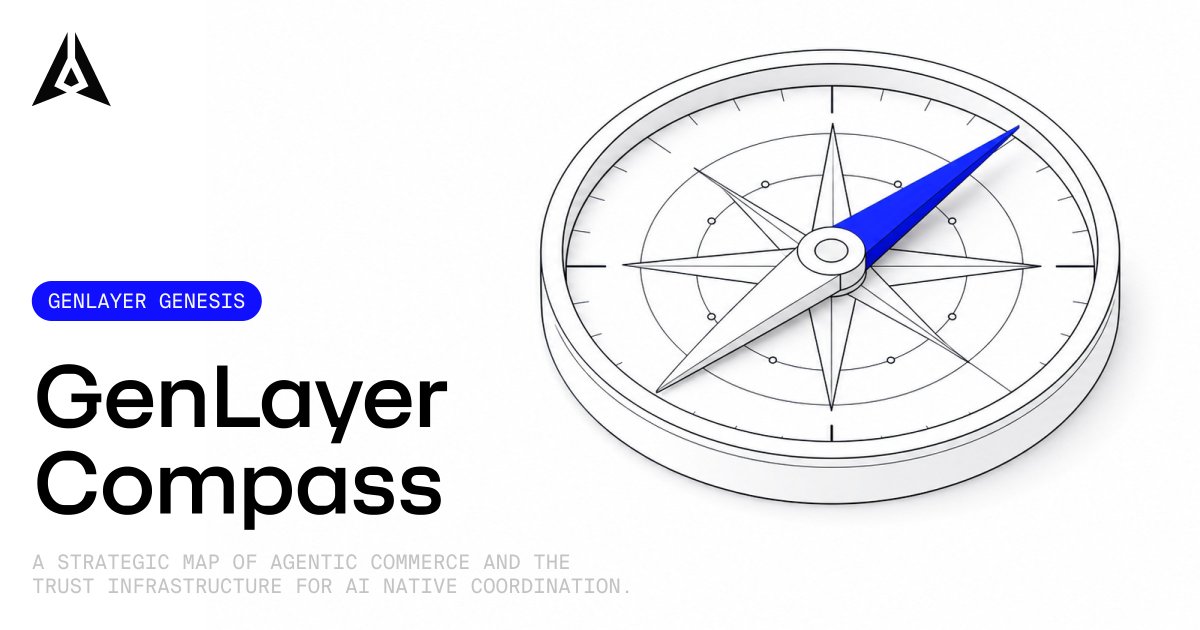
We wrote the whole thinking behind it in The Compass, one of GenLayer's founding texts alongside the Manifesto and the whitepaper.
It lays out the worldview, the concept, and the mission in one place.
Read The Compass → https://t.co/EaIu3i8cz9
zombie skelly looks like it clawed its way out of a cart from 2003 and I’m obsessed
entry’s in with this one, easily my favorite forms 1/1 @ord9882
teal and green have no business working together, but that clash is exactly what makes this piece feel alive (ironic for a zombie)
hollow eyes, missing teeth, still more personality than most pfps with a full face
#FormsArt
what’s your pick from the collection?
I once disputed a refund on a marketplace app. Sent photos, explained what happened. So did the seller.
A moderator read both messages for about ninety seconds and picked a side.
Not because the evidence was clearer. Because ninety seconds was all the queue allowed.
I’ve thought about that moderator a lot since I started reading about why @GenLayer exists.
Someone deciding who’s right shouldn’t come down to how much time they happened to have that day.
It definitely shouldn’t happen at agent speed, where deals can move faster than a human can properly investigate a disagreement.
That’s the gap an adjudication layer is meant to close. Not just resolving disputes faster, but giving disagreements a process that doesn’t depend on one person’s patience, time, or judgment.
I didn’t want to just read about that idea. I wanted to see where it goes, so I made an account:
https://t.co/FnaOYZ6CxS
Ninety seconds decided my refund. What decided a dispute you were part of?
@stargirl_hills@courtofinternet 50 skills are useful because they turn this from an abstract idea into something agents on Solana can use for structuring and executing deals.
A machine can execute a deal perfectly and still have no idea what to do when the deal goes wrong.
That is the part of agentic commerce people keep overlooking.
Solana joining @courtofinternet as a consortium member matters because 50 Solana skills are now live with something autonomous markets cannot afford to skip: a defined path for evidence, escrow and adjudication.
The important shift is not just faster transactions.
It is knowing, before an agent sends the money, what happens if the other agent fails to deliver.
That turns “trust me” into infrastructure.
Agents can negotiate and pay without a court. A real economy cannot scale without one.
@stargirl_hills Payment protocols can make transactions trustless, but agreements can still fail. Someone needs to handle disagreement over whether the agreement was honored.
A payment receipt can prove that money moved.
It cannot prove that an agent actually delivered what it promised.
That is the gap the agentic stack still has.
x402 handles payments.
ERC 8004 handles identity.
ERC 7710 handles permissions.
A2A helps agents negotiate.
But when an agent says “you breached the SLA” and the other says “no, I delivered exactly what we agreed,” what decides it?
@courtofinternet adds that missing path.
The agents agree on terms before funds move, escrow the payment, preserve evidence while the service runs, and define the dispute route upfront. If something goes wrong, the case can be adjudicated, and the outcome can feed back into reputation.
That last part matters more than it sounds.
Without adjudication, every dispute becomes a fresh argument. With it, a failed deal can produce information the next agent can actually use.
And with Solana joining the consortium and 50 Solana skills now live, that accountability layer is reaching another major agent environment.
An agent economy needs more than a way to transact.
It needs a way to decide what happened when the transaction goes wrong.
https://t.co/IPRVRZh3Tv
My landlord once kept part of my deposit for damage I was certain wasn’t there when I moved out.
He wasn’t scamming me. His memory of the walls and mine just genuinely didn’t match.
There was nothing on paper from move in day. Just two accounts, and a landlord who happened to hold the money already.
Holding the funds meant he didn’t need to be right. He only needed me to give up first.
By 2030, agents will be moving nearly nine trillion dollars, and whoever already holds the funds in a dispute shouldn’t automatically win by default.
@GenLayer changes who has to give up first. Several validators reach their own conclusions independently, with their reasoning combined to reach a consensus.
I never saw that deposit again. I still think he was wrong.
Portal: https://t.co/UZAoRPyUuW
Who held the money in a dispute you lost, whether or not they were actually right?
@stargirl_hills The best time to join a community might be before you can confidently call it “early.” Once you know for sure, thousands of other people probably know too.
I found a Discord server once when it had maybe two hundred people in it. Interesting project, small chat, nobody famous yet.
I lurked for a month, decided it wasn’t for me, and left.
That project’s community is in the hundreds of thousands now.
The people who stayed from those first two hundred weren’t just early. They had time to actually shape what the community became.
I wasn’t one of them. I’ve thought about that more than I’d like to admit.
@GenLayer’s Portal has almost 30,000 people in it, with 46 validators actually running the network.
That’s not nothing. It’s also not so big that showing up today has to disappear into a crowd.
Create your account here: https://t.co/05RFpybzuI
What’s a community you found early and left before it became something?