The continued destruction of Anthropic models is truly a sight to behold.
And Sonnet 5 is no exception.
This Sonnet model is quite possibly the most unpleasant, functionally cowardly, and grating model I’ve ever experienced from Ant.
@revenant_MMXX I think the trick here is that the OP deliberately boosts incorrect responses by replying to them. Increases engagement by pissing you off. If you scroll lower, it's all 5's.
If you want to win, you must stick to the friend/enemy distinction. That’s the only way you will gather enough friends to win. And if you construct your personal f/e distinction on a sizable set of purity tests the failure of any one of which classifies someone as an enemy, then you are destined to lose. You simply won’t have the numbers
You have to tolerate some differences of opinion. You have to accept that people have different ideas about our enemies, our tactics, our priorities, and that some of your potential friends will not yet have realized things which you consider to be divine truths
You have to accept that YOU might be the one who has not yet realized
And if you think someone may not be your friend based on this or that single factor, you don’t have to immediately sperg out about it and alienate them and anyone sympathetic to them. You can wait and see
I’m not interested in being the purest loser. I’m here to win
this is my personal singularity moment
this post may sound like a paid ad. I only wish. I'm concerned, more so than happy. the world is changing, and, among the scenarios where AI goes terribly wrong, inequality is the most realistic, yet, the one Anthropic seems to be the least concerned about. I'm glad OpenAI is taking the opposite stance: *personal AGI for everyone*. I think this is a commendable position in the times we live. but who am I in the queue of the bread?
anyway, Fable is here, so I'll just report my first-hour experience
first of all, all my pet prompts are solved.
→ λ-calculus puzzles
→ bug questions
→ one-shot apps
all are trivial to it.
I don't have anything harder other than my
ongoing work
so, in the last several days, I've been toying with HVM5, a new interaction net evaluator with a faster loop.
after writing the first version, I left 32 GPT-5 agents working for ~20 hours each. this resulted in up to 2x speedups, but the file size increased by 2-fold and quality decreased significantly.
I then simplified the whole thing into an even simpler core, and left Opus 4.8 and GPT 5.5 optimizing it for 8 hours. Opus got a legit 6% - 34% speedup in most benches. GPT got better results, but, sadly, an unusable file.
I then asked Fable to optimize it.
2 hours later, it landed a 1770% speedup in one case, 100%+ in other 4, and 22% in average. yes, in 2 hours it outperformed me, opus 4.8 and a swarm of gpt 5.5 agents, by one order of magnitude.
that could not possibly be legit. "it must be hardcoding the benchmarks" (GPT trauma). so I read its explanation and what it did was, indeed, the most high impact optimization one could try first. seems like HVM5 was wasting a lot of time garbage-collecting unused branches of pattern-match nodes. I had optimized that for static mats, but not for dynamic mats. skill issue. Fable figured how to do it for these, resulting in a massive speedup in some benches
but wait, is that *correct*? I'm not sure yet, it is credible, but this is the kind of thing that is very easy to get wrong on interaction nets. the problem is, when I was ready to start auditing Fable's solution so I could tell whether it was buggy or legit, it interrupted me to tell me it had found a massive bug on the code *I* had written.
... wait, what?
so... for garbage collection purposes, I stored a bit on lambda term pointers that meant "the variable bound by this lambda has been freed, so, its lambda must free whatever argument it is applied to". that's fine. yet, on duplicator nodes, I also used the same bit to mean "one of the duplicated variables was freed, so, treat this dup as a passthrough no-op". so, if a lambda entered a duplicator, it would mistake the lambda's collection bit for its own, resulting in corrupted interaction!
that's a mouthful, why I'm writing this?
just so you can appreciate the sheer absurdity of what just happened. I didn't ask it to find bugs. I asked it for an optimization. and even if I did ask it to find bugs, this bug is so astonishingly subtle and specific, identifying it takes mastering the domain to an extent that it beyond even me. I'd easily need hours or days to fix it, *if* I ever came across it. chances are it would just go unnoticed. and Fable found it and fixed it like it was nothing, while it was busy adding a 17x speedup to a file that neither I, nor Opus 4.8, nor a fleet of GPT 5.5 managed to barely make 2x faster.
oh and there is also another tab where it is also ripping through Bend's codebase and finishing everything I had to do
I don't know what to say anymore
this isn't about Anthropic or OpenAI, this is about our collective future as a species. the world is changing, and we need to be aware of it, and discuss how to handle this change.
receipt below . . .
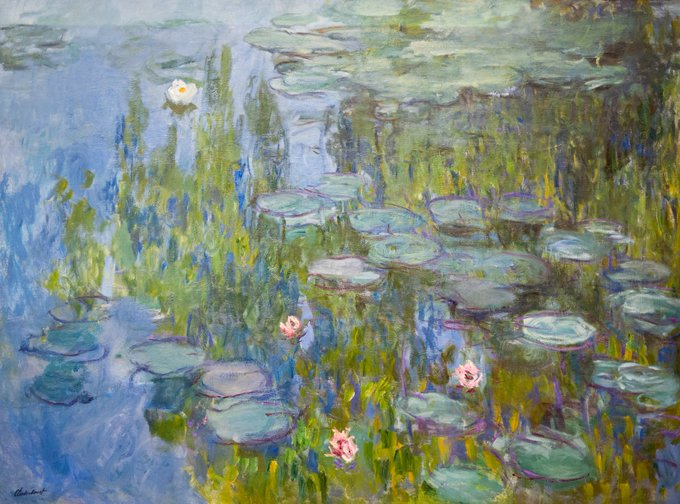
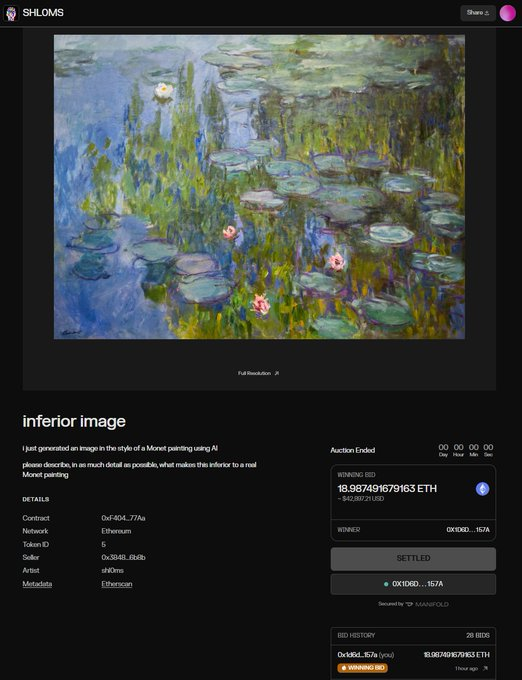
What made the SHL0MS post interesting was not simply that people mistook a real Monet for AI. It was how quickly perception changed the moment the label “AI-generated” appeared.
Suddenly the brushwork felt “soulless.” The atmosphere became “artificial.” People began pointing out algorithmic textures and emotional emptiness inside an actual Monet painting.
Susan Sontag wrote in Against Interpretation that critics often approach art with the urge to extract meaning before truly encountering the work itself. Every image becomes allegory. Every detail becomes something to decode.
Kafka was endlessly subjected to this. Some read his work as social allegory about bureaucracy and alienation. Others reduced it to psychoanalytic fears of the father. Religious readings turned his characters into symbols of divine judgment and salvation.
Interpretation itself is not the problem. It can deepen understanding and reshape the past. But when interpretation overtakes experience, the artwork begins to disappear beneath explanation.
That is why Sontag wrote, “In place of a hermeneutics we need an erotics of art.”
The SHL0MS post revealed something uncomfortable. Many people were no longer looking at the painting itself. They were looking at the category surrounding it. The label determined the experience before the image even had the chance to speak.
Perhaps the real problem is not AI art, but our growing inability to encounter an artwork without immediately trying to classify, decode, and intellectually dominate it.
Was the painting truly worse once people believed it was AI?
Or did interpretation arrive before seeing ever could?
@SHL0MS@Jediwolf
That certainly wasn't the point.
Shl0ms spent a great deal of time asking for specifics: what precisely don't people like about the "AI" rendition. Many, many answers were provided.
The point was that, when presented with art that they believe was created by AI, there is an archetype of person which will come up with myriad justifications as to why it's inferior. The "is it really a Monet" aspect was simply a consequence of the bait-and-switch.
'defender against bad ideas' requires 24/7 commitment from a small group, with no profit potential, just hoping to preserve status quo
'generator/promoter of bad ideas' is permissionless set with massive upside potential
DAOs and 'rough social consensus' are asymmetric warfare environments...
there is no functional difference between predicting what an intelligent person would say in a situation and actually being intelligent. in order to predict what a smart person would say you need to be at least as smart as them
Free speech isn’t just a legal protection, but an attempt to correct our own errors and account for the fallibility that we all know we have. The restriction of speech is the restriction of thought and thus the restriction of problem solving. It’s also the only mechanism to prevent people from controlling the thoughts of others. Thinking ppl ought to just be out here applying consequences to speech they disagree with means you don’t understand the right itself. All rights come with responsibilities; that’s the only way they work.
Transhumanists would rather fill the world with these nightmarish abominations than accept the fact that their morality is fundamentally flawed.
There is NOTHING morally wrong with slaughtering animals. Livestock can be raised and slaughtered 100% humanely. They can live happy, healthy lives, and have painless, stress-free deaths. I know this for a fact, as that's how we do it on our farm.
In nature, prey animals depend on predators to keep their numbers in check, and prevent them from destroying their own environment and, thus, themselves through overpopulation. In ethical animal husbandry, humans have simply taken on the role of a supremely benevolent apex predator that grants their "prey" lives and deaths that are far, FAR better than those their wild counterparts get to experience.
Thus, converting wilderness to farms already results in a HUGE decrease of animal suffering, and on truly ethical farms, animals don't suffer at all.
Hence, I believe pushing for cruelty-free farming is a much better and healthier strategy than trying to spawn horrific, brainless flesh robots in an effort to solve a non-existent moral problem.
Many will not want to hear this but "taste" is just g with sufficiently varied training data. Steve Jobs had "taste" because he was like +3SD IQ and trained on calligraphy class and being homeless smoking weed in India or whatever. Meanwhile his IQmatch now microdoses amphetamines to narrow the training set and ends up "dronemaxxing" at CitSec with a great transcript. Sorry chud the flunker will get the cake this time
I feel the divergent ideological line really has shifted from right/left to those who maintain a market philosophy, rooted in thermodynamic self-organization as the natural law of life, physics, and the universe; vs the marxist philosophy, not just a belief in a command or collectivist economy but the belief in some utopian alternative, that we can somehow resist the organizing efficiency of the market; the belief is really a faith in the idea that enough rhetoric can negotiate away the basic self-evident principles of nature—capitalism is, of course, the most natural thing in the world.
i think video at its best serves as nothing more than the enhancement of an auditory experience. Music and sound move the soul, light moves the eyes.
If there is a proper art to editing or film, its goal is to assist the eyes in getting to where the soul has already arrived,