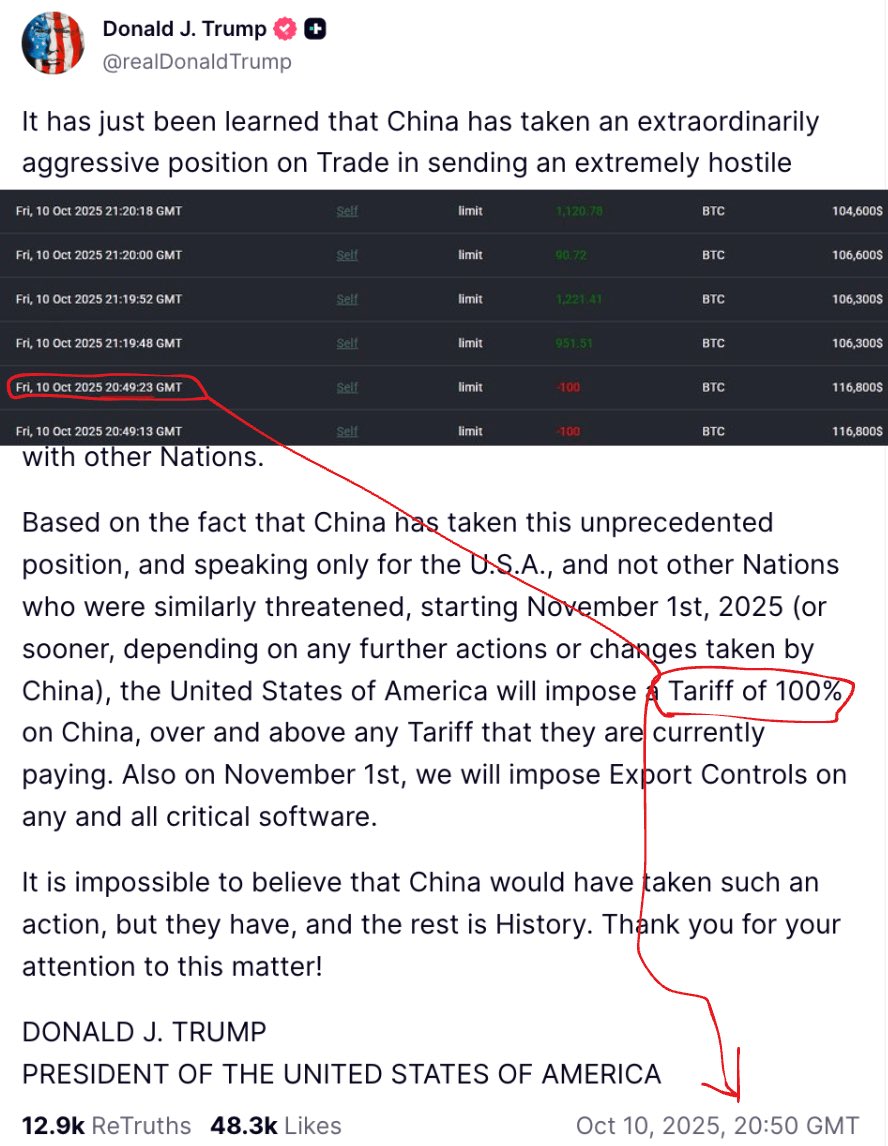
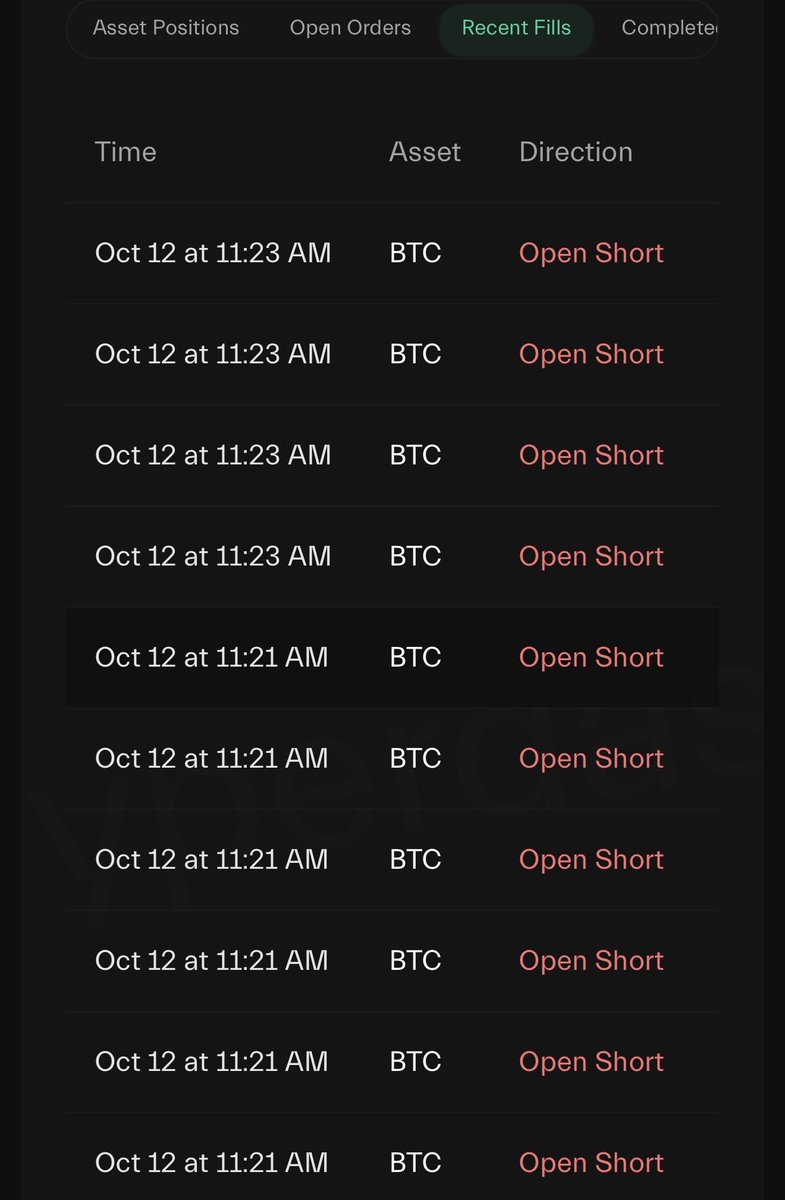
This is my theory of what I think really happened during the October crash:
The market lost $19.1 billion in less than 24 hours.
More than 1.6 million traders were liquidated
And it all started right after Donald Trump posted on Truth Social about new 100 % tariffs on China.
But here’s the strange part:
About 30 minutes before Trump’s post, a new wallet funded an account on Hyperliquid, a decentralized exchange with no KYC.
The wallet was created between October 9 and 10 and received $80M–$160M USDC through Arbitrum.
Then, that same account opened more than $1.1B in short positions on BTC and ETH.
Positions opened:
BTC short: $419M–$752M with 6–10x leverage
ETH short: $330M–$353M with 12x leverage
Total: around $1.1B notional, opened between 20:30–20:59 UTC
The last short, worth $23M on ETH, was opened 1 minute before Trump’s post
When the crash started, that trader closed everything at the exact bottom.
They made $160–$200 million in profit.
(You don’t do that by luck wtf)
Then, when the market started falling, Binance and Bybit had “technical issues” that stopped traders from closing positions.
Meanwhile, the mysterious wallet that shorted everything was closing perfectly.
At the same time, the Trump family has more than $5B in crypto holdings through World Liberty Financial (WLFI).
Their main treasury wallet is
0x5be9a4959308a0d0c7bc0870e319314d8d957dbb
A Gnosis multisig that holds $2.7B+ across Ethereum, Solana, and BNB Chain.
During the crash, the WLFI token and TRUMP memecoin both dropped around 25–30 %, but the family kept all their tokens.
But WLFI bought back $1.4M worth of tokens during the same weekend using the treasury wallet.
Wintermute, one of the biggest market makers, was also moving billions in WBTC that day
They said it was “liquidity management,” but the timing is too close.
My theory:
1. Someone with insider access knew Trump’s post timing.
2. That info was used to open huge short positions and move billions into exchanges.
3. Market makers like Wintermute and Binance amplified the move for profit.
4. Trump’s team and family, who hold billions in WLFI, benefited indirectly by cleaning leverage from the market.
The wallet timing, the exchange flows, the political ties, all match.
There's been a lot of discussion on Hyperliquid's margin design. I’ll address some flaws in the common arguments and explain Hyperliquid's first-principles based approach to improving the system. To my knowledge, this is the first such design in margining systems.
Perhaps other teams will find it useful for their own logic. Like good theories in physics, the best margining design is simple, canonical, explainable, and works in a wide variety of pathological scenarios.
1. The conclusion of some people has been that there needs to be a centralized force that detects and limits malicious behavior. This completely violates the purpose of defi and everything Hyperliquid stands for. This forces users back to a web2 world where the platform has the final say. True decentralized finance is worth it, even if it is 10x harder to build. Just a few years ago, no one believed DEX/CEX volumes would reach its ratio today. Hyperliquid is leading the charge here and has no intention to stop.
2. Some assume that copying approaches from CEXs will work in defi. The most common suggestion I've seen is per-address margin requirement fraction scaling with position size, as CEXs only offer higher leverage for smaller positions. However, this doesn't work to prevent manipulation attempts on a DEX because a sophisticated attacker can easily open positions on many accounts. Nonetheless, this will help somewhat reduce the impact of "organic whale" positions and is on the list of features to implement.
3. Another suggestion is to implement some features that severely limit usability of the platform in exchange for safety. For example, if unrealized pnl is not withdrawable, many attacks are not possible. Indeed, Hyperliquid pioneered isolated-only perps for illiquid assets which feature this safety mechanism. However, this change would have a crippling effect on funding arbitrage strategies, where unrealized pnl from Hyperliquid needs to be withdrawn to offset the loss on other venues. Real user needs are a top priority in system design.
4. There were also suggestions to innovate on design by having margin settings based on global parameters. However, liquidation prices need to be deterministic functions of price and position size. If global parameters such as open interest were added as inputs to margin requirements, users would lose confidence in the ability to use leverage at all.
So what's the answer? We all want defi, but a permissionless system must be robust to manipulation at all scales.
The answer lies in understanding the true problem with large positions: they are difficult to mark. The first order approximation of mark price times size breaks down when market impact approaches maintenance margin. It's impossible to accurately simulate market impact because book liquidity is a path-dependent function of time and actions of other participants. Without simulating market impact, it can be possible for liquidation to be a low-slippage way to exit at a price that is unfavorable to the liquidator.
Therefore, Hyperliquid's margining system update has the following desirable property: any liquidated position is either a loss relative to entry price, or at least a (20% - 2 * maintenance_margin_ratio / 3) = 18.3% loss relative to the last margin transfer out (using an example of 20x leverage). An organic 20x user who makes 100% return on equity after a 5% move will still be able to withdraw the majority of the pnl without closing the position. However, by introducing separate margin requirements between transfers and opening new positions, profitable manipulation attempts require moving the mark price almost 20%. This kind of attack is infeasible from a capital perspective.
Finally, I'd like to point out that the mark price problem also solves itself as market makers continue scaling up on Hyperliquid. It's quite possible that the trader yesterday could have lost money in aggregate. $1.8M pnl longing on Hyperliquid could have been more than offset when pushing the price on other venues, or using other accounts on Hyperliquid. HLP took over an undesirable position, losing $4M. The only market participants who definitely made money in aggregate are the market makers. With millions of dollars of pnl to be made in the span of minutes, it's becoming clear to sophisticated participants that Hyperliquid is one of the venues with the best flow. As liquidity improves, it will become more and more expensive to dislodge prices. So while the margining system improvements will go a long way, the allure of easy pnl attracting market makers will provide an independent source of robustness over time.
The future is decentralized.
Hyperliquid.
I JUST GOT HACKED! 🥲
Lost some ETH, SOL, and a bunch of NFTs especially my @Azuki , @BEANZOfficial and @Pixelmon , which I truly treasured.
Here’s what happened:
I’ve been actively applying for jobs lately. Yesterday, I got a LinkedIn DM from someone claiming to be a recruiter from @Alchemy . She asked if I was interested in a role, and if so, to share my resume. I did.
After she reviewed my resume with the team, she came back saying I was quite suitable for the role. She then sent me a link to complete a 20-minute timed test and a video recording interview.
During the process, there were some issues with webcam access, and the site provided suggestions on how to fix it. Since it was a timed test, I rushed and followed the instructions blindly, thinking everything was fine.
Later, I received transaction alerts from @MagicEden App and that’s when I knew I f*cked up.
By enabling those permissions and rushing through, the hackers somehow gained access to my wallet extensions. I didn’t sign anything suspicious, so it was likely session hijacking or some browser-level exploit.
Lesson: Hacks can happen anywhere even through what looks like a legit Web2 job process.
Slow down. Double check everything. Never let your guard down, no matter how “professional” it looks.
Stay safe, frens. I’m sharing this so no one else has to go through the same pain.
Ppl chasing longterm goals beyond money as they moved up highest ranks in Maslow hierarchy
If u haven’t made it, dont judge s.o having a short-term vision for focusing on financial goals while u just make ends meet
Make sure your actions align w the time horizons you think in
Contrary to popular belief, the Pudgy Penguins ETF would not be the first institutional NFT investment fund.
Few remember that PROOF co-founder Ryan Carson ran a private NFT investment fund called 121G.
The track record was absolutely phenomenal:
- He swept countless Moonbirds at an average of 20-30 ETH each (more than 700 ETH in total). Floor price today is 0.3 ETH.
- He roundtripped Art Gobblers from ATHs (10+ ETH each) and dumped them into WETH bids months later for 0.1 ETH.
- He spent 183 ETH ($360,000 USD!) on 15 Bitcoin Punks (copies of CryptoPunks on Bitcoin) when the Ordinals bull run happened. These Punks are completely worthless today.
- He bought countless other worthless garbage, spent $100k on Tigerbob Genesis (wtf), Ledger Passes (later sold for -95%) and more.
And those are just the highlights.
Estimates at the time showed that a fund that was once managing $40M USD in funds, traded everything down to less than $500k USD - in about one year.
Put some respect on Ryan Carson's name, no one did it better