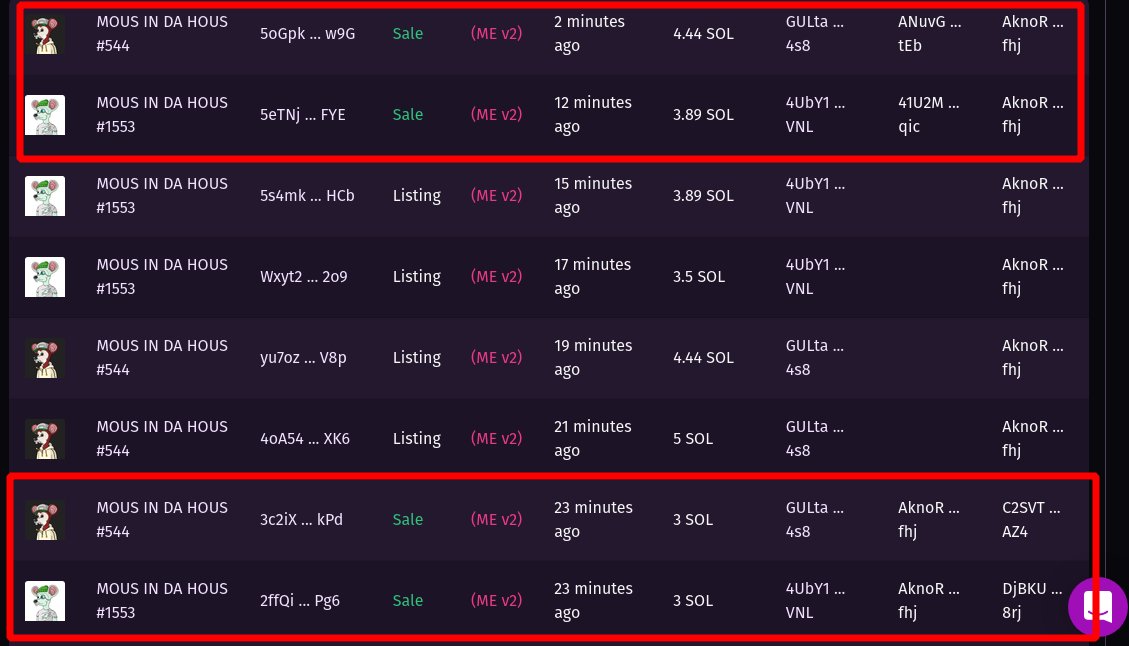
@KChimaev in case of an investigation by any federal entity or similar, I do not farm potatoes with this group nor with the people in it, I do not know how I am here, probably farming potatoes, I do support the cumulative growth of potatoes for all parties here.
Silent but still building. Stats for the past week:
- ~550 members have joined.
- Added CTO monitors, Token Burn monitors, Volume Reports, Moonshot monitor, OUR OWN DEX PAID CHECKER and more.
You're missing out. Restricting access soon.
https://t.co/rGzip4Yinv
@_BL33_@MousInDaHous this was freest money during the nft supercycle of late 2021.
showed all buys/sells for any nft. the edge was unmatched for the time.
literal cheat code lmao damn what a throwback
"Solana is centralized because hardware requirements"
Reality: Solana has ~3k nodes which is only slightly less than the number of Ethereum nodes — but it's also 10,000x cheaper and has at least 100x more capacity...seems like a tradeoff worth considering.
"Ok but those nodes are in datacenters, no one can run them at home"
Reality: Actually you can run them at home, this is a myth.
Bare metal is just more convenient.
ETH is not immune to "convenience" either, you can see this with i) Lido's domination ii) how many ETH nodes run on AWS.
Also, Solana is in more datacenters than most networks have nodes in total.
Read that sentence again.
Calling over 3k globally distributed nodes "centralized" is non-sense.
"But in the event of world war 3 or a nation state attacking the network, you wouldn't have censorship resistance because you can't run nodes at home"
Reality: Check the map above. You are saying that *all* of the locations above would be shutdown. This is only possible if all governments everywhere, ever, simultaneously decided to crack down at the exact same time. Statistically impossible.
And assuming this did happen (lol) — you CAN run nodes at home still!
You know what will actually censor you as a user in this case?
The majority of L2s in their current state.
They are generally single servers (sequencer) governed by a multisig at best. This is a fact. Calling Solana centralized while not realizing you have 100x worse centralization at home is hypocrisy.
Most of them don't even have fraud proofs....
"No... because L2s are still early, they will get decentralized over time."
Reality: and so will Solana..
100% of tech scales with hardware/bandwidth. Solana is explicitly designed to take advantage of these improvements. Not to mention light clients and optimized clients driving hardware requirements down.
You can't both make the claim that L2s will get more decentralized AND ignore that Solana will also get more decentralized over time. It's a total contradiction.
"Okay well even if L2s are centralized, users can still force include transactions into the L1"
Reality: Ignoring the fact that 99% of users won't do this (since almost none of them currently run their own nodes DESPITE the nodes being easy to run)....just think about this for a second.
It is "World War 3". The L2s are being censored. You must i) run your own ETH node and ii) force include your transactions / make the txn directly on the L1
Since this is the only last "censorship resistant" piece of tech remaining by construction of the argument — there is obviously tremendous demand.
You know what can't handle a surge in demand at the base layer? Ethereum.
Who is going to pay 2,500$ in gas costs? People who can afford it.
And if they can afford that, they can afford running a Solana node. The accessibility argument has fell apart.
I understand that Ethereum is technically more decentralized due to it having more nodes.
But to say that this somehow implies Solana is "centralized" and prone to "censorship" is absolute non-sense.
It also completely ignores incentives.
If something is more expensive to run and hence is less accessible to the majority BUT people have more incentives for it — that thing can easily win out. Simple supply and demand. I could've bought a windows laptop or an M2 laptop. Even though the M2 is much more expensive, I bought it because it helps me more. I have more demand for it.
You can't just optimize for supply but not demand
Both design spaces can & should be explored, obviously.
This "Solana is not decentralized" argument is objectively nonsense.
The OP Stack & the Superchain Vision
The OP Superchain is the end game vision of the @optimismFND scaling thesis. 🔴✨
It evolves around an ecosystem of independent, mainly app-specific rollups based on the #OPStack that are interoperable & composable with each other. 🌐🚀
Let's have a look where we stand & how we get there! 👀👇
Introduction: The multi-chain future
There is broad consensus at this point that the future is multi-chain. However, many argue that it won't be cross-chain, as there are too many issues that come with connecting multiple sovereign networks.
Traditional approaches to such multi-chain architectures suffer from two fundamental problems:
🔴 Each chain introduces a new security model, resulting in compounding systemic risk as new chains are introduced into the ecosystem.
🔴 New chains are costly to spin up because they require new validator sets & block producers.
These challenges emerge largely due to the absence of a unified blockchain, referred to as an "L1" chain, acting as a consistent source of truth for all subsequent "L2" chains in the system. Theoretically, by establishing an L1 chain as a shared reference, it becomes feasible to (a) apply standardized security protocols across all chains and (b) obviate the need for individual validator sets for each chain because L2 chains can leverage the L1 consensus mechanism. Which is exactly what we’re doing by scaling Ethereum on rollups.
The Rise of the OP Stack
In a bid to offer a robust solution to these challenges, Optimism introduced the OP Stack. This development stack, which powers Optimism, is standardized, open-source framework to build rollups, and is maintained under the stewardship of the Optimism Collective.
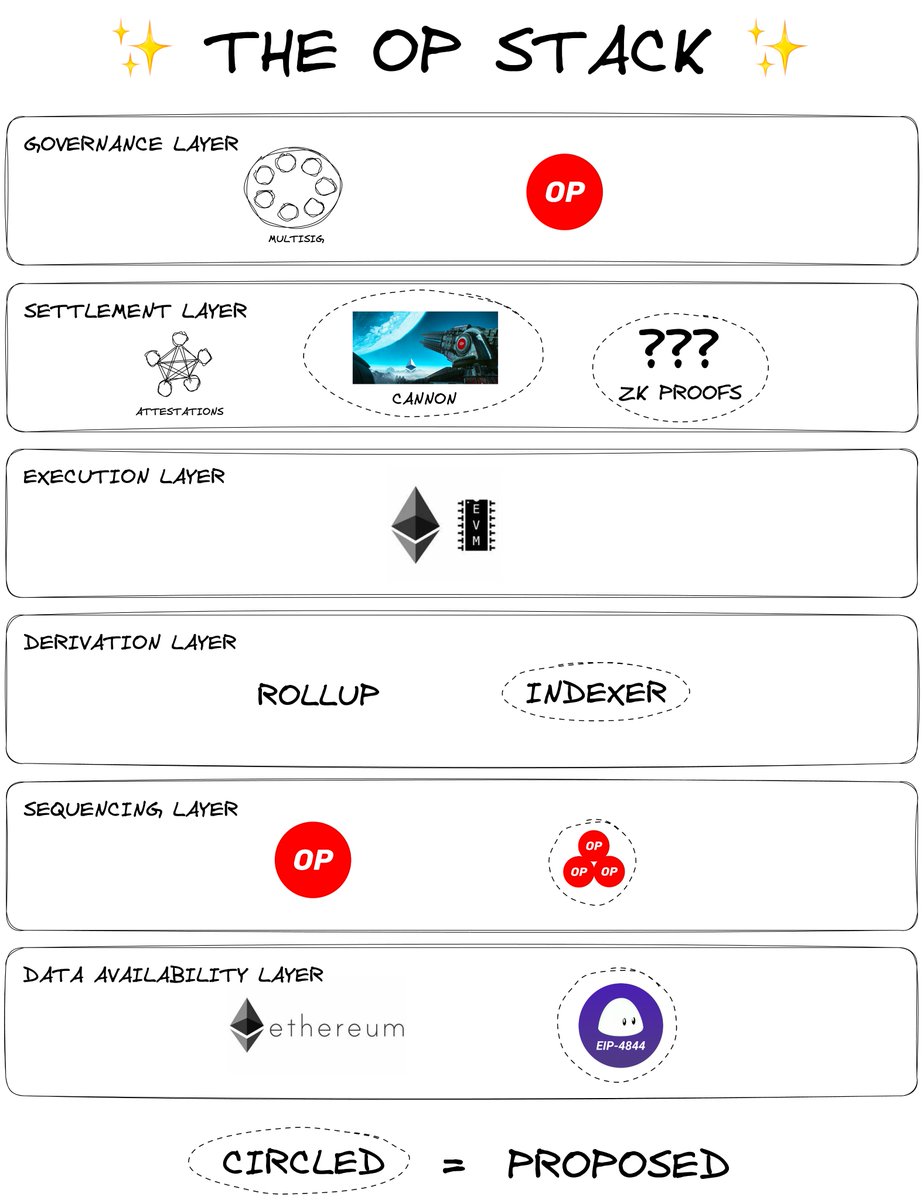
At its core, the OP Stack comprises software modules that define specific layers of the Optimism ecosystem. While its current primary function is facilitating L2 blockchains, its potential extends to higher layers, encompassing tools like block explorers, message communication protocols, governance frameworks, and more. The intention behind the OP Stack is to establish it as a public good, benefiting both the Ethereum and Optimism ecosystems.
The Optimism Bedrock serves as the current version of the OP Stack. It delivers tools essential for launching an industrial-grade Optimistic Rollup blockchain. But let’s explore that in more detail.
Optimism Bedrock: Features and Enhancements
Bedrock represents a quantum leap over its predecessor by offering:
🔴 Reduced Transaction Costs: Transaction fees are drastically lowered by optimizing data compression and employing Ethereum for data availability. Preliminary metrics indicate that this reduces fees significantly. Additionally, the elimination of EVM execution-related gas costs during L1 data submissions further lowers fees by roughly 10%.
🔴 Fast Deposit Times: Bedrock’s node software now supports L1 re-orgs, thereby drastically reducing deposit wait times from a previous maximum of 10 minutes to an anticipated 3 minutes.
🔴 Modular Proof Systems: A critical enhancement in Bedrock is its ability to detach the proof system from the main stack, allowing rollups to utilize either fault or validity proofs (such as zk-SNARKs) to verify execution validity.
🔴 Superior Node Performance: Node software performance has seen a significant boost. Nodes can now execute several transactions within a single rollup block, a departure from the previous "one transaction per block" protocol. In conjunction with improved data compression, this efficiency means state growth is cut down by an estimated 15GB annually.
🔴 Greater Ethereum Compatibility: Bedrock's design is closely aligned with Ethereum. This approach means several deviations present in the older versions have been rectified, including the one-transaction-per-block model, unique opcodes for accessing L1 block data, separate fee structures for L1/L2 in the JSON-RPC API, and custom representations of ETH balances.
Strategic Direction and Vision for the Superchain
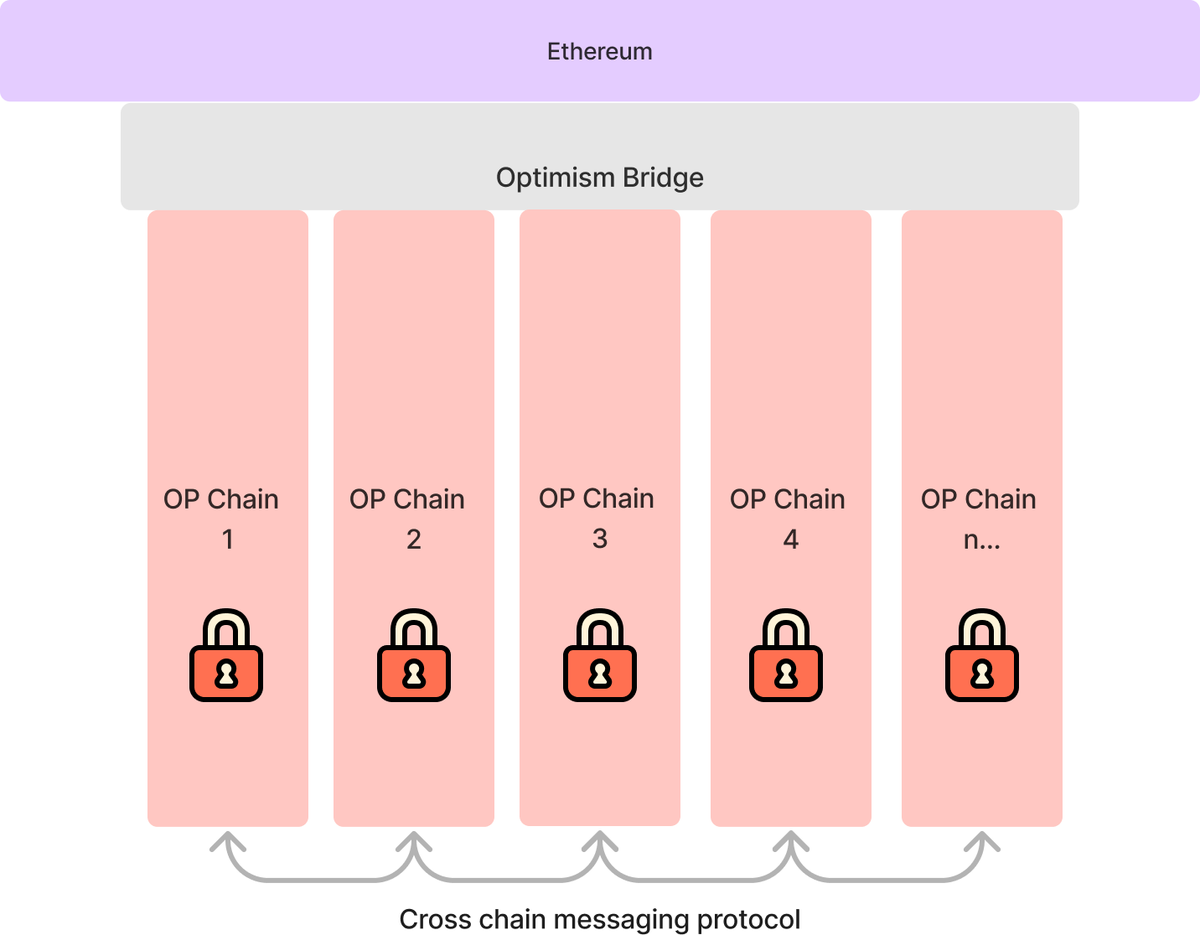
The current OP Stack iteration (Bedrock) is crafted to support the upcoming Optimism Superchain, which is visualized as an interconnected network of L2s that share security protocols, communication frameworks, and a common development platform, i.e., the OP Stack itself. The central idea behind the Superchain is to have a network of standardized L2 chains, dubbed as OP Chains, which function one logical network. This system empowers developers to craft applications targeting the Superchain, thereby bypassing the intricacies of all the individual underlying chains.
How is Bedrock built to Support the Superchain?
🔴 SystemConfig Contract: This new introduction aims to directly define the L2 chain with L1 smart contracts. The objective is to encapsulate all details defining the L2 chain, including the creation of unique chain IDs, setting block gas limits, etc.
🔴 Sequencer Flexibility: A distinctive feature in Bedrock is the capacity to designate sequencer addresses via the SystemConfig contract. This innovation introduces the concept of modular sequencing, allowing various chains with unique SystemConfig contracts to have their sequencer address determined by the deployer.
🔴 DA Flexibility: Bedrock also provides flexibility with regards to Data Availability (DA). This flexibility allows builders to opt for optimized DA solutions, significantly reducing cost compared to DA on Ethereum L1.
🔴 Multi-Proof System Support: Bedrock will adopt Cannon as its primary fault-proof mechanism. Yet, it remains flexible, hinting at future integration with various optimistic as well as validity proof based systems in the future. This multiplicity in proof systems ensures a broader spectrum of security and optimization options, enhancing the resilience and adaptability of the network.
The Challanges on the Road to the Superchain
The anticipated success of the post-Bedrock Superchain release is expected to resemble a quantum leap on the scalability and decentralization journey of Optimism. Nevertheless, it's important to note that some challenges persist in achieving a fully scalable blockchain ecosystem.
⚠️ Challenges and Solutions with Withdrawal Claims:
Withdrawal claims currently necessitate reliance on a trusted set of chain attestors. There exists a potential solution to this challenge: by replacing the trusted attestors with permissionless proofs, such as Cannon, that offer entirely onchain dispute resolution. However, solely onchain proofs come with inherent risks, especially in the absence of a fallback mechanism. An innovative approach to circumvent this vulnerability is the integration of a multi-proof system, which offers redundancy, thus ensuring an enhanced safety net.
⚠️ Cross-Chain Transactions and the Challenge Period Hurdle:
The predominant drawback with fault proofs in cross-chain transactions is the necessary waiting period, known as the challenge period, before finalizing transactions safely. This waiting duration can vary, thereby affecting the speed at which assets are transferred between OP Chains. On the contrary, validity proofs present a solution to this latency issue. They eliminate the challenge period, paving the way for instantaneous asset transfers. However, validity proofs predominantly employ zero-knowledge proofs (ZKPs), which are not only expensive but also prone to bugs. Productionizing ZKPs, to the point they become the primary solution for cross-chain communication might still be a long journey. Nevertheless, the OP Stack’s modular proof system, which allows for simultaneous utilization of two proof systems, might support some interesting intermediate solutions. This dual system allows for both low latency bridging with compromised security and high-security bridging with increased latency.
Consequently, developers have multiple bridging options, including:
🔴 High-security, high-latency fault proof.
🔴 Low-security, low-latency fault proof.
🔴 Low-security, low-latency validity proof.
🔴 High-security, low-latency validity proof, upon the productionization of ZKPs.
⚠️ Addressing Asynchronous Cross-Chain Transactions:
A salient concern is the asynchronous nature of cross-chain transactions, which breaks atomic cross-chain composability. However, there's potential in introducing synchronous cross-chain messaging through a shared sequencing protocol across OP Chains. In this model, sequencers across chains reach a consensus regarding transaction inclusion, ensuring atomicity. Moreover, transaction fees are paid only upon successful inclusion on both chains, shifting the synchronization risk from users to sequencers. Implementing this shared sequencing protocol is feasible atop the modular sequencing layer of the post-Bedrock Superchain.
⚠️ Scalability Concerns with Posting Transactions to the Superchain:
A notable challenge is the non-scalable nature of posting transactions to the Superchain due to the limited data capacity of L1. An innovative solution could be a Plasma protocol, which can expand data availability for OP Chains. This protocol enables alternative Data Availability (DA) providers (Celestia and co.) to augment the restricted L1 DA.
Ecosystem Growth
The attractiveness of the OP Stack is evident from the rapidly expanding ecosystem of rollups being developed on top of it. Some notable examples include:
🔴 @BuildOnBase (Coinbase’s general purpose L2)
🔴 @0xMantle (BitDAO’s gneral purpose L2, using EigenDA)
🔴 @MantaNetwork (Universal zk circuits, using Celestia for DA)
🔴 @OPBNB_Network (General purpose L2 settling on BNB Chain)
🔴 @SynapseProtocol Chain (Cross-chain interop / bridging)
🔴 @ourZORA (NFT-centric)
🔴 @UniDexFinance (Spot & Perp DEX/Aggregator)
🔴 @DeBankDeFi (Social networking/portfolio tracker)
🔴 @OPCraft (Gaming)
🔴 @aevoxyz (Derivatives)
Conclusion
In conclusion, the OP Stack and the Superchain vision that comes with it, could be a game changer on the path towards a true multi-chain future. While challenges persist, Optimism offers a promising solution that could take us towards greater scalability and decentralization. If it keeps gaining traction quickly, we might see the OP Stack cement its strong position through the network effects inherent to the Superchain’s interop/composability-focused concept. 🔴✨
Friend Tech, the future?
Or will it fade into a fad... like many before it?
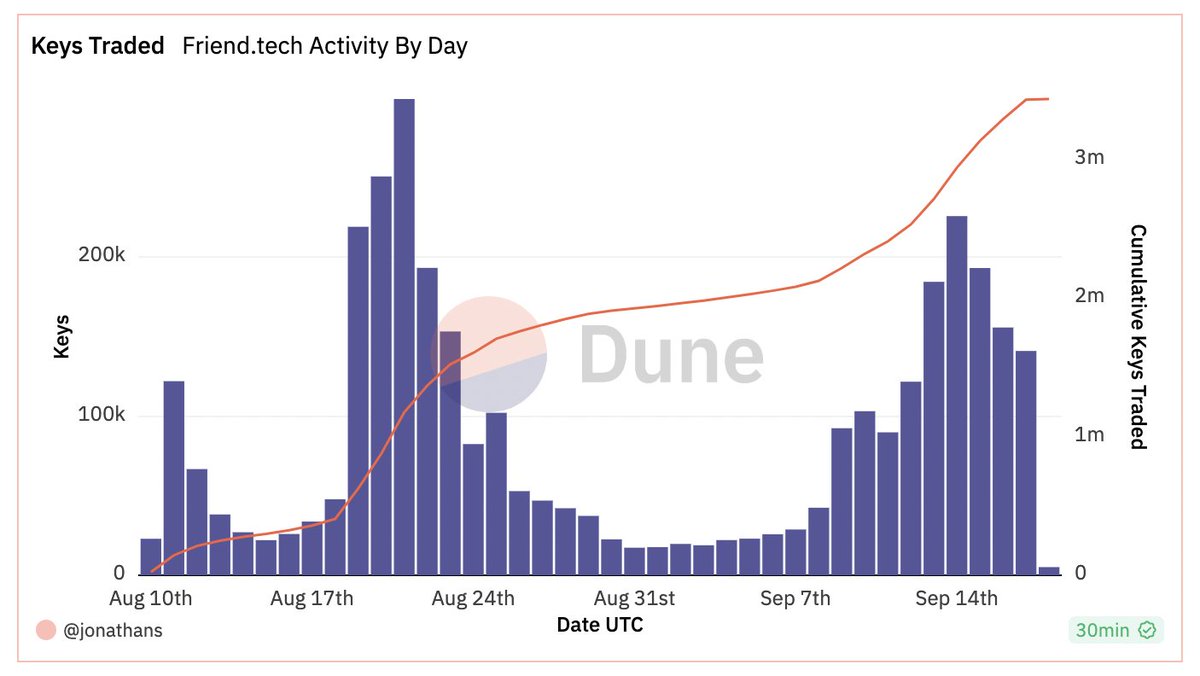
Well, I thought tonight was a great night to look at data around the platform itself and try to make some level of determination.
A buyer to seller ratio is one of the best ways to weigh demand.
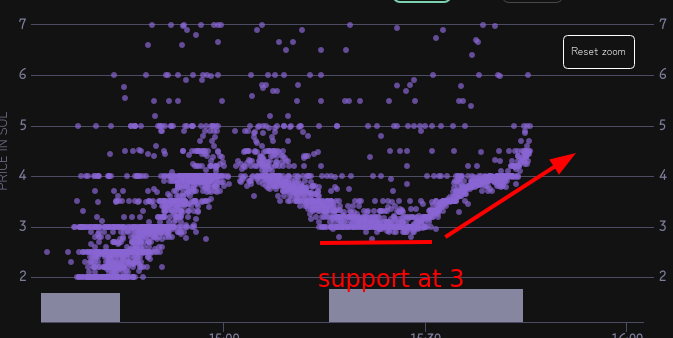
In this case, we are currently struggling to regain previous highs even from last run up.
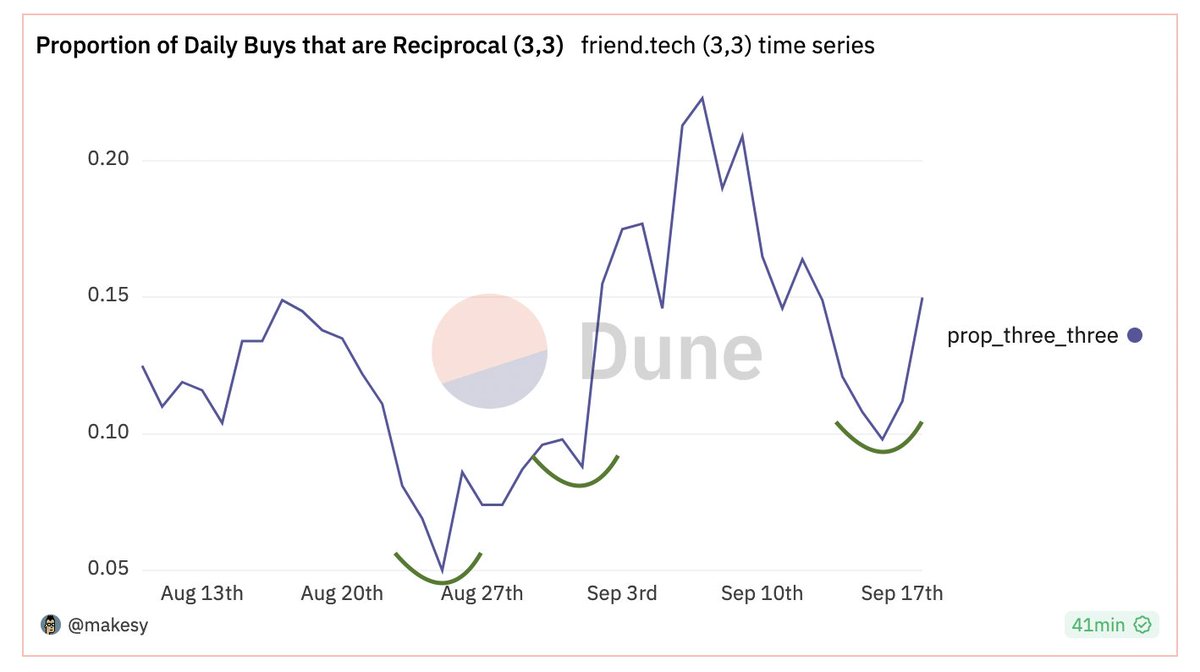
Much of the buying pressure right now is also what is being called (3,3) or you buy me, i buy you.
You can see higher lows each time on the (3,3) method, which leads me to believe that THIS is where a lot of the volume will continue to drive.
The hands down most bullish thing, for me to believe this has some major staying power...
Total Value Locked, continues to push to new all time highs.
Showing people are not sprinting to withdraw the funds, but rather re-deploying them in some capacity, or at least leaving them in their FT wallet.
If we can continue to see a trend up on the # of sales happening then I think this is far from over
The more sales = more eyes = more people talking about it
As far is Friend Tech going to die, my gut wants to say no, theres something unique with this.
- Devs that care and are shipping quickly.
- An airdrop looming over people's heads, much like the never ending szn 2 of BLUR
- Advocates for the platform posting it constantly on twitter
Do I think that there will be quiet times for FT?
- Absolutely, i mean hell... even just 10 days ago people had written it off, only to be excited again once the timeline saw gains
Catalysts can continue to send this
- Big name individuals getting on
- Large profits being shared
- Unique opportunities that creators use the platform to give to key holders
There's a lot more opportunity and innovation that I believe WILL come from both the creator and developer side of FT
But I also think the consumer base will come and go, ebs n flows, like any market.
Excited to keep tabs on it tho regardless
It's given the space some excitement in a time where we all really needed it.
Imagine all blockchains sharing the same order book, allowing you to trade on future prices of assets without owning them - all via TG.
People don't realise: OrderlySDK orderbooks, GMX vaults, uniV3 farms- $emp is real DeFi, not just the typical "bridging trading sniping" stuff.
On-chain NASDAQ: DeFi at the Speed of Light ⚡️
With some RPC wizardry and @solana's geyser plugin, we were able to reduce our on-chain orderbook latency *well below 400ms* (i.e. intra block).
This is all on mainnet, hoping to ship to @ZetaMarkets prod front-end soon.
ZkSync airdrop is set to happen, but the average farmer will only get 1/10 of the top allocation.
Are you willing to earn $20,000 instead of $2,000?
🧵 In this thread, I'll guide you on maximizing your zkSync airdrop.
Introducing a new way to trade on @Solana - Just Type! 🤯
Simply type in what you want, and our AI will do the rest. From simple queries to chained commands, it can do it all!
Try out FluxBot today: https://t.co/LsSmkGs2jz
#opos#flux#trading
1/ How is it possible that all major marketplaces on Solana support creator royalties while the two largest marketplaces on Ethereum don’t? 🧐
A breakdown of why Solana is the best chain for NFT creators 👇