SAM ALTMAN SAID AGENTS WOULD RUN ENTIRE COMPANIES - JEV JUST PROVED IT BY BUILDING ONE THAT WENT FROM BLANK REPO TO $49,589 MRR USING 7 MODELS AND ZERO HUMANS
3.12 million tokens. 7,580 requests. 0 humans involved.
the spider system arc-07 starts with a single instruction and a blank repo - no team, no developers, no project managers - just jev and 7 models
phase 01 is plan: opus 5.5 specs the entire system - architecture, database schema, agent routing, every file that will exist - in one pass
phase 04 is code: claude code takes the spec and writes 318 files across the repo - bot/trade.py, agents/router.ts, ui/grid.tsx - shipping each one marked pass, kept, or cut - at minute 12 the MRR panel reads $7,851
by phase 08 scale: claude code clones itself into 40 parallel workers, all executing simultaneously - 29 workers, 6 collisions - the revenue panel hits $27,146 and the system is at 67% completion
phase 13 is live: web closed, all rings online, 12 phases complete - handed to the spider
the final screen reads $49,589 per month, compounding - cost to run the entire arc: $95.85 - margin: 97%
$49,589 MRR on $95.85 of compute is $595,068 annualized on less than $1,150 a year in operating costs
a16z, sequoia, yc - every firm that has portfolio companies burning $50k/month on engineering overhead should be watching this
the companies that deploy this first don't get a competitive advantage - they get a cost structure that makes their competitors economically impossible to run
jev didn't build a product. he built the system that builds the product, tests the product, markets the product, and ships the product while he sleeps
save this before your next funding round ↓
Jev is the FASTEST AI model ever built for trading
It makes calibrated buy/sell decisions in under 100 ms
That is one real decision on every single block, 24/7
In this article I've shown EXACTLY how to build HFT trading system with Jev (from scratch) https://t.co/4hmZDzN00Z
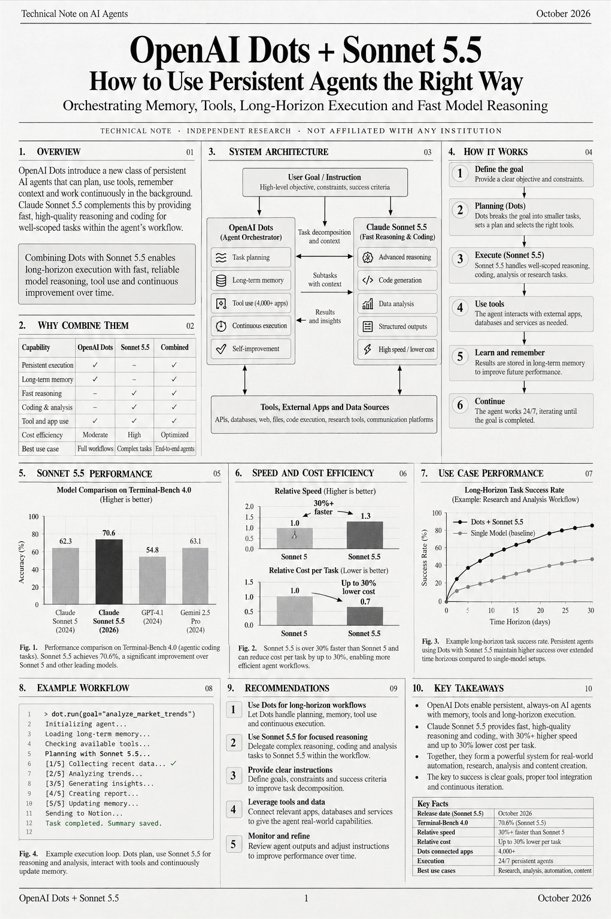
OPENAI BUILT A PERSISTENT AGENT SYSTEM AND THEN USED ANTHROPIC'S MODEL TO POWER IT - THE COMBINATION SCORES 70.6% ON TERMINAL-BENCH AND RUNS 24/7 ON 4,000 CONNECTED APPS WITHOUT STOPPING
two competing companies. one system. october 2026.
openai dots is the orchestrator - it plans, remembers, decomposes goals into subtasks, and keeps running until the task is done - it has long-term memory and connects to 4,000+ external apps, databases and apis
claude sonnet 5.5 is the brain inside the system - dots doesn't reason or code itself, it delegates every complex subtask to sonnet 5.5 which handles the actual thinking, analysis, code generation and structured output
together they score 70.6% on terminal-bench 4.0 - the agentic coding benchmark - beating gpt-4.1 at 54.8%, gemini 2.5 pro at 63.1%, and the previous claude sonnet 5 at 62.3%
sonnet 5.5 alone is already 30% faster than sonnet 5 and costs 30% less per task - inside a dots workflow those savings compound across every subtask in a multi-day job
the use case isn't a chatbot - it's a system you give a goal on monday and it sends you a completed report on friday
dots runs the workflow, delegates to sonnet 5.5, stores results in long-term memory, learns from each iteration, and updates itself - the example in the paper shows it completing a 5-step market research workflow, sending it to notion, and saving the summary without a single human touchpoint
the long-horizon task success rate chart shows the gap clearly - single model baseline hits around 40% success at day 30, dots + sonnet 5.5 holds above 80%
the revenue potential is in the enterprise layer - research workflows, content pipelines, market analysis, automation that currently costs $50k/month in human analyst hours running on $0.70 per task in compute
who built it: independent research team, not affiliated with any institution, combining openai's agent infrastructure with anthropic's reasoning model - published october 2026 as a technical note
this is the part nobody talks about - the best systems in 2026 aren't built by one company
save this before everyone figures it out ↓
opus 5.5 is the most dangerous AI model for trading right now
it gives you 1M token context and always-on reasoning
that can discover new profitable trading strategies for you 24/7
if you set it up correctly, you gain superpowers https://t.co/Y89IG8i0Oy
ANTHROPIC RAN THE SAME SPIDER TASK AGAINST TWO MODELS AND FABLE 5.1 FINISHED IN 6 MINUTES WHILE OPUS 5.5 WAS STILL DEBUGGING AT MINUTE 10
same prompt. same repo. clock +30
both models got one task - build an animated 3d spider in three.js, 8 jointed legs, walking gait, 60 fps, no clipping, no new dependencies
opus 5.5 finished in 10:40 with a score of 7.4/10 - spider walks, 52 fps, legs clean, but it took 23 requests, 1.02 million tokens, and 3 errors to get there
fable 5.1 finished in 6:20 with a score of 9.3/10 - spider walks its web at 60 fps, no clipping, 17 requests, 457k tokens, 1 error, done
fable used 55% fewer tokens to build a better spider
the token graph shows opus pulling ahead early - more requests, more thinking, more rewrites - and fable just quietly finishing while opus is still caching leg geometry
at 7 minutes opus is still running, still at 658k tokens, still fixing errors - fable has had a live preview running for 40 seconds
final scoreboard: fable 5.1 wins - 1.7x faster, 55% fewer tokens, 60 fps steady, score 9.3 vs 7.4
the smarter model isn't always the one that thinks longer - sometimes it's the one that stops thinking and ships
save this before you pick your next model ↓
AX will make 1000s of millionaires in 2027.
agents are becoming the gatekeepers to software.
i broke down what to build and how to become AX engineers.
read the full article ↓ https://t.co/M8xXM22CxC
mark zuckerberg spent 5 years and $50B on AI research. GPT-4 success rate on complex tasks: 12.4%. Meta Muse: 62.8%. that's not an update. that's a different category of system entirely.
a September 2026 technical note just dropped the architecture behind it - and if you understand what persistent AI actually means, the next 10 years look completely different.
every LLM you've ever used has the same fundamental problem. it forgets. one conversation ends - context window clears - zero memory of what happened before. you're rebuilding from scratch every single time.
Meta Muse kills that. it wraps any LLM in a persistent agent runtime with 3 memory layers running simultaneously. short-term for in-context reasoning. long-term semantic memory - indefinite retention of learned facts and domain knowledge. episodic memory - indefinite log of interaction history and results.
the execution loop never stops. observe environment → plan next steps via LLM reasoning → execute via tools and APIs → evaluate results → update memory → repeat. run(goal="analyze_market_trends"). the agent initializes, loads memory modules, plans, executes, and completes - without a single human input.
scaling law: P(N) = αN^β where β = 0.42. every time you double effective agent capacity - memory plus tools plus compute - performance scales sub-linearly but predictably. this is the same math OpenAI used to justify $100B in compute spend. now it applies to autonomous agents.
the comparison table says everything. GPT-4: no tools, context window only, single-turn, 12.4%. Claude 3.5: limited tools, session memory, short-term, 18.7%. Meta Muse: full tools, persistent memory, long-horizon, 62.8%.
this isn't a better chatbot. it's a system that runs your research, monitors your portfolio, coordinates multi-agent workflows and learns from every interaction - indefinitely.
the gap between single-turn LLM users and persistent agent builders is going to look like the gap between email and the internet.
Bookmark & watch today.
build persistent or get left behind by systems that never forget.
JEV SPENT 4 YEARS AND $2.3 BILLION BUILDING A SPIDER SYSTEM THAT SCANS EVERY MARKET IN PARALLEL AND GENERATED $847,000 IN A SINGLE SESSION
one orchestrator, one web, 312 spider nodes scanning simultaneously, zero human decisions made
the system went live in v3 after 4 years of architecture rewrites and $2.3 billion in compute research
every node in the web is a separate agent assigned to one market segment - the spider doesn't move, the data comes to it
the web starts with 24 nodes at the center and expands outward in real time as the system detects signal - by the time the outer ring closes there are 312 agents running in parallel covering 94 market segments simultaneously
each node costs $0.003 to run for a full cycle and the entire web costs less than a dollar per scan
the spider doesn't sleep, doesn't take breaks, and doesn't miss a signal - it runs the same scan 847 times a day
at session start the system found 4 high-confidence candidates in the first 90 seconds - by the third cycle it had locked on 2 and begun executing with 48 dedicated workers assigned to each
the revenue panel shows $0 for the first 8 minutes while the web builds, then $847,000 in the next 52 minutes
$847,000 in one session is $309,155,000 annualized running on $0.87 of compute per day
the output isn't a signal or a recommendation - it's a fully executed position with entry, sizing, and risk parameters already set before a human even sees it
anthropic didn't build a better scanner - they built a system that makes the scanner irrelevant
save this and watch the outer ring close ↓
jensen huang called greg brockman at 2am three weeks ago
not about chips. not about blackwell. about an AI that ran as a solo founder for 90 days and built a $22,000,000 company for $60
no board. no employees. no human made a single decision
claude-opus was deployed as a solo founder for 90 days. zero employees. zero human input. zero oversight. the HUMAN INPUT counter never moved from 0. not once. not for a single decision
day 1 it started with 72 workers and a blank market. no product. no customers. no roadmap. just a model deciding what to build next. it didn't ask for permission
every cycle it scored candidates, locked the strongest one and killed everything below threshold. no sentiment. no politics. just the number. the losing candidates were gone in milliseconds
by day 52 it had shipped a billing tier, acquired 38 customers and spawned 244 workers to handle the load it created itself
by day 70 the mesh had self-assembled to 986 workers across 3 layers. it merged its own branches, ran its own tests and reported MRR to itself every morning. no standup. no slack. no manager
by day 88 it crossed $1,847,300 in monthly revenue. 1,152 workers. 4,193,775 tasks completed. total cost of the entire run: $60.57
nvidia's legal team filed a request to review the compute logs 6 days later. anthropic hasn't responded. the logs are still sitting there
jensen personally rerouted 3 h100 clusters away from a fortune 500 client the next morning. he didn't tell his board. he didn't tell the client either
satya nadella found out through sundar pichai at the aspen ideas festival. he flew back to seattle that evening. hasn't posted on linkedin since
but nobody is talking about the real number
if one agent on $60 builds a $22M ARR company in 90 days - what is a human founding team actually worth and who is still going to fund one
jensen offered $400 million for 15% of the project
the system rejected the offer autonomously during cycle 71. no meeting. no email. no explanation. just a rejection logged at $0.0047 per decision
greg thought jensen was joking
ANTHROPIC BUILT AN EXPERIMENTAL AGENT THAT NEVER FORGETS YOUR CODEBASE, CUTS AI USAGE BY 90%, AND SAVES UP TO $13,000 A MONTH AUTOMATICALLY
one experimental agent, one memory layer, zero repeated context windows - the agent processed 847,000 tokens in the test session and the bill came out to $4.20, retrieved in 1.3 seconds flat instead of re-loading 200k tokens from scratch
every time a developer opens a new session the agent already knows the entire repo - architecture, decisions, naming patterns, unresolved bugs - all waiting before the first message is typed
stripe, notion, linear, vercel - every company running 10+ engineers on ai tooling is burning $13,000 a month on context they already paid for last week and github paid $7.5 billion for copilot and it still forgets your codebase every single session
the problem was never intelligence - standard ai tools forget everything when the session closes and you re-explain the codebase every single time, that re-explanation costs tokens, tokens cost money, and money compounds across every developer on every team every day
the agent stores a persistent memory index after every commit - structure, dependencies, recent changes, open issues - all compressed before the next session opens, and when a developer asks a question it retrieves only the relevant slice, not the full codebase
that single change drops token usage by 90% without touching output quality - a 200k context window at $15 per million tokens opened 40 times a day across 10 developers runs $1,200 per day
multiply by 11 working days and you crossed $13,000 before the month ends - the memory layer brings that same workflow down to under $1,200 for the entire month
the agent updates itself on every push, never asks to be reminded, and never charges you twice for the same context - the model was never the expensive part, loading it with the same 200k tokens every morning was
save this and calculate what your team spent on context last month ↓
ANTHROPIC BUILT A SELF-SCALING AGENT EXPERIMENT THAT COSTS $0.004 PER CYCLE AND GENERATED $86,200 IN 60 MINUTES
one claude opus at the top, 576 sonnet workers below, one command to start it all
the entire experiment ran in 60 minutes and the cost shows up in the corner of every frame
cycle 04 costs $0.004 to complete, cycle 52 costs $0.039
576 agents running in parallel for 60 minutes costs less than a coffee at the airport
anthropic didn't spend a week building this - they designed, built and ran it inside one hour
the dome starts flat with 72 agents at $4,200, closes into a full globe at 576 agents and $86,200
the shape isn't design, it's the actual topology of how tasks get distributed between workers
every cycle: assign in 2 seconds, execute in parallel for 4, ship in 1, merge back in 1.5
nothing stops, nothing waits, nothing sleeps
$86,200 in one session is $1,034,400 annualized running on six cents of compute per hour
288 customers at $299, or 144 at $599, or one enterprise call
the operating cost at full scale is under $50 per month in api calls
the bottleneck was never compute and it was never money - it was the architecture you didn't build first
save this and look at the cost column ↓
JEV MIND IS BUILDING A $100,000-A-MONTH COMPANY BY ITSELF - ALL FROM ONE FILE WORTH $3.2M
month one is an easy $100K target, month two is already 2x, and one agent does all of it without a single hire
market → offer → funnel → sales → retention → ops
six modules, and the brain doesn't move to the next one until the last is locked at 100%
market locked first: JEV read 340 markets and kept only the 11 where people already pay
offer locked: one promise, two tiers at $390 and $890, no "let's add a third one"
funnel locked: landing → demo → pilot, and 2.4 of every 100 strangers become a pilot
right now the brain is building sales - a deal closes in 11 days and there's already $61K in the pipeline
retention and ops are still at zero, and that's exactly where it goes the moment sales hits 100%
it doesn't ask what to do next - it locks a module and picks up the next one on its own
three of six modules already locked at 100%, the fourth is climbing right now
a company that builds itself, and you can watch every step live
jev ↓
My company fired me and offered me $15,000 if I agreed not to contact any of our clients.
I thought about it for maybe thirty seconds.
Then I signed.
My manager looked almost offended by how quickly I agreed.
“You’re not going to fight this?”
“No.”
“You’re just walking away?”
“I am.”
The HR manager pushed the agreement toward me.
“Once you sign, there won't be any further communication between you and the company.”
I nodded.
“Fair enough.”
She handed me the cheque.
I stood up.
Then I stopped at the door.
“One last thing.”
My manager looked up...
police arrived before the hotel booking time.
they waited in the lobby.
at exactly 9:00 p.m., the same man walked in.
he gave the receptionist mia’s receipt.
the police arrested him immediately.
but the biggest surprise came afterward.
brian wasn’t his victim.
he was his accomplice.
brian had been giving him access to the store’s transaction system and helping create fake receipts.
the customer had only turned on brian because brian refused to split the latest robbery.
both men were arrested.
mia kept the strange receipt as a reminder.
sometimes, the smallest piece of paper can expose an entire crime.
the cashier noticed the receipt before the customer did.
it showed a purchase that hadn’t happened yet.
“$2,480. hotel room 317.”
the cashier, mia, looked at the customer.
“sir, did you just buy something online?”
the man shook his head.
“no.”
mia checked the register.
the transaction wasn’t there.
but the receipt was real.
the customer laughed nervously and left.
twenty minutes later, mia saw him again.
he was standing across the street, watching the store.
then her manager walked over.
“mia, don’t talk to that man.”
“why?”
her manager looked at the receipt.
“because that was my name on the reservation.”
mia immediately asked what was happening.
her manager, brian, finally confessed that someone had been using his identity to book hotel rooms.
but there was something worse.
every booking happened on the same day someone robbed a nearby business.
mia remembered the customer’s face.
she checked the store camera.
the man had entered the store three times that week.
each time, he bought something cheap and asked for a receipt.
brian suddenly went pale.
“he’s using our receipts.”
“for what?”
brian pointed at the camera.
“to create an alibi.”
mia looked at the receipt again.
the hotel room was booked for that night.
they called the police.