🚀 The IOSG Kickstarter Program
Backing crypto founders with $100K first checks, early support, real conviction, and the network to get you moving.
🧵 What Kickstasrter is & how to join
YC 是传奇,我们不试图复制它
但就像硅谷有 YC,亚洲 crypto 需要自己的 home base
@0xKickstarter 的使命:
让亚洲 crypto 创始人不必迁移到西方也能获得世界级支持
我们不是亚洲的 YC
我们是让亚洲创始人能与 YC 创始人同台竞争的桥梁
Shoutout to @AllianceDAO for being great partners 🤝
Join us for a 🔟/🔟 call with @memespin_io - where crypto, memes & gaming collide.
Memespin brings slots, plinko & roulette to 𝕏 via @winksdotfun miniapps.
Powered by TEN for provably fair, lightning-fast gameplay & revenue-sharing staking.
We’re thrilled to share that the finalist teams have been announced for the https://t.co/mMfh55aiyt BUIDL_QUESTS grand finale!
Over the past month, we’ve seen incredible innovation as participants tackled important challenges at the intersection of crypto and AI. The creative solutions demonstrated enormous potential to unlock new opportunities through these emerging technologies.
Our esteemed judges had a tough task reviewing the many outstanding submissions. They were impressed by the passion, vision and strong execution demonstrated. To the selected finalists – congratulations on making it through a rigorous selection process. Your projects truly stood out.
Thank you to all who participated in pushing the boundaries of what’s possible. And thank you to our partners and mentors who supported this challenge.
Join us in September in Korea and Singapore to celebrate the most promising talent in our growing Web3 ecosystem at the event! We’re excited to see what’s next from these innovators.
📍 RSVP (9.22 Korea): https://t.co/rdNsefT2i9
📍 RSVP (9.30 Singapore): https://t.co/QKuqcx6zRr
Here are our Top 10 shortlisted projects:
🟢 AgentFi Infra: AiMo Network @AiMoNetwork, DTINetwork
🟢 AgentFi Application: Agora Space @AgoraSpace_ai, AskDolly @AskDollyToday, Buzzing @BuzzingApp, KOLECT @kolect_info, LinkLayerAI @LinkLayerAI, https://t.co/sYojmxkL7B @reppo, TradingFlow @TradingFlowAI, XHunt @xhunt_ai
🚀 The IOSG Kickstarter Program
Backing crypto founders with $100K first checks, early support, real conviction, and the network to get you moving.
🧵 What Kickstasrter is & how to join
Early strategy slides don’t mean much if no one uses the product. Focus on a small group of users, solve for them, and make them happy. That should be the only strategy that counts at the start.
Don't think about strategy when you haven't built anything yet!
When you're starting, it's much better to focus on a specific customer (even better if you're the customer!) and making them extremely happy— than to go through the motions playing startup while worrying about TAM
Shoutout to @jshinny12 for putting this idea forward.
We will be sharing more ideas like this through our Request for Startups series. If you are building something exciting, our DMs are open and applications are always open at https://t.co/NHYFWDE4vt.
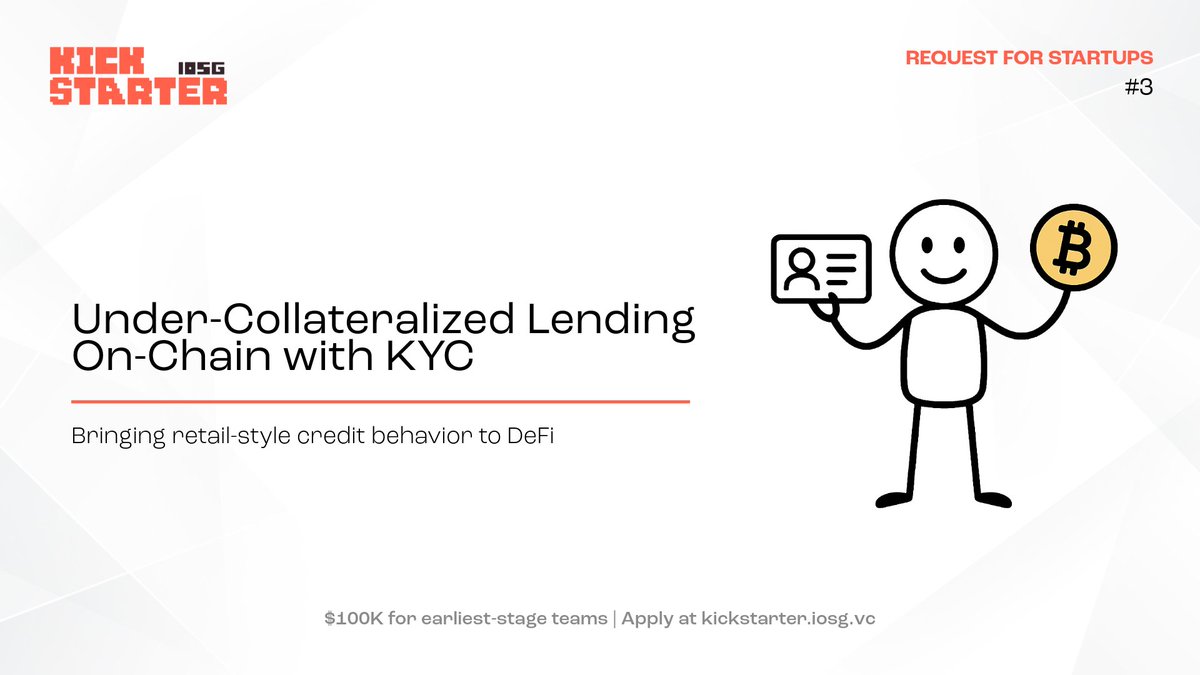
📢 Request for Startups: Under-Collateralized Lending On-Chain with KYC
Most DeFi lending today requires you to lock up more than you borrow. It protects lenders but does not reflect real world behavior. Retail users want to borrow assets they do not fully have, whether to spend, invest, or smooth cash flow. This is why credit cards, personal loans, and mortgages exist.
Onchain activity has expanded beyond trading into staking, payments, and consumer apps. The TAM is much larger now, and the demand for credit is broader. The opportunity is to build the onchain equivalent of a neobank, where borrowing happens against a mix of assets and identity. KYC can anchor this process and evolve into onchain creditworthiness.
There are already early attempts in this direction. Neobank style protocols combine custody, staking, and lending but remain close to traditional rails. Projects like 3Jane utilizing zkTLS point to the next layer, enabling borrowers to prove attributes such as income, residency, or repayment history in zero-knowledge. This unlocks privacy preserving credit that lenders can trust.
Crucially, defaults need to matter. If a borrower fails to repay, there should be consequences that extend beyond losing onchain collateral, such as negatively impacting their real world credit profile. Without this linkage, lenders will hesitate to take under collateralized risk.
The design space is wide:
> What level of KYC is sufficient: simple ID checks, zk proofs of attributes, or hybrid models
> Should on-chain credit scores evolve dynamically from repayment history
> How should lenders take exposure: pooled risk tranches, peer to peer agreements, or sponsor backed vaults
> What kind of interface makes this feel accessible to retail while remaining composable in DeFi
With this, it is clear that if onchain borrowing can become both safe for lenders and accessible for users, under collateralized lending with KYC could grow into one of the largest verticals in crypto.
Fed up with AI vendor lock-in? Proprietary APIs, Geo blocking, and Censorship?
For Web3 developers, no more fiat friction
For AI developers, no more geo restrictions
Meet AiMo Network — the first decentralized permissionless LLMs marketplace via unified API where you can🧵👇:
Early GTM is your community 👥
In crypto, distribution often comes before product. The fastest way to get your first users isn’t a paid campaign or a polished launch, but instead it’s creating a small community around what you’re building.
Your first 20–50 users should feel like insiders, not followers. That group becomes your testing ground, your distribution channel, and often your first evangelists.
Here’s what that looks like in practice:
> Start small. A Telegram group or a private Discord is enough. Keep it intimate so people feel part of something early.
> Make it two-way. Share updates, but also ask questions. Let them shape features, point out flaws, and feel like they’re building alongside you.
> Dogfood together. Use your own product inside the group. Run experiments there first, show you’re listening, and move fast.
> Show up personally. Don’t outsource early community to mods. Founders being present builds trust.
The best early traction doesn’t look like 10k users on a dashboard. It looks like 20 people who care so much they’re willing to test, give feedback, and spread the word for you.
How are you building with your first 20 users?
Kickstarter Notes
When pitching, don’t just explain what your idea is.
💡 Start with a story or a moment that makes people lean in.
💡 Most people are visual. If you have a demo, show it and walk through the core flow and explain the choices behind it. 🤔
💡 Don’t make investors guess what your product or positioning is. Show what makes it different.
When you pitch, do you lead with story or demo? In your case, what feels more natural?
Credit to @momir_amidzic for bringing this one to the table!
We will be sharing more ideas like this through our Request for Startups series.
If you are building something exciting, our DMs are open and applications are always open at https://t.co/NHYFWDE4vt.
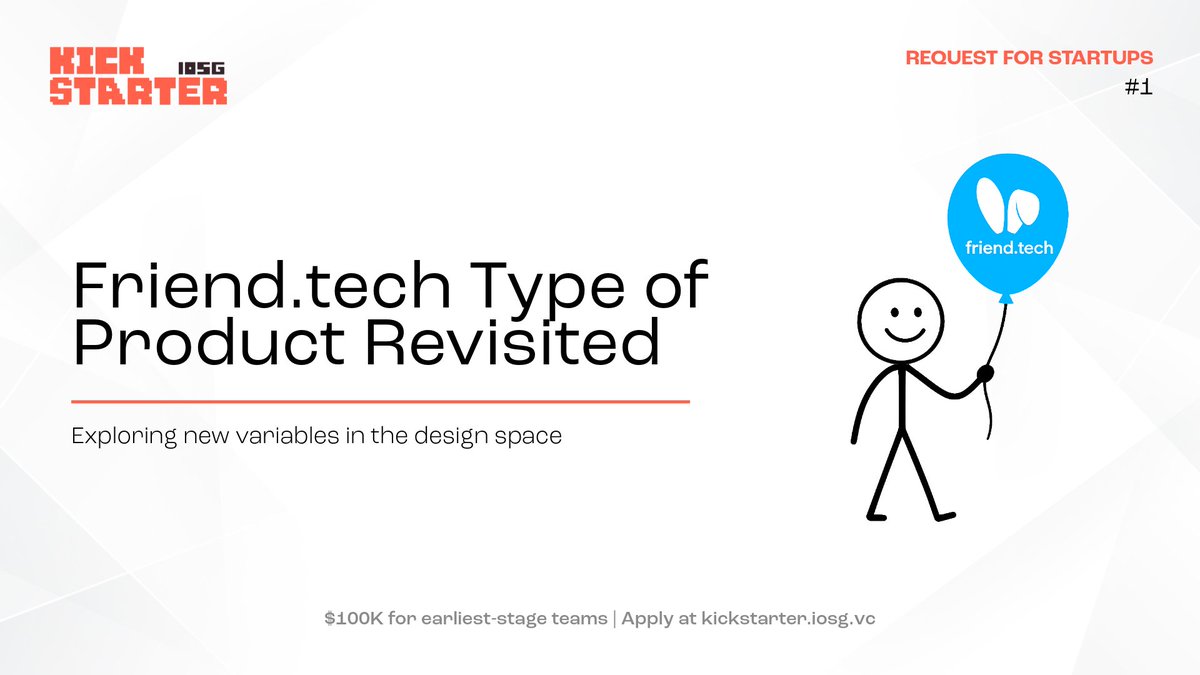
📢 Request for Startups: https://t.co/gOtvlm0qM0 Type of Product Revisited
https://t.co/gOtvlm0qM0 proved that social connections onchain can spark entirely new markets, but it also revealed the limits of its original bonding curve. Prices became prohibitively expensive too quickly, which funneled activity into speculation rather than sustained usage. Most follow-ups repeated the same design and missed the chance to explore new paths.
Some directions worth testing:
> Pricing models that separate speculation from activity. For example, a creator coin that outside participants can purchase, still dominantly owned by the creator, where stakers share the fees that creator earns.
> Fixed pricing alternatives for real usage, combined with tiered access. Messaging could be the base tier, with premium subscriptions unlocking extra perks at different price points.
> Exploring different content forms such as text, video, or images, and how they change engagement.
> Experimenting with content mediums. Do you need to build a new messaging layer, or can you create gated access on top of existing popular platforms?
The opportunity is not to copy https://t.co/gOtvlm0qM0 but to push the design space forward. By rethinking pricing, ownership, content, and distribution, there is still a chance to build products that feel native to the communities people already care about.
💡 Not quite ready to commit to a product yet?
Check out our Entrepreneur in Residence program in Hong Kong and Shenzhen. It is a 6-month in-person program to refine your vision and build your MVP.
Apply here → https://t.co/9nQ2x4ezVw