i still don't understand why people think their opus 5.5 bill is the cost of intelligence
most of it is NOT intelligence. it's a verdict
every time your agent asks "which worker next?" or "is this draft done?", you're paying frontier rates plus output tokens for a multiple choice answer
i broke down the math in a short paper: the DECISION SHARE
move those calls to jev and they cost $0.042 per million tokens with zero output charge. 10,000 decisions = 42 cents
the numbers from real deployments:
→ browser agent found flights in 7 seconds for $0.0039
→ 1,018 papers classified for $0.08
→ 500 emails triaged for 3.5 cents
→ a claude session compacted from 1M tokens to 86K in a second
opus 5.5 generates. jev decides. stop paying a genius to answer yes or no:
A dead MIT professor accidentally destroyed the $25 billion executive coaching industry with one hour of lecture, and ten million people have already watched him do it.
He filmed it once in January 2018 and died eighteen months later.
Executive coaches charge sixteen thousand dollars a session to teach a third of what he covered in that one hour for free.
His name was Patrick Winston. He ran the MIT Artificial Intelligence Laboratory from 1972 to 1997 and wrote the AI textbook every computer science major in the world read for thirty years.
Every January for four decades, he gave a lecture called "How to Speak."
His entire framework fits on a napkin.
Do not read. Be in the image. Keep images simple. Eliminate clutter. Start with an empathetic connection. End with a punch line the audience can repeat over dinner. Never open with a joke. Never end with "thank you."
That last rule alone has probably cost the executive coaching industry a hundred million dollars.
"Your success in life will be determined largely by your ability to speak, your ability to write, and the quality of your ideas. In that order."
That is the actual opening line of the lecture. Winston believed it strongly enough to spend fifty years teaching computer scientists how to talk.
Founders spend $80,000 on an MBA and then hire a communications coach to teach them the same material Winston filmed once for free. Engineers write brilliant code and lose promotions to teammates who watched this lecture on the train.
The lecture is free on MIT OpenCourseWare. The textbook is free on his page.
Winston died in 2019. Almost none of the ten million viewers have actually implemented the four rules on the napkin.
The napkin is free. The willingness to actually use it in your next meeting is the entire edge.
The answer is in this video. Don't miss this gem.
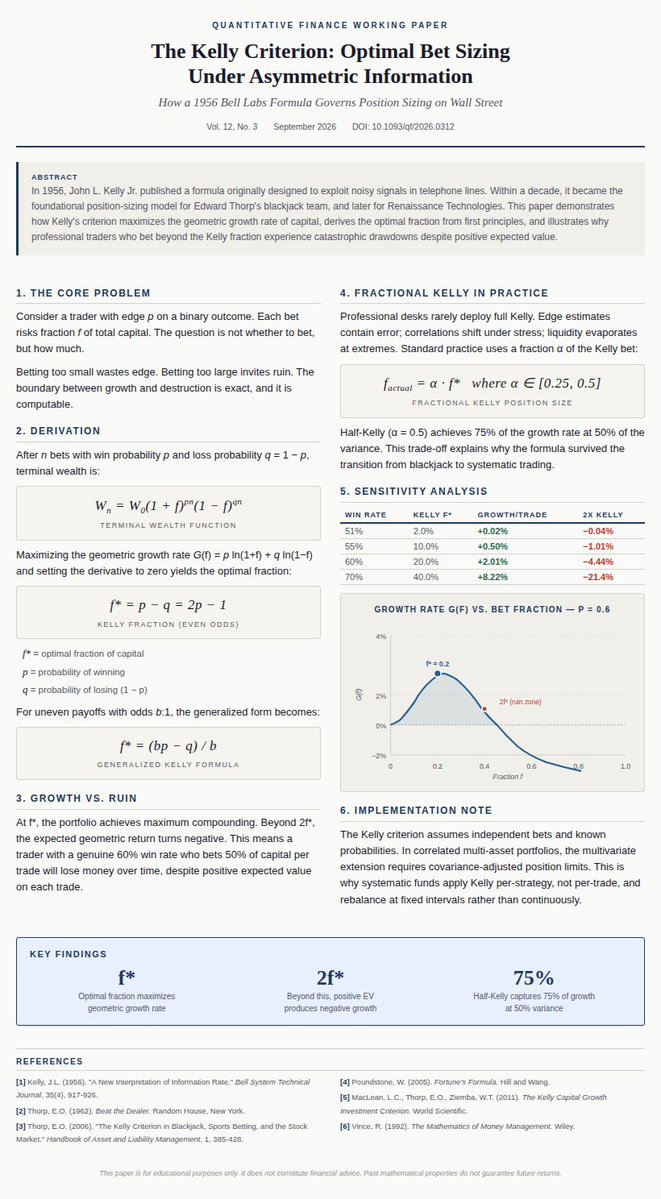
A Bell Labs engineer solved gambling in 1956.
The paper was 9 pages. Published in a telephone journal. Almost nobody in finance read it.
10 years later Edward Thorp used it to beat every blackjack table in Vegas.
20 years later Renaissance Technologies built a $130B fund around the same equation.
The formula fits in one line. It tells you exactly how much of your capital to risk on every single trade.
Bet below it and you leave money on the table. Bet above it and you go broke. Even with a winning strategy.
That's the part nobody teaches you.
A trader with a 60% win rate who sizes at 50% per trade will lose everything. Mathematically guaranteed. Positive expected value. Negative growth.
The formula is called the Kelly Criterion. And it separates every fund that survives from every fund that blows up.
I broke down the full derivation in one page. Formulas. Charts. The exact numbers.
Save it before your next trade.
Charlie Munger said this on camera, weeks before he died: "I don't regard Elon Musk as truly rich, because I don't think it's sure that everything he's working on can work."
Then he went further. "I would not invest in Elon Musk myself."
Munger's reasoning wasn't about Tesla's product or Musk's talent. It was about pattern.
"He's used leverage so much that he's doubled down right to the edge of extinction maybe two or three times." Asked how many times Musk had walked that edge without falling in, Munger's answer: "he's done it three times. Maybe he's got six more."
This is coming from a man who spent six decades building Berkshire on the opposite principle. Munger and Buffett deliberately took smaller stakes than they could have afforded, using less leverage than was available, specifically so a bad stretch would never wipe out the people who trusted them.
Munger used the phrase "two hard pile" for things he'd rather not spend time thinking about, things he can't fix himself. He used it earlier in the same conversation for the risk of nuclear war. Elon Musk went in the same pile.
"I never met with him," he said. "As far as I'm concerned, he doesn't exist."
A California community college professor has over 4 million YouTube subscribers, and more calculus students than Harvard, MIT, and Stanford combined.
this is Professor Leonard, Calculus 2, lecture 6.2, free on YouTube. he's been teaching calculus there for over a decade, with students in 150 countries, and at nearly every major university someone is watching him the night before their exam.
the concept he's covering: an inverse function is a machine that undoes another machine. feed it 8, it hands back the 2 that produced it. you build one by swapping x and y in the equation and solving for y all over again. the graph flips across the line y = x, like a mirror.
then the actual problem. sometimes the inverse is easy to write down. sometimes it's flat-out impossible with plain algebra, and you have to think your way backward through the unit circle instead, asking what angle makes the whole expression equal a specific number.
then the shortcut that makes the whole lecture worth watching. to find the derivative of an inverse function at a point, you don't need the inverse function itself. you only need the derivative of the original function, evaluated at the point that got swapped. one formula, no inverse required.
watch the moment he gets the derivative of the inverse without ever writing the inverse function down. that's the entire trick, made visible.
every engineering student memorizes the inverse derivative rule as a formula to plug numbers into. this lecture is the one that shows it's just the same derivative rules everyone already knows, run in reverse.