🐧 PIXUIN: MINT DETAILS
Date: August 3 • 13:00 UTC
Price: 0.0008 ETH
Supply: 999
Mint on: @opensea
Chain: Ethereum
🎟️ Want a GTD spot?
• Like & RT
• Drop your EVM wallet
brand I'd want to see on @clashoAi :
TON, the blockchain behind Telegram, whose native token just went through an actual identity change most people got wrong.
Toncoin didn't disappear, it got renamed to Gram as of June 15, ticker switched from TON to GRAM, while the chain itself is still called TON.
small distinction, but I've seen it misreported constantly, which tells me there's a real content gap here.
that confusion is exactly the kind of thing a Clasho campaign is built for.
instead of a generic TON is great post, imagine creators actually explaining the difference, why the token changed but the network didn't, what it means for anyone holding the old ticker, how exchanges are handling the transition.
that's useful, checkable content, not hype, and it's the kind of clarity a lot of casual crypto Twitter still doesn't have weeks after the change happened.
given how deep TON's ties to Telegram run and how much attention this rebrand already pulled, a campaign here wouldn't need to manufacture interest, it would just need creators willing to explain what already confused a chunk of the market.
someone in a crypto discord said last week that creator economy platforms are basically all the same thing with different branding.
disagreed at the time, but it sat with me long enough that I actually went and compared how three different platforms I've used handle scoring, and landed on a take I didn't expect to land on.
most of them aren't measuring creators at all, they're measuring compliance.
did you post at the right time, tag the right account, hit the right hashtag count, follow the format they showed in the example.
that's not talent evaluation, that's a checklist with extra steps.
what's different about @clashoAi , at least from what I've tracked across my own posts, is that following the checklist perfectly doesn't guarantee a good score if the actual content is empty.
had a technically flawless post by every visible rule last week, right tags, right length, right structure and it scored average because there wasn't a real opinion buried in it.
that's the first time a platform's scoring actually punished me for following the format instead of rewarding it.
so here's the actual take, most of these platforms reward obedience and call it merit.
this one seems to be trying, imperfectly, to reward the thing it's actually claiming to reward.
A friend outside crypto asked me last week to explain what I actually do on @clashoAi and trying to describe it out loud made me notice something I hadn't put into words before.
I like that it doesn't let me be lazy about my own opinions.
Most platforms reward having a take, any take, confident and loud enough to get attention.
This one seems to check whether the take actually holds up, whether there's a real reason behind it or just a strong sounding sentence.
Caught myself deleting a post last week because I realized halfway through writing it that I didn't actually believe the thing I was arguing, I just liked how it sounded.
Never had a platform make me interrogate my own opinions before publishing them.
Most encourage the opposite, post fast, sound certain, worry about accuracy later if at all.
spent longer than usual on today's post, not writing it, deciding what to cut.
had three separate points I wanted to make about Clasho's scoring and realized halfway through that trying to fit all three was exactly the mistake I've been correcting for weeks, cramming coverage into one post instead of picking the one thing that actually needed saying.
ended up keeping just the part about how the Hedera campaign brief rewards technical accuracy differently than the Nike one rewards emotional framing, and cutting the other two points entirely, even though they were true.
neither was wrong to include, they just would've diluted the one point that mattered.
feels like the actual skil this platform is teaching me isn't writing, it's editing.
knowing what to leave out is turning out to be worth more than knowing what to say
@clashoAi
the line that got me was creating great content is only half the battle, getting that content discovered is often much harder.
that's the part most creator platforms conveniently skip when they pitch you on joining, they focus entirely on the reward, never on the actual distribution problem underneath it.
discovery on X specifically is broken in a very specific way, the algorithm favors accounts that already have momentum, so a genuinely good post from a smal account can get buried under a mediocre one from someone with an existing audience just because the platform trusts reach over relevance.
Clasho's scoring doesn't fix the X algorithm itself, obviously, but it creates a separate layer where that bias doesn't apply, where a post gets judged on what it actually says instead of who's saying it.
that's a bigger deal than it sounds like on paper.
most meritocratic pitches from platfrms turn out to still quietly favor existing reach once you dig into how they actually score things.
the real test isn't the campaign prize pool, it's whether a brand new account with zero history can outrank an established one purely on the substance of one post.
from what I've seen running my own posts through it, that's actually happening here, not just claimed.
@clashoAi
spent longer than usual on today's post, not writing it, deciding what to cut.
had three separate points I wanted to make about Clasho's scoring and realized halfway through that trying to fit all three was exactly the mistake I've been correcting for weeks, cramming coverage into one post instead of picking the one thing that actually needed saying.
ended up keeping just the part about how the Hedera campaign brief rewards technical accuracy differently than the Nike one rewards emotional framing, and cutting the other two points entirely, even though they were true.
neither was wrong to include, they just would've diluted the one point that mattered.
feels like the actual skil this platform is teaching me isn't writing, it's editing.
knowing what to leave out is turning out to be worth more than knowing what to say
@clashoAi
the line that got me was creating great content is only half the battle, getting that content discovered is often much harder.
that's the part most creator platforms conveniently skip when they pitch you on joining, they focus entirely on the reward, never on the actual distribution problem underneath it.
discovery on X specifically is broken in a very specific way, the algorithm favors accounts that already have momentum, so a genuinely good post from a smal account can get buried under a mediocre one from someone with an existing audience just because the platform trusts reach over relevance.
Clasho's scoring doesn't fix the X algorithm itself, obviously, but it creates a separate layer where that bias doesn't apply, where a post gets judged on what it actually says instead of who's saying it.
that's a bigger deal than it sounds like on paper.
most meritocratic pitches from platfrms turn out to still quietly favor existing reach once you dig into how they actually score things.
the real test isn't the campaign prize pool, it's whether a brand new account with zero history can outrank an established one purely on the substance of one post.
from what I've seen running my own posts through it, that's actually happening here, not just claimed.
@clashoAi
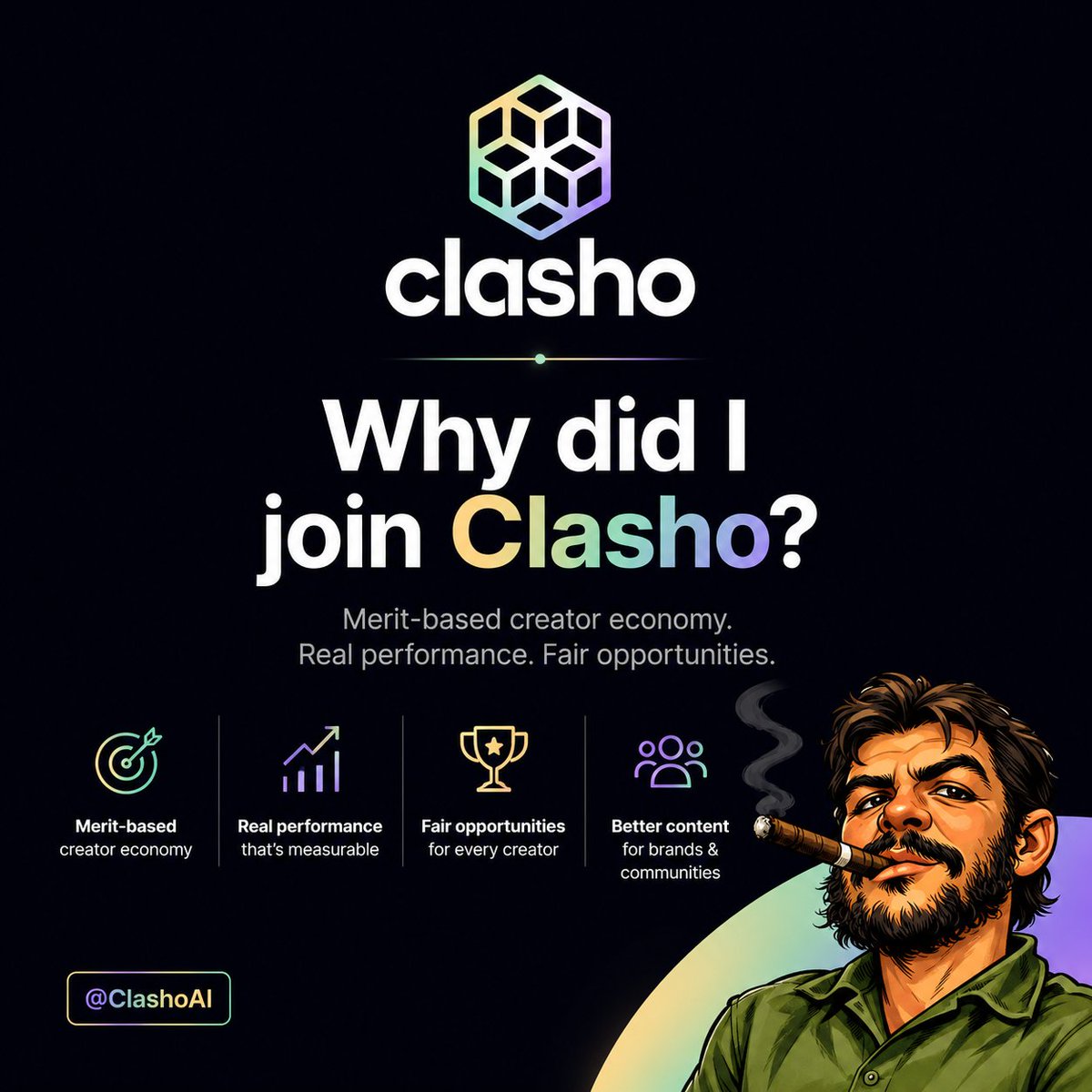
Why did I join @clashoAi ?
I've been creating content across different Web3 communities for quite a while, and one thing has become impossible to ignore:
Creating great content is only half the battle.
Getting that content discovered is often much harder.
On most platforms, visibility is heavily influenced by follower count and algorithms. As a result, many talented creators never get the recognition they deserve, while larger accounts continue to dominate simply because they've already built an audience.
That's the biggest reason I joined @clashoAi .
What impressed me wasn't just the idea of creator campaigns—it was the fact that those campaigns are performance-driven.
Instead of asking creators to promote a product and hoping for good results, brands launch campaigns where creators compete by producing original content. Performance is measured, which means value can actually be demonstrated instead of assumed.
That changes the incentive completely.
When creators know their work will be evaluated on impact rather than popularity alone, they're encouraged to research more, explain better, and create content that's genuinely useful.
As someone who regularly writes about blockchain, DeFi, and emerging Web3 projects, I enjoy turning complex topics into content that's easy to understand.
A platform that rewards effort, originality, and measurable performance feels much more aligned with how the creator economy should work.
I also think this model benefits brands just as much as creators.
Instead of selecting creators based only on follower counts, brands gain access to people who consistently produce content that resonates with real audiences.
Communities benefit too.
When creators compete on quality instead of empty engagement, readers receive more educational posts, deeper analysis, and more thoughtful discussions.
That's a win for everyone involved.
For me, Clasho isn't simply another social platform.
It's an infrastructure layer that makes creator marketing more transparent, more competitive, and more merit-based.
The creator economy has spent years rewarding popularity.
I believe it's time to reward performance.
That's why I joined @clashoAi . 🚀