A profitable trade can be a terrible trade...
You ignored your entry rules.
Sized way too big.
Had no exit planned.
Watched it go against you.
Held because you “believed.”
And somehow closed +$4,000.
Green P&L.
Terrible trade.
Meanwhile, you can follow your system perfectly, manage risk properly, take the exact setup you wanted…
And lose.
Red P&L.
Good trade.
This is where traders get themselves into trouble.
If you only judge yourself by P&L, bad decisions get rewarded whenever you get lucky.
And good decisions get punished whenever variance goes against you.
Do that long enough and you start learning the wrong lessons from your own trading.
The outcome of a trade and the quality of a trade are not the same thing.
That's why we think traders should track more than P&L.
Results tell you what happened.
Your decisions tell you how you got there.
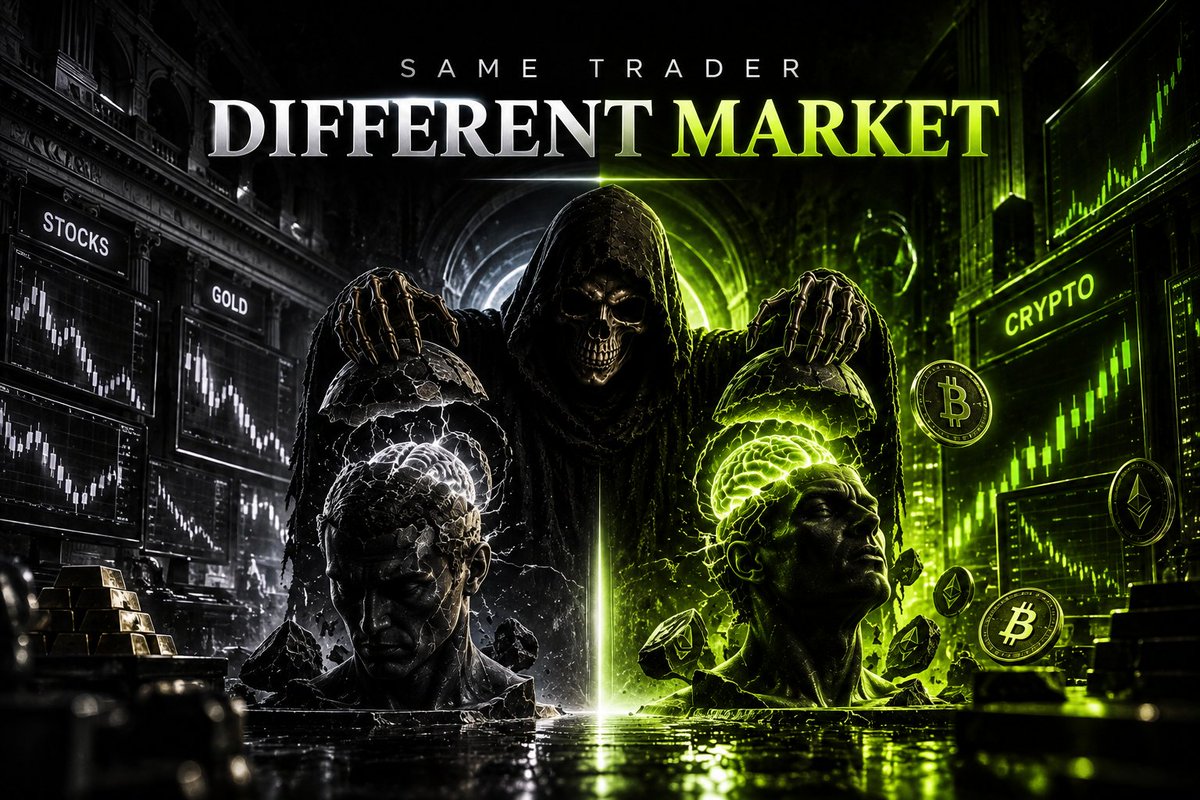
The same person can become a completely different trader when they enter crypto.
A study published in the Journal of Financial Economics analyzed 200,000 retail accounts.
In stocks and gold, investors tended to trade against recent price movements.
In crypto, the SAME investors followed a momentum-like strategy, holding even after large price moves.
Same person.
Same brain.
Different market.
Different behavior.
Source: https://t.co/j2yHY802FU
And market conditions matter too.
A 2026 study analyzing 1,008 cryptocurrencies found evidence of herding in larger cryptocurrencies during high-volatility and falling markets.
In smaller cryptocurrencies, overconfidence appeared during rising, highly liquid markets.
Source: https://t.co/wcYexT6OEt
Your trading behavior isn't fixed.
The asset you trade and the market you're trading in can influence how you make decisions without you even realizing it.
That's why knowing your strategy isn't enough.
You need to understand how YOU actually trade when conditions change.
Your trading history knows. Your memory probably doesn't.
There are traders with a 40% win rate making money.
And traders with an 80% win rate losing money.
Being right and making money are two very different skills.
Let that sink in for a moment.
Traders gotta feel this one... ☠️
The hardest part of trading isn’t finding a setup.
It’s watching a setup you ignored do exactly what you thought it would do.
Then convincing yourself not to chase it 18% higher... 🧐
A study published in The Journal of Finance analyzed 66,465 investor accounts.
The most active traders returned 11.4% per year.
The market returned 17.9%.
That's a 6.5 percentage point gap.
The study: “Trading Is Hazardous to Your Wealth” by Brad Barber and Terrance Odean.
And the interesting part isn't “don't trade.”
It's what happens when activity gets confused with skill.
More charts.
More positions.
More decisions.
More screen time.
None of it automatically makes you better.
Sometimes your biggest edge isn't finding another trade.
It's having enough data on yourself to know which trades you should stop taking.
Most traders can tell you BTC's price within 1%.
Ask them these 5 numbers about their own trading and suddenly it gets quiet:
• Win rate
• Average win vs average loss
• Profit factor
• Best performing setup
• Total fees paid
That's pretty wild when you think about it. We spend hours studying the market.
Charts. Funding. OI. Liquidations. News. Wallets. Macro.
Meanwhile, the one dataset we have complete control over is usually the one we understand the least: OUR OWN.
You don't need to know everything about the market.
But you should probably know everything about the person placing your trades. 🫵😶🌫️
Your brain is probably lying to you about how good you are at trading.
And there’s research to prove it.
The research on how traders actually behave is pretty brutal.
1/5 🧵👇