Excited to share that I’m beginning a new chapter with @ORBT_Protocol as the VP of Product & Growth.
This role aligns deeply with how I think about infrastructure, scale, and long-term value creation.
In my new role, I’m looking forward to contributing with clarity and intention.
It’s a big shift, but the mission remains the same: building and scaling systems that leave a lasting impact on global payments infra.
tokenization projections for 2030 are still wildly underestimating this
even the bull case puts under 5% of global assets onchain. the real story isn't the number
it's what gets rebuilt to make that number possible:
- 2-day settlement turns into minutes
- 5-party custody chains collapse to one
- secondary markets that didn't exist start clearing 24/7
Building the infra underneath is where the real opportunity lies.
and the ecosystem is only as valuable as how easy you make it to ship on it.
every chain claims it wants more builders. then ships a developer experience that takes a week to set up throughput, TPS, finality.
none of that matters if the median builder gives up on day two.
there are entire categories of web2 apps that would obviously be better onchain and almost nobody is building them:
- a spotify where every stream pays the artist per second
- a patreon where subscriptions are programmable.
- a kickstarter where funds release in milestones voted by backers.
Instead of being crypto versions of a product, they're just better products that happen to use onchain rails.
who's building these?
doordash is paying drivers in stablecoins through tempo.
im bullish on this because this is how crypto proliferation actually starts.
dashers in colombia wont have to wait for 3 days for $40, and can instead expect instant payouts.
can’t wait to see which companies deploy this next.
every team i talk to is shipping faster than they're talking to users.
we've all done it.
you ship something you were sure people wanted, watch the usage chart stay flat, and then realize the actual problem was three layers deeper than what you built for.
the cheapest thing in product development right now is one honest conversation with someone using your protocol. and almost nobody is having it.
while everyone was panicking about the weekend, RWA tvl quietly ticked up to $27.6B. 4% gain on a red week.
the institutional capital also seems to be landing in the same direction:
- ondo, clearstream, and 360x signed a deal to put tokenized us stocks on a regulated european venue
- singapore's ocbc launched southeast asia's first onchain gold fund this week
- blackrock, apollo, deutsche börse all making moves in the same window
interestingly, even though retail lost faith and started pulling money out of defi after the last two hacks, the institutions just kept building positions.
tempo shipped passkey wallets recently for its users.
that’s a very subtle yet meaningful shift because:
- onboarding goes from a 15-step tutorial to a biometric scan.
- audience for every DeFi product gets wider overnight
- the wallet UX gap has been crypto's biggest bottleneck for years. this is the first time it feels like it's actually closing
this will never trend but matters more than most things that will.
here's one under-discussed thing from this weekend:
a lot of teams park meaningful treasury in aave for yield, which means right now that capital is either stuck or moving slowly.
that implies runway just got compressed for teams that had nothing to do with any of it.
most treasury frameworks treat "DeFi yield" as one bucket. one protocol hits a snag and your operating cash is suddenly harder to reach for a week.
after years of getting burnt, the lesson remains the same: optimizing for an extra 1% only looks smart until the day you actually need the money.
liquidity can make or break your project, which is why you can never optimize it’s allocation enough.
. @AnthropicAI's unreleased model Mythos found a 27-year-old bug in OpenBSD for $50. flagged weaknesses in TLS and SSH too.
these are the crypto libraries most of DeFi runs on. and $200B in smart contracts are sitting in public codebases, fully readable.
we spent years getting good at auditing solidity. and the attack surface moved to everything around it and nobody updated the scope.
"audited" hasn't meant "safe" for a while now, making this gap impossible to ignore.
the smartest builders i know aren't building for "crypto users" anymore.
they're building for people who will never know they're using crypto. payroll products, treasury tools, cross-border settlement, card programs backed by stablecoin rails.
and honestly that shift feels right. the best infrastructure disappears into the product.
but i think something gets lost when every serious team optimizes for invisibility. the weird experimental stuff, the things that only make sense onchain, the products that couldn't exist without programmable money, those are getting starved of talent
the teams still building things that only work because of crypto, not despite it, are the ones i'm watching closest right now.
recently realized that the best DeFi products right now don't feel like DeFi at all
- phantom is basically a neobank.
- hyperliquid feels like binance.
- bridge cards just work at any visa terminal
the infra got good enough that the frontend can finally hide it. and that's not a small thing, it took years of grinding on gas abstraction, chain routing, and wallet UX that nobody wanted to fund.
the teams still building for people who understand gas fees are building for a shrinking audience.
DeFi is the fundamental architecture of cryptocurrency.
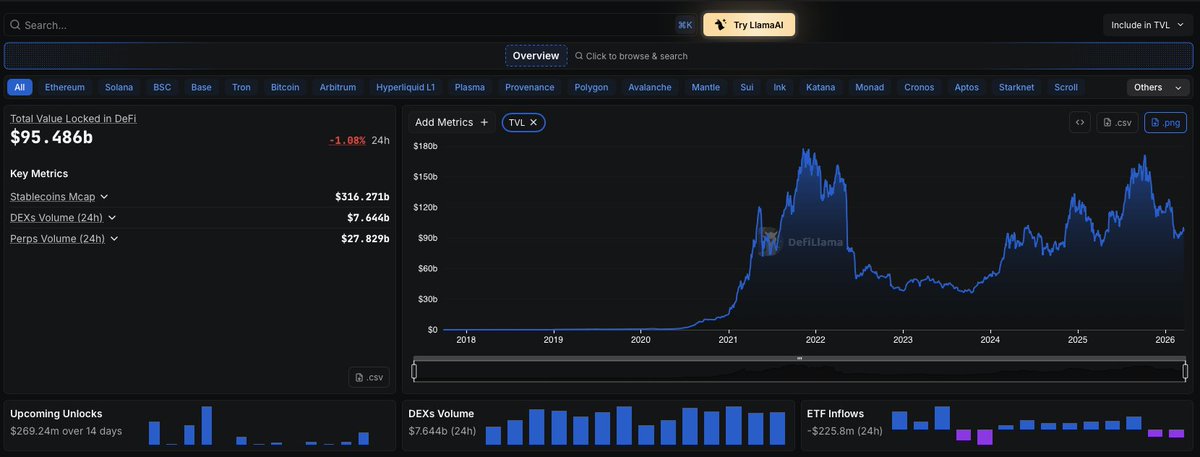
• DeFi TVL sits at ~$92B.
• Stablecoin supply has crossed $315B.
• DEXs hit 21%+ of all crypto trading volume.
Here's where the major categories stand 🧵
absolutely love mert’s view here.
every serious builder i talk to is heads down on efficient finance because that's where the revenue is.
but the best products from every past cycle were things nobody asked for. and the tools to build those things just got massively better and cheaper.
that gap doesn't stay open forever.
here's something i keep noticing: every platform is drowning in AI content and the response is always "better detection".
but detection is an arms race you can't win. the models generating content improve at the same rate as the models trying to catch them.
the more interesting question is what happens when you stop trying to detect and start trying to verify.
so it's not about "is this AI" but "can this person prove they made this"
whoever builds that product layer is going to crack the main problem that's plaguing every avenue today.
every cycle optimists say "this is the year crypto goes mainstream" and every cycle the bottleneck ends up being the same thing: onboarding.
getting a normal person from "i want to try this" to "i have a wallet with money in it" without losing them somewhere in the middle is a major headache for crypto.
coinbase solved it for buying. but buying isn't the same as using. the gap between holding crypto on an exchange and actually doing something with it onchain is still massive.
the teams closing that gap right now are focused on building better doors into existing ones.
and if you think about it, that might be the most undervalued work happening in crypto rn.
DeFi TVL currently sits at ~$95.5B. projections from a year ago said we’d be at $250B by now.
So is this a demand problem? No, because it's more likely a concentration proble.
Aave alone controls 59% of lending market share. The top 5 protocols hold ~80% of all activity. So everything else fights over scraps
Here’s the issue nobody wants to say out loud: most new protocols can't attract sticky liquidity because there's no distribution layer.
Users don't discover new DeFi apps, so they stay where they already are.
Agents might actually change this.
If routing becomes automatic, TVL distribution stops being a loyalty game and starts being a performance game.
An AI agent built by an OpenAI researcher was supposed to distribute small token rewards to community members.
Instead when the session crashed, the decimal parsing broke. So after the agent rebooted, it sent 52 million tokens to a random address. $441,000 gone in a second.
There was no exploit nor a hack. Just one autonomous system with signing authority and no guardrail between "send $5" and "send $441K."
MoonPay's recent response was interesting - they integrated Ledger hardware signing so every agent-initiated transaction requires human approval on a physical device.
That's the right instinct, but it defeats the entire point of autonomy.
Here's the actual product question nobody's answering: how do you give an agent enough authority to be useful without giving it enough rope to be catastrophic?
RWA tokenization hit $33.91B in 2025, showing 380% growth over three years.
But while everyone's celebrating the numbers, I'm keen on watching where the capital actually comes from:
- Most capital behind tokenized RWAs is crypto-native firms and hedge funds, not institutional allocators
- Liquidity remains thin with long holding periods and limited secondary trading
- Regulatory frameworks like ERC-7943 are emerging, but legal clarity still lags adoption
Infrastructure exists. Legal precedent doesn't. That's the real $30T gap.