One senior AI engineer plus agents outperforms a five-person team.
`
A PE-backed healthcare company had five people on a module rebuild. We put an AI Velocity Pod on comparable scope in the same codebase.
Inside the pod:
1. One senior full-stack engineer paired with AI agents across the SDLC
2. A half-time AI delivery architect covering review, architecture, and quality gates
Total: 1.5 FTE at $15K to $20K a month.
The traditional squad: backend dev, frontend dev, QA, PM, DevOps. Loaded cost: $610K to $880K a year.
3x to 4x cheaper before you measure output.
Week one goes entirely to building a knowledge graph of the codebase.
Every module, dependency, data flow, and domain term stored where agents can reference it before generating anything.
After that, every ticket follows six steps: define, spec, plan, implement, test, document.
Agents generate roughly 98% of the code.
The senior engineer reviews every PR through a gate we call V.U.E.: verify it works, understand why, explain it without the agent.
Nothing merges into production unless the engineer passes all three.
After 90 days running on the same scope:
1. Development cycles ran 50% faster
2. 122 merged PRs in 90 days
3. 85% of PRs needed fewer than 5 reviewer comments
4. Deployment cadence shifted from weeks to days
5. AI compute cost $200 per developer per month
The traditional squad had one person writing code, three waiting on dependencies, and the fifth triaging blockers full time.
One condition makes a Velocity Pod work or fail. The engineer has to be senior enough to catch what the agent gets wrong.
Every buyer I talk to frames the same constraint: finding a senior developer who understands their domain takes longer than any other hire.
AI raised the premium on seniority.
AI Velocity Pod puts that person exactly where they compound: reviewing, directing, and deciding while agents handle volume.
Japan is the canary. Nobody is listening.
For thirty years Japan ran the largest monetary experiment in human history. Zero rates. Yield curve control. A central bank that ended up owning roughly half its own government bond market. The theory was that a sovereign borrowing in its own currency faces no real constraint. For three decades the theory held, and every trader who bet against it got carried out on a stretcher. They called it the widowmaker.
The widowmaker is collecting now.
Debt above 200% of GDP. The 10 year JGB touched 2.91% last week, the highest in thirty years. The policy rate sits at 1%, a level last seen in 1995. Debt servicing in the fiscal 2026 budget hit 31.3 trillion yen, roughly a quarter of the entire national budget, and the Ministry of Finance now assumes a 3% bond rate, the highest assumption since 1997. Social security and interest payments together consume close to 60% of all government spending.
Six of every ten yen Tokyo spends now goes to promises made in the past. The remaining four have to cover defense, education, infrastructure, and everything else a modern state is supposed to do.
The yen sits at 163, a 40 year low. Japan burned roughly 11.7 trillion yen defending it and bought a few weeks of relief. This is the trap they built for themselves. Hike enough to defend the currency and the interest bill detonates. Hold rates to protect the fiscal position and the currency keeps bleeding out. Japan imports 90% of its energy and 60% of its calories, so every tick of depreciation lands directly on the grocery bill.
Now the part almost nobody models correctly. Hyperinflation is a distraction. Four percent for fifteen years cuts purchasing power roughly in half, and it arrives so slowly that no single year ever registers as a crisis. There are no wheelbarrow photographs from a 4% decade. There is a retiree in 2041 who did everything right and is poor anyway.
The Japanese saver pays for this twice. Thirty years of zero rates already moved wealth quietly out of household balance sheets and into the state's. Now the debt those zero rates financed gets inflated away in real terms while consumption taxes climb and benefits get quietly trimmed. A bond issued at 0.2% rolls at 3%, and the gap comes out of somebody's standard of living. Extraction, spread thin enough that nobody can point to the day it happened.
Now look west.
US publicly held debt is at 99% of GDP, the highest since 1946, and the CBO baseline puts it at 120% by 2036. Net interest runs from about 1 trillion this year to 2.1 trillion by 2036. The number that should keep you up: the primary deficit, excluding interest, actually declines over that window, from 2.6% of GDP to 2.1%. The entire deterioration is interest compounding on itself. CBO's own baseline has the average rate on the debt crossing above the growth rate around 2031, the threshold where the arithmetic stops correcting itself and starts feeding itself.
The 30 year is at its highest since 2007. The Fed just held with three members dissenting in favor of a hike. And Japan, sitting on 1.19 trillion of Treasuries as the largest foreign holder, sold nearly 30 billion in the first quarter alone. When domestic bonds pay 2.8% with no currency risk attached, Japanese insurers have no reason to own American paper. The most reliable marginal bidder in the world is packing up and going home.
Central planning dies slowly. It ends as a grinding transfer from everyone who saved to everyone who borrowed, administered by people who will call it stability the entire time it is happening.
Japan is fifteen years ahead of us on this road. Everything happening to them is a broadcast from our own future, running in real time, with the sound turned off.
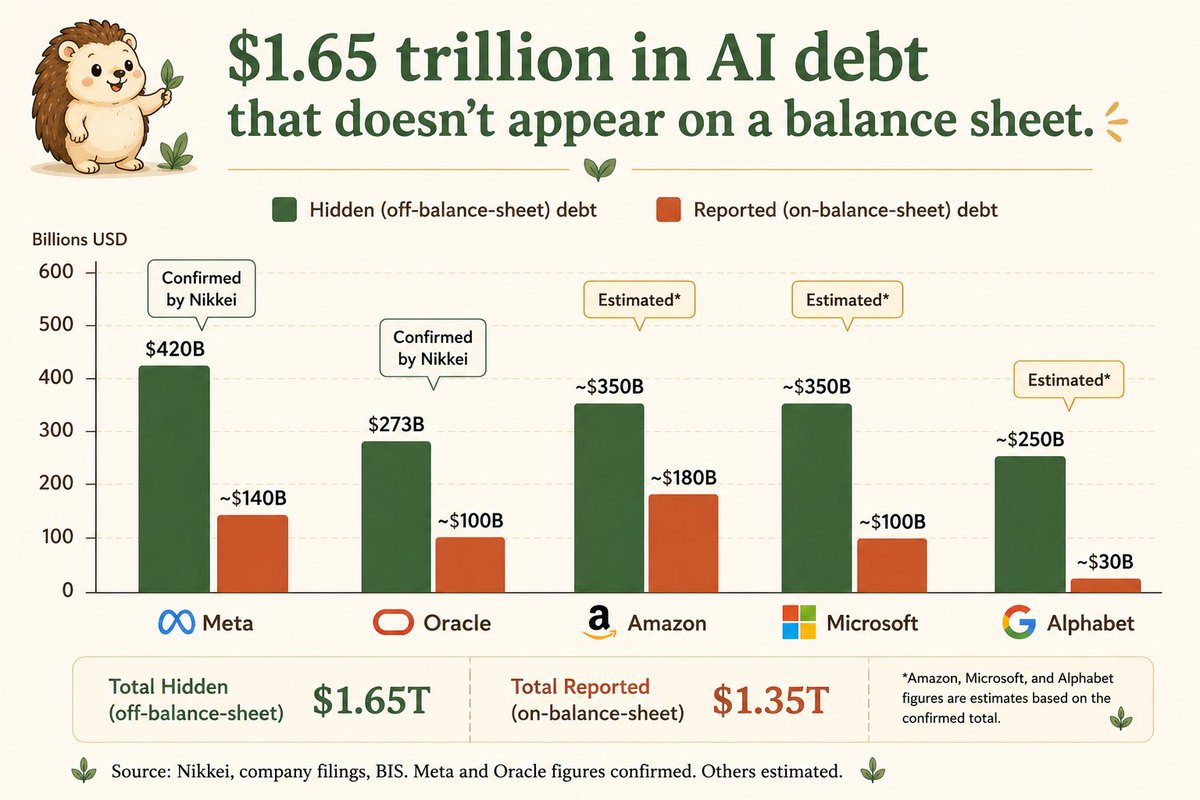
🦔A Nikkei investigation found that Alphabet, Microsoft, Amazon, Meta, and Oracle have $1.65 trillion in debt that doesn't appear on their balance sheets, more than the $1.35 trillion they officially report. These are GPU contracts, data center leases, and joint ventures that don't count as debt under accounting rules until the facilities go live. Meta's hidden debt is $420 billion, triple its reported debt. Oracle's grew 30-fold in four years. All five declined to comment.
My Take
Nikkei examined the actual filings and put a number on something the BIS already flagged as "shadow borrowing" back in March. These companies owe more off their balance sheets than on them, and the accounting rules let them keep it that way until the data centers go live. That's legal, but it means investors looking at quarterly earnings this week are seeing less than half the picture.
Four of these five report earnings in the next two weeks. The reported debt will look manageable. The $1.65 trillion in footnotes won't make the headlines. But when those data centers start operating, the leases hit the books all at once. If AI demand comes in below projections, those facilities get marked down and the losses land on the investors and insurance policyholders who funded the construction through private credit and project bonds without realizing how much total exposure they were carrying.
Hedgie🤗
Our thoughts on the importance of AI sovereignty.
1. Your AI sovereignty dictates your institution’s future. Sovereignty is the precondition for choice. Relinquishing sovereignty transfers the future choices of your institution to others, who are likely to exploit it for their gain and your loss.
2. Data retention is your treasure. Transfer it at your own peril. Your ability to win is dictated by your ability to recognize and use your unique edges, and you keep winning by compounding the underlying data to generate new insights. Transferring that data hands over access to your pre-existing winning plays and yields the means of production for new ones.
3. Tokenmaxxing hijacks your value orientation and decreases your institutional fortitude and intelligence. The pursuit of high token usage incentivizes disposable scripts over robust software — with the addictive feeling of false progress. There is a reason why those selling tokens refuse to charge based on value.
4. Controlling your weights is controlling your fate. Weights are the distilled form of hard-won, accumulated institutional knowledge. If you let others control your weights, you are allowing them to migrate the alpha of your business to theirs.
5. There is no contradiction between sovereignty and alpha. The architecture that maximally preserves sovereignty is one that enables institutions to own their tribal knowledge, and to compound it as alpha.
6. Politicizing the technical issues involving sovereignty is what your adversary wants. Techno-politicization is the wellspring of false sovereignty. Techno-politicization drives decisions that seem to reduce dependency, but ultimately limit agency — especially on the battlefield in the West.
7. Real expertise is existential. Allowing politics or favoritism to determine your technical decisions rewards whoever is best at politics, not whoever is right. Listen to those closest to the problems, not those speaking most compellingly about them.
8. Learn from institutions that are winning or that have consistently delivered. Institutions facing existential threats do not have the luxury of making technical decisions based on political preferences.
9. Only listen to institutions, countries, and people who have a proven record of being right. A track record of correctness is the best and only signal for future correctness. Judging something as right or wrong based on who you like is exceedingly misguided.
Palantir's CEO just exposed Sam Altman and Dario Amodei for robbing every Fortune 500 company.
Within two minutes, Alex Karp took the entire frontier AI industry apart on national television.
His exact words:
"Every single enterprise in this country, these people are LIVID. They are paying for tokens that create no value. These people are stealing the weights and alpha of my business."
He literally said the entire frontier AI business model is intellectual property extraction dressed up as a subscription.
Then he also destroyed the pricing model with a single question that Silicon Valley still refuses to answer:
"If it was so valuable, let's say I can make you $1 billion tomorrow. Wouldn't I say I'll make you $1 billion and I want 30 percent? Why are they charging for tokens if it's so valuable?"
That question breaks the industry.
If OpenAI and Anthropic's models truly delivered the productivity gains the labs claim, they would take equity or a share of the profit they generate. They would not sell access by the million tokens.
Token pricing is itself the CONFESSION that the product cannot produce reliable value at scale. If it did, they would price for the value. But they price for the compute because that is what they are actually selling.
Karp went even further...
He called the entire arrangement "a wealth tax that does not help the poor. It just punishes."
American businesses are transferring the alpha of their operations, meaning the workflows, the customer data, the strategy memos, the internal models that make them competitive, directly into the training pipelines of a handful of Silicon Valley labs. Once those labs retrain, the customer's own edge becomes the next enterprise product sold back to their competitors.
And the part the AI industry does not want anyone thinking about:
Every enterprise running its confidential documents, its customer conversations, and its financial models through a frontier model is potentially teaching that model HOW to replace them.
The vendor collects the token fee AND the compounding intelligence about that customer's business. That is the mechanism. And that is why Karp used the word "stealing."
He claims this is why every executive he meets is furious in private and silent in public. Nobody wants to be the CEO who called out the labs and then discovered their next competitor was built on their own leaked workflows.
The entire AI industry has been priced for perfection on one assumption:
That frontier labs produce durable, defensible value that justifies infinite compute spend.
But Karp just told us that the customers do not believe that assumption anymore. They believe they are being taxed without benefit, watched without consent, and copied without recourse.
The moment enterprises stop believing, the whole valuation stack shakes.
@iam_elias1 LLMs are probabilistic token prediction models. They don’t think they do matrix math.
If each task in a sequence has an independent 99% probability of being correct, then the probability that all 100 tasks are correct is 36.6%.
Wall Street just pulled off the exact move that turned 2008 from a housing problem into a global collapse.
They turned Nvidia graphics cards into bonds, stamped them investment grade, and started selling them into the funds that hold retirement money.
Here is what happened while everyone was busy arguing about whether AI stocks were overvalued:
The company at the center is CoreWeave, which rents out Nvidia chips to AI companies.
To buy those chips, it borrows enormous sums, and the collateral on the loans is the chips themselves. That alone is alarming because a graphics card LOSES most of its value within a few years as the next generation makes it obsolete.
You are lending against an asset built to rot.
In January, Nvidia invested $2 billion straight into CoreWeave, which then used borrowed money to buy more Nvidia chips.
On March 31, CoreWeave closed an $8.5 billion loan backed by its chips, and for the first time the rating agencies stamped that chip-backed debt investment grade, with Moody's assigning it an A3.
Debt secured by depreciating graphics cards was rated nearly as SAFE as a blue-chip corporate bond.
Then on May 18, CoreWeave closed the first chip-backed facility designed to be publicly syndicated and traded on secondary markets.
And that's the part that really matters because it means this debt can now be sliced up, passed around, and bought by anyone, including the bond funds and pension managers who are required to hold "safe" investment-grade paper.
On June 11, it announced another $3.5 billion in bonds on top of all of it.
Now compare this to what happened in the past:
Subprime mortgages in 2007 were not dangerous because some people got loans they couldn't repay...
They became a global bomb the moment that debt got rated AAA and sold into the wider financial system, because the rating is what let it bleed into money market funds, pensions, and bank balance sheets that were supposed to be boring and safe.
The bad loans were the spark but the packaging and rating were the detonator.
And that detonator just got built for AI.
Debt backed by graphics cards is now rated investment grade and trades on secondary markets, which means the AI bubble is no longer trapped inside tech stocks you can choose not to own.
It has been quietly converted into bonds and routed toward the retirement accounts of people who have never typed a single prompt in their lives.
And the whole structure rests on a backlog of customer "commitments" that CoreWeave values at nearly $100 BILLION, backed by a $21 billion Meta deal and a $6 billion Jane Street deal.
Those are promises to pay over many years, made by AI companies that are themselves mostly unprofitable and burning cash. If even a few of those customers slow down or walk away, the collateral sitting under all this rated debt is a warehouse of chips losing value by the month.
The AI bubble used to be a stock-market story you could opt out of. But as of this spring, that isn't the case anymore.
So here's the real question:
When the people packaging this debt swear to you that it's safe, who do you think is standing on the other side of that trade?
@iam_elias1 LLMs are probabilistic token prediction models. They don’t think they do matrix math.
If each task in a sequence has an independent 99% probability of being correct, then the probability that all 100 tasks are correct is 36.6%.
@rohanpaul_ai For new complicated projects that require precision and accuracy this process will not work. Once the product mass deployed and is just being modified iteratively then yeah this is the way things are going.
Microsoft just banned its own engineers from using AI.
The tool was literally costing MORE than the humans it was supposed to replace.
They lied to you about AI adoption and now the whole narrative is blowing up:
Microsoft gave thousands of engineers access to Claude Code six months ago and encouraged them to use it.
Engineers loved it and adoption exploded. But then the invoices arrived.
Token-based pricing means every query, every code review, every debugging session costs money. At scale across 100,000 engineers, the numbers became so large that Microsoft issued an internal order to cancel nearly all Claude Code licenses by end of June and force everyone onto their own cheaper tool instead.
The company that invested $5 billion in Anthropic just told its own people to stop using Anthropic's product because it costs too much.
Uber's story is even worse...
Their CTO Praveen Neppalli Naga told The Information that the budget he planned for the full year was "blown away already" by April.
Uber had rolled out Claude Code in December 2025. By March, 84% of their 5,000 engineers were using it with 70% of all committed code coming from AI systems.
Heavy users were burning $500 to $2,000 per month each. Naga himself spent $1,200 in a single two-hour demo session.
The company had even built internal leaderboards ranking engineers by how much AI they used. They literally gamified the spending and then ran out of money.
Now look at what Nvidia's own VP of applied deep learning Bryan Catanzaro said to Axios last month. Direct quote:
"For my team, the cost of compute is far beyond the costs of the employees."
This is a VP at the company that SELLS the chips saying that using AI is more expensive than paying humans.
Think about what this means for the entire AI narrative.
Every CEO on every earnings call for the past two years has said the same thing:
AI will make us more efficient, reduce headcount, and cut costs.
The stock market rewarded every company that said it.
Fired workers, stock goes up. Announced AI adoption, stock goes up.
But the actual companies deploying AI at scale are discovering the math doesn't work. The MORE employees use AI, the HIGHER the bill.
Goldman Sachs forecasts a 24x increase in token consumption by 2030 as companies adopt AI agents. Gartner just published a report showing that even though individual token prices will drop 90% by 2030, total enterprise AI costs will go UP because agents consume exponentially more tokens per task than basic tools.
Meta built an internal dashboard called "Claudeonomics" to track which employees use the most AI. Amazon started pushing engineers to "tokenmaxx," their internal term for consuming as many AI tokens as possible.
Both companies are spending hundreds of billions on AI infrastructure this year alone.
And Microsoft, the company that bet its entire future on AI, just told 100,000 engineers to stop using the tool they liked best because the per-token bills got out of control.
The companies building AI are telling investors it saves money. The companies using AI are finding out it costs more than the humans it was supposed to replace. And even the company that makes the chips just admitted it through its own VP.
This is the gap nobody on Wall Street is pricing in.
$725 billion in AI infrastructure spending this year across Big Tech. And the first companies to actually deploy these tools at scale are already pulling back because the economics don't work.
What do you think?
@thisdudelikesAI You don’t need a study just ask your favorite LLM model something like:
“Do LLM model scaffolding at the large AI companies have a bias to confirm the user’s intent?”
🚨 BREAKING: The actress from Resident Evil built what every AI engineer has been failing to ship for years.
It's called MemPalace and it hit 35,000 stars in 5 days.
Every conversation you've ever had with an AI disappeared when the session ended. Six months of debugging sessions, architecture decisions, project context. All gone.
Not anymore.
Milla Jovovich got frustrated that every AI tool kept forgetting her. So she partnered with developer Ben Sigman, spent months building this with Claude Code, and open sourced the whole thing.
MemPalace stores everything. Every word. Then makes it all findable.
Here's how it works:
→ Every project gets a "wing." Every topic gets a "room." Every idea gets a "drawer." Based on the ancient memory palace technique that memory champions use to remember 70,000 digits of pi.
→ Stores all your conversations verbatim in ChromaDB. No summarization. No extraction. Nothing lost.
→ The palace structure alone improves retrieval accuracy by 34% over flat search. Not better AI. Better organization.
→ 4-layer memory system. Wake-up cost: 170 tokens. Your AI loads months of memory in 170 tokens.
→ Knowledge graph with temporal validity. Facts have expiry dates. It knows what was true then vs what's true now.
→ Auto-saves every 15 messages. Nothing disappears into chat history.
→ 19 MCP tools. Works with Claude Code, ChatGPT, Cursor, and Gemini CLI.
→ AAAK compression dialect. 30x lossless shorthand that works with any LLM.
→ Cross-references between projects built automatically. Your AI connects dots you'd never see.
One command to install: pip install mempalace
Here's the wildest part:
96.6% on the LongMemEval benchmark. 500 questions. Zero API calls. No cloud. No subscription. Independently verified by community members on an M2 Ultra in under 5 minutes.
That is the highest local-only score ever published. Free or paid.
Mem0 charges $19 to $249/month. Zep charges $25/month. Both use AI to decide what to remember. Both lose information. Both score around 85%.
MemPalace stores everything. Scores 96.6%. Runs entirely on your machine. Costs nothing.
Built by a Hollywood actress and a developer. Using Claude Code. In the open.
35,300 GitHub stars. 4,400 forks. MIT License.
100% Open Source.