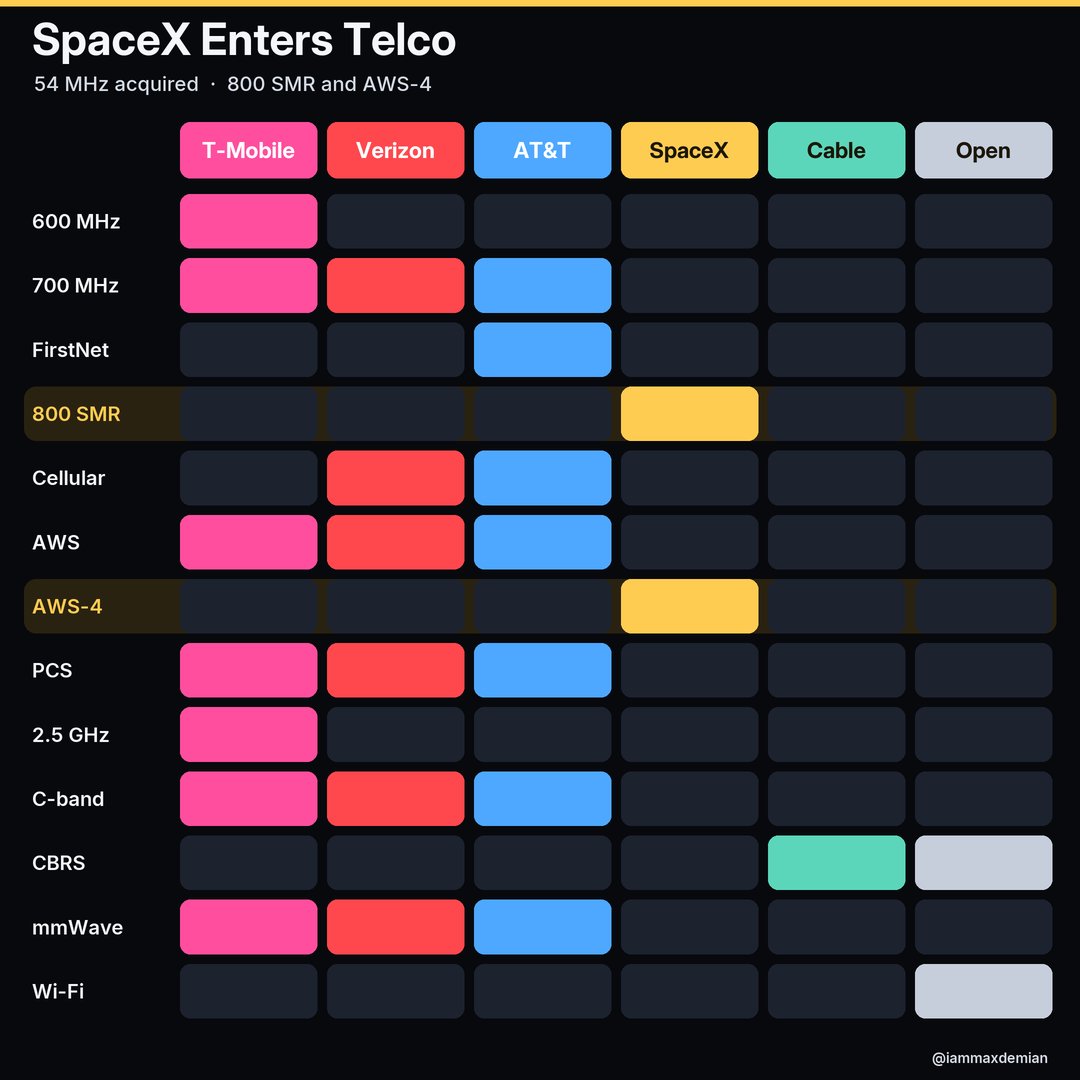
They own the licenses, so the sites run on their spectrum. 800 MHz covers. The 20 MHz channel carries the load. When that channel fills, they add sites. That is the terrestrial build.
The tower is a normal cell site. Low-band radio, mid-band radio, a core behind them. Where there is no fiber, a Starlink terminal is the backhaul. The license gets them onto the tower. The satellites get the tower onto the network.
Phones already tune both. 800 MHz sits in the old Sprint band. The 2.1 GHz downlink sits at the top of the AWS band. SpaceX can put a signal up without waiting on a new handset.
Same tower, two radios. The 800 MHz radio holds the connection and the uplink. The 2.1 GHz radio moves the data. The phone uses both at once. That is the whole air interface.
A ground network needs two layers. 800 MHz is the one the phone can still hear indoors and at the edge, so that is where it attaches. The 20 MHz channel at 2.1 GHz is where the traffic goes once the session is up.