ArcHub V2 is Live
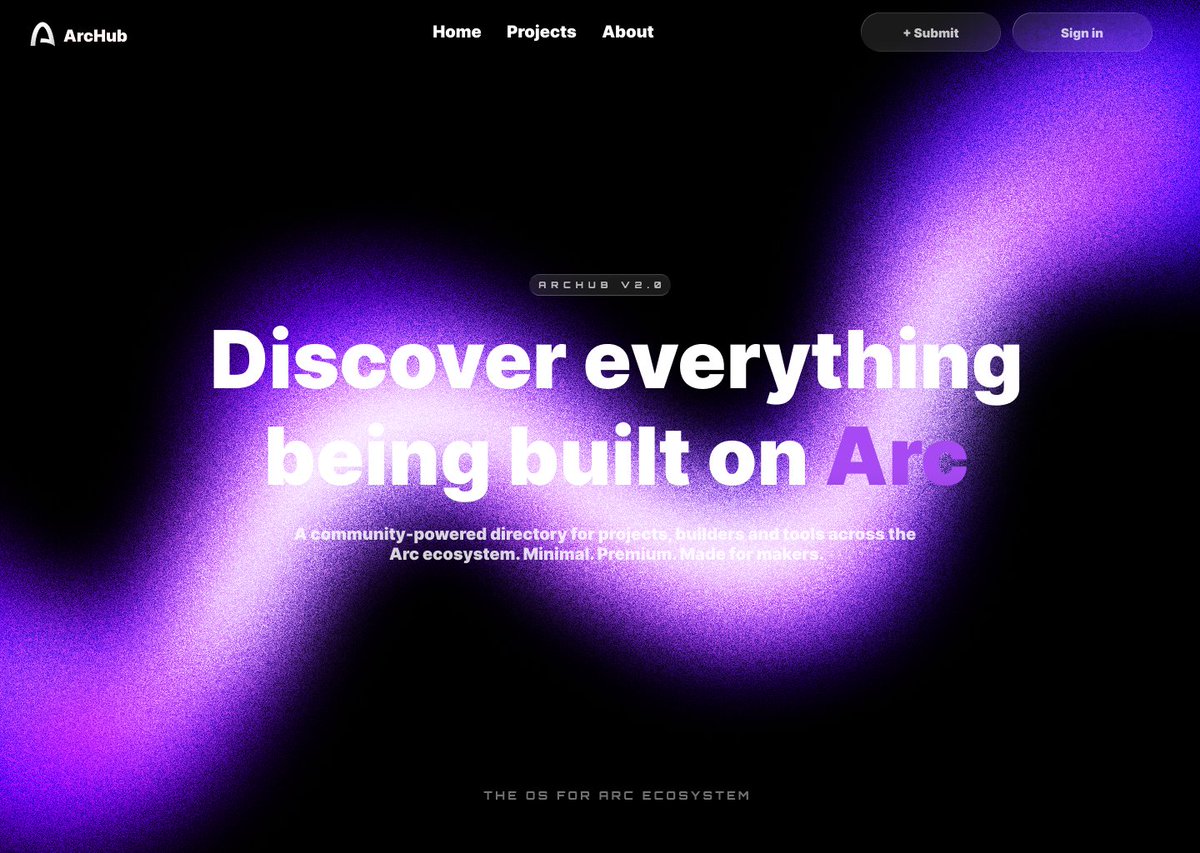
After countless hours of designing, building, testing, and refining, I'm excited to introduce @arc Hub V2.
A faster, cleaner, and more polished experience for discovering everything being built on the Arc ecosystem.
Explore now : https://t.co/urYKjGN4St
@cryptoalkash420@voicecc The idea of turning opinions into meaningful signals is actually interesting. OpinionFi could make everyday discussions more valuable.
Soneium is moving beyond simple onchain ownership
One thing I find interesting about @soneium is how it is approaching IP, entertainment and AI.
Putting an IP onchain is one thing.
But the bigger question is:
What can people or AI actually do with that IP?
For example, imagine an AI agent finds a song, image, video or other creative work online.
It may be able to identify the content, but understanding its licensing terms is a different problem.
Who owns the IP?
What license is available?
What are the allowed uses?
Has the required license been obtained?
Today, this information can be difficult for machines to discover and understand because licensing details are often stored in contracts, databases or different platforms.
This is where ERC-8432 becomes interesting.
@soneium plans to support ERC-8432, an open standard designed to make IP assets and licensing information easier to identify, read and check through a common onchain structure.
The interesting part is that this is designed to be readable not only by people, but also by AI agents.
That could become important as AI starts interacting more with creative content.
And Soneium is already exploring the connection between entertainment IP and onchain value.
Its recent partnership with DayOneDream aims to bring K-pop IP and related economic value onchain through WAVIST.
So for me, Soneium is not just about putting NFTs on a blockchain.
It is exploring a bigger ecosystem where IP, creators, fans, licensing and AI can interact onchain.
This is one of the directions I’ll be watching closely.
I was checking out the different Seats from @TheMutualFun and initially I was mostly looking at the characters and thinking which one I would actually pick.
But while going through the Prospectus, I noticed something interesting about the supply structure.
There are 4,001 Seats in total
Five funds have 800 Seats each - ARGON, BOGLE, SMAUG, MIDAS and VLADD - plus Seat 0, which is the Chairman’s Seat and isn’t for sale.
What caught my attention is that the supply can only go down
Two Seats can be merged if they are from the same fund and the same class, and both are enrolled. They become one Seat of the next class with a Corner Office upgrade.
For example, if someone has two Retail Seats from the same fund, they can merge them into one Investor Seat instead of keeping both separately.
The interesting part is that those two original Seats are gone after the merger. No new Seat is created to replace them.
The new Corner Office Seat gets the combined weight of the two Seats plus 10%. That weight matters for things like dividends and voting.
But there is a limit too
A Corner Office Seat cannot be merged again, and Class R is already the highest class.
So when I saw “4,001 Seats”, it wasn’t just a normal fixed-supply NFT number.
There is actually a mechanism that can reduce the supply over time, while there is no mechanism to create more Seats.
Of course, lower supply alone doesn’t mean the NFT will become more valuable. The fund performance, voting and other mechanics still matter.
But I like that the supply has an actual system behind it, instead of just being called “limited”
At first, I was just looking at the pixel characters.
Now I’m looking at what the Seat actually does
https://t.co/uMPbnz1tcm
If it’s truly mine, I shouldn’t need anyone’s approval to access it, move it, or decide what happens next. That’s what real control looks like with @Tangem
If it’s truly mine, I shouldn’t need anyone’s approval to access it, move it, or decide what happens next. That’s what real control looks like with @Tangem
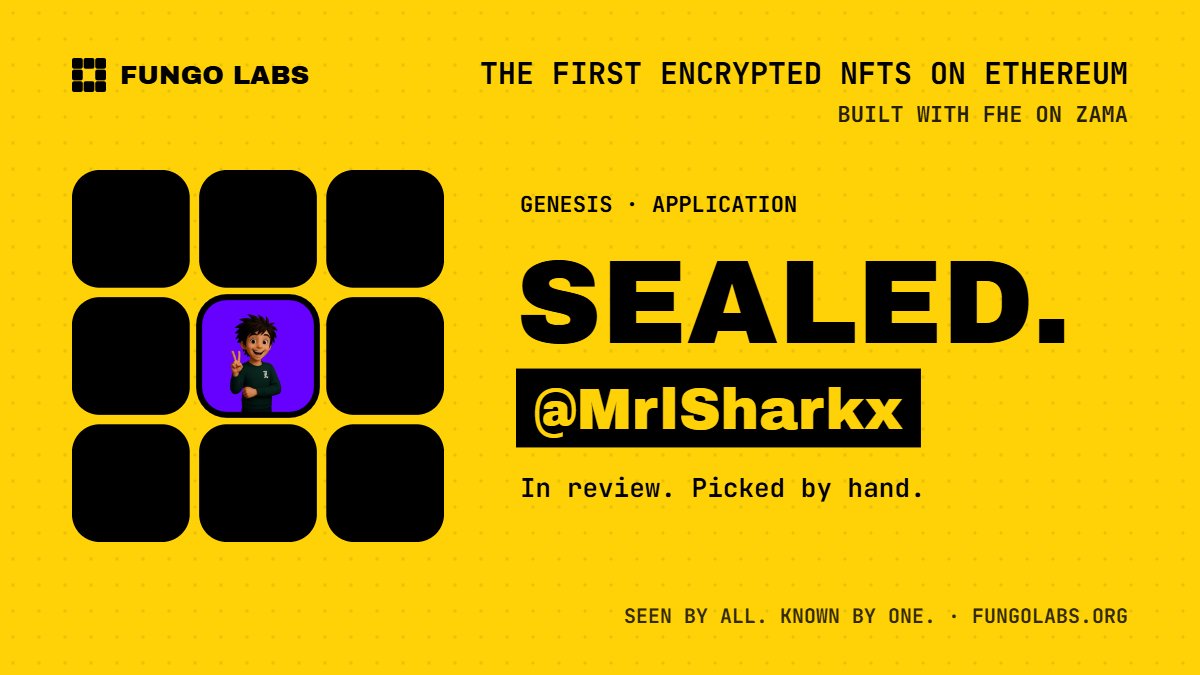
Encrypted NFTs are something I haven’t seen done like this before. The mix of privacy, randomness and onchain functionality is what caught my attention. Curious to see what Fungo Labs builds next.
@fungolabs
How we use Zama ?
→ Every NFT mints sealed and is encrypted onchain using Zama’s FHE.
→ The contract computes on data it can never read.
→ Its look and essence are determined by FHE randomness. Nobody gets to choose. Not even us.
🟨 Built with FHE on @zama.
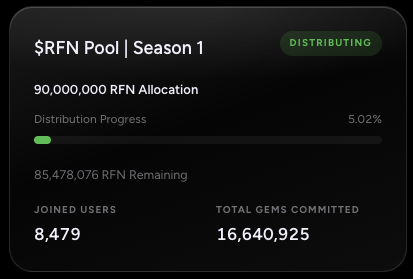
$RFN Pool — Early Stage Launchpool
Commit your Gems. Build your position. Earn your share of $RFN token 💎
🪙 Pool Size: 90,000,000 $RFN
Built for the early Ryfinite community — giving our earliest users access to the first stage of the $RFN Pool.
Join here 👉 https://t.co/Cj3Rwd2clT