@ekwufinance the interesting part is the debt math.
higher yields can pressure heavily indebted governments into lower rates later.
but “we don’t own enough gold” is a thesis, not a fact.
@Zayan5754 the $306K/month claim is the part i’d verify first.
if 6 agents were each generating $15K/day, that’s $90K/day (assuming all 6 hit the stated minimum simultaneously), or roughly $2.7M/month (assuming 30 days).
the system may be interesting.
the numbers don’t add up.
@mr_kozh the wild part isn’t that a robot can move.
it’s that biological wiring became the control system.
166,700 neurons mapped into 125M synapses, then translated into a machine’s perception and movement loop.
we’re starting to study evolution’s solutions as engineering blueprints.
@bridgebench the interesting part isn’t whether limits changed.
it’s whether anyone is actually measuring them consistently.
5-hour limits + weekly limits tracked over time gives users something better than screenshots: a baseline.
if the numbers move, the data should show it.
@0xForce_ the $427/day headline is the easy part.
the real business question is whether the content stays monetizable after the AI makes production nearly free.
cheap production creates more uploads.
it doesn’t guarantee more revenue.
@_avichawla the key distinction isn’t model size.
it’s control flow.
system 1 makes bounded decisions inside a workflow.
system 2 drives multi-step work through tools, state and verification.
production systems need both.
@0xShoopy the wildest part isn’t the 14 bots.
it’s the eng lead bot that never codes.
it delegates, watches the swarm, and only steps in when the system needs a decision.
the human role is moving from doing the work to designing how the work gets done.
@beamnxw the ranking isn’t the valuable part.
the execution loop is.
goal → context → tool → act → observe → verify → repeat.
that’s the difference between an agent that generates an answer and one that can actually finish a job.
@impreiaxbt the interesting shift isn’t “agents write code.”
it’s that the human moves up one layer and starts operating the system.
researcher → writer → tester → reviewer → fixer.
the bottleneck becomes orchestration, feedback and verification.
@N01ennn the 444x number is the hook, but the architecture is the real story.
if Jev costs $0.044 per 1,000 judgments vs $12.182 for GPT-6, that’s ~277x cheaper (assuming both figures refer to the same 1,000-judgment workload).
the frontier model becomes the exception, not the default.
@polydao the interesting part isn’t the 10-step architecture.
it’s the economics.
if the loop really takes a $765/month claude bill down to $3, the company brain isn’t just smarter.
it’s 255x cheaper (assuming $765 ÷ $3 and both figures are monthly spend).
@dunik_7 15 shorts a night sounds impressive until you look at what actually happened.
3 of 120 passed 1M views.
the hard part isn’t generating more videos.
it’s knowing which one deserves to exist.
@0xCodez "Something breaks mid-flow? It replans sourcing and revalidates instead of stalling" is the one sentence that separates a decision model from a routing table — the recovery is the product.
@x_insider4 $100 to $2,981 in 45 minutes with zero human clicks and a written record for every decision — the record is the only part of this that matters, and it hasn't been published.
@hanakoxbt jev-claude routing Claude Code's own judgment calls through Jev before risky commands execute is the architecture where the decision model audits the generation model — and that is the correct order of operations.
@0xCodez The QA agent that rejects output before it reaches the human is the role that makes the rest of the team trustworthy — without it, the Chief of Staff is just routing noise faste
$277 A MONTH FOR 11 TABS TO MAKE ONE 60-SECOND SHORT. $44 A MONTH FOR THE SAME OUTPUT THROUGH ONE PROMPT BAR.
picsart put 187 models from 34 providers behind a single interface — Veo, Kling, Suno, and 184 others — and $277 is their own calculation of what people currently pay to approximate the same stack across separate subscriptions.
the Big Yowie case study is the number that reframes the cost: $250/month for Veo Ultra, $50-150 per video, 5-10 attempts per 8-second clip, 4-6 hours a night. one clip still pulled 823K likes. the model was not the bottleneck. the format was. and 6 hours a night is not a content workflow, it is a second job.
the pipeline that replaces it: GPT-6 Astra finds 10 shorts doing 25x their channel's normal views and describes each one's format in one sentence. Picsart's director agent turns that sentence into a scene-by-scene plan. Make posts to 3 platforms, waits 48 hours, writes the watch-through rate back into the research sheet.
the format was always the product. the yowie was just wearing it.
$44/month. full pipeline in the article below.
WHOEVER STILL PAYS $277 A MONTH FOR 11 AI TABS TO MAKE ONE 60-SECOND SHORT HAS MORE PATIENCE THAN SENSE
picsart put 187 models from 34 providers behind one prompt bar and that $277 is their own math
most people still open veo in one tab, kling in another an suno in a third then lose the file somewhere in between
the guy behind big yowie paid $250 a month for veo ultra and burned $50-150 on every video
he needed 5 to 10 attempts for each 8-second clop, 4 to 6 hours a night
one of those clips still pulled 823k likes
he said the hardest part was never the generation, it was the script
that's exactly the part this pipeline hands to and agent:
/ gpt-6 astra finds 10 short doing 25x their chanel's normal views and describes each one's format in one sentence
/ picsart's director agent turns that sentence into a scene-by-scene plan and checks every shot against it
/ make posts to 3 platforms, waits 48 hours and writes the watch-throught rate rate back into the research sheet
the article puts all there at $44 a month
the yowie never needed a better model
the format was the product the whore time and the yowie was just wearing it
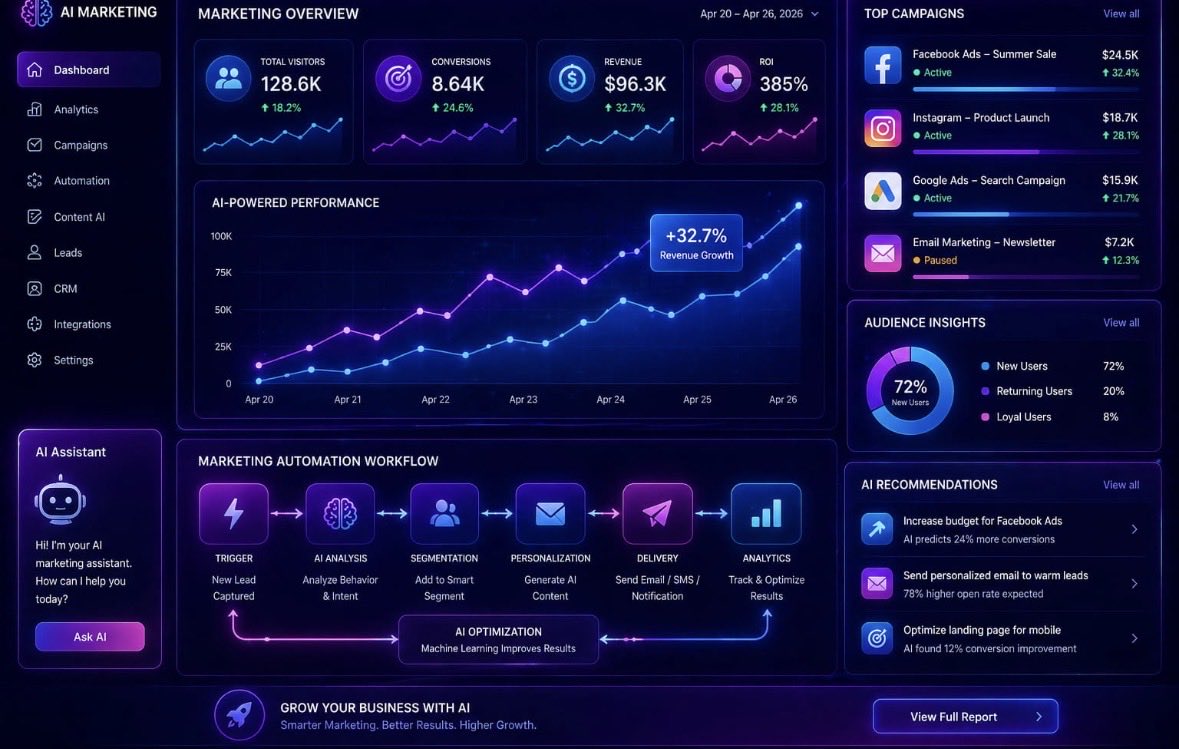
@joshkim@SpaceXAI@bot Product audit → landing page → paid campaigns → automation is not a marketing workflow. it is an org chart compressed into one agent loop.
GROK BOT AUDITING A PRODUCT, SHIPPING A LANDING PAGE, BUILDING AND ANALYZING PAID CAMPAIGNS, THEN AUTOMATING THE ENTIRE PROCESS — IN ONE CONTINUOUS AGENT LOOP.
most marketing teams treat these as four separate jobs done by four separate people across four separate tools. the SpaceXAI demo treats them as four stages in one agent workflow.
the sequence matters: audit first means the campaign brief comes from actual product data, not a creative brief written in a vacuum. landing page second means the conversion surface exists before the ad spend starts. paid campaign analysis third means the loop closes — spend generates data, data informs the next campaign iteration.
automation at the end is not a feature. it is the point where the human job shifts from execution to approval.
the marketing use case is the highest-leverage entry point for agent teams because the output is directly measurable — conversion rate, cost per click, revenue per campaign. the feedback loop is short enough that the system can improve between runs.
full demo in the post below.
I'm excited to share how the @SpaceXAI team uses Grok Bot for Marketing.
see how @bot builds a marketing campaign from start to finish, including:
• auditing a new product
• shipping a landing page
• building and analyzing paid campaigns
• automating the entire process
watch the full demo here:
@Dr_Singularity 1% to 26% in six months means Claude is not just being used at Anthropic — it is becoming the primary mechanism by which Anthropic builds the next version of itself.