This take seems correct from an individual's incentives POV, but I don't think that makes it a great future
It seems most likely that every successful chain will opt in to building strong composability guarantees within its ecosystem (their own superchains) and then the natural outcome is everyone building different flavors of the same thing 🫠
"Synchronous atomic composability is very overrated"
Been saying this for years now... sorry monolithic maxis, we don't need a single atomic global state machine.
We need an internet of asynchronous modular blockchains 🤷♂️
@nickwh8te can agree on the synchronous side, but atomic guarantees across chains seems like a fundamental building block for many useful applications, as well as just increasing devX + UX
Sync atomic interop is overrated at the infra level, but the UX of sync atomic interop is unbeatable. There's a reason users flock to liquidity bridges with the lowest fees + fastest UX.
atomic interop (sync or otherwise) tightens spreads and provides a platform for better products for users downstream
xchain atomicity is the key unlock and this is a much lower hurdle than xchain synchronicity -- all it takes is a proposer to commit to the bundle with some stake or an enforcement mechanism: app-chain PEPC coming soon ™️
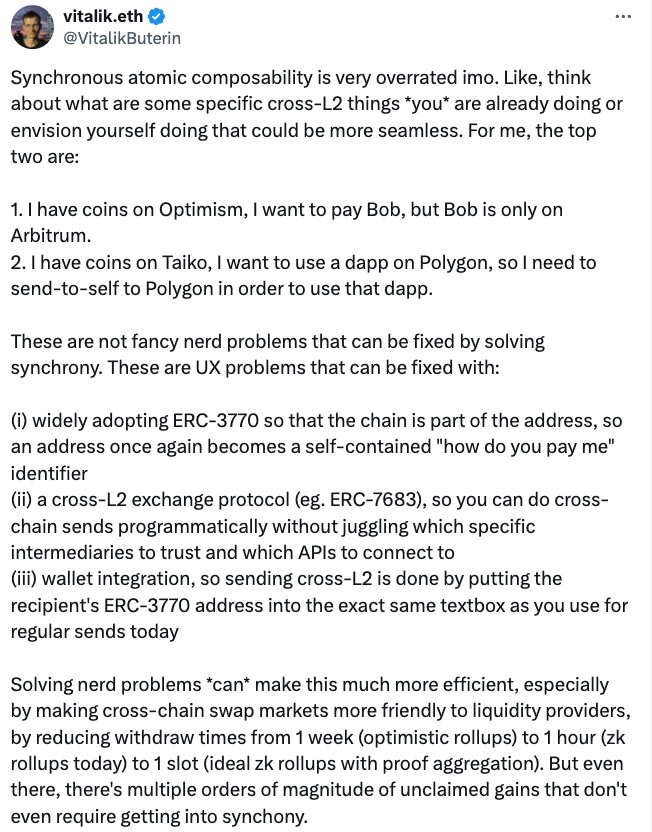
Synchronous atomic composability is very overrated imo. Like, think about what are some specific cross-L2 things *you* are already doing or envision yourself doing that could be more seamless. For me, the top two are:
1. I have coins on Optimism, I want to pay Bob, but Bob is only on Arbitrum.
2. I have coins on Taiko, I want to use a dapp on Polygon, so I need to send-to-self to Polygon in order to use that dapp.
These are not fancy nerd problems that can be fixed by solving synchrony. These are UX problems that can be fixed with:
(i) widely adopting ERC-3770 so that the chain is part of the address, so an address once again becomes a self-contained "how do you pay me" identifier
(ii) a cross-L2 exchange protocol (eg. ERC-7683), so you can do cross-chain sends programmatically without juggling which specific intermediaries to trust and which APIs to connect to
(iii) wallet integration, so sending cross-L2 is done by putting the recipient's ERC-3770 address into the exact same textbox as you use for regular sends today
Solving nerd problems *can* make this much more efficient, especially by making cross-chain swap markets more friendly to liquidity providers, by reducing withdraw times from 1 week (optimistic rollups) to 1 hour (zk rollups today) to 1 slot (ideal zk rollups with proof aggregation). But even there, there's multiple orders of magnitude of unclaimed gains that don't even require getting into synchony.
@tripleboccaccio @smyyguy it could work imo, but in order to detect spamming you would likely want users to sign txs and at that point isn't this the same as just sponsoring/subsidizing gas fees for most users?
That might just be a simpler design: subsidize gas until spamming is detected?
@MikeIppolito_ making the validators bigger also introduces centralization pressure, especially at the scale necessary to support preconfs
at least with the complicated preconf designs we can hope for minimizing the scope of centralization (e.g. with inclusion lists we still have CR)
@mert while it's true that other attacks are feasible (and so economic security/TVS isn't a complete metric), saying "economic security is a meme" glosses over the many useful application-level uses of economic security
This gets lost in all this L1 v L1 drama