Assuming this is true, which unfortunately I absolutely think it could be, all the United States is doing is exploiting the weakness of its enemies to destroy them.
Spain's government gave blanket amnesty and residency to illegals. MILLIONS of them. They invited the world into Europe.
Now, perhaps, the US is giving them what it asked for in spades more than it expected - using the collapse of these strategic cities, which help Spain control the straight and are coveted by Morocco (an actual ally, unlike Spain whose government denied us use of bases), to collapse in turn the Spanish government - and indeed collapse pro-migration / anti-US parties across Europe.
I know no one likes to see this happen to historic cities that are European. But the image of these cities being sacked is visceral. If it creates strategic defeat for pro-migration parties against Europe before the frog boils, would that be worth their loss?
I can't answer that question morally. But that is how realpolitks works.
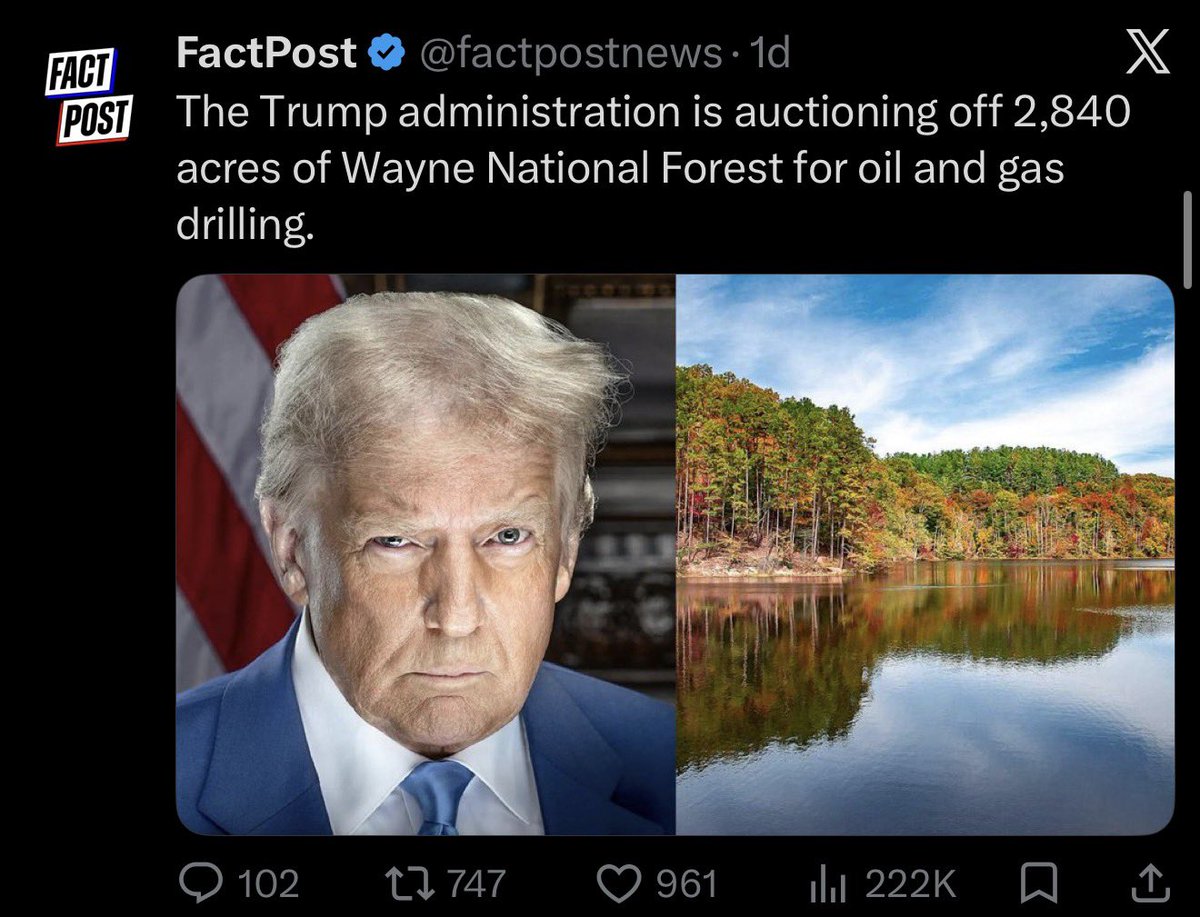
These posts drive me insane because I basically have to deprogram students from this utter nonsense every fall. Oil and gas extraction in national forests has been a completely legal use in our National Forests for over a century, and even back to the pre Forest Service days of the 1890s. The ability to balance extraction with recreation is part of the DNA of the Forest Service and a uniquely American conservation institution, we should be incredibly proud of this.
The National Forests are managed under a multiple use mandate, and when this occurs there are extensive federal laws and regulations along side site specific environmental reviews targeted at wildlife, water, ecosystems, etc. I’d make the argument that this type of extraction is more sustainable and tightly regulated here than anywhere else in the world. What makes American National Forests such an innovative system in the conservation world is the requirement that we manage for recreation (hunting, camping, fishing) alongside sustainable yields of resources in the same forest. It’s actually incredible.
A psychologist spent 10 years studying 400 people who called themselves lucky or unlucky. Then he handed each one a newspaper and asked them to count the photographs inside.
Unlucky people took about two minutes. Lucky people took seconds.
Page 2 held a half-page ad in giant type reading "Stop counting. There are 43 photographs in this newspaper." A few pages later, another one offered a cash prize to anyone who told the experimenter they'd seen it.
The lucky group spotted both messages. The unlucky group counted straight past them, so locked onto the task that half a page of bold print became invisible. When Richard Wiseman asked afterward if they'd noticed anything unusual, they said no.
His personality data explains why. Unlucky participants scored roughly twice as high on anxiety, and tension narrows attention until the unexpected gets filtered out entirely. Lucky participants also varied their routes to work, talked to more strangers, and broke their routines on purpose, which multiplies how much unexpected material crosses their path to begin with.
Wiseman ran one more test that proves the mechanism. He surveyed 700 lottery players. Self-described lucky people were twice as confident they'd win. Their winnings matched everyone else's exactly. Feeling lucky does nothing in a game of pure chance, because there's nothing to notice.
So he built a "Luck School" that trained unlucky people to behave like lucky ones. Participants reported lasting gains in fortune, confidence, and even health.
The luck was sitting in plain sight on page 2, in type half a page tall. The only variable was who looked up.
I am not a Trump worshipper, that would be idolatry, and I also have no patience for those wishing Trump had not won. Maybe people were not paying attention? I was. I lived it. This woman was about to given complete control over the Internet.
should be obvious by now, but OpenAI and Anthropic are just gonna keep cannibalizing all their biggest customers.
it’s simply too profitable for them to resist. and it’s already happening:
1. Figma partnered with Anthropic on AI design tools. then Anthropic’s product chief quit Figma’s board, and 3 days later Anthropic launched Claude Design to compete with Figma. CEO Dylan Field said Anthropic was “not consistently candid.”
2. Novo Nordisk uses Claude to help develop drugs. now Anthropic is developing drugs of its own.
3. Microsoft poured billions into OpenAI. now OpenAI is building a Jobs Platform to compete with LinkedIn, and reportedly a code repository to compete with GitHub. Microsoft owns both.
4. Harvey uses Claude to sell AI contract analysis, due diligence, and litigation tools. now Anthropic sells those same workflows through Claude for Legal.
5. Intercom used OpenAI’s Realtime API to build Fin Voice. now OpenAI sells its own voice-and-chat support agent through Presence.
6. Abridge and Ambience build clinical documentation products on OpenAI. now OpenAI sells ChatGPT for Healthcare directly to hospitals with clinical documentation built in.
7. Benchling uses Claude to power its biotech R&D platform. now Anthropic sells its own scientific workbench through Claude Science.
the frontier lab playbook is simple:
1. sell their models to the world’s most valuable businesses
2. help wire them into those companies’ most valuable and sensitive work
3. map the business from the inside and find where AI can take over
4. turn those capabilities into their own products and become the customer’s competitor
There sure has been a lot of *talk* about Bitcoin development these last 18 months. Meanwhile, there's been an awful lot of actual development work done. Examples of what Bitcoin Core has been working on throughout this all:
- a node that syncs in nearly half the time
- a path to 5x faster (SwiftSync)
- a new GUI to make running that node easier, maybe even on mobile
- a redesigned mempool with better fee bumping and fee estimates
- a mining interface so individual miners can build their own block templates (Stratum v2)
- a private broadcast so your transactions can't be traced to your IP
- a reproducible map of the entire internet for node eclipse attack protection
- a better way to relay time-sensitive Lightning and Ark transactions for confirmation
- a multisig that's cheaper, more private, and looks like any other payment on-chain (MuSig2)
- a private payment address with zero linkable payments (silent payments)
- a threshold (e.g. 3-of-5) signature scheme that looks like a single signature (FROST)
- a proposal to fix known protocol bugs and current attack vectors (BIP54)
- a slew of post-quantum research to be ready for future attack vectors
- a first-ever independent security audit for more eyes on the code
- a new tool that attacks a live node the way a real adversary would (Fuzzamoto)
- a fix that killed an entire class of disk-filling attacks
- a replacement for a risky external library
- a consensus engine the whole ecosystem can build on (Bitcoin Kernel)
Over a hundred contributors and more than a dozen funding organizations around the world. Not without controversy. Not without bugs. But undeniable progress.
August will come and go. This work will continue.
btw anthropic's internal document on this literally said "we don't want it to be known that we are working on this.”
it was called project panama.
here's exactly what happened:
1: anthropic concluded that books were the cheapest way to build a world-class model because they gave claude curated facts, structured arguments, compelling stories, and writing “an editor would approve of.”
2: once anthropic decided it needed books at enormous scale, its first solution was piracy.
it downloaded 7m+ books from online libraries including libgen. the judge later wrote that although anthropic had legal ways to buy them, it chose piracy to avoid what dario amodei called the “legal/practice/business slog.”
3: that piracy created a massive legal risk.
so in february 2024, anthropic hired tom turvey, the former head of partnerships for google books, to find a legally safer way of obtaining “all the books in the world.”
4: turvey first contacted major publishers about licensing their catalogs.
those attempts didn’t produce agreements, so anthropic chose a route that required no publisher permission: buying millions of physical books through distributors and used-book retailers.
5: within about a year, anthropic spent tens of millions acquiring and scanning millions of books, including many rare and 1/1 titles. one vendor proposal targeted 500,000 to 2 million books in six months.
6: to scan that many books within months, the vendors physically dismantled them.
a hydraulic cutter removed each spine. the pages were trimmed to size, fed as loose sheets through high-speed industrial scanners, and converted into searchable PDFs. the paper remains were then sent for recycling.
7: these PDFs were fed into claude as training data.
the complete collection became a private, searchable anthropic library that the company planned to “store forever.” the scans aren’t available to the public and were never open-sourced.
It’s easy to enjoy the finer things in life. Nice dinners, fancy cars, extravagant vacations, swimming Hapuna beach on the Big Island at sunset.
It’s also easy to enjoy the simple things. A hike through a temperate rainforest. The whirr of a bumblebee or hummingbird near a flower. The first Spring bloom. The sound of your baby laughing. These are the two categories of things that everyone insist you have to savor and enjoy. And I totally agree that these make life worth living.
But everyone knows that. Everyone treasures these things especially because every day on social media you see some influencer or another imploring you to do so, helping remind you of what “really matters.”
What I want to talk about today is enjoying the basic things . The so called “normie” things. Or maybe pedestrian.
I get flack from people in my comments or after I do a podcast where I talk about one of my favorite nighttime activities: watching TV. It’s one that I’ve done for most of adult life on a regular basis and I probably do more of it now than I have in the past. And no, I don’t wear blue blocking goggles - although I have tried and recommended it in the past, and I still do keep a pair around for when I really need to control my circadian rhythm. And I’m not watching history documentaries or avant garde films. More often than not I’m just watching some TV show that millions of others are probably watching or streaming or talking about with their friends at work. I enjoy it, it doesn’t detract from my life or productivity or ability to enjoy other so-called “finer things.” Why wouldn’t I watch TV?
Lots of things are like that.
The happiest most fulfilled people I know are those who appreciate the finer things in life and are quick to stop and smell the roses, but also won’t sneer at something just because it’s popular.
A good heuristic is to never sneer. Sneering because something is beneath you or too popular with the masses is never good look. Things are often popular for a reason, and liking one thing doesn’t preclude you enjoying another, finer thing.
So watch Netflix with your spouse. Catch the game. Go to a bar and shoot pool or have people over for UFC. Watch the art film and the Hollywood blockbuster. Listen to pop music and classic rock. I promise you that it’s better to truly and authentically find joy in more things than to find joy in just a few.
I’m glad that ABC is admitting that the toxic chemicals in your sunscreen are dangerous and cause cancer.
Everyone I know who has skin cancer wore them. 😬😭
Do you still put this on your kids?😭🤣🤯
If you want to get amplified on youtube and X all you need to do is claim the official story of Charlie Kirk's assassination is a cover up and there's a conspiracy
Why is social media amplifying this so much?
Why does Big Tech want this narrative to be front and center?
If someone made a movie set in Africa and based on ancient African folklore, and then populated the cast with white people and other random races and ethnicities that have nothing to do with Africa, everyone would say that the casting is ridiculous and distracting at best (and I would agree). Yet the same thing is done in the reverse to a foundational text of western civilization and even conservatives line up to defend it. It’s pathetic, honestly.
Flock would be a great tool in a right wing system where laws are applied universally. The issue is if you have a job, you get squeezed while illegals can’t be tracked down to fine and collect from.
Let’s talk Flock once we have mass deportations.
I’m generally pro-data center, but if you’re a normie, here is the story you���ve been hearing from Silicon Valley over the last decade:
-AI is probably going to take your job.
-It might kill you.
-You will probably become part of “the permanent underclass”.
-The very Big Tech billionaires+companies who have been more hostile+malicious to conservatives than any other business bloc in the world over the last decade will become unimaginably rich, while you+everyone you love will lose your job and become poor @Cernovich
-The main spokesmen/“faces” in charge (Dario and Scam Altman) are openly hostile to you, your values, your politics, your way of life and everything you stand for
-The tasteless philistines in tech are going to plant an utterly hideous industrial monstrosity in your backyard and probably pay you nothing.
-for all this, in return you get: ????
It is not remotely difficult to understand why normies have reservations…& imbeciles on this website should stop pretending that it is.
As usual, the blinkered tech spergs are abysmal at persuasion because they do not understand people, politics, or anything outside their (extremely narrow) cone of technical expertise and how any of this sounds outside their siloed, out-of-touch SF echo-chamber. If you support data centers, as I generally do, the normies are the last people you should blame.
Frequent sex is a monogamous relationship would boost "happiness" (fake term) way more than 50K. It's pretty much priceless. A billionaire in a sexless marriage is living a terrible life. Having a great wife would more than 10x his "happiness."
When you go down the BIP 110 rabbit hole, you realize it’s not just a debate about technical issues or base layer consensus. It’s also a fascinating study in psychology, persuasion, tribalism, and human behavior.
The technical side is important, but so are the social dynamics that emerge when a community becomes deeply divided.
One of the most interesting patterns I’ve observed is the “No True Scotsman fallacy”
The argument becomes: “Plebs with integrity support BIP 110.” But the moment you point to a pleb with integrity who opposes it, the definition quietly changes: “Then they weren’t a real pleb of integrity.” The claim becomes impossible to falsify because the category is continually redefined.
Layered on top of that are several other psychological mechanisms.
Ad hominem / poisoning the well: opponents are pre-labeled as “grifters,” “suitcoiners,” or other dismissive terms so their arguments can be discounted before they’re even heard.
The Kafkatrap: disagreement itself becomes evidence of guilt. If opposing BIP 110 is taken as proof that you’re compromised or acting in bad faith, then there is no possible way for an honest dissenter to defend themselves. The accusation becomes unfalsifiable.
In-group vs. out-group identity framing: as demonstrated in Henri Tajfel’s social identity experiments, people naturally favor members of their perceived group even when the groups themselves are arbitrary. Once a technical proposal becomes a tribal identity marker, many people stop evaluating the merits of the proposal and instead defend the identity attached to it.
History has shown this pattern many times.
During the French Revolution, Robespierre equated virtue with support for the Revolution. Opposing the Terror became evidence that you opposed virtue itself, and eventually the purity spiral consumed many of its own architects.
During McCarthyism, questioning the investigations was often portrayed as evidence of communist sympathies. Doubt itself became suspicious.
In the Soviet Union, dissenters were labeled “enemies of the people.” Some were even diagnosed with so-called sluggish schizophrenia because the ideology assumed that only an irrational person could oppose the system.
During Mao’s Cultural Revolution, labels such as “capitalist roader” functioned as social disqualifiers. Once the label was applied, arguments no longer needed to be answered.
Even in modern politics, phrases like “real Americans” or “true patriots” follow the same pattern: defining membership in the virtuous in-group so that agreement becomes the admission ticket.
What I find most interesting is that these dynamics tend to emerge when debates shift away from evidence and toward identity. The discussion stops being “Is this proposal good for Bitcoin?” and becomes “Are you one of us?”
Whether someone supports or opposes BIP 110 is ultimately their decision. But studying this debate has taught me something beyond Bitcoin’s technical architecture. It has shown me how quickly intelligent communities can fall into tribal thinking, identity protection, and purity tests.
In Texas I was taken to a grocery store called H-E-B.
I asked what the letters stand for. My friend said, "Howard Edward Butt."
I waited for the rest of the name. There was no rest. The man built an empire on his actual name, and the empire did not flinch.
Inside, a woman in a red apron said, "Welcome! Finding everything okay?"
I had been inside for eleven seconds. I had found nothing. I had not begun to look.
"...I have only just arrived."
"Well, let me know if you need anything, sweetheart."
Sweetheart. From a stranger with a price gun. I held the cart handle with both hands and tried to proceed as a man who had not just been loved at the produce section.
The store was clean in a way that suggested someone cared about it the way my grandmother cared about her kitchen floor. Not for the guests. For the floor.
A man named Dale in the meat department was cutting brisket behind glass. I watched him work. He held the knife the way a calligrapher holds a brush. Each cut landed in the same place twice.
I bowed slightly. I could not help it.
Dale looked up. "You want a sample, boss?"
"...I was paying respects to your blade work."
He paused. Then he cut a piece, put it on a toothpick, and handed it over the counter.
"Well, that's a first. Most folks just ask if I got any ribs left."
I ate it. It was perfect. I told him it was perfect.
"Appreciate that. Twenty-six years behind this counter."
Twenty-six years. The same counter. The same knife. In my country we would call this man a living national treasure and put him on television. Here he wore a red apron and asked if I wanted it wrapped.
Then the storm came.
I do not mean this as a metaphor. A hurricane was approaching the coast, and I learned something about this grocery store that I did not believe until I saw it with my own eyes.
H-E-B has mobile kitchens. Disaster relief trucks. A full-time Director of Emergency Preparedness. Over a hundred and fifty thousand employees they call Partners, and when the wind starts to build, the Partners do not go home.
They drive toward it.
During Hurricane Harvey, this grocery store fed thousands. They sent trucks into flooded towns before the government arrived. Before the Red Cross set up. Before anyone asked.
A grocery store. With a meat counter and a bakery and a sign that says HERE EVERYTHING'S BETTER.
Texans have a name for H-E-B during hurricanes. They call it the FEMA of Texas. I have confirmed this. Multiple Texans said it to me without smiling, the way you state the name of a general who does not lose.
I asked Dale if he had worked during Harvey.
He stopped cutting. He set the knife down, which I had not seen him do.
"Drove in at four in the morning. Water was up to my truck doors. Store was the only thing open for nine miles. We made sandwiches till we ran out of bread. Then corporate sent more bread. Then we ran out again."
"...How long?"
"Sixteen days."
I stood there holding a package of brisket in both hands and tried to find the word.
"...You are not a butcher, Dale."
He picked up his knife. "Sure I am."
In my country, a man who feeds his village through a disaster is honored for the rest of his life. In Texas, he is called a butcher, and he goes back to the counter on Monday, and he does not mention it unless you ask, and even then he picks up his knife before he finishes the story, because the brisket is not going to cut itself.
The store was founded in 1905 by a woman named Florence Butt, who put sixty dollars' worth of groceries on a shelf on the ground floor of her family's home in a town called Kerrville. That was the whole store. One shelf. One room. Sixty dollars.
A hundred and twenty years later, the family still owns it.
I walked out with four bags. A boy in a red apron carried two of them to my car. I told him I could carry my own bags. He said, "I know you can. But I'm already here, so."
I did not tip him. He would not let me.
I drove home past the highway where the flood line was still visible on the guardrail, three feet up, and I thought about Dale, and the bread, and the knife, and the name Howard Edward Butt, who was not embarrassed by it, because the name is not the point.
The shelf is the point.
Florence Butt put sixty dollars on a shelf in 1905. A hundred and twenty years later, when the water rose and the power died, the shelf was still standing, and there was bread on it.
A store is not its name. A store is whether the bread is there when you need it.
The bread was there.
1. China-hawk president
2. China creates a virus
3. Virus used to justify wrecking the economy and expanding mail-in voting
4. Steal the election to bounce the China-hawk and install a man you completely own with blackmail material
It’s like something out of a movie.
Was talking to a friend who was dour about Trump's first term. I'm elated actually, and yes I'm away of the "issues." Huge accomplishments, including:
- Stop the bleeding. Not only at the border, but the far left wing domestic terrorism has been reduced. Yes, more can and should be done, but under Harris? Let's be realistic.
- Catholic grandmas who prayed at abortion clinics were going to DIE IN PRISON. Trump pardoned them.
- Consent decrees that limited policing were undone.
- No more false and malicious prosecutions against Trump voters, such as the Douglass Mackey case.
- EEOC is making discrimination against white men illegal, and even pushing back against disparate impact theory, which is used as a basis to refuse to hire whites, especially white men.
- Massive spending to reindustralize. Factories are being built.
- Attempting to end the genocide of white South Africans.
- SCOTUS has been about as good as it gets due to the way conservatives operate (afraid of their own shadows), birthright citizen was always a long shot, and it looks like it was death threats that swayed ACB.
- Transparency on fraudulent investigations.
- J6ers freed.
- OBBB tax cuts.
Most of the problems people have with Trump are the result of the Senate blocking him and his agenda. You can't blame Trump for what Cornyn and Thune refuse to do.
I understand the anger over other issues. I feel the same way. Problem is. The standard isn't Trump or utopia. It is Trump or Harris and her demonic lieutenants.
Trump's second term has been a spectacular success compared to his first one, and is not in the same universe as what we would be living under if "the bad timeline" had happened.