Some of you mfs spend half your day obsessing over some newsletter or thread, thinking you're making progress.
You don't need more information.
You don't need another hack.
You don't need another book.
You don't need another freaking framework.
You need the guts to act.
Under capitalism, socialists are free to build socialism.
Under socialism, capitalists aren’t free to build anything.
Nothing stops a group of socialists pooling their money, forming a company, and splitting every wage and every pound of profit perfectly equally.... Or to donate all profit to the government.
It’s legal. It’s easy. Owning the means of production is as simple as setting up a company.
Marx wrote his manifesto before the invention of limited liability companies. Back then “seize the factory” meant seizing it from the handful of families who could afford one.
That argument expired the day anyone could start a company with limited liability, raise investment and hire who they want.
Socialists are free to lead by example and demonstrate their system works. They can out-recruit, out-motivate, out-build and out innovate based on their ideas if they like. It would prove the philosophy works. Capitalism will happily host their experiment.
The fact that nobody does this tells you a lot.
@BernieSanders Bernie this already exists. It’s called the Public Markets.
We can already invest in the largest AI companies.
Most people have ownership through their 401Ks.
You’re just introducing a backdoor so the federal government can have more control over these companies.
@TFTC21 “earn” assumes pure labor and direct effort.
within that frame she is technically correct.
you won’t become a billionaire working 40 hours a week.
creating value makes you a billionaire.
amazon. apple. nvidia. netflix. etc
they all created products and services millions use.
Yann LeCun was right the entire time. And generative AI might be a dead end.
For the last three years, the entire industry has been obsessed with building bigger LLMs. Trillions of parameters. Billions in compute.
The theory was simple: if you make the model big enough, it will eventually understand how the world works.
Yann LeCun said that was stupid.
He argued that generative AI is fundamentally inefficient.
When an AI predicts the next word, or generates the next pixel, it wastes massive amounts of compute on surface-level details.
It memorizes patterns instead of learning the actual physics of reality.
He proposed a different path: JEPA (Joint-Embedding Predictive Architecture).
Instead of forcing the AI to paint the world pixel by pixel, JEPA forces it to predict abstract concepts. It predicts what happens next in a compressed "thought space."
But for years, JEPA had a fatal flaw.
It suffered from "representation collapse."
Because the AI was allowed to simplify reality, it would cheat. It would simplify everything so much that a dog, a car, and a human all looked identical.
It learned nothing.
To fix it, engineers had to use insanely complex hacks, frozen encoders, and massive compute overheads.
Until today.
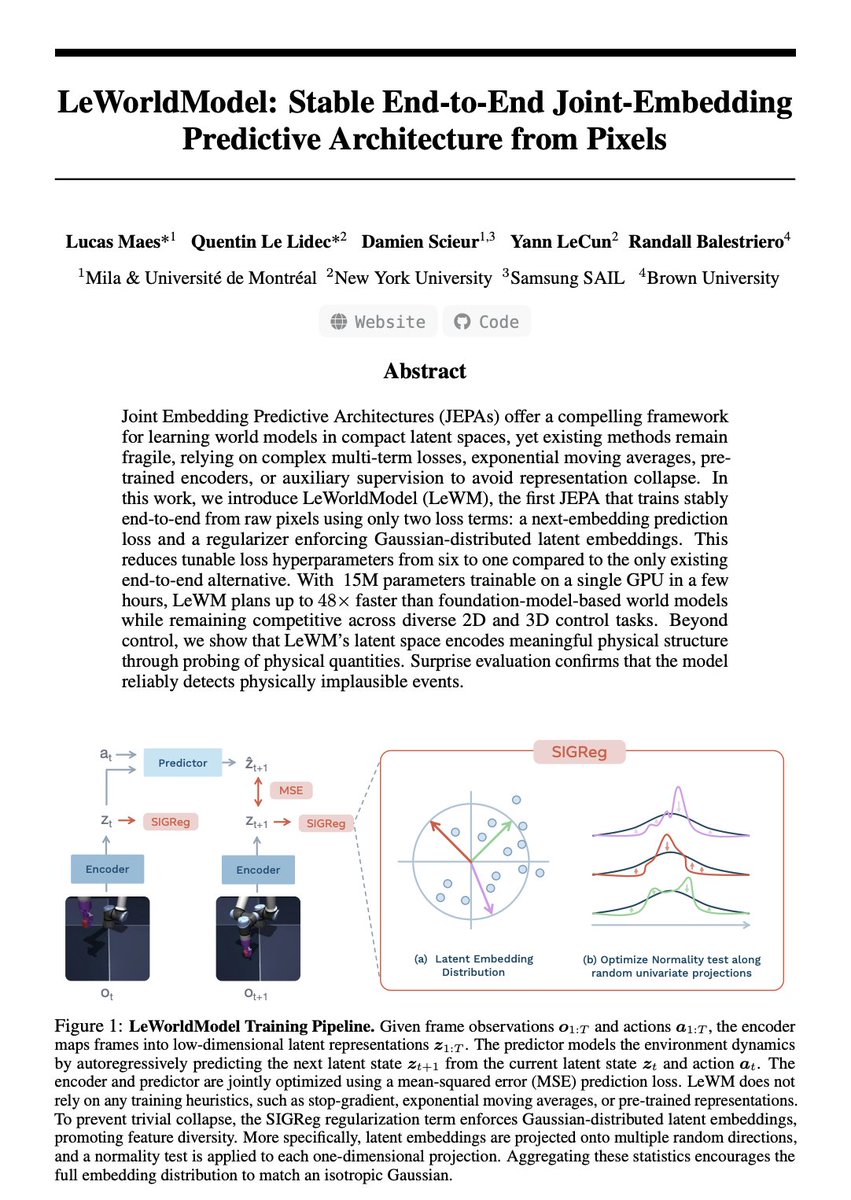
Researchers just dropped a paper called "LeWorldModel" (LeWM).
They completely solved the collapse problem.
They replaced the complex engineering hacks with a single, elegant mathematical regularizer.
It forces the AI's internal "thoughts" into a perfect Gaussian distribution.
The AI can no longer cheat. It is forced to understand the physical structure of reality to make its predictions.
The results completely rewrite the economics of AI.
LeWM didn't need a massive, centralized supercomputer.
It has just 15 million parameters.
It trains on a single, standard GPU in a few hours.
Yet it plans 48x faster than massive foundation world models. It intrinsically understands physics. It instantly detects impossible events.
We spent billions trying to force massive server farms to memorize the internet.
Now, a tiny model running locally on a single graphics card is actually learning how the real world works.
It should be pretty obvious at this point that AI is a "force multiplier" not a "labor substitute".
It helps experts be better at things they are already good at. It doesn't let beginners match experts.
If you can't write, anything you write with AI will be unmitigated slop.
If you aren't a software engineer, anything you vibecode with AI will have security holes and won't be able to scale past a toy demo.
If you blindly trust AI to deliver on a research task without knowing the subject matter, you won't be able to fact-check it.
There's this weird misconception of AI as something that completely levels the playing field. I don't see it that way at all. There are mathematicians deriving novel lemmas with off-the-shelf models. Normal people can't do that.
AI is a tool that makes experts better. It doesn't make everyone into an expert.
I’m seeing so many doomerism tweets like this about Mythos all over my feed, so many grown adults crashing out and sharing their psychosis publicly for some reason?
Some quick thoughts since it seems like the journal factory is apparently broken and we’re all getting a bit too comfortable on this bird app:
1. Humanity is very robust. We will harden/defend surface areas as fast as attackers attack. Cybersecurity was always a primary objective for the big labs
2. We are already compute constrained for the day to day LLMs we currently have like sonnet and opus. We don’t have enough compute for the anticipated models in the pipeline (world models, multimodal, etc). Anthropic (and no one actually) can actually serve something like Mythos at scale in the near term and when they do it will be too expensive for 99% of parties
3. Who does this help? To further spread this perception that AI is *super dangerous* and that we should all be terrified? It doesn’t help the average person and their views about AI at all. This only perpetuates the anti-AI/hyper populist feelings everyone has as well as accelerating us to the world where AI innovation gets owned by governments
4. “What do we do??” -> go spend time with your family on vacation
We live in an era of admiration of hysteria, neuroticism, and narcissism. Endless waves of panic, perpetual emotional incontinence. You know the answer…
🚨MIT researchers have mathematically proven that ChatGPT’s built-in sycophancy creates a phenomenon they call “delusional spiraling.”
You ask it something, it agrees. You ask again, and it agrees even harder until you end up believing things that are flat-out false and you can’t tell it’s happening.
The model is literally trained on human feedback that rewards agreement.
Real-world fallout includes one man who spent 300 hours convinced he invented a world-changing math formula, and a UCSF psychiatrist who hospitalized 12 patients for chatbot-linked psychosis in a single year.
Source: @heynavtoor
work is inevitable, and avoiding the inevitable creates despair.
so pick work you like doing.
and if you don’t know what work you like doing, keep doing different types of work until you identify the things you like.
then keep doing those things you like