Introducing OpenAI’s Dots x Higgsfield.
Your always-on Higgsfield creative crew keeps working while you’re away.
Check in by text, call or email, and pause the work whenever you need.
Powered by GPT-6.1 Sol.
Introducing Claude Fable 5: a Mythos-class model that we’ve made safe for general use.
Its capabilities exceed those of any model we’ve ever made generally available.
Meet "Tawan" (ตะวัน means “The sun” 🌞)
20-min Demo
AI Animated Film experiment (full feature is 90 mins)
With a $500 budget and 1.5 months of work, this story is based on my original idea from 2010... and today, the technology is finally ready to bring it to life.
AI showed me that solo creators can now manage an entire animation workflow. No need to pitch to big studios—you can fund yourself and bring your own stories to life. Without AI, this would still be stuck in my head.
(Of course, the quality is still far from high-budget films from big studios that have 300-600 people behind them, but I think the gap will close step by step in the future.)
This animated created by Seedance 2.0 on @dreamina_ai and @kinovi_ai and opening scene by @midjourney - thank you for watching.
We’re excited to announce that Pudgy World, our free to play browser-based game, is now live.
Explore 12 unique towns across The Berg, help Pengu find Polly, and play mini-games, all on @PudgyWorld_.
Play now: https://t.co/x7lkMt8Rre
MACHI BIG BROTHER HAS $10K LEFT
In the last 6 months Machi Big Brother has lost $74 Million - attempting to leverage long ETH since September, when ETH was at $4.7K.
He now has $8.5K left in his HL account. It appears that he is almost out of money.
saying nfts are dead is incredibly short sighted.
nfts represent true decentralized digital ownership. and the world is getting more digital, not less.
innovations continue to emerge from nft technology - like RWAs - which can bridge the gap between digital and physical. and we haven’t even started to scratch the surface of what they can mean for dozens of other industries.
the way people use nfts will continue to change. their purpose will evolve. for years they were largely used as instruments for people to gamble. we might not see another year like 2021 and that’s ok! focus can shift now to driving value vs just speculation.
nfts are important building blocks for a future where people take ownership over their digital assets and identity. where culture trades and creators reap the benefits from their own success.
and they’re an essential part of an integrated strategy at opensea - one place where you can own and trade everything onchain.
onward and upward.
There have recently been some discussions on the ongoing role of L2s in the Ethereum ecosystem, especially in the face of two facts:
* L2s' progress to stage 2 (and, secondarily, on interop) has been far slower and more difficult than originally expected
* L1 itself is scaling, fees are very low, and gaslimits are projected to increase greatly in 2026
Both of these facts, for their own separate reasons, mean that the original vision of L2s and their role in Ethereum no longer makes sense, and we need a new path.
First, let us recap the original vision. Ethereum needs to scale. The definition of "Ethereum scaling" is the existence of large quantities of block space that is backed by the full faith and credit of Ethereum - that is, block space where, if you do things (including with ETH) inside that block space, your activities are guaranteed to be valid, uncensored, unreverted, untouched, as long as Ethereum itself functions. If you create a 10000 TPS EVM where its connection to L1 is mediated by a multisig bridge, then you are not scaling Ethereum.
This vision no longer makes sense. L1 does not need L2s to be "branded shards", because L1 is itself scaling. And L2s are not able or willing to satisfy the properties that a true "branded shard" would require. I've even seen at least one explicitly saying that they may never want to go beyond stage 1, not just for technical reasons around ZK-EVM safety, but also because their customers' regulatory needs require them to have ultimate control. This may be doing the right thing for your customers. But it should be obvious that if you are doing this, then you are not "scaling Ethereum" in the sense meant by the rollup-centric roadmap. But that's fine! it's fine because Ethereum itself is now scaling directly on L1, with large planned increases to its gas limit this year and the years ahead.
We should stop thinking about L2s as literally being "branded shards" of Ethereum, with the social status and responsibilities that this entails. Instead, we can think of L2s as being a full spectrum, which includes both chains backed by the full faith and credit of Ethereum with various unique properties (eg. not just EVM), as well as a whole array of options at different levels of connection to Ethereum, that each person (or bot) is free to care about or not care about depending on their needs.
What would I do today if I were an L2?
* Identify a value add other than "scaling". Examples: (i) non-EVM specialized features/VMs around privacy, (ii) efficiency specialized around a particular application, (iii) truly extreme levels of scaling that even a greatly expanded L1 will not do, (iv) a totally different design for non-financial applications, eg. social, identity, AI, (v) ultra-low-latency and other sequencing properties, (vi) maybe built-in oracles or decentralized dispute resolution or other "non-computationally-verifiable" features
* Be stage 1 at the minimum (otherwise you really are just a separate L1 with a bridge, and you should just call yourself that) if you're doing things with ETH or other ethereum-issued assets
* Support maximum interoperability with Ethereum, though this will differ for each one (eg. what if you're not EVM, or even not financial?)
From Ethereum's side, over the past few months I've become more convinced of the value of the native rollup precompile, particuarly once we have enshrined ZK-EVM proofs that we need anyway to scale L1. This is a precompile that verifies a ZK-EVM proof, and it's "part of Ethereum", so (i) it auto-upgrades along with Ethereum, and (ii) if the precompile has a bug, Ethereum will hard-fork to fix the bug.
The native rollup precompile would make full, security-council-free, EVM verification accessible. We should spend much more time working out how to design it in such a way that if your L2 is "EVM plus other stuff", then the native rollup precompile would verify the EVM, and you only have to bring your own prover for the "other stuff" (eg. Stylus). This might involve a canonical way of exposing a lookup table between contract call inputs and outputs, and letting you provide your own values to the lookup table (that you would prove separately).
This would make it easy to have safe, strong, trustless interoperability with Ethereum. It also enables synchronous composability (see: https://t.co/9jy6v1X6Fw and https://t.co/gZmu3YjebM ). And from there, it's each L2's choice exactly what they want to build. Don't just "extend L1", figure out something new to add.
This of course means that some will add things that are trust-dependent, or backdoored, or otherwise insecure; this is unavoidable in a permissionless ecosystem where developers have freedom. Our job should make to make it clear to users what guarantees they have, and to build up the strongest Ethereum that we can.
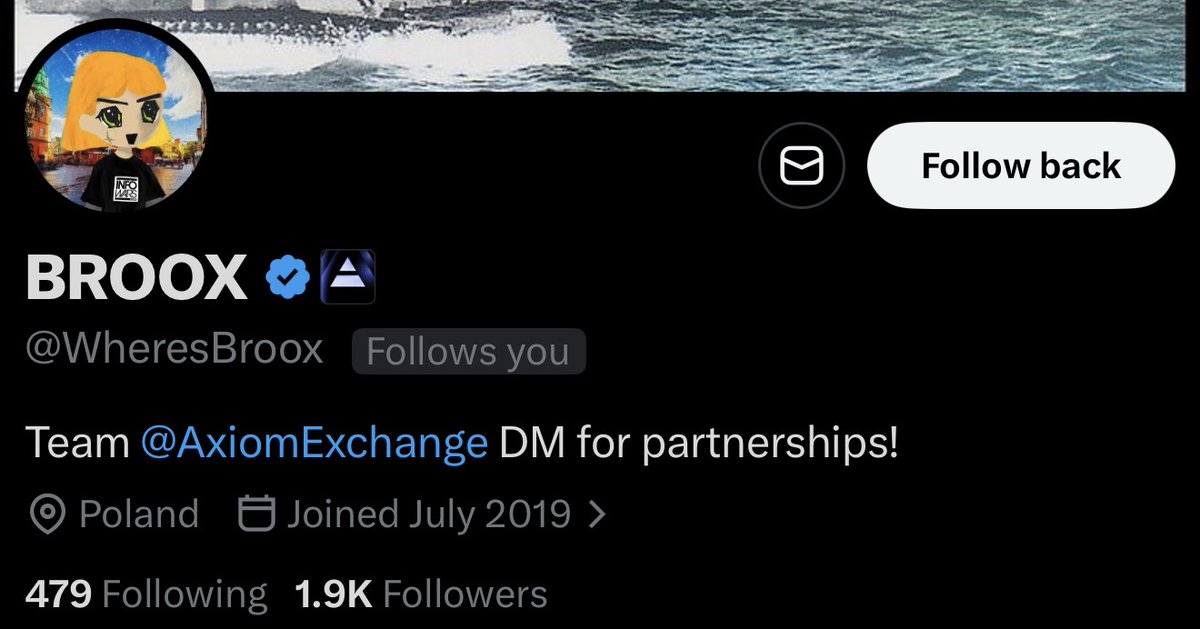
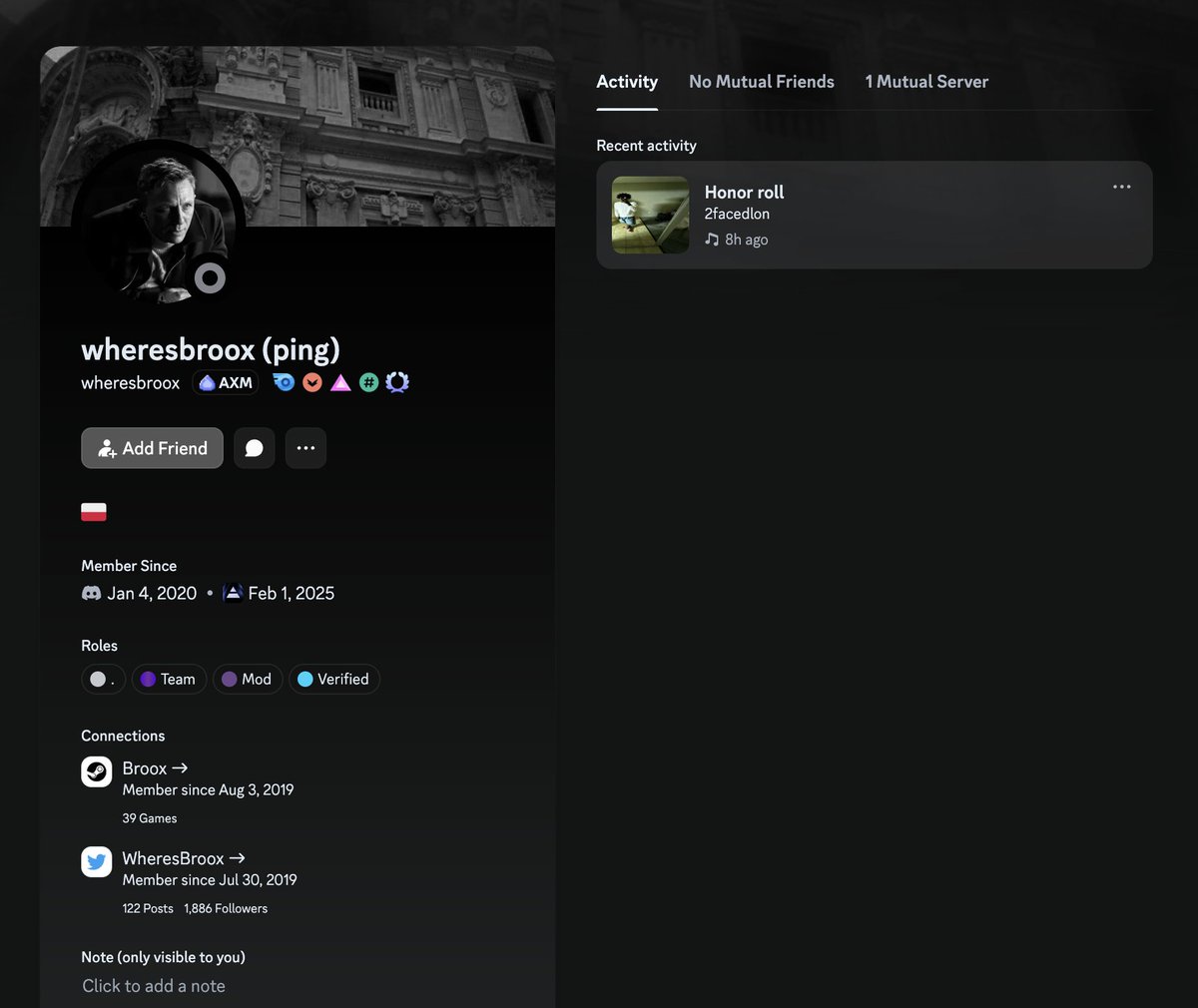
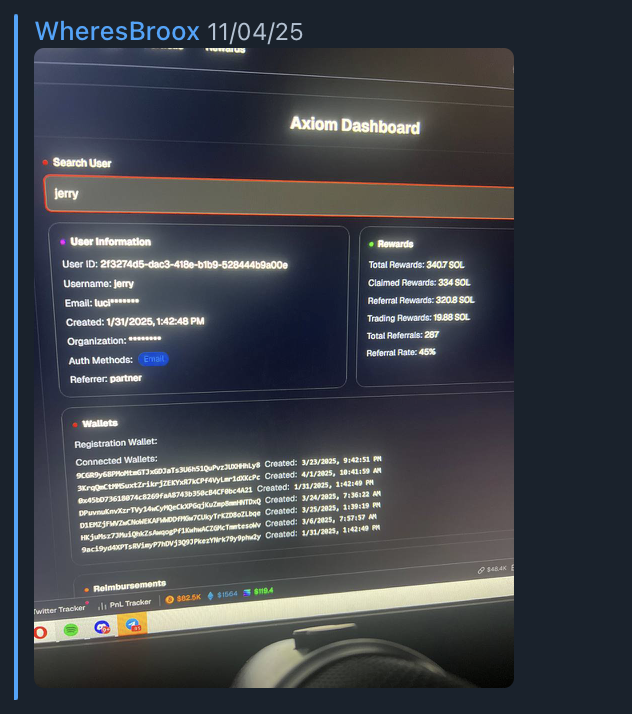
1/ Meet @WheresBroox (Broox Bauer), one of the multiple @AxiomExchange employees allegedly abusing the lack of access controls for internal tools to lookup sensitive user details to insider trade by tracking private wallet activity since early 2025.
❤️🔥HOW TO ONE-SHOT PREMIUM CINEMATIC WEBSITES WITH AI
1) Design system first — AI second
Never hit “generate” with a vague prompt. Paste your full token system at the top:
css--background: 0 0% 0%
--primary: 0 0% 95%
--accent-warm: 25 90% 55%
Define every pattern (pill navs, liquid-glass cards, glow accents, scroll behaviors). Gemini 3.1 follows it like a $15k senior designer.
2) Feed real cinematic video assets
Forget static screenshots. Drop exact video URLs: hero_bg.mp4, services_card.mp4, etc. Tell it:
“autoplay”
“loop”
“muted”
“object-cover”
“60% black overlay”
Instant Hollywood feel instead of flat AI slop.
3) Lock in typography + micro-animations upfront
Specify: Plus Jakarta Sans (or your custom), clamp() sizes, tracking -0.02em, framer-motion stagger fades, backdrop-blur on scroll, icon glows with drop-shadow.
Ditch default Inter + Lucide or it screams “AI template”.
4) Blueprint every section in exact order
List them like a film script:
Section 1 → Fixed pill navbar with scroll state change
Section 2 → Full-vh hero video + clamp headline
Section 3 → BigLinks with 12-column glowing icon grid
…right down to the final CTA
Include asset list and mobile rules. One prompt = complete production-grade site.
5) Bake anti-slop rules into every prompt
“No generic gradients. No light mode. Editorial dark cinematic only. Reference Awwwards-level motion. Use glassmorphism + specular highlights.”
This is my secret sauce for Apple-level output.
6) Iterate with visual references only
Generate → screenshot the part you love/hate → new prompt:
“Keep the exact design system, improve this section to match the attached ref, add smoother framer-motion transitions.”
Zero guessing.
7) Fonts, icons & details separate the pros from the templates
Swap Lucide for custom SVGs with orange glows. Add subtle hover scale-ups, parallax layers, 3D hover cards via Antigravity + Google Flow.
These 5% tweaks make it look custom-built, not AI-generated.
The real issue isn’t the AI.
It’s that most people type “make a beautiful website” and pray.
You treat it like briefing a world-class studio — you win every time.
(Pro tip: the electric vehicle landing page in my last post? Built with prompt #4 above in under 2 minutes.)
Copy, tweak, ship. Let’s see what you build
Claude in Excel is now available on Pro plans.
Claude now accepts multiple files via drag and drop, avoids overwriting your existing cells, and handles longer sessions with auto compaction.
Get started: https://t.co/cAMDXM1h7r