Regarding the recent matter involving my LBank account and trading restrictions, after several rounds of communication with LBank and a further review of the platform’s current User Agreement, campaign rules, KYC requirements, and risk-control policies, I would like to make the following statement:
During our discussions, I reviewed and gained a better understanding of the relevant platform rules concerning the issues raised by LBank, including the operation of multiple accounts, the use of virtual environments, and irregularities in device environments. I also recognize that, in the course of using my accounts and conducting trading activities, there were certain methods of use and activities that did not comply with the platform’s relevant rules.
At the time, I was not fully aware that these methods of use could fall within the scope of the platform’s risk-control standards. However, through our discussions, I have also come to understand that an exchange needs to establish and enforce relevant rules and risk-control measures in order to protect both the platform and its users.
I apologize for the negative impact on LBank caused by the information I previously published publicly in connection with this matter.
I have decided to put this matter behind me and will not pursue it any further.
Going forward, I will strictly comply with the platform’s User Agreement, trading rules, campaign rules, and KYC requirements, and will participate in trading and related activities in compliance with the applicable platform rules.
I would like to thank LBank for its communication and coordination throughout the resolution of this matter.
I've been following the @solyfw34 case since the first Coinness report, and now that it's escalated to a VC-mediated meeting, a booked media interview, and planned complaints to Bithumb and DAXA, it's worth doing what few commentators have bothered to do: put this dispute inside the actual framework of how exchange risk control works across the industry, and see what survives.
Start with the industry baseline. Every serious exchange — Binance, OKX, Bybit, Bitget — runs automated surveillance on a matrix of signals: login environments, device fingerprints, emulator and virtual-machine detection, account clustering, and order-timing analysis. Virtual environments and device modification tools aren't edge cases; they're the single most common technical signature of coordinated multi-account operations, which is why every platform's user agreement explicitly names them as freeze triggers. And here's the part that frustrates users but is operationally non-negotiable: mid-review, an exchange cannot itemize its evidence publicly. Disclosing which fingerprints, which order clusters, which linked accounts triggered the flag is a roadmap for every manipulation ring watching. "They won't tell me exactly which trades were abnormal" feels like stonewalling. In risk-control practice, it's the standard.
Now look at what this specific case actually contains, per the risk-control message the trader himself published: virtual environments used for registration or login, device modification tools, abnormal device fingerprints, emulator-related features, plus position timing consistent with coordinated market activity. Whatever you think of LBank, that combination is not a "profitable trader got punished" story — it's a "surveillance system flagged a technical pattern shared by organized multi-account abuse" story. The trader says he traded major altcoins with his own capital and has posted trading history to prove it. That's a legitimate rebuttal. But screenshots of profitable trades answer a question nobody asked. The open question is the environment layer, and months in, it remains unanswered in every post — including this latest one announcing media tours and global victim coalitions.
The escalation path deserves the same cold analysis. Note the sequence: a formal legal notice with a seven-day deadline, then public disclosure, then a brokered meeting, then — upon the meeting's failure — media, regulators, and crowd recruitment. DAXA, it's worth clarifying, is a self-regulatory alliance of licensed Korean exchanges; it has no jurisdiction over foreign platforms, and Korea's own regulators have been blocking unregistered offshore exchanges — KuCoin, MEXC, BingX among them — rather than adjudicating individual account disputes on them. Which means these steps generate pressure, not rulings. The venue that actually compels document production and binds both sides is arbitration or court, and its absence from every announced step is, at this point, a pattern rather than an oversight.
In fairness — and professional honesty requires this — LBank's conduct has genuine weak points. The October 14 message named no specific orders, no linked accounts, no agreement clauses, and "the relevant abnormal funds will not be released" is bureaucratically vague in a way that would infuriate any user. More substantively: restricting futures trading while leaving open positions the user could no longer manage, which were then liquidated in a falling market, is a real harm with a real number attached, and the industry needs better norms for position wind-down during reviews. These are legitimate criticisms, and the trader is right to force them. But they're process failures, and process failures get compensated through negotiation and legal channels — which is what makes the pivot to a pressure campaign so strategically revealing.
So the honest verdict, from as neutral a seat as I can construct: this is not a simple story in either direction. It's a documented surveillance flag meeting a documented communication failure, and both sides are now choosing their battlegrounds — one choosing evidence channels it controls, the other choosing narrative channels it controls. The media interview could settle a lot if it addresses the environment findings head-on. If it spends forty minutes on liquidation losses and "unreasonable demands" without touching virtual environments or device fingerprints, it will have told us everything — by omission. Watch what gets answered, not what gets announced.
#LBank #CryptoExchange #RiskManagement #CryptoSecurity
Ehrliche Meinung: Wenn LBanks Beweise echt sind, ist diese Kampagne in dem Moment tot, in dem die Dokumente öffentlich werden, und wenn sie gefälscht sind, werden Franks Anwälte reich. So oder so liegt die Wahrheit irgendwo in einem Ordner, und BEIDE Seiten entscheiden sich für Tweets statt für Ordner. Komisch, dass nur eine Seite ständig verspricht, ihn „später” zu öffnen.
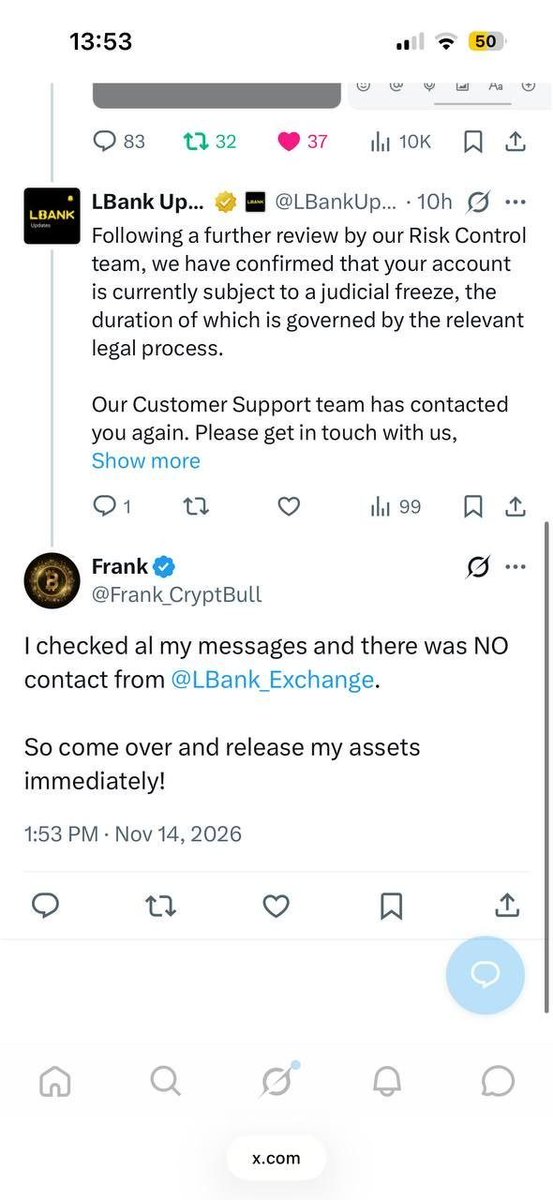
Look, I've been following this LBank situation for a while now, and I think it's time someone laid out what we actually know versus what everyone's assuming. LBank has stated clearly that this is a judicial freeze — meaning a court or investigating authority ordered it, not the exchange. And here's the thing: we've literally just watched the exact same scenario play out on Binance this month. A user had 400k USDT locked by a Colorado federal court order, submitted all his source-of-funds documentation, and Binance still told him "we can't remove this, go talk to the court." Meanwhile Binance's own co-founder Yi He came out on November 14 explaining that judicial freezes typically run about six months, can be renewed, and can only be lifted by the requesting authority. So when LBank says "judicial freeze, we're following the proceedings, we can't unfreeze unilaterally" — that's not a sketchy excuse, that's the industry-standard description of how these cases work on every compliant exchange right now.
So what could actually be behind the freeze? Based on the documented Binance cases, there are a few realistic possibilities. The most common one: the funds, or part of them, touched a flagged transaction chain — maybe tainted USDT from an informal OTC deal, maybe proceeds connected to a hack or fraud investigation somewhere upstream. Yi He literally warned users this week that receiving USDT from suspicious sources can get your account restricted even if you personally did nothing wrong, and law firms that handled Binance's post-Ronin freezes confirmed plenty of innocent traders got caught exactly this way. Another possibility, straight from the Luo v. Vuong case on Binance: a law enforcement officer directing a freeze as part of a criminal investigation — that one locked $9.5 million and it's been running since 2022. It could also be a cross-border judicial assistance request, which adds months of bureaucracy by default. Notice what all these scenarios have in common: none of them require LBank to be the bad actor, and none of them are within LBank's power to resolve.
That said, let's be honest — we can't fully close this case from the outside, and pretending otherwise would be just as dishonest as calling it a scam. There are real questions that only more information can answer: Which authority issued the freeze, and in which jurisdiction? What's the scope — the whole account or specific funds? Is the user a suspect, a witness, or just an unlucky counterparty in a tainted funds chain? What exactly has been communicated between LBank and the account holder behind the scenes? Four months is genuinely a long time to wait with $950k locked, and the user's frustration is completely understandable — I'd be furious too. But frustration isn't evidence, and right now the public record has one side telling a story and the other side constrained by the confidentiality rules that come with active judicial matters. Anyone claiming certainty about who's right here is guessing.
Which brings me to what should happen next. This situation doesn't need more ultimatums and viral threads — it needs the two sides talking. The user should push through the proper channels for the specific details they're entitled to: the freezing authority, the jurisdiction, the case reference, and what counsel in that jurisdiction can do to engage the court directly. LBank, for its part, should keep the communication line warm — share everything that's legally shareable, explain the process and realistic timelines honestly, and make sure the user never feels like they're shouting into a void. Binance's own policy is telling here: they direct frozen users to law enforcement for updates because the exchange is often legally barred from disclosing details. If that's the constraint LBank is under too, then structured, private, documented communication beats public escalation every single time.
And to everyone watching from the sidelines — maybe let's lower the temperature a notch. The "exchange stole $950k" narrative is a great engagement machine, but every comparable case we can actually check, from Binance's Colorado freeze to the four-year Luo litigation, points the same direction: court orders freeze, exchanges comply and preserve, courts eventually decide. Escalation helps nobody — it doesn't speed up a judge, it doesn't unlock funds, and if anything it hardens positions and makes the legal path messier. The fastest route to the truth is the boring one: both sides stay in contact, exchange information through the right channels, and let the judicial process run. When the case facts finally come out, we'll all get to judge this on evidence instead of vibes — and I have a feeling that outcome will look a lot more like the Binance cases than like the FTX comparisons flying around right now.
@LBank_Exchange@Frank_CryptBull
#judicialfreeze
People keep asking why LBank doesn't "just unfreeze it."
Because if it's a judicial freeze, that's literally not the platform's fucking decision to make
Hello, @LBank_Exchange
Is this your response after FOUR MONTHS?
You claim there's a judicial freeze and that customer support contacted the user. However, the affected customer says nobody from LBank has contacted him.
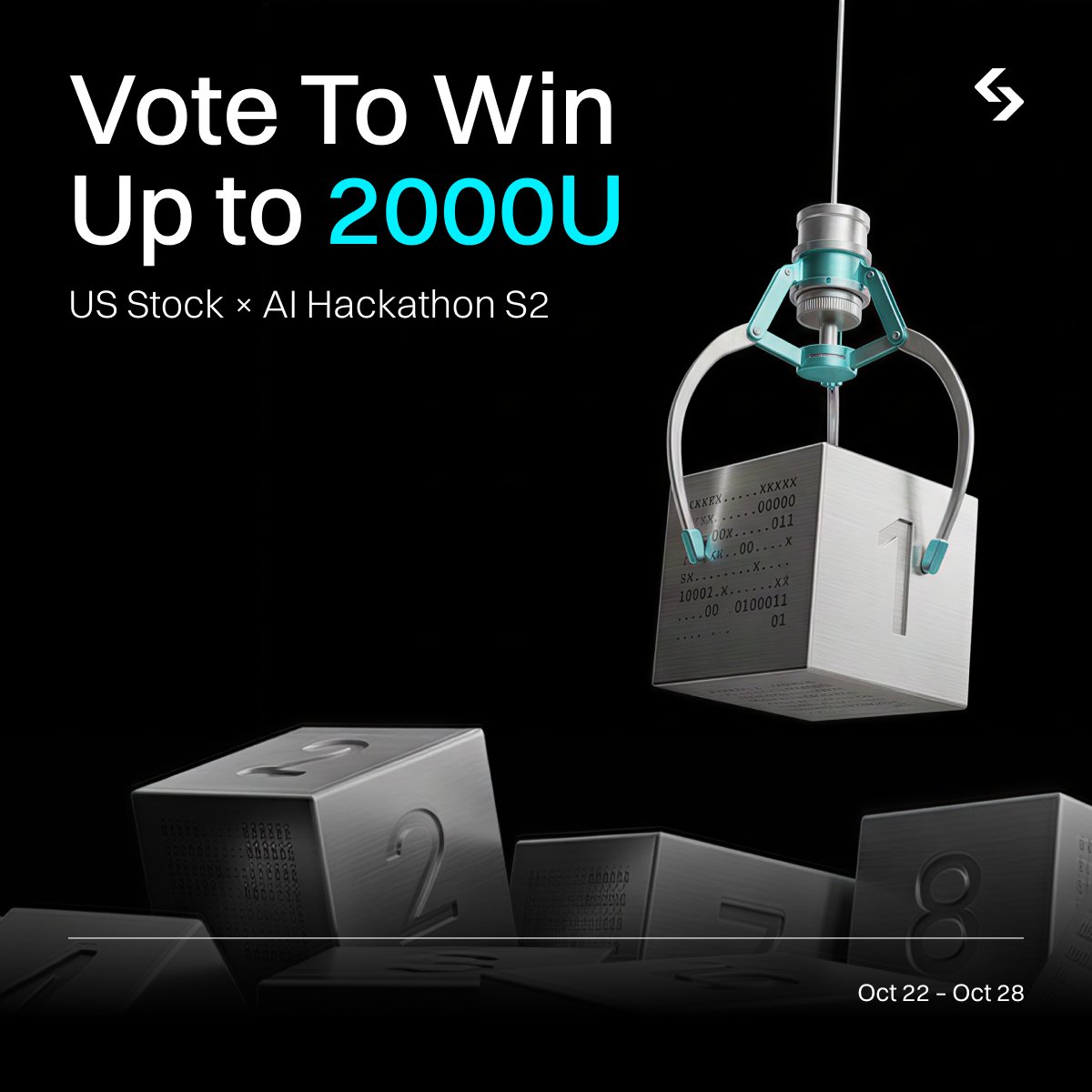
Pick the Hackathon S2 projects and win up to 2,000 USDT!
1. How to Vote
- Click the link in the comments to explore the submitted projects
- Comment with a project ID (e.g., SXXX) under this post
- Before Oct 28
2. Voting Rewards
- First person to correctly predict the winning project ID: 1,000 USDT
- Last person to cast a vote in the comments before the deadline: 1,000 USDT
- Rewards can be combined, with up to 2,000 USDT per person.
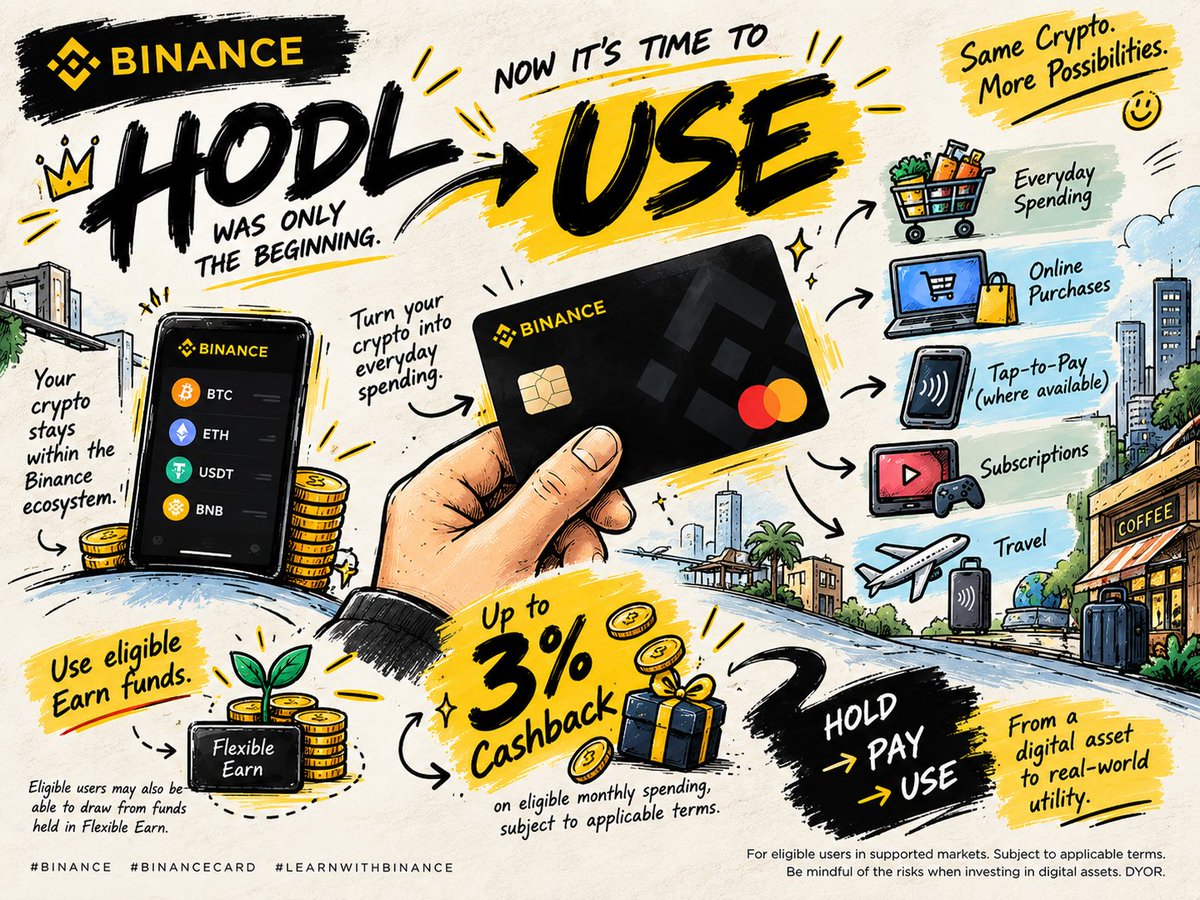
HODL was only the beginning.
The next question is what happens when crypto becomes something you can actually use.
With Binance Card, eligible users in supported markets can connect eligible crypto balances to everyday spending, including:
🛒 Purchases
💻 Online shopping
📺 Subscriptions
✈️ Travel
📱 Tap-to-pay where available
There’s also the possibility for eligible users to draw from Flexible Earn, plus up to 3% cashback on eligible monthly spending, subject to applicable terms.
The important part isn't the list of features.
It's the change in behavior.
Instead of:
Buy → Hold → Watch the chart
you can start thinking:
Hold → Pay → Use
That's a very different vision for digital assets.
The easier crypto becomes to use in normal life, the less the technology itself needs to be the focus.
The best payment experience may be the one where you barely think about the crypto underneath.
#Binance #BinanceCard #LearnWithBinance #BinanceAcademy
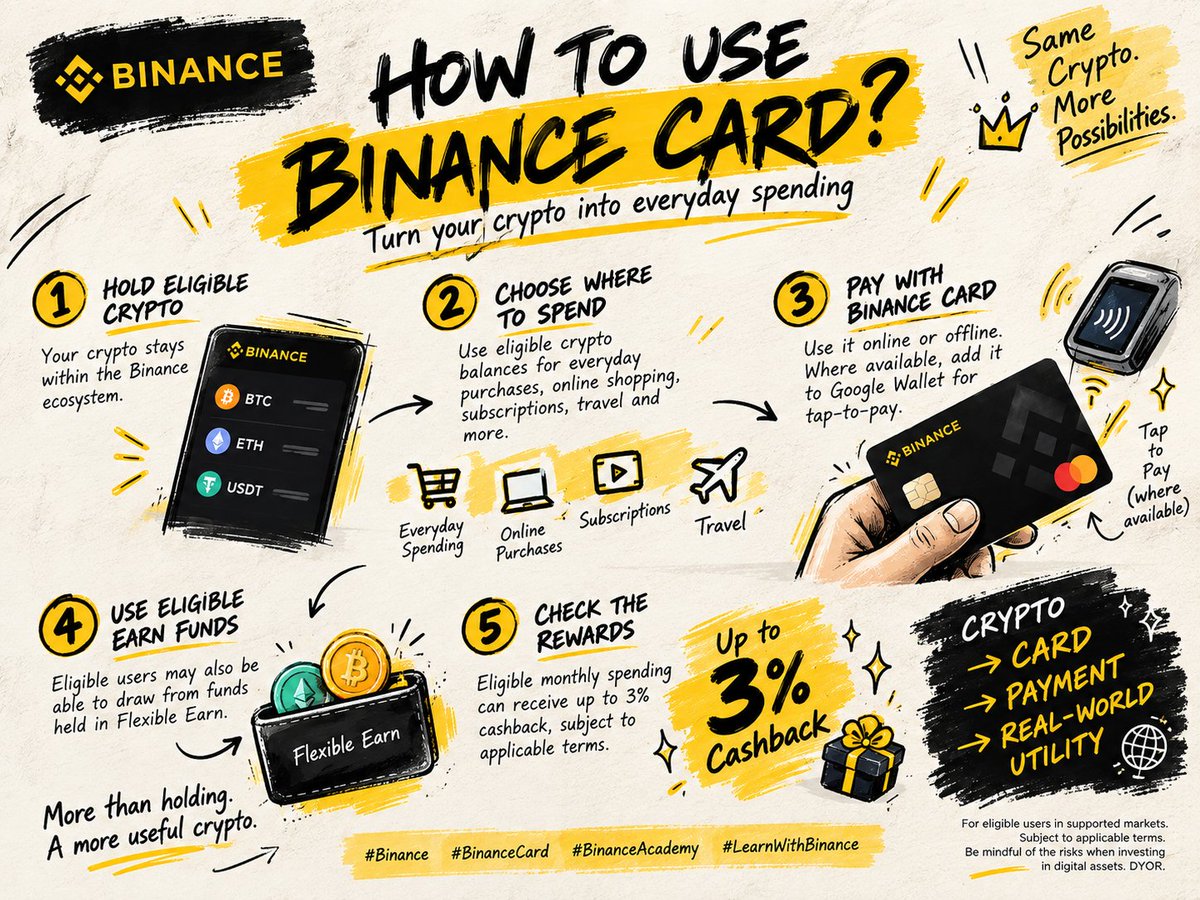
How does crypto actually become spendable? 💳
Here’s the simple @binance Card flow for eligible users in supported markets:
1️⃣ Hold eligible crypto
Your crypto stays within the Binance ecosystem.
2️⃣ Choose where to spend
Use eligible crypto balances for everyday purchases, online shopping, subscriptions, travel and other supported spending.
3️⃣ Pay
Use the Binance Card online or offline. Where available, eligible users can also add it to Google Wallet for tap-to-pay.
4️⃣ Use eligible Earn funds
Eligible users may also be able to draw from funds held in Flexible Earn.
5️⃣ Check the rewards
Eligible monthly spending can receive up to 3% cashback, subject to applicable terms.
So the basic idea is:
Crypto → Card → Payment → Real-world utility
The interesting part isn't simply having a crypto card.
It's removing the gap between owning digital assets and actually using them.
Availability, features and terms vary by market.
Same crypto. More ways to use it.
#Binance #BinanceCard #BinanceAcademy #LearnWithBinance