Not a good take.
DeFi infra today is materially more resilient than in prior cycles (partially also thanks to AI).
Also DeFi has improved across the board over the years:
- better risk engines + lending market structures
- formal verification, audits, bug bounties
- better cap management, oracle improvements
- automated monitoring and security operations inc. circuit breakers
- far better tooling for smart contract security (including AI-assisted analysis)
Ironically, a lot of the remaining attack surface now comes from web2-type opsec, which is why many DeFi teams are investing heavily into better processes (inc. SOC2-based), infra hardening, and internal controls.
DeFi is constantly evolving, but pretending the industry hasn’t matured significantly or that AI is only a net negative for DeFi security is simply not true. The same AI capabilities attackers use are also increasingly used by security researchers, auditors, and whitehats to strengthen protocols.
DeFi Will Win.
Everyone knows Arbitrum froze 30k ETH. What few know is that after the initial hack, the Hyperithm and Kelp teams successfully rescued 40k ETH. Huge respect to our team for making this happen.
There is another way to look at this.
The LayerZero/KelpDAO hack was caught in about an hour. Teams saved another $72M+ by reacting instantly. It took JPMorgan 20+ years of ignoring screaming red flags before Madoff’s $65B Ponzi finally collapsed.
Market manipulations like the RAVE token pump-and-dump got uncovered and crushed in under 24 hours by on-chain sleuths and exchanges. JPM’s own LIBOR, FX, and precious-metals rigging cartels ran for 5+ years before anyone outside the chat rooms noticed.
A $60B Enron-style rug pull would be damn near impossible to hide on-chain. JPM managed to keep that one going for years through offshore shells, fake trades, and straight-up hiding the debt from analysts and investors.
Maybe they’re concerned they wouldn’t be able to peddle opaque financial instruments on-chain without anyone noticing? You know, like the mortgage-backed securities they sold in the 2000s that triggered the $15+ trillion market meltdown.
Are they really “concerned about our industry”? Or are they just using the latest hack as perfect cover to push their “institutional” DeFi vision and JPM Coin while CLARITY Act negotiations are still live?
DeFi is not "scaring institutions away", it is scaring JPM that they will have to work honestly and transparently.
The Arbitrum Security Council has taken emergency action to freeze the 30,766 ETH being held in the address on Arbitrum One that is connected to the KelpDAO exploit. The Security Council acted with input from law enforcement as to the exploiter’s identity, and, at all times, weighed its commitment to the security and integrity of the Arbitrum community without impacting any Arbitrum users or applications.
After significant technical diligence and deliberation, the Security Council identified and executed a technical approach to move funds to safety without affecting any other chain state or Arbitrum users.
As of April 20 11:26pm ET the funds have been successfully transferred to an intermediary frozen wallet. They are no longer accessible to the address that originally held the funds, and can only be moved by further action by Arbitrum governance, which will be coordinated with relevant parties.
Update on mHyperETH:
Net exposure to rsETH is $3.5M, split between $1.5M on Mantle and $2.0M on Ethereum mainnet.
mHyperETH was not explicitly referenced in the previous update as we wanted to wait for clarity from Aave and KelpDAO on the recovery plan before sharing a detailed breakdown.
Strategist seed capital accounts for the majority of the $11.5M AUM, and we are in close contact with external LPs.
More details will follow as Aave and KelpDAO confirm their next steps.
Merkl is more than an incentive platform. With GENIUS live and CLARITY incoming, it's the distribution layer stablecoin issuers need to distribute activity-based rewards to their users.
Catch @GuillaumeNervo at @stable_summit to hear more!
Please check if you're deposited into any of these Morpho vaults and WITHDRAW, some of them still have liquidity. There's no reason to wait for the curators to force remove the Resolv markets and hope that they cover the (potential) bad debt, protect yourself.
Most of the vaults will force remove the Resolv markets in approx. 2 and half days (timelocks), socializing the bad debt across depositors.
List of vaults with withdrawable liquidity:
@gauntlet_xyz Seamless USDC Base: $10.26M of deposits, $9.88M of liquidity, 381k of exposure (3.7%)
Link: https://t.co/vfi93NGHei
@gauntlet_xyz USDC Core Mainnet - $20M in deposits, $7M in liquidity, $5M of exposure (25%)
Link: https://t.co/4Pvt17DwLR
@kpk_io USDC Yield Mainnet: $2.65M in deposits, $2.35M in liquidity, 221k in exposure (8.3%)
Link: https://t.co/TzbrG9Oguo
@Re7Labs USDC Mainnet: $2.14M in deposits, $1.66M of liquidity, 450k of exposure (20%)
Link: https://t.co/azvNhrqmwM
@Extrafi_io USDC Base- $1.26M in deposits, $834k of liquidity, 433k of exposure (34%)
Link: https://t.co/46kakwzaLq
@MEVCapital USDC Mainnet: $7M in deposits, $969k in liquidity, $52k of exposure (0.73%)
Link: https://t.co/6tCefbBSAW
KeyRock USDC Mainnet: $2.47M in deposits, $1.36M in liquidity, 36k of exposure (1.4%)
Link: https://t.co/uBeHYEOzUi
These vaults have no liquidity,:
Gauntlet USDC Frontier, Resolv USDC, 9Summits USDC, Apostro Resolv USDC, Clearstar Yield USDC, Clearstar USDC Reactor
It's still worth trying to withdraw, others might repay or deposit, you never know.
Use @antonttc's tool to spam the withdraws: https://t.co/eh0qkMyqox
Most of the vaults above with liquidity available have lent against wstUSR AFTER the incident, which makes it significantly less likely that @ResolvLabs cover any bad debt here. Please withdraw.
Good luck!
Despite the drop in the underlying asset, the lending market was completely unaffected. Some people are criticizing the curators simply because mF-one incurred losses. But I believe this is exactly what good curators are supposed to do, and that @SteakhouseFi handled the situation perfectly
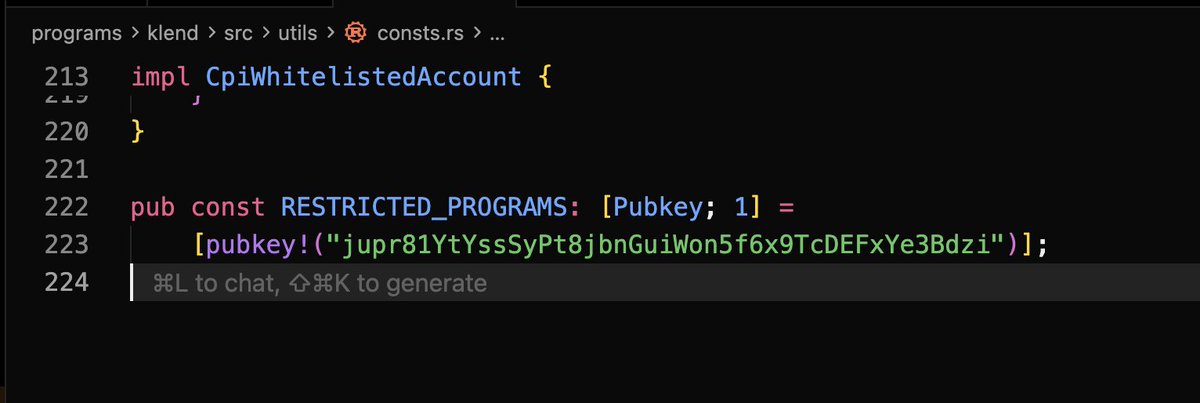
Your product is so good that competitors feel the need to block it at the program level.
@kamino is openly ignoring open-finance principles by stopping users from leaving their platform via @jup_lend refinancing, all while preaching ‘transparency.’
Peak 5/10 multisig power, able to upgrade the program whenever they want. What’s next, blocking users individually?
At least their code includes a hall-of-fame mention to Jupiter lend, finally something superior in their codebase.
‘If you can’t win fairly, just change the rules, it’s easier.”
Setting aside the issues with the GAIB airdrop itself, their collateral definitely looks strange.
First, their TVL is not 200M. I think it is 72M. I believe the remaining 138M already exited rather than migration. You can verify the circulating supply of AID (GAIB dollar) on chain - https://t.co/G0LlYyrtMr
According to their previous transparency dashboard, they had already issued 50M in loans.
So we are looking at 50M of loans backed by only 72M of stablecoins. That suggests they are holding a very large amount of illiquid assets