I resigned from Anthropic today. I spent the last three years doing pretraining research at both OpenAI and Anthropic. Neither company is acting responsibly. They are racing straight to self-improving superintelligence and gambling with our lives. More thoughts below.
The Oct 11 Crypto Crash — What Really Happened
TL;DR:
Roughly $60–90M of $USDe was dumped on Binance, along with $wBETH and $BNSOL, exploiting a pricing flaw that valued collateral using Binance’s own order-book data instead of external oracles.
That localized depeg triggered $500M–$1B in forced liquidations, cascaded into $19B+ globally, and earned the attackers about $192M via $1.1B in BTC/ETH shorts opened on Hyperliquid hours earlier, but minutes before Trump tariff announcement.
It wasn’t a USDe failure!! It was Binance’s design flaw, timed with macro panic (Trump’s tariffs) for cover.
What looked like chaos was actually a coordinated exploitation of Binance’s internal pricing system, amplified by a macro shock and systemic leverage.
1️⃣ The Setup
Binance’s Unified Account let traders use assets like USDe, wBETH, and BNSOL as collateral.
Instead of oracle or redemption prices, Binance valued these using its own spot market - a major vulnerability.
On Oct 6, Binance announced a fix to move to oracle-based pricing, but rollout wasn’t until Oct 14, leaving an 8-day window.
2️⃣ The Exploit
During that window, sophisticated actors manipulated Binance’s order books, dumping ~$60–90M of USDe, driving it to $0.65 on Binance only (still ~$1 elsewhere).
Because the Unified Account marked collateral to internal prices, this instantly wiped margin value and triggered $500M–$1B in forced liquidations.
Then, Trump’s 100% China tariff headline hit, magnifying panic and liquidity stress.
3️⃣ The Profit Engine
The same day, fresh wallets on Hyperliquid opened $1.1B in BTC/ETH shorts, funded by $110M USDC from Arbitrum-linked sources.
As the Binance cascade unfolded, BTC and ETH cratered, those shorts netted $192M in profit before closing out at the bottom.
Timing, precision, and funding paths all suggest coordination.
4️⃣ The Contagion
Binance liquidations dumped BTC/ETH/ALTs into thin books.
Other exchanges mirrored the collapse through cross-market bots.
Market makers hedged across venues were forced to unwind everywhere.
Result: $19B+ global liquidations, with many alts down 50–70% intraday, all triggered by <$100M of manipulated collateral.
5️⃣ Who’s at fault?
Binance: design flaw + delay in oracle rollout = root cause.
Exploiters: executed and timed the manipulation, profited via external shorts.
Ethena (USDe): not at fault - protocol stayed 1:1 collateralized, redemptions normal, peg held everywhere else.
6️⃣ Aftermath
Binance admitted “platform-related issues,” promised compensation for affected margin/futures/loan users, and rolled out minimum price floors + oracle integration.
USDe remained operational, and the incident is now a case study in how exchange-side pricing errors can trigger system-wide liquidations.
Bottom line:
A ~$90M dump on Binance and a $1.1B leveraged short elsewhere sparked a $19B bloodbath.
Not a stablecoin failure, but a masterclass in exploiting flawed collateral valuation during peak macro stress.
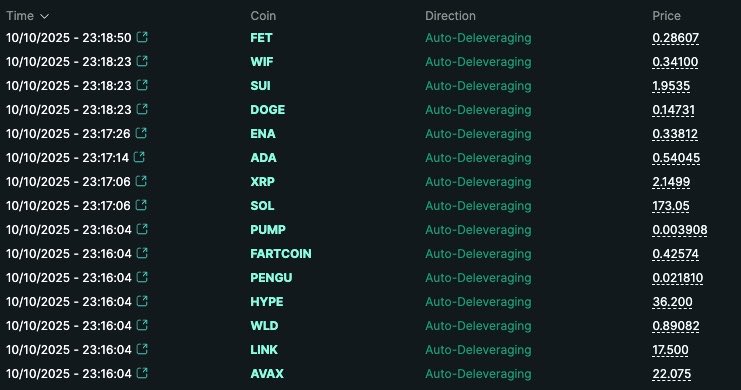
TLDR: During recent volatility, Hyperliquid had 100% uptime with zero bad debt. This was Hyperliquid’s first cross-margin ADL in more than 2 years of operation. ADL does not change the outcome for any liquidated users. While some specific ADL providing trades were unfavorable, the aggregate effect of ADL was that traders realized significant pnl by closing positions at favorable prices that were only briefly available.
--
It’s sad to see some people attack Hyperliquid to deflect from their own platforms’ issues. Solvency and uptime are the two most important properties of a financial system. These are table stakes for any trading system, and gaslighting to convince users otherwise is unethical and irresponsible.
Below is more analysis on how Hyperliquid’s margining system handled the extreme volatility.
Background on liquidations
For a perps system to be solvent, every position must be backed by a minimum amount of collateral. This is called the “maintenance margin.” When positions do not meet the maintenance margin requirement, they are taken over by the system to be liquidated. Earlier today, many altcoins dropped by more than 50% in a short period of time. When this happens, long positions at 2x or higher leverage must be liquidated, or else the system accrues bad debt.
There were billions of dollars worth of positions liquidated on Hyperliquid in a matter of minutes. In a permissionless system, each user chooses their own position sizing and collateralization. Any system that does not liquidate the necessary users is irresponsibly gambling with other users’ funds. On Hyperliquid, every order, trade, and liquidation is transparently verifiable onchain. Many other venues significantly under-report liquidation data. This cannot be compared apples-to-apples against the fully onchain picture of Hyperliquid.
Background on HLP
HLP is a protocol vault with permissionless deposits that 1) provides order book liquidity and 2) performs backstop liquidations. The first role is negligible, with HLP trading less than 1% market share. The focus of this post is liquidations.
Liquidations are first attempted against the order book, and any user can provide liquidity to these market liquidations. Backstop liquidations occur when the order book does not have enough liquidity to absorb an undercollateralized position. In this case, HLP takes over the position along with its collateral. For improved risk management, HLP is split into several child vaults, and each liquidation is only sent to one child vault.
Background on ADL
Auto-deleveraging (ADL) is the liquidation mechanism of last resort, when market and backstop liquidations do not work. See Doug’s thread (link in reply) for a thorough explanation on the details of ADL.
Every ADL event has two sides: the “triggered” side is undercollateralized, while the “providing” side is decided as a function of profitability and leverage used.
Similar to backstop liquidations, even though providers to ADL are profitable on average, there are no guarantees for any specific event. Some ADL providing trades were unfavorable, such as when only some components of long/short portfolio were closed. The system is designed to minimize ADLs because they are unpredictable even if ADL providing trades are profitable on average. Because HLP is a non-toxic backstop liquidator, ADL is a rare settlement of last resort. As far as I know, this was the first cross-margin ADL event on Hyperliquid mainnet (ADL is more common for isolated-only assets such as hyperps, which are not backstop liquidated by HLP).
Summary of events
Over the course of 20 minutes, HLP backstop liquidated billions of dollars worth of positions.
HLP's philosophy has always been to provide liquidity of last resort. Contrary to misconceptions, HLP is a non-toxic liquidator that does not pick profitable liquidations. Instead HLP is a public good for maintaining system solvency. In particular, Hyperliquid has no liquidation fees. HLP’s design, including its multi-component child vault system, is the product of countless simulations, and allows HLP to maximally serve the benefit of the protocol while managing its own risk.
In fact, the liquidator child vaults of HLP themselves became undercollateralized in the course of backstop liquidating as many user positions as possible. This is by design, where child vaults are isolated from the other components of the overall strategy. HLP is treated no differently from other users when participating in ADL. In aggregate, HLP's child vaults were the largest addresses on the triggered side of ADL by more than an order of magnitude. The addresses on the providing side of ADL against HLP’s child vaults realized hundreds of millions of dollars in additional profit relative to the prices shortly before and after the dislocation.
On other venues, the liquidation engine is not transparent and therefore may not be subject to the same strict margin requirements as for normal users. On these venues, the exchange could have backstop liquidated more positions, bearing increased solvency risk to extract hundreds of millions in business revenue. This is not an acceptable tradeoff for Hyperliquid.
Finally, I know that this is a difficult time for many traders, and I hope the community can continue to support each other and grow together. As a contributor to Hyperliquid, I’ll continue to work my hardest to build the best possible platform that can house all of finance. Times like this highlight the importance of transparency and fairness in the financial system.
1/ Since a lot of people are waking up to see their perps positions closed and wondering what the hell “Auto-Deleveraging” means, here’s a quick and dirty primer.
What is ADL? How does it work? And why does it exist?
Trade XYZ, c’est la suite du farm d’HyperUnit.
On est littéralement sur l’évolution la plus intéressante d’Hyperliquid, avec la première application à grande échelle du HIP-3.
Pour le moment, uniquement sous la forme de waitlist, je ne m’en fais pas : on aura l’occasion d’y revenir !
—> La possibilité de trader des stocks US H24, 7j/7
—> L’expérience utilisateur d’Hyperliquid
—> L’airdrop #2 d’Hyperliquid
—> Le $UNIT (ou le $TRADE ?)
Lien (référé) : https://t.co/H8kLfGQt3Z
💡 Il te faut un code référé pour rejoindre la waitlist.
Et comme l’a écrit @obymuralex, imagine juste qu’à l’ouverture, on ait des points rétroactifs pour le trade du volume spot Unit…
Juste imagine…
Hyperliquid
Le marché des cartes Pokémon tokénisées explose !
124,5 millions $ de volume en août 2025 (x5,5 depuis janvier), sur un marché total de 21,4 milliards $ pour les cartes à collectionner.
Comment ça marche ? (pour les débutants) :
1️⃣ Vos vraies cartes Pokémon sont stockées dans des coffres-forts sécurisés (Brink's, PWCC)
2️⃣ Chaque carte devient un NFT = certificat numérique de propriété
3️⃣ Vous pouvez échanger ce NFT instantanément avec n'importe qui dans le monde
4️⃣ Si vous voulez, vous "brûlez" le NFT et récupérez votre vraie carte par courrier
Les avantages sont vraiment là : frais réduits (2-4% vs 13% sur eBay), authentification garantie par PSA/BGS, pas de risques d'envoi postal, liquidité immédiate, possibilité de fractionnement pour les cartes rares.
The date is set 🐮🌝
@lamumudotxyz mint details are live:
– September 19th, 2025
– 4,500 supply
– 0.02 $ETH
– Ethereum mainnet
The Lamumu drop is almost here!
Pour ceux qui n’y croient pas, Hyperliquid génère autant de profits, voire plus, que le putain de Nasdaq.
Le tout en étant 11 dans l’équipe.
On-chain Nasdaq.
🚨 Le fondateur de Cobo annonce que l’iPhone 17 intègre une nouvelle sécurité mémoire au niveau matériel, appelée MIE.
C’est une énorme avancée pour les utilisateurs de crypto qui signent souvent des transactions ou qui ont beaucoup d’actifs.
Cette protection vérifie en temps réel la mémoire (EMTE), activée par défaut, et bloque la majorité des attaques zero-day (comme out-of-bounds ou UAF), tout en limitant les risques de fuites via des canaux cachés.
Il faut savoir que les failles liées à la mémoire représentent 70 % de toutes les vulnérabilités logicielles.
🚨 AIRDROP FEEDBACK @LineaBuild / @LineaAssoc
Everything is onchain and as we used to say: don’t trust, verify!
That’s something completely new for any airdrop and honestly very cool
LXP is onchain, LXP-L is onchain, LAM is onchain, all directly in your wallet, and we can calculate our allocation of Linea tokens. 100% aligned with transparency
=> Total LXP * LAM = 6,480,899,100 which represent 9% of the supply
=> Total LXP-L distributed = 2,880,399,600 which represent 4% of the total supply
You can find your LXP, LXP-L and LAM on:
Lineascan → Search for your wallet → Token holdings → Search and click on TAM → Check your balance
To calculate your allocation: 1,000,000 * LXP * LAM
Here are the tiers for the LAM:
Tier 1 - 0.000000001491
Tier 2 - 0.000000001640
Tier 3 - 0.000000001789
Tier 4 - 0.000000001938
Tier 5 - 0.000000002461
Tier 6 - 0.000000002640
Tier 7 - 0.000000002684
Tier 8 - 0.000000003132
Tier 9 - 0.000000004474
Tier 10 - 0.000000004847
Tier 11 - 0.000000007605
Tier 12 - 0.000000008053
Tier 13 - 0.000000008547
Tier 14 - 0.000000008724
Tier 15 - 0.000000009209
There are many tiers which is a good thing for the community. There’s nothing more frustrating than being just 1 LXP away from the next tier, which would have given you 30% more rewards
=> Between tier 1 and tier 15, there’s about a x6 multiplier regarding the LAM. But if you compare a wallet with 1700 LXP versus a wallet with 9000 LXP, it's about x30.
For reference, Arbitrum was somewhere between x13 and x16 and zkSync way more then everything else (I don't remember well and it's late, but it was something about x70)
x30 is a good compromise to reward well the users that go deep to gain LXP on each campaign while being active on the network all the year.
Can't wait to see the details of the LAM!!!
=> I saw some people who doesn't understand why efrogs or other communities didn't get anything: it's planned, but with the 1% of supply distribution. No much info about it yet, but it was never part of the 9% supply.
=> Something I've to say because I've make an analysis few months ago: your balance doesn't mind. I made a thread about wallets that had $6 (across every chain) and months later still had $6, yet they still received a LAM allocation. Some will say it’s good and others not
The issue is that Starknet made too much drama on CT with the 0.005 ETH minimum balance for the eligibility. I think Linea didn’t want to repeat Starknet’s mistake.
Here some stats regarding the token price:
$5B FDV: 0,0694
$10B FDV: 0,1389
$15B FDV: 0,2083
--------------------------------------------------
what you guys think?
i want to have the feedback from the happy and angry guys, let me know
Nouveau rebondissement dans l’affaire Linea
Tu as désormais 3 types de tokens différents sur ton wallet qui seront très probablement reliés à l’Airdrop de Linea.
1️⃣ $LXP (Linea Voyage XP)
Celui-là, tu l’as depuis un moment, ça correspond aux points que tu as marqués lors des différentes campagnes d’activité sur le mainnet.
À ça s’ajoute un équivalent en LXP qui correspond au NFT que tu avais récupéré lors de la campagne du testnet.
Spéculation : Il semblerait que ce soit le critère principal, et que 9 % de la supply serait distribuée proportionnellement à ces points + un multiplicateur.
2️⃣🆕 $LXPL (Linea Surge XP)
Distribué aujourd’hui, ça représente les LXP-L de la campagne de liquidité Linea Surge.
C’est proportionnel à la quantité de LXP-L que tu avais sur le dashboard, mais ce n’est pas exactement la même quantité.
C’est normal que tu en aies reçu moins que les points que tu avais, c’est le cas de tout le monde.
3️⃣🆕 $LAM (Linea Allocation Multiplier)
On n’a pas beaucoup d’informations dessus pour le moment, mais au vu du nom, on peut facilement spéculer qu’il s’agira d’un multiplicateur.
Il fonctionne avec un système de tiers, et tu peux savoir quel tier tu as en fonction de l’allocation en tokens que tu as reçue.
(Le 15e tier est le plus élevé et semble être lié au plus gros multiplicateur.)
Tier1 - 0.000000001491
Tier2 - 0.000000001640
Tier3 - 0.000000001789
Tier4 - 0.000000001938
Tier5 - 0.000000002461
Tier6 - 0.000000002640
Tier7 - 0.000000002684
Tier8 - 0.000000003132
Tier9 - 0.000000004474
Tier10 - 0.000000004847
Tier11 - 0.000000007605
Tier12 - 0.000000008053
Tier13 - 0.000000008547
Tier14 - 0.000000008724
Tier15 - 0.000000009209
Note : Les utilisateurs avec moins de 1 500 $LXP ne semblent pas avoir reçu de $LAM. Est-ce que c’est ça le seuil minimum de $LXP pour être éligible ?
Note² : Certains utilisateurs ont-ils des seuils intermédiaires ?
Note³ : Il semblerait que le multiplicateur dépende de ton activité on-chain pendant une période encore non déterminée.
=====
Voilà pour les derniers détails !
On devrait en savoir plus dès la semaine prochaine, avec peut-être un checker.
Lien pour check : https://t.co/CGvEeYoB2G
Le vol Paris-Rome coûte 89€ le mardi.
Le même vol atteint 299€ le vendredi soir.
Votre chambre d'hôtel passe de 89€ à 249€ le samedi.
Ce n'est un hasard. Mais un vol organisé à l'echelle mondiale
Voici la vérité sur l'arnaque des prix du weekend ( et comment y échapper) :