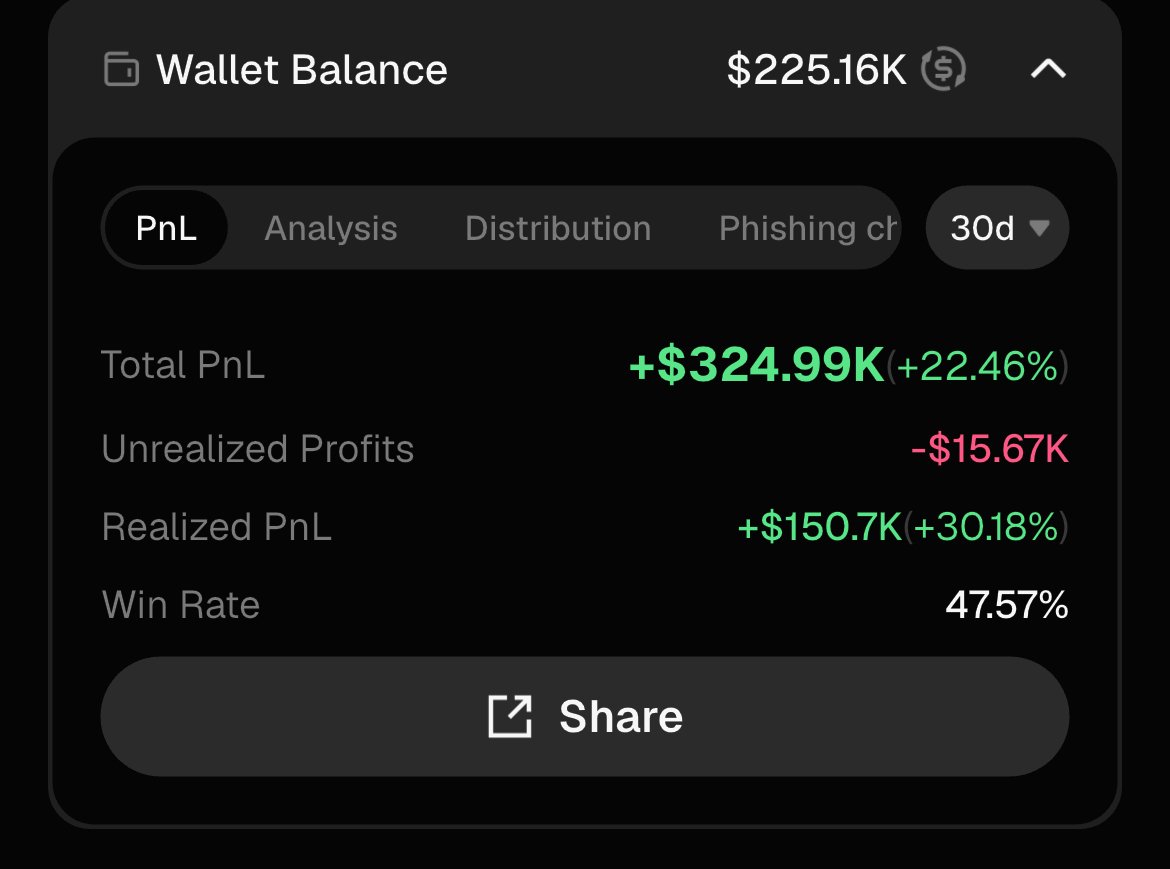
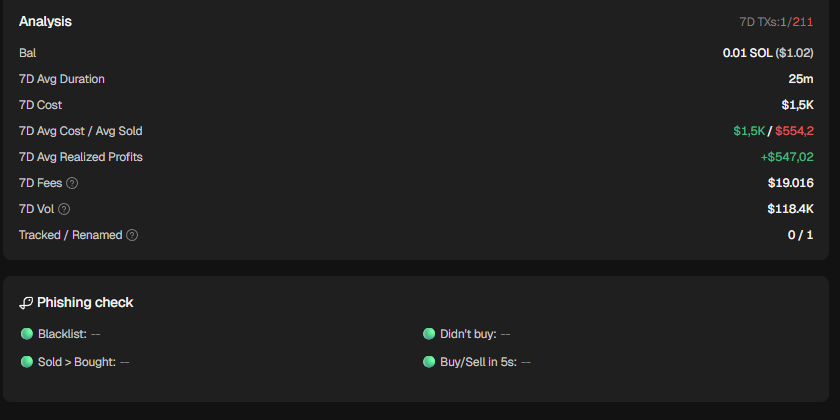
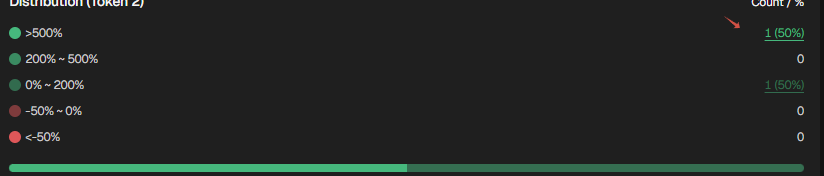
🐋 This Smart Money wallet has made $150,700 over the past 30 days.
The craziest part? Its win rate is only 47%. It only needs to be right less than half the time to make hundreds of thousands of dollars.
I scanned his portfolio. Here are the coins he’s aggressively accumulating right now 🧵👇
Here, you attach screenshots from his “Holdings” tab and list the tickers of the coins he holds the most of in his portfolio, adding a couple of your own thoughts on why they might go up.
💡 Lesson: With meme coins, you don’t need to aim for a 100% win rate. Cut your losses quickly and let your profits run.
Save this wallet to your watchlist: BprdjjAzFLoS2gVJqUVR1pdJpwCacNK4kctLTiMmcdSh
$0 → $115,000 per token in a matter of hours.
I found a wallet with a 100% win rate on $STUNK. But don’t rush to copy it—it’s a classic insider burner wallet.
Analysis of on-chain traces 🧵👇
The $STUNK token on Solana showed a trading volume of $2.5M. Meanwhile, the top 10 holders own just 2%—the distribution looked clean at first glance.
But in the Top Traders tab on GMGN, one address immediately stands out: +7,620% profit ($115k).
The first transaction in the wallet’s history—a bull’s-eye right at the peak.
Current balance: 0 tokens. The profit has been fully locked in and withdrawn from the coin’s ecosystem.
💡 Lesson: High PnL on a new token often indicates a scalper or an insider using a one-time wallet. It’s pointless to copy-trade such addresses—save them only to understand when “smart money” is exiting the market.
@cryptojourneyrs@solana I think that, lately, RH has been SOL's strongest competitor; out of all of them, it has the best chance. We'll keep an eye on it.
7 mistakes that destroy new memecoin traders
99% of newcomers to meme coins lose their entire deposit within the first month by making the same basic mistakes, and end up as exit liquidity for snipers and whales. Here are 7 pitfalls that wipe out portfolios, with real-world examples from the market.
1. Buying on a green candle (FOMO at the peak)
Newcomers see screenshots of other people’s profits in their feed, open the chart, see a vertical green candle, and buy out of fear of missing out.
Example: The $WIFDOG token surged 400% in an hour. You jump in at the very peak, thinking the trend will continue. A couple of minutes later, early traders and bots start aggressively taking profits, and your portfolio instantly drops by 70%. You sell at a loss in a panic, after which the price goes back up without you.
2. Failing to Verify the Smart Contract (Honeypots)
Blindly buying a token without checking the contract’s basic security using scanners (e.g., Token Sniffer or RugCheck).
Example: You find a token that’s rising steadily every minute. You buy $200 worth. An hour later, your balance is $2,000. You try to sell, but the DEX returns an error. It turns out the developer programmed a 100% sell tax into the smart contract or simply technically blocked the sell function for all wallets except their own. Your money is visible on the screen but frozen forever.
3. Magic Hands”(Failure to Take Profits)
Holding onto a meme coin for the sake of mythical goals imposed by the community (for example, “let’s reach the $1 billion cap”), forgetting that the lifespan of 95% of meme coins ranges from a couple of hours to a week.
Example: Your deposit has multiplied by 5x ($100 turned into $500). In a Telegram chat, the developer promises an imminent listing on a major exchange. You decide not to sell. Overnight, the project team drains the pool’s liquidity (a “rug pull”), and your $500 turns into $0.15. CT’s golden rule: cash out your initial investment at 2x, and let the “free tokens” continue to grow.
4. Buying Based on Influencers’ Posts (Blind Copy-Trading)
The blind faith that a popular Twitter account with 200k followers is recommending a token to make you rich.
Example: An influencer writes: “$PEPEAI — the next gem, loading up my wallets!” The crowd rushes to buy, and the price skyrockets. At that very moment, the influencer—who bought this token 12 hours ago at the absolute bottom—is systematically selling off their coins to this crowd. You’ve just paid for their new car.
5. Misunderstanding the Relationship Between Liquidity and Market Cap
Assessing a token’s potential based solely on Market Cap (market capitalization), without checking the size of the liquidity pool.
Example: You see a meme coin with a market cap of $5 million. You try to close your position and sell $3,000 worth of tokens. But there’s only $10,000 in the liquidity pool. Your trade causes massive price slippage, and instead of $3,000, you receive $800 in your wallet, causing the token’s price to plummet by 40% with a single order.
6. Revenge Trading
Attempting to recoup losses instantly after a painful loss, breaking all your own rules for selecting coins.
Example: You hit a $300 stop-loss on a substantial trade. Instead of closing the trading platform, you’re overcome by tilt. You take the remaining $700 and impulsively throw it into the first token you see in the “New Pairs” tab on DexScreener. Five minutes later, you lose that money too because the token turned out to be a scam.
7. Going All-In on a Single Token
Lack of bankroll management. Meme coins are a highly volatile environment with a negative expected value if you don’t control your risks.
Example: You have $1,000 to trade with. You find a “sure thing” and invest all $1,000 at once. The token drops by 80% (normal volatility for meme coins). You’re left with $200. Now, just to break even and get your $1,000 back, you need to find an asset that will rise by 500% (5x). Statistically, this is dozens of times harder than covering a loss from a standard $50 bet.