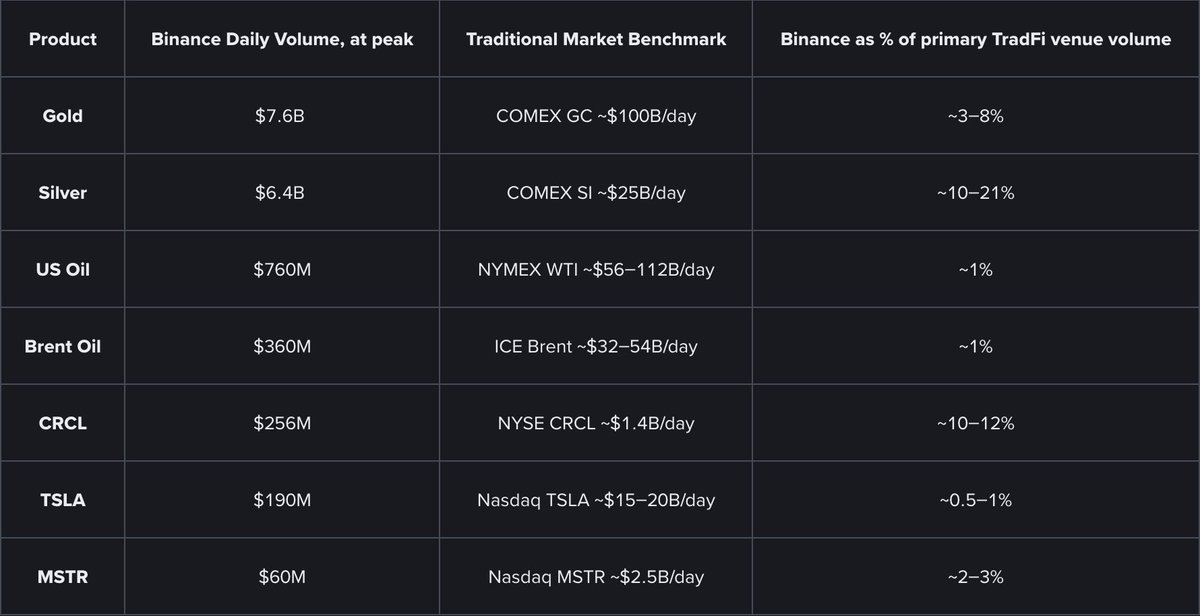
We feel like most people still see @binance as just a crypto exchange… but that take already feels kinda outdated.
Like, in just 90 days, it went from basically zero to doing around $7.6B daily in gold and $6.4B in silver. That’s not normal growth, that’s the kind of shift where you start asking where price discovery is actually happening now.
And the crazy part is, those numbers aren’t small in a “crypto” sense, they’re big even compared to traditional exchanges. It’s already doing multiples of places like MCX, DGCX, TOCOM, and even touching a noticeable share of SHFE. At that point, it’s not experimenting with TradFi… it’s operating at that level.
But what really clicked for us is the 24/7 angle.
News breaks at random times. Weekends, late nights, whenever. Traditional markets just… wait. But here, people are already trading, already reacting, already setting expectations before those markets even open. That kind of changes how everything gets priced globally.
And then you realize it’s not just about one asset anymore.
You’ve got crypto, gold, silver, oil, even equities, all sitting in the same place. No jumping between platforms, no fragmented setups. Just one continuous market where you can actually think in terms of a full portfolio instead of isolated trades.
Plus there’s this whole CeFi + DeFi overlap happening in the background. Liquid markets on one side, on-chain RWAs growing fast on the other. That combo of liquidity + programmability is kinda new if you think about how TradFi usually works.
Feels like the line between crypto and traditional finance isn’t something that’s coming later… it’s already getting blurry.
Anyway, worth paying attention to.
Trade the world, 24/7.
Ether Machine scraps SPAC merger with Dynamix
Ether Machine and Dynamix have mutually terminated their planned SPAC deal, citing unfavorable market conditions.
The canceled merger included plans for a $900M ETH treasury, with Ether Machine set to pay $50M as part of the agreement.
World Bank signals rapid $20B–$25B support capacity
The World Bank Group said it can quickly deploy up to $25B to economies impacted by the Iran conflict, using its crisis response toolkit.
The move aims to address shocks across oil, trade, and shipping amid rising global economic uncertainty.
Mike Tyson joins $TRUMP meme coin event lineup
@MikeTyson has been added to the $TRUMP meme coin gala at Mar-a-Lago on April 25, alongside other high-profile speakers.
The event targets top token holders, highlighting how meme coins continue leveraging celebrity and political ties.
Kraken gains Federal Reserve master account
Kraken Financial has received a Federal Reserve master account, becoming the first digital asset firm with direct access to U.S. payment rails like Fedwire.
The limited purpose account enables faster fiat settlement, marking a step toward deeper integration with traditional banking.
Most people see crypto as charts and cycles, but very few think about what it actually took to build this industry from scratch while everything was still uncertain.
That’s why Freedom of Money feels interesting to us. It’s a first-hand look from @cz_binance at how @binance grew from an idea into global infrastructure, all while the space was evolving faster than any rules around it.
A lot of what we see today comes from that phase where builders had to move forward without clear frameworks, focusing on users, security, and scaling something that didn’t really have a playbook yet.
It also adds a different layer knowing that all proceeds go to charity, which makes it feel more like sharing a journey than pushing a product.
Got us thinking about how we define ��freedom of money” in the first place. Is it just about access, or is it about something deeper like ownership and independence?
If you’re trying to understand where this space is going, hearing directly from builders might be worth it. Curious how others here think about it.
Feels worth reading just to understand how those early decisions were made and what actually carried forward.