what Polymarket on Metamask?? when on $RNBW
and today is very bullish $IN $MIRA $MVRK
Wild how the whole feed is waking up to @Infinit_Labs now.
I’ve been watching the flow for weeks.
Partnerships stacking nonstop.
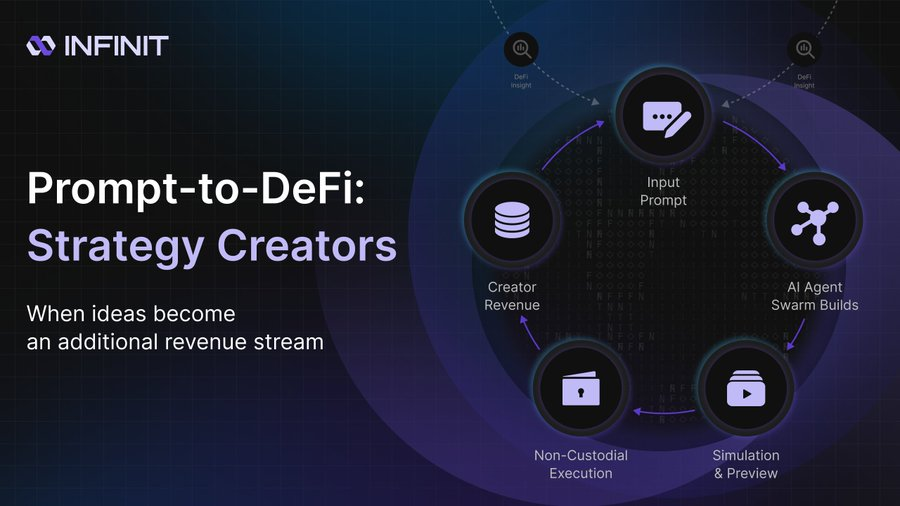
Prompt-to-DeFi about to hit the surface.
Real yield showing up before most even notice the pipes exist.
> Everyone talks sentiment.
> I look at behavior.
> And the behavior is loud.
> More integrations.
> More users locking.
> More strategies going live.
> Price finally catching up to fundamentals instead of the other way around.
This is what early infrastructure momentum feels like.
Quiet for months.
Then vertical.
Not advice.
Just saying: when an AI agent layer starts plugging into every major DeFi corridor at once, I pay attention.
And INFINIT is not slowing down.
> $MIRA $IN $ETH and $BOBA top gainers
People assume the danger is AI making a mistake.
It’s not. @miranetwork
The real danger is you believing it can’t.
> When enough money flows into a narrative, truth becomes optional.
> Benchmarks get massaged.
> Confidence gets inflated.
> And the models start speaking with a certainty they haven’t earned.
> Most systems don’t fail because they’re wrong.
> They fail because humans stop checking.
> We outsource judgment.
> We trust the output.
> We forget the underlying chaos.
Verification isn’t a philosophical stance.
It’s survival.
Especially when models start influencing credit decisions, trading signals, hiring pipelines, and risk scoring at industrial scale.
That’s why Mira approach matters.
Consensus.
Disagreement surfaced.
Signals interrogated before they reach the user.
Not “trust the model”.
Trust the verification.
In a world racing toward automated certainty, the only defensible edge is structured doubt.
And the teams building verification at the protocol layer
will define which AI systems remain safe enough to use
and which ones collapse under their own confidence.
Gm friends Gm $IN $MIRA $ARB $MVRK
Most people think DeFi scale comes from faster chains.
It doesn’t. @Infinit_Labs
It comes from turning knowledge into something that executes itself.
> Prompt-to-DeFi removes the part humans are worst at.
> Translation.
> You describe intent.
> The agents handle the mechanics.
> No spreadsheets.
> No manual wiring.
> No pretending complexity is skill.
• For creators, this isn’t “content monetization”.
• It’s leverage.
• Your insight becomes a strategy.
• Your strategy becomes code.
• Users execute it.
• And every execution pays you.
• Not sponsorship money.
• Not engagement crumbs.
• Actual recurring fees tied to real activity.
The system tests the logic.
Verifies components.
Keeps custody where it belongs.
You provide the edge.
The rails do the rest.
DeFi has always rewarded the few who could write code.
INFINIT rewards the ones who can think.
Ideas become infrastructure.
Creators become operators.
And the market decides who rises.
The window is open.
Not for long.
Gmira Everyone $MIRA $IN $MVRK $ETH
People talk about AI like it’s a straight line.
It isn’t.
It breaks.
It lies.
It drifts when no one is watching.
@miranetwork didn’t chase hype.
It chased accuracy.
70 to 96 is not an upgrade.
It’s a different species.
It’s what happens when the system stops guessing and starts knowing.
So when bad signals circulate, they hit harder.
They shake trust.
They damage the work built in silence.
But this is why Mira matters.
It doesn’t ask for belief.
It demands verification.
It gives you tools to check the world instead of absorbing it blind.
Most networks want you obedient.
Mira wants you awake.
Most models want scale.
Mira wants truth.
That’s the difference.
If you’re paying attention, you already know what comes next.
This is the inflection point.
And Mira is the one holding the line.
g $MON $IN $MIRA $MEGA $RNBW
Everyone keeps talking about “multichain expansion” like it’s a marketing checkbox.
@Infinit_Labs
But plugging Intelligence into Monad and megaETH isn’t expansion.
It’s escalation.
> Both ecosystems are built for speed.
> Low latency.
> High throughput.
> Brutal execution environments where inefficient strategies die instantly.
> If your agent can survive there, it can survive anywhere.
Most DeFi research still looks like manual archaeology.
Tabs, dashboards, spreadsheets, gut instinct.
People pretend it’s sophisticated.
It’s not.
It’s slow.
And slow gets punished.
Real time personalized insights aren’t a luxury.
They’re the minimum requirement for competing in markets that move before humans can blink.
Intelligence turns noise into a decision surface.
Then executes from wherever the user stands.
November didn’t make INFINIT “popular”.
It made the infrastructure visible.
A place where strategy meets execution without ceremony.
Agentic DeFi isn’t a slogan.
It’s a transition.
From traders interpreting markets
to agents acting on them.
Most teams promise vision.
This one is quietly building the rails to make it unavoidable.
when tge @0xMiden
gngn $BTC $IN $MIRA @0xMiden
Most teams talk about hiring “strong engineers”.
Then you look at Bernhard’s background and you realize most people don’t even know what strong means.
> Embedded safety systems.
> Autonomous driving.
> Real cryptography in Rust.
> Not tutorial level work.
> Not weekend ZK experiments.
This is the kind of experience that either breaks you or turns you into someone who understands systems at the edge of failure.
Choosing IC over management is another signal.
People who’ve seen the whole cycle and still want to build
usually smell a frontier worth chasing.
Miden doesn’t need marketers right now.
It needs people who can optimize a VM, rewrite a node, and debug cryptography while the system is on fire.
Bernhard fits that shape.
Most chains brag about “scaling”.
Very few hire the people who can actually make it real.
This is the type of addition that shifts a roadmap
from aspiration
to inevitability.
> $BTC $$93.500 $ETH $3.207 $BNB $923 pump??
@SentientAGI@openagisummit@Princeton@nvidia@CapitalOne@Visa@Barclays@RiceUniversity
Everyone keeps talking about AGI like it’s a fictional milestone we’ll debate forever.
Then you look at this schedule and realize some people stopped debating and started engineering the uncomfortable parts.
> High stake agents.
> Open competitive programming.
> Cascaded reinforcement for reasoning models.
> This isn’t the “build a cute chatbot” crowd.
> These are the people trying to reduce failure when the system is making irreversible decisions.
> Finance sessions hit even harder.
> LLMs interpreting risk.
> Trading signals.
> Execution under uncertainty.
> If these models get even slightly better, entire industries will have to rewrite their defensive playbooks.
> Then the games block exposes the real frontier.
> Multi agent systems.
> Meta agents.
> Reasoning under adversarial pressure.
> Everyone laughs at games until they realize games are the safest sandbox to test how intelligence behaves when the stakes escalate.
Sentient showing up here isn’t marketing.
It’s placement.
They’re putting their work beside institutions that measure progress by what breaks, not by what trends.
Most teams chase hype.
This one shows up where the real problems start.. $SENT $IN
gmsoor @cysic_xyz
Everyone keeps talking about “AI scaling,” but nobody wants to mention the obvious part:
You can’t scale anything when the compute is centralized, rented, and owned by someone else.
That model was fine when the internet was small.
It breaks the moment trillions of ZK proofs and AI inferences start fighting for the same pipelines.
That’s why the shift looks like this:
Centralized → Decentralized
Rented → Owned
Cloud → ComputeFi
Not because it sounds cool.
Because the old system literally cannot carry what’s coming next.
Cysic isn’t “another compute network.”
It’s the moment compute stops being a bill you pay and becomes an asset you own.
A marketplace instead of a monopoly.
A rail instead of a bottleneck.
People will think this is hype.
It’s not.
It’s the direction the entire industry is already moving $CYS is just getting there first.
The evolution isn’t coming.
It’s already in motion.
>> @cysic_xyz isn’t giving you a “friendly reminder.”
They’re telling you the line is being drawn.
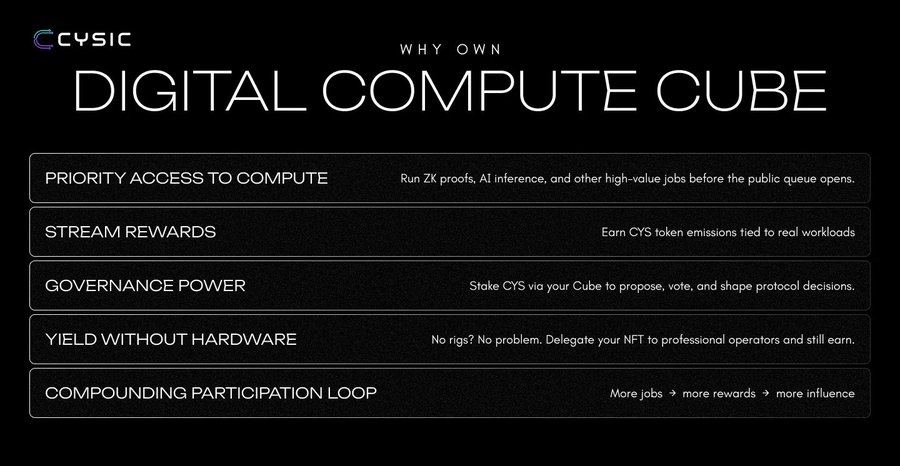
Tomorrow at 2 PM UTC, Cube transfers go dark.
No last minute scrambling, no begging for extensions, no “bro I didn’t know.”
If the Cube isn’t in your wallet by snapshot time, you’re not a holder you’re an observer.
The network takes its final imprint, and whatever address is holding your Cube becomes your future allocation identity. That’s it. Immutable. Onchain. Brutally fair.
You don’t need to click anything, sign anything, or run around in panic.
You just need to hold your Cube like someone who actually wants exposure to what’s coming.
Everyone else?
They can watch the next phase from the outside, explaining to their friends how they “almost made it.”
ComputeFi doesn’t wait for the unprepared. $CYS
>> @cysic_xyz opening its first Korean community meetup isn’t just another event.
It’s the start of a full blown ComputeFi wave about to rip through one of the fastest moving crypto markets on the planet. Korea doesn’t wait for narratives.
Korea creates them. And now they’re getting front row access to a network that turns everyday devices into yield producing compute phones, PCs, GPUs, even custom ASICs built for ZK and AI.
This is the kind of expansion you expect right before a vertical breakout. $18M from Polychain , OKX Ventures , and HashKey didn’t happen by accident.
Integrations with ETHProof, Succinct, Boundless didn’t happen by chance. The demand curve for ZK proofs and AI inference is going parabolic, and $CYS is positioning itself as the pipeline for that explosion.
Korean communities latch onto real momentum, and Cysic is showing up with real infrastructure, real partners, and real rewards. If this is the first meetup, imagine what the next 6 months look like.
ComputeFi isn’t coming.
It’s igniting.
And Korea just lit the fuse.
Everyone keeps talking about “AI scaling” and “ZK going mainstream” like it’s some mystical future event.
Meanwhile, the entire internet is still running on compute they don’t own and don’t control.
Centralized clouds hold the chokepoints, set the prices, and rent your future back to you at a premium.
@cysic_xyz looked at that system and did the only sane thing: broke it.
Compute isn’t a privilege. It’s the raw material of the digital world.
If you don’t own compute, you don’t own anything. Not your apps. Not your AI. Not your infrastructure. You’re just a consumer praying the overlords don’t throttle you.
Cysic flips the hierarchy.
It turns compute into a financial weapon ownable, provable, yield bearing.
Not because it sounds cool, but because the world is already moving there and everyone else is too slow to admit it.
The cloud era was about access.
The compute era is about ownership.
And $CYS is the first project treating compute like the asset it actually is, not the hand me down resource the industry got used to accepting.
If you’re still “waiting to see how this plays out,” congratulations.
You’re already behind.
gmsoor..
Everyone keeps talking about zkML like it’s some far future experiment. Meanwhile @cysic_xyz is out here actually shipping the infrastructure that makes it real.
@NetworkNoya needed faster, cheaper, verifiable machine learning proofs across a distributed AI network. Cysic stepped in and flipped the entire pipeline from “theoretically possible” to “production ready.”
Most teams still brute force ZK proofs on general GPUs and call it innovation. Cysic brings a full stack proving network built specifically for heavy workloads AI inference, ZK proofs, distributed compute.
NOYA gets exactly what every agentic network eventually hits a wall on: proving outputs at scale without melting budgets or latency.
The savage truth is simple. Without verifiable compute, AI agents are just expensive guesswork.
With $CYS, $NOYA now has zkML running on optimized proving infrastructure that can keep up with real time distributed tasks.
This partnership isn’t just “support.” It’s Cysic showing the entire industry what efficient, cryptographically verified AI actually looks like.
If you’re building Web3 scale AI and you’re not plugged into Cysic, good luck keeping up.
ComputeFi isn’t “coming someday.”
@cysic_xyz is already wiring the engines that make it unavoidable.
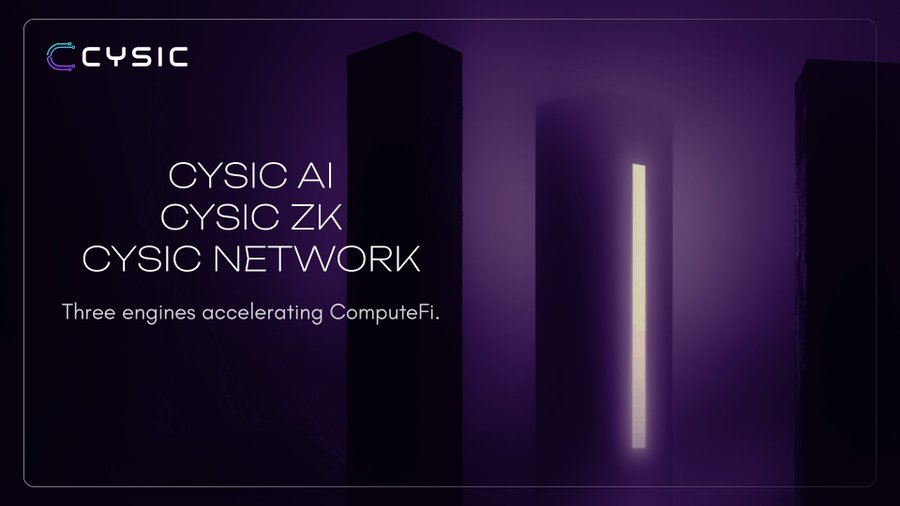
Cysic AI gives you verifiable inference instead of mystery box outputs.
Cysic ZK turns proofs from a luxury into a cheap primitive.
Cysic Network scales compute like a global market instead of a rented server farm.
Individually, they’re breakthroughs.
Together, they’re a coordinated assault on the old idea that compute must be opaque, centralized, or rented from cloud giants.
This is the first real onchain compute economy.
Not a narrative. Not a slide deck.
A system where AI, ZK, and hardware feed the same flywheel and anyone can own a piece of the engine.
$CYS isn’t describing the future.
They’re building the rails it will run on.
gngn..
People keep talking about “the next evolution of DeFi” as if it’s going to magically appear when the market feels ready.
Meanwhile, @Infinit_Labs is quietly rewriting the architecture underneath everyone’s feet. The funny thing is most people won’t notice until the system becomes too big to ignore.
The real shift isn’t the APYs or the integrations. It’s the idea that strategy execution can be expressed as logic, verified as computation, and coordinated by agents with cryptographic guarantees. That’s not “another DeFi tool.” That’s a new primitive.
45M+ users gaining access through GateWeb3 wasn’t hype, it was distribution. And distribution is the half of the game that pretenders never understand.
You don’t win by shouting.
You win by embedding yourself into flows people already use.
Prompt-to-DeFi matters because it exposes the uncomfortable truth : most users don’t want DeFi, they want outcomes.
If an agent can take a natural language intent and produce a verifiable action path, the old UX barrier collapses instantly.
systems that compress complexity while expanding guarantees tend to dominate. Not immediately. But inevitably.
INFINIT isn’t competing with DeFi apps.
It’s competing with the entire idea of doing things manually. $IN #INFINIT
Most people read AMA summaries like a checklist. Cysic AMA wasn’t that. It was a reminder that 99% of networks talk about “launching soon,” while @cysic_xyz quietly pushes through every hard part of infrastructure that other teams avoid.
Mainnet isn’t a concept anymore.
> It’s at the last stage of testing,
> contracts audited,
> airdrop flow wired,
> governance portals ready, and even mobile apps prepared for simultaneous Play Store and App Store release.
Nobody else in compute is shipping all layers at once hardware, software, chain.
Rewards aren’t vague promises either.
> Cube holders get royalty weighted benefits.
> Runners unlock more slots.
> Discord roles actually matter.
> Testnet users and Succinct provers get real allocations.
It’s a compute economy where contribution is measurable, not just “active community vibes.”
And the hardware roadmap? That’s the part everyone glosses over.
> DogeBox for light proving and mining.
> GPUs split for flexible compute.
> ASIC scale out only when capital efficiency makes sense.
Most teams chase headlines. $CYS optimizes the pipeline.
This AMA made one thing obvious: ComputeFi isn’t going to be won by the loudest narrative. It’s going to be won by whoever controls the stack hardware, proofs, coordination, economics.
Cysic is dangerously close to being the first one to actually pull that off.
Most people in crypto chase noise. Retweet hype, repeat narratives, wait for the “next big thing” to magically show up.
Meanwhile, the actual foundations are being built right in front of them. The problem is simple: almost nobody has the patience to understand the structure.
@cysic_xyz isn’t selling dreams of compute.
They build the hardware. Real ASICs. Real performance. Not glossy posters.
They’re not a frontend wrapped around someone else’s cloud.
They design their own machines, run them at scale, and let the community own the output.
If you spent the last decade trusting cloud providers, this is the first time you can actually own a piece of the system that generates ZK proofs and AI inference every day. That isn’t a narrative. That’s infrastructure.
@bitdealernet is doing the same thing in a different arena.
Everyone talks about RWA but almost nobody touches liquidity architecture.
Bitdealer starts there. The Duo Liquidity Pool is brutally simple and brutally effective.
2 AMMs that lock prices through constant arbitrage. No weird wicks. No drift away from fundamentals. Everything transparent, mechanical, and auditable.
People love to say they want “real value.” What they don’t say is how rare it is to find teams willing to build the heavy parts.
$CYS and $BIT are not chasing virality. They’re building the rails the next cycle will depend on.
If you see it earlier than the crowd, you already know where you stand.
The past 24 hours say a lot about where crypto is heading.
@cysic_xyz filing their CoinMarketCap listing isn’t just a formality.
It’s a signal that ComputeFi is stepping out of the testnet echo chamber and into actual market validation.
PoC → PoC liquidity → PoC price discovery. The pipeline is starting.
At the same time, Bitdealer private sale selling out in seconds shows something most people underrate:
utility based meme infra is entering its product market fit moment.
People no longer want empty narratives. They want systems that generate real activity and real value.
And then you have INFINIT, quietly doing the hardest thing in DeFi:
making AI agents verifiable.
EigenCloud brings cryptographic guarantees into agentic execution, which is basically the missing trust layer for AI driven strategies.
Creators get reliable prompts.
Users get auditable execution.
Protocols get predictable coordination.
These 3 signals point in the same direction.
Crypto is shifting from hype → infrastructure.
From speculation → verification.
From promises → systems that actually work.
Builders are shipping.
Users are noticing.
And 2026 is shaping up to be the year where execution finally overtakes narrative.