Injective is opening more doors for onchain finance and this week showed it clearly.
Veyra has reached mainnet, bringing new support for real world asset markets and enterprise use.
It also prepares the ground for CypherOS, a privacy platform that could add another layer to @injective financial tools.
The Base launch gives $INJ a place in a wider trading environment.
With liquidity on Aero and swap access through 1inch and KyberSwap, people can reach the token from apps they may already use.
Injective is also looking beyond technology. Its 22-page letter to the SEC calls for tokenized stock trading rules to cover onchain orderbooks.
That could help create a clearer path for a market structure used across traditional finance.
Meanwhile, USDC supply rose from $11M to nearly $80M in seven days.
dYdX has also finished moving its USDC deposits and withdrawals to Injective.
I see these as different pieces of the same direction: more assets, more trading access, stronger liquidity and tools built for real financial activity.
The progress is happening across several areas not just one upgrade.
$INJ
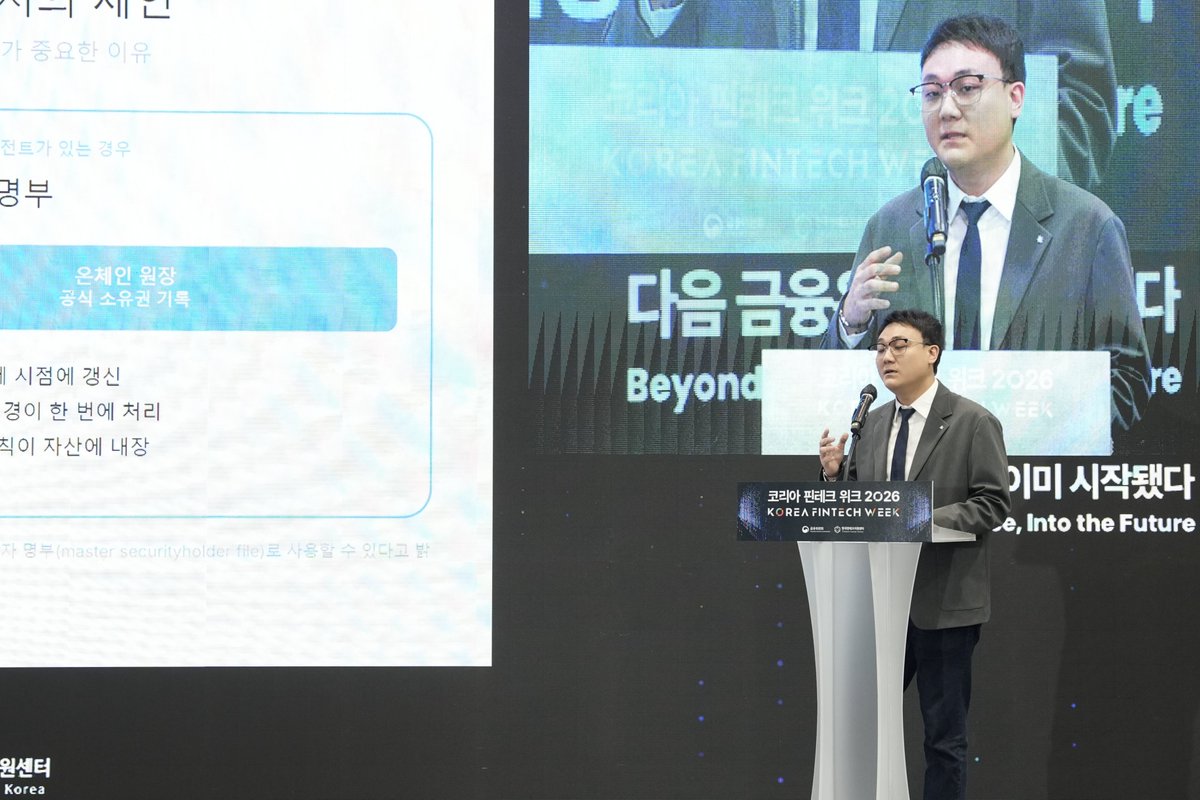
Injective is building stronger connections with Korea financial sector.
At Korea Fintech Week 2026, regulators, banks, and fintech companies came together to discuss the future of finance.
Injective Head of APAC BD, @AndKrypto, also joined the discussion alongside teams from Hana Bank, LG CNS and Shinhan Securities.
These are the kinds of conversations that matter when blockchain starts moving beyond crypto native users.
Korea has a strong financial and technology industry and working with local institutions can help Injective understand what businesses need before bringing more assets and services onchain.
For me, regional growth is not just about expanding a name into another country.
It is about building relationships, learning how the local market works and finding real use cases with the people already shaping finance there.
@Injective presence at the event is another step in that direction.
The next part is turning those connections into real projects and wider adoption.
$INJ
Injective is bringing builders, investors and AI founders together in Bangkok during Binance Blockchain Week.
The schedule is not just about showing up at events.
@injective is hosting and joining different spaces where people can meet, share ideas, and build new things.
The biggest part for me is the Injective Hacker House, running from December 1 to 10.
Selected AI founders and developers will spend 10 days building on Injective, with help from the core team and partners like AWS, Animoca Brands, and Gulf Labs.
There are also sessions around investors, product demos, AI, and real-world assets.
Andrew from Injective will speak at Nouns House, while the AI Meets RWA event brings together people working on how AI and real financial assets can connect onchain.
This kind of week can create value beyond the stage talks.
Developers get time to build, teams meet possible partners, and ideas can turn into real products.
Injective Bangkok presence shows that the ecosystem is putting time into people and projects not only technology.
$INJ
Injective has moved past the Veyra proposal. The upgrade is now live on mainnet.
I see Veyra as a step toward making @injective work better for larger financial markets, not just another network upgrade.
The new RWA infrastructure gives tokenized assets a stronger base.
Enterprise gateways also make it easier for institutions to connect with the network.
One feature I want to highlight is RFQ trading.
Large traders can ask market makers for private quotes instead of placing every order on a public order book.
This can help them manage large trades with less market impact.
Veyra also improves connections between Injective EVM side and the wider IBC ecosystem, including support for atomic swaps.
And there is another piece coming later: CypherOS.
Veyra lays the groundwork for Injective’s upcoming privacy platform, but confidential trading and shielded transactions are not fully live yet.
The upgrade passed with 99.51% support and activated at block 193,145,000.
The next phase is now about putting this infrastructure to work.
Injective financial roadmap is becoming part of the live network.
$INJ
Injective is making $INJ easier to reach across different networks, and Base is the latest step.
Now, Base users can trade $INJ against USDC 24/7 and provide liquidity through @aeroxyz INJ/USDC pool.
This is more than a token appearing on another chain.
The launch comes with real trading and liquidity support from day one.
Other partners are also helping users hold, swap and access $INJ across the Base ecosystem.
Base already has an active DeFi community, so this gives Injective another place to connect with traders and builders who may not use its native chain yet.
I see these integrations as a practical way to grow access.
A token becomes more useful when people can reach it through the networks and apps they already use.
From Injective own chain to Solana, Nasdaq through $INJC, and now Base, $INJ is reaching a wider market while its core network continues building finance focused infrastructure.
Injective is now leading the tokenized real estate sector by represented value, with more than $1.5B in mortgage records onchain.
The latest addition came from Pentiv, a publicly traded company, which brought another $524.8M in Canadian mortgage records to @injective in a single day.
That batch included 998 mortgage records and increased its onchain registry by around 49%.
But these are not new securities or tokens representing ownership of houses.
They are digital records of existing mortgage loans, each with a unique cryptographic fingerprint that helps verify the data.
Sensitive borrower information stays in Pentiv's private systems.
The registry now contains 2,897 records across nine Canadian provinces and Pentiv has a longer term target of bringing over $10B in mortgage originations onchain.
For me, the bigger story is how blockchain can help institutions manage and verify existing financial records without putting private customer data in public.
Injective is moving beyond simple token launches and building infrastructure for real financial systems.
$INJ
Injective is making it easier for traditional financial assets to move onchain.
With Injective Mint, anyone can create digital versions of real world assets like stocks and bonds without writing smart contracts or dealing with complex coding.
The process is simple. Fill in the asset details, set the rules and issue it on @injective.
Issuers can also control who can hold these assets, which countries can access them and when transfers can be paused.
Once created, these assets can be used for trading, lending, and collateral across the Injective ecosystem.
The network already has over $1B in tokenized assets and more than $6.8B in settled RWA volume.
I also see a strong connection with $INJC.
The ETF brings $INJ to traditional investors through Nasdaq, while Injective Mint brings traditional assets onto the blockchain.
Both moves connect traditional finance with the onchain world from different sides.
Injective has been running onchain derivatives markets for 5 years.
Now the U.S. is opening a clearer path for blockchain based derivatives exchanges.
On November 16, the CFTC confirmed approvals for firms to operate regulated derivatives exchanges and clearing services using blockchain technology.
The key point is that blockchain does not get a free pass.
These firms still have to meet the same rules around customer protection, market monitoring, risk management and financial safety as traditional exchanges.
For me, this shows a shift in how regulators view the technology.
Blockchain can be used not only to move crypto, but also to run parts of regulated financial markets.
@injective has already processed more than $85B in derivatives activity, according to the network figures.
It also has CFTC-regulated $INJ futures and the Nasdaq-listed $INJC ETF as part of its wider financial ecosystem.
The CFTC decision is not an approval of Injective itself, but it supports the direction Injective has been building toward for years: financial markets running onchain.
Injective is bringing blockchain into real business operations,
The POSCO International and LG CNS pilot is a good example.
Two of South Korea major companies have completed a pilot on @injective to put real trade payment records onchain.
These records are called trade receivables.
In simple words, they are payments a company is waiting to receive after selling goods or providing services.
In global trade, many companies are involved in one deal.
Each party may keep its own records, making it difficult to check payment amounts, documents, and other details.
The pilot uses Injective to create one shared record that all approved parties can check.
This makes it easier to verify the information and follow the payment process.
It also explores how AI can help review trade documents and reduce manual work.
Another key point is that this pilot used real trade data from POSCO's overseas business activities, not just test information.
For me, this goes beyond putting stocks or other assets on a blockchain.
It shows how injective can help large companies improve the way they handle everyday financial operations.
More companies are testing these systems today and 2027 could bring wider use of tokenization in real business activities.
$INJ
Injective is making its way into traditional finance, but there is a bigger story behind the $INJ ETF.
The Canary Staked $INJ ETF ( $INJC ) is now trading on Nasdaq.
It gives eligible U.S. investors a way to get exposure to $INJ through a normal brokerage account, without managing a crypto wallet or staking on their own.
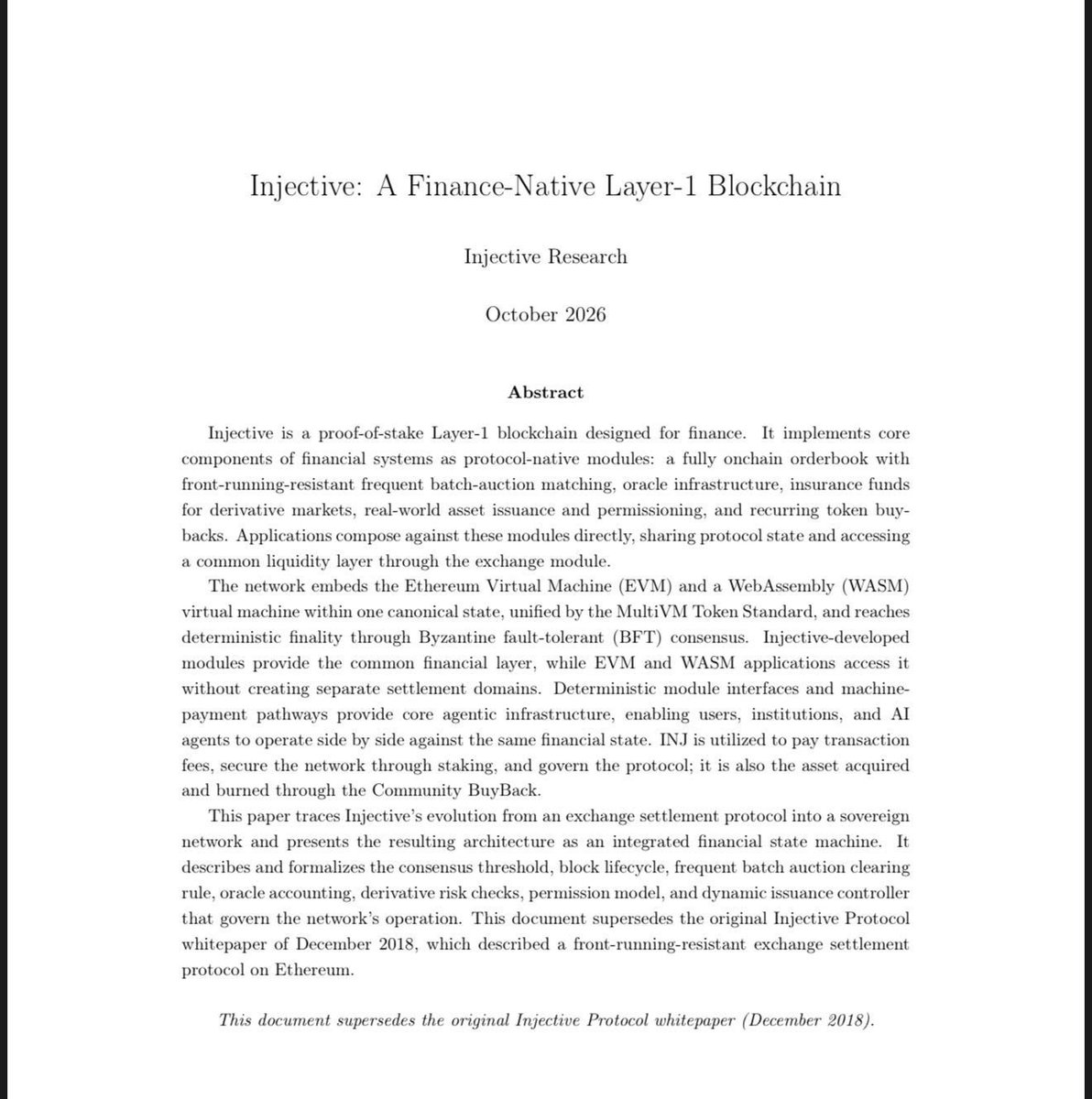
But the new Injective whitepaper caught my attention for another reason.
It explains how Injective is built around finance from the ground up.
Real world assets can be issued with clear rules about who can hold or transfer them.
Trading and settlement happen directly onchain, while the network also supports derivatives, stablecoins and AI agents.
The architecture brings these parts together instead of leaving every application to build its own separate system.
For me, the ETF is a new way for traditional investors to access $INJ.
The whitepaper explains the infrastructure behind that opportunity.
Both tell different parts of the same story: @injective is building a blockchain where financial assets, markets and applications can work together on one network.
Injective is moving closer to a future where financial assets can be issued, owned and managed directly onchain.
The SEC transfer agent registration adds a new layer to that plan.
Through its affiliate, Injective Institutional Services can help maintain official ownership records for securities and manage ownership changes.
This goes beyond simply putting an asset on a blockchain.
For tokenized securities, the legal record of ownership also matters.
Bringing that record closer to the onchain process can help connect asset ownership with digital settlement.
@injective is also building around this with Injective Mint, which gives issuers tools to set rules for holders, transfers, and compliance.
There is already activity around this vision.
POSCO International and LG CNS are testing real trade receivables on Injective, over $1 billion in mortgage records have been brought onchain and Gulf Labs is exploring institutional use cases in Thailand.
For me, this is where Injective direction becomes clear.
It is not only trying to bring more assets onchain; it is working on the legal, technical and institutional layers those assets need to operate.
$INJ
Injective is starting year six with a clear focus on making onchain finance ready for bigger players.
The Veyra upgrade is now open for a vote by $INJ stakers.
If approved, it is expected to go live on November 24.
Veyra brings new tools for large institutional trades through RFQ, expands atomic swaps, and improves asset movement between @injective EVM and other IBC connected chains.
It also prepares the ground for native privacy through CypherOS.
The birthday week also brought more activity across the ecosystem.
Anthropic pre IPO market went live, $INJ joined Robinhood crypto sweepstakes for eligible U.S. users and Injective branding appeared across New York taxis and subway stations.
The numbers show the network's growing activity too.
Annual trading volume passed $12B, staked $INJ reached 58.8M and $255M moved through the Exchange module in just seven days.
Another development I noticed is the growing role of Injective USDC, with dYdX and Juris Protocol moving toward it as a settlement asset.
For me, year six is about taking the infrastructure built so far and making it useful for more institutions, markets and users. Veyra is the next step in that direction.
Injective is expanding $INJ access across the US and Europe, bringing onchain finance closer to global markets.
In the US, Canary Staked $INJ ETF ( $INJC ) is now trading on Nasdaq.
Traditional investors can get exposure to $INJ through a regular brokerage account, with net staking rewards reflected in the fund’s value.
In Europe, @injective has published its MiCA whitepaper, which is now listed in ESMA’s register.
This gives exchanges across the European Economic Area a regulatory framework to list and integrate $INJ under MiCA rules.
I see these as two different but connected milestones.
The US is opening a new investment route through a familiar financial product.
Europe is creating a clearer path for crypto exchanges to support $INJ under its regulatory framework.
Global growth is not only about building technology or adding more applications.
Access and regulation also play a big role when a network wants to reach traditional financial markets.
Injective is building its presence across both sides of the Atlantic, one step at a time.
Injective is bringing Wall Street closer to onchain finance.
The Nasdaq opening bell was a clear sign of that progress.
On November 6, the @injective team joined Canary Capital at Nasdaq to celebrate the launch of the $INJC ETF.
But I see this as more than just an ETF launch.
$INJC gives traditional investors a way to access $INJ through a regular brokerage account.
It also holds actual $INJ and aims to stake around 90% of its holdings, with net staking rewards reflected in the fund's value.
At the same time, Injective is building beyond token exposure.
More than $1 billion in real-world assets has already been brought onchain through its ecosystem.
The network is also working on institutional infrastructure that can support larger financial players and their needs.
This is where the bigger picture starts to take shape.
Traditional investors are getting new ways to access $INJ, while institutions are exploring how real world financial assets can move onchain.
The Nasdaq bell was one milestone.
Building the infrastructure for global finance is the much bigger journey ahead.
Injective is playing a bigger role in bringing USDC to the Cosmos ecosystem.
More than $80M in USDC is still waiting to move from Noble to @injective.
Cosmos Hub has already moved its treasury, while dYdX is now voting on an upgrade that could move around $68M in USDC to Injective.
Circle is ending its support for Noble USDC, so Cosmos needs a new place for native USDC.
Injective is now providing Circle issued USDC that can move across Cosmos chains through IBC and CCTP.
The key point is that this is native USDC, not a wrapped token.
dYdX is also a big part of this change. Its new v9.9 upgrade will slowly move its USDC support from Noble to Injective.
User balances and trading will stay the same, so users won't need to change how they trade.
The vote is open until November 16.
If approved, the upgrade is planned for November 17 18.
For me, this is more than just moving USDC from one chain to another.
Injective is becoming an important USDC hub for Cosmos, helping major apps and chains move money more easily.
This also creates a stronger base for future growth across the Cosmos ecosystem.
$INJ
Injective is bringing the $INJ story to the heart of traditional finance.
@injective CEO Eric Chen recently appeared for an interview at the New York Stock Exchange, discussing the launch of Canary Capital's Staked $INJ ETF, $INJC.
For me, this is an important moment because the conversation is no longer limited to crypto events or blockchain communities.
Injective is now getting attention in major financial market settings.
The launch of $INJC gives U.S. investors a new way to access $INJ through regular brokerage accounts.
They don't need to buy the token directly, manage a wallet, or handle staking themselves.
There is also a staking feature.
The fund aims to stake around 90% of its $INJ holdings under normal conditions, with net staking rewards reflected in its value.
This creates a new access point for both everyday investors and institutions that prefer traditional investment platforms.
Of course, an ETF does not remove the risks of crypto market volatility, and its price can still move with the value of $INJ.
But seeing Injective CEO discuss this product on the NYSE floor shows how far the project has moved beyond the usual crypto space.
For me, the bigger story is $INJ gaining a place in conversations happening inside traditional financial markets.
Injective is taking its presence across New York to another level.
After putting $INJ branding on thousands of yellow taxis, Injective has now moved underground with digital ads inside Wall Street and Times Square subway stations.
The campaign also features Cortlandt Street Station, near the World Trade Center.
The ads carry simple messages like Next Stop: Injective and The City Never Sleeps. Neither Do We.
I like how this campaign connects with Injective main idea.
Traditional financial markets have fixed trading hours, but onchain markets can operate 24/7.
That's exactly what the line Wall Street still takes weekends off. @injective doesn’t. is trying to show.
There is also a bigger picture here.
Just days ago, Injective joined Canary Capital at Nasdaq to celebrate the launch of the $INJC Staked $INJ ETF.
Now its branding is appearing across major parts of New York, from yellow taxis to subway stations.
This puts Injective in front of people who may not even follow crypto yet, especially in places connected to finance, business, and tourism.
These campaigns help build public awareness, but visibility alone is not adoption.
The real value will come when more people discover the network, use its financial products and become part of its ecosystem.
Injective is building its presence both inside the crypto industry and beyond it.
Injective started with a vision in 2018: bringing the world's financial markets onchain.
Eight years later, Eric Chen stood at the Nasdaq podium and rang the opening bell for the launch of $INJC.
That journey from a dorm room to Wall Street is worth thinking about.
The Canary Staked $INJ ETF gives traditional investors a way to get exposure to $INJ through regular brokerage accounts.
They don't need to manage a crypto wallet or private keys.
There is another part to this ETF. It holds actual $INJ and aims to stake at least 90% of its holdings under normal conditions.
Any net staking rewards are reflected in the fund NAV, not paid as cash dividends.
Of course, staking rewards are not guaranteed.
For me, the bigger point is what this milestone represents.
@injective spent years building financial infrastructure around trading, tokenization, and onchain markets.
Now, a product linked to its native token is available through a traditional US investment channel.
The Nasdaq bell is a big moment, but the real story is how far that original vision has come.