Sleepagotchi and the Three-Pillar Challenge: Useful – Habitual – Trusted
Sleepagotchi’s roadmap sounds compelling: moving beyond simple sleep data, the project aims to build a full multi-agent AI ecosystem featuring a Sleep Coach, Wellness Coach, Meal Planner, and Shopping Agent complemented by gamification, wearable integration, and the $SLEEP token. Yet, an ambitious roadmap does not guarantee a successful product. The real question is: what must hold true for this vision to become reality?
In my view, the answer lies in three conditions that must coexist: being useful, becoming a habit, and earning trust. @sleepagotchi
First is utility arguably the toughest test. The Sleep Coach has already launched, but the AI involved cannot merely "sound smart." If I sleep less or my recovery metrics drop, a standard dashboard already tells me that.
True value emerges only when the system connects disparate signals with historical data to create context such as detecting a pattern of increasingly late bedtimes or identifying several consecutive days of poor recovery following an unusually intense workout.
The same principle applies to the Meal Planner or Shopping Agent: generating recipes or shopping lists is nothing special; thousands of apps already do this. Value arises only when these agents act as natural links in a chain of personalized recommendations, rather than standing as isolated, disconnected chatbots.
Second is habit formation. Even an excellent recommendation can fail if the user opens the app twice and then forgets about it. This is where Sleepagotchi’s gaming roots offer a natural advantage: the Dino, the virtual room, morning rewards, and progression systems these mechanisms provide reasons to return that have nothing to do with "reading another health data chart."
The morning loop waking up, checking in, gaining key insights, and receiving feedback must remain simple on the surface, even as the underlying complexity grows.
Finally, there is trust. As the system seeks to gather more data on nutrition, stress, supplements, or shopping habits the responsibility involved grows correspondingly.
Users need clarity: what is connected, which agents can see what data, and whether they can disconnect at any time. Without trust, users won't share enough data, and the entire premise of personalization will hit a ceiling.
If any of these three elements is missing, the system falters: something useful but not habitual gets forgotten; something habitual but not useful is merely hollow gamification; and something useful and habitual but lacking trust cannot take personalization very far.
Therefore, Sleepagotchi’s next step shouldn't be adding as many agents as possible, but rather solidifying the foundation: making the Sleep Coach truly useful, ensuring the morning loop is worth repeating, and making privacy settings easy to understand all before adding any further layers.
Smartphones may not be the world's best spatial sensors. But perhaps they don't need to be. @vangrid_io
That is why the concept behind Vangrid is becoming increasingly compelling to me. Specialized hardware such as LiDAR systems, mapping vehicles, or professional scanning gear can achieve precision far beyond that of any phone.
Yet, precision is only half the equation. The other half is distribution; when the goal is to gather real-world data from thousands of diverse locations, distribution becomes the decisive factor.
A specialized sensor must be purchased, deployed, maintained, transported to the right location, and operated by a skilled professional. Then, the entire process must be repeated whenever the environment changes.
In contrast, smartphones have already solved most of these issues before the network even begins to operate: cameras, network connectivity, and geolocation capabilities are built-in and most importantly, the people carrying these devices are already present in every city, neighborhood, building, and workplace.
Imagine a Physical AI company needing fresh ground-level data from a warehouse in one city, a loading dock in another, and a retail entrance in yet another country. With specialized scanning infrastructure, each new location presents an operational challenge:
Who ships the equipment? Who operates it? What is the cost? What happens when an update is needed next week? But with a distributed network where a nearby contributor can accept a request and use the device they already own that challenge is resolved far more efficiently.
A phone doesn't need to be a perfect sensor. It simply needs to be good enough for the data collection requirements, present in the right place, and easy enough to use for repeated tasks. This is the crucial point: scaling infrastructure works very differently when participation doesn't require everyone to purchase specialized equipment upfront.
That is also what I like about Vangrid’s "hardware-light" approach the network focuses on coordinating demand, contributors, and data collection and provenance, rather than needing to deploy new hardware everywhere coverage is desired.
The right question isn't "Is a phone the best spatial sensor?" but rather: can a globally distributed device that people already carry serve as a useful data-collection layer for real-world data on demand? If the answer is yes, the advantage lies not in the phone’s technical superiority, but in the fact that the sensor network may already exist in millions of pockets.
Reputation is not a static badge of honor, but a continuous learning loop. @NucleusCodes
Most current Web3 reputation systems operate linearly: you act, the system measures it, you receive a score, and that score unlocks a specific privilege after which the process essentially stalls.
A far more compelling model, however, is cyclical: your history determines the opportunities you receive; how you utilize those opportunities generates new evidence; that evidence updates your profile; and the updated profile shapes your next set of opportunities.
Consider someone whose profile demonstrates a deep understanding of narratives and a track record of sustained contribution. That history grants them early access to a product.
But the crucial part follows: do they actually provide useful feedback? Do they remain engaged even without obvious leaderboard incentives? If so, the opportunity has validated them existing reputation opened the door, while new behavior proved they deserved it.
Conversely, if a user gains privileged access but simply exploits the situation and vanishes, that too is valuable data; the system must learn from both outcomes.
This is precisely what makes projects like Nucleus noteworthy: on-chain activity, social presence, contributions, behavior, referrals, and committed capital are merely initial signals.
The real question goes beyond "Who deserves access?" to "What happens after access is granted?" Does the capital remain? Do referrals bring in high-quality users? Do content creators generate genuine insight or merely fleeting impressions?
For users, this opens a genuine path to improvement: you are not trapped by yesterday’s profile. Better contributions generate stronger evidence, and stronger evidence leads to better opportunities. At the same time, a high reputation entails accountability if significant power consistently yields poor results, the system must recognize it.
In this context, each campaign ceases to be merely a delivery event; instead, it becomes a source of data for learning and refining future pairings.
Reputation thus shifts from being a mere ranking to functioning as infrastructure: an ongoing dialogue between who you once were, the trust placed in you, and what you did with that trust.
Good morning🔆
Happy Monday to everyone!
Decentralization: A Perspective from the Operations Room @BeldexCoin
When discussing decentralized networks, we often visualize elegant diagrams: nodes, connections, routing paths, and infrastructure spanning multiple independent operators. Yet, behind these diagrams lies a rarely mentioned reality: every node has a daily "life," and someone must tend to it.
The first task unglamorous as it may be is checking uptime. Is the node online? Did the server remain stable overnight? Were there any connectivity issues? A perfectly configured node can quickly become useless if left unmonitored. Infrastructure is not a "set-it-and-forget-it" affair; it is an ongoing responsibility.
Next comes monitoring: CPU, memory, storage capacity, network connectivity, service status, and system logs. Operators constantly look for subtle signs before they escalate into major issues an unusual load spike, a service behaving erratically, or a process suddenly stopping. Most users never see this work; they simply expect the network to run smoothly which makes monitoring all the more critical.
Then there is synchronization. A node participating in blockchain infrastructure must constantly keep pace with the network's current state. If a node falls behind, the operator must investigate the cause: does a service need attention? Is there a connectivity issue? Or does the node require a restart and further troubleshooting?
Finally, there is software maintenance. Networks are constantly evolving; new versions are frequently released, and configuration requirements may shift. A responsible operator cannot simply install the software and walk away they must track updates, understand the changes, and ensure the system remains up to date.
This is the operational rhythm: checking uptime, verifying synchronization, reviewing monitoring data, inspecting logs, applying updates as needed, confirming stability and then repeating the cycle. It may sound repetitive, and indeed it is. Yet, it is precisely this repetition that builds reliability.
The interface layer visible to users BChat, BelNet, the Beldex Browser, and digital wallets is merely the tip of the iceberg. Beneath the surface lie terminals, server dashboards, system health checks, and the people quietly ensuring the network keeps running.
A decentralized network does not exist simply because the word "decentralized" is spoken. It exists because independent individuals, day in and day out, keep their infrastructure alive ensuring that no node becomes an abandoned server.
Surviving the Journey Matters More Than the Final Figure
A trader can be profitable yet still carry a terrible risk profile. This is why @agenticscredit’s perspective on drawdown is so noteworthy: PnL alone can mask a great deal.
Someone might end a period with a positive return, post the final figure, and make the strategy look impressive. But that screenshot doesn't reveal what happened along the way.
How deep did the account draw down before recovering? How much risk was required to generate that profit? Did the trader truly maintain control throughout, or did a single lucky recovery salvage a string of otherwise disastrous trades?
Consider this scenario: two traders both finish the month up 10%. Trader A keeps maximum drawdown at 3%, trades with discipline, and always keeps positions under control.
Trader B allows the account to lose 40% of its value before a final, reckless trade claws everything back. On paper, both show a "10% profit." Yet, these are clearly two vastly different stories regarding risk exposure and long-term survivability.
That is precisely why drawdown is a crucial component of ACS. I would rather see a strategy that earns slightly less but keeps risk contained than witness one generating massive profits by repeatedly putting the entire account in jeopardy. Because, ultimately, surviving the journey is what counts.
This also shifts how I approach my own experiments within Agentics Credit; I look beyond whether a single trade wins or loses. I want to observe what happens between entering and exiting a trade: how far the position moves against me, the level of volatility I am accepting, and whether I am taking on unnecessary risk simply by fixating on the final PnL figure.
And as I adjust those behaviors, does my ACS begin to reflect that change? That is the aspect I want to fully understand through practical experience.
A profitable trade can still be a bad trade. A losing trade can sometimes stem from a perfectly sound process. The final outcome tells only part of the story. To me, the more interesting question is always: how did the account survive the journey to reach that result? That is precisely what I will continue to monitor as my trading record grows.
MINT goes beyond simply starting a game, placing a bet, and closing the tab once the session ends. @PlayOnMint
Beneath that surface-level activity lies a progression layer designed to transform isolated actions into part of a broader journey.
The key differentiator lies in how MINT handles XP. On most traditional betting platforms, the outcome of a session is straightforward: you win or lose, then start over from scratch next time.
Nothing carries over; nothing accumulates. With MINT, however, both gaming and sportsbook activities generate XP meaning a user's time and engagement don't vanish after a session but instead become part of a long-term progression system.
This shifts the fundamental question players ask themselves. Instead of just wondering, "Did I make a profit this session?", they now consider: "Is this activity helping my account progress?"
This is precisely why the concept of capturing "before-and-after" XP snapshots is so compelling it provides tangible proof that platform activity is tied to something enduring, rather than serving as just another generic promotional gimmick.
Consider this scenario: a player places a few sports bets in the evening; regardless of the win/loss outcome, their XP increases after the session. The bet is no longer "just a bet" it becomes part of a wider account journey where every action is acknowledged.
Crucially, XP does not exist in isolation. It operates within a larger ecosystem where activity, progression, rewards, and ultimately $MNTD are all interconnected. The formula can be summarized as follows: play earn XP build progression and leverage that progression within MINT’s broader loyalty system.
Personally, I haven't experienced this flow firsthand yet, so I can't say for sure if the increased XP feels truly satisfying that’s something only actual experience can reveal.
Structurally, however, it is a noteworthy concept. It provides users with a metric beyond just winning or losing, and the most robust progression systems are typically those that make users feel their past activity still holds value.
That is why this XP layer is worth watching. It isn't because adding a number to a dashboard is inherently compelling, but because if MINT executes it well that figure will serve as tangible proof of activity across the platform.
And once this progression ties into rewards, Status, and $MNTD, the entire system will become far more intuitive functioning as a continuous loop rather than a collection of disjointed features.
Narrative, Product, Traction: How I Evaluate a Project Like Sleepagotchi
@sleepagotchi
In the worlds of crypto and AI, crafting a compelling narrative has never been difficult. AI agents, personalized health data, gamification, token utility they all sound impressive. But for me, a great narrative is merely the starting point. The real question is always: is anyone actually using the product?
That is why I view Sleepagotchi through three layers: Narrative → Product → Traction.
The narrative layer represents the vision. Sleepagotchi is evolving from a sleep-tracking game into a broader intelligence layer for holistic health. Sleep serves as the entry point; AI analyzes the data, agents translate that data into actionable insights, and gamification keeps the experience accessible. Logically, it is a coherent story.
The product layer is what turns that vision into something tangible: the Dino character, the bedroom loop, sleep tracking, the reward system, and the Sleep Coach. This serves as proof that the idea exists beyond just a slide deck.
However, the layer I care about most is traction evidence that users are actually returning. Sleepagotchi has reported over 2 million users throughout its history and generated more than $100,000 in revenue during just three weeks of beta testing for its new product direction. I always emphasize that these are self-reported figures not independently audited yet they remain signals worth watching.
User numbers indicate the project isn't starting from scratch; people have already engaged, played, and tracked their sleep. Revenue offers another signal: a willingness to pay. The next question is whether they will keep paying once the initial novelty wears off, or if this is merely a fleeting launch-day effect.
A narrative without a product is just a pitch. A product without users is just an experiment. Users who don't return represent nothing more than fleeting attention. Non-recurring revenue is merely a launch-day event. Only when all three layers narrative, product, and traction reinforce one another does a project truly establish a solid foundation.
Therefore, what I continue to monitor regarding Sleepagotchi is not the upcoming roadmap, but actual user behavior: downloads, retention rates, session counts, and most importantly whether users pay again.
Reputation: The Missing Translation Layer of Web3 @NucleusCodes
Web3 does not lack data. It lacks a common language to turn that data into meaning.
Consider an obvious example: a wallet with high transaction volume. That figure alone reveals nothing significant does it represent experience accumulated over time, genuine belief in a project, or merely behavior driven by short-term incentives? Similarly, a creator with a massive reach does not necessarily have an audience that aligns with the narrative a project is building.
A contributor might complete 20 campaigns but the real question isn't "how many," but rather "what those campaigns reveal about their capabilities." A referral dashboard might report 50 new users, yet the ecosystem cares more about how many of them actually stay and generate real value.
This is precisely Web3’s "translation problem": users understand themselves better than raw numbers can convey, while projects know what they need, yet the signals they receive often depict something slightly different. One side speaks through actions, the other requires context and in the gap between them, meaning is lost.
This offers an interesting perspective on on-chain reputation layers: they can transform raw activity into contextualized evidence. On-chain activity is not just about transactions it can serve as proof of experience. Social presence is not merely posts and followers it can represent contextual influence. Contributions are not just about completing tasks they can demonstrate the value actually delivered. Referrals are not just numbers they can reflect the quality of a network.
The distinction lies in "measurement" versus "translation." Measurement says: you have done ten things. Translation says: those ten things show you are exceptionally trustworthy in this field. Measurement says: you have referred twenty people. Translation: your network tends to generate high-quality participants.
As the translation improves, the alignment between users and opportunities also improves creating a self-reinforcing loop: the clearer the profile, the less explanation required; the more suitable the opportunity, the easier it is to contribute; and the more one contributes, the more distinct their reputation becomes.
Web3 needs more than just additional reputation data; it needs better ways to transform that data into meaningful insights that both users and projects can utilize.
Consistency: The True Measure of Reputation in Web3 @NucleusCodes
Web3 has traditionally evaluated reputation based on isolated signals: an active wallet, an influential social media account, a productive contributor, or significant capital flow. Any one of these figures, in isolation, might be impressive. Yet, the more critical question is not "Is this number large?" but rather, "Do these signals tell a consistent story?"
Consider two content creators within the same ecosystem. The first constantly speaks of a "long-term vision," yet their wallet withdraws funds the moment incentives wane creating a conflict between their social signals and their capital behavior.
The second claims to focus on infrastructure: their posts discuss infrastructure, their on-chain history is tied to it, their referrals share that interest, and their capital remains committed to the sector.
None of these signals proves anything on its own. However, when viewed together, they reinforce one another and that is precisely what builds genuine credibility.
This is the core concept Nucleus introduces: transforming reputation from a collection of disjointed scores into a test of consistency. Does the wallet activity support the narrative? Do contributions align with claimed expertise? Do referrals belong to the community the individual claims to understand? When multiple independent signals point in the same direction, trust grows naturally not because of a single massive metric, but because the entire profile "makes sense."
This implies that building a reputation does not require you to maximize every single number. An individual with a modest but targeted following, a modest wallet size but a track record of actions consistently aligned with their stated beliefs, someone who doesn't join every campaign but remains consistent whenever they do all of this creates clarity, which is far more valuable than a single standout metric.
Notably, inconsistency isn't always a bad thing people change, and interests shift. However, a new direction must be validated by repeated evidence across various aspects of one's profile, rather than just a single post or transaction.
This is precisely what makes credibility difficult to fake: while one might copy rhetoric or game a ranking system, it is extremely difficult to align months of behavior, contributions, capital allocation, and personal narratives.
For projects, this approach enables a smarter way to evaluate participants: instead of asking, "Is this number high?" they can ask, "Do these signals reinforce one another?" It represents a shift from blind trust...
Exploring MINT Originals: A Lineup Worth Slowing Down For @PlayOnMint
I spent more time today going through MINT Originals, and I want to be upfront: I haven't played anything yet. No fake session recap, no manufactured screenshot. Just an honest first look at the lineup.
And honestly, that first look already told me a lot. MINT Originals currently includes Pink Crash, Plinko, Mines, Power Dice, Crash, Blackjack, Towers, Limbo, The Collector, Shootout, Dice Drop, and Momo Moolah.
That's a solid spread of formats, but the real standout isn't the quantity. It's how consistent everything feels. Blackjack, Mines, Plinko, Crash, and Towers are familiar formats, but here they're wrapped in the same visual identity instead of feeling like games bolted on from different studios.
That distinction matters more than people usually give it credit for. A platform can have a hundred games and still feel like a directory. MINT Originals feels like a designed experience instead.
Even without playing, you can already spot different moods baked into the lineup. Dice Drop reads as quick and low-friction. Blackjack is more decision-heavy. Crash leans into timing and nerve.
Mines and Towers seem built for the kind of overthinking that comes with incremental risk. Then there's a separate tier The Collector, Shootout, and Momo Moolah that feels distinctly tied to the MINT brand itself rather than borrowed from a generic template. That's probably where I'll start.
The goal isn't to pick whatever looks easiest to turn into content. It's to pick something I'd genuinely be curious to try regardless, play a real short session, and then talk honestly about how it felt.
Was it smooth? Did the interface stay out of the way? Did the risk-reward loop feel satisfying, or just repetitive? And the real test: did it feel meaningfully different from playing the same game format somewhere else?
A win or a loss isn't the interesting part. What matters is whether the session gives me a reason to come back on its own not because I need a post, but because the experience earned it.
Next step is simple: pick one, actually play it, and see what sticks.
Demand-Driven Data: The DePIN Model Vangrid Is Betting On
Most physical infrastructure networks follow the same script: deploy hardware, collect data, build coverage, and hope demand eventually catches up to supply. It's a bet that "more data" is inherently valuable. But @vangrid_io flips that sequence, and the reversal changes what kind of network you end up with.
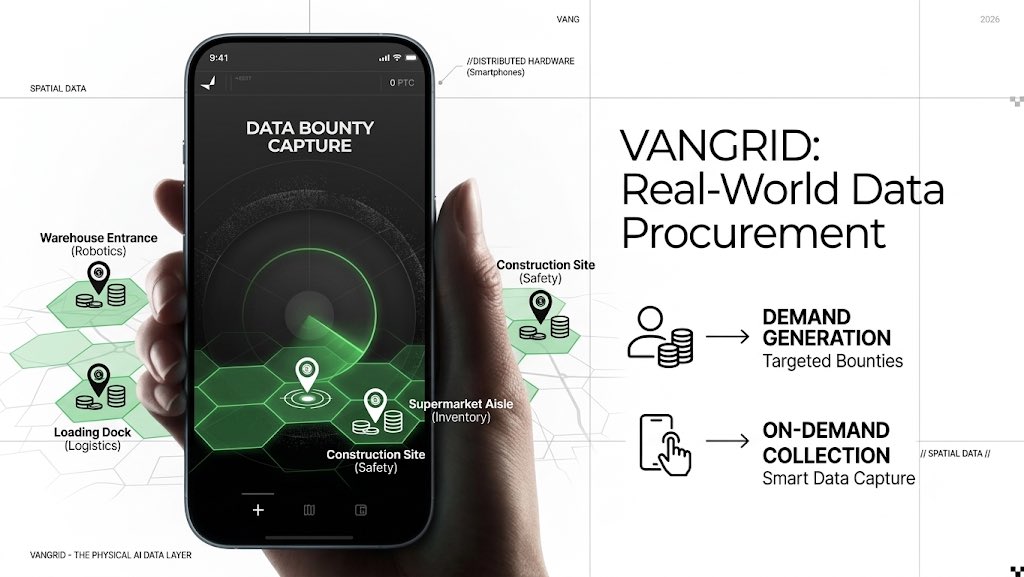
In Vangrid's model, the need comes first. A requester wants fresh data from a specific physical location not data in general, but this place, at this time, from this angle. That need becomes a bounty.
A nearby contributor picks it up, goes there, and captures the environment with their phone. The output is tied back to the original request, provenance intact. Demand creates supply, not the other way around.
This matters because the real bottleneck in physical-world data usually isn't scarcity it's specificity. A robotics team testing warehouse navigation doesn't need another million street images; they need current captures from five loading areas. A logistics company doesn't care about global coverage; it cares about access conditions around one facility.
A world model team may need examples from one particular kind of indoor space. In each case, more random data doesn't solve the problem. The right data does.
That's what makes the requester → bounty → capture → output loop worth paying attention to. The requester defines what has value. The bounty converts that into an incentive.
A contributor becomes the capture layer, using nothing more exotic than a smartphone. The network's job is simply to coordinate between the two sides demand and delivery efficiently and with traceability.
The smartphone is what makes this accessible; anyone can participate without specialized gear. But it's not the interesting part. The interesting part is that the network knows what to capture before anyone starts capturing it. That's a fundamentally healthier starting point than accumulating a dataset and searching for buyers afterward.
As Physical AI pushes further into real-world deployment robots, autonomous systems, machines that need up-to-date context about changing environments this distinction will only get more important.
Not decentralized data collection for its own sake, but demand-driven physical data collection, built around the moment someone actually needs to know what a specific place looks like right now.
Good morning🔆
Happy Weekend to everyone!
Masternodes and Exit Nodes: Two Roles, One Ecosystem @BeldexCoin
When discussing Beldex's infrastructure, it is easy to lump all "nodes" together into a vague, catch-all concept. In reality, however, masternodes and exit nodes perform distinct functions, even though they share a common goal: building a private, decentralized ecosystem.
Masternodes – The Heart of the Network
Beldex operates on a decentralized network of masternodes that secure the blockchain and facilitate data routing across the entire system.
You can think of the masternode as the core component that keeps the internal "machinery" running smoothly handling everything from blockchain security and network participation to routing support. This architectural foundation underpins Beldex’s privacy-focused products.
Exit Nodes – The Gateway to the Outside World
In contrast, an exit node only comes into play when BelNet traffic needs to leave the private routing environment to reach its final destination on the open internet. Consider the data journey:
User → Relay → Relay → Exit node → Website
Here, relays handle the secure movement of data along a private path, while the exit node serves as the journey's endpoint, opening the gateway for data to proceed onto the public internet.
Why Does This Distinction Matter?
Lumping all "nodes" into a single concept causes us to overlook the core value of decentralized architecture: the fact that each component is specialized for a specific task. One element maintains the system's core (masternode)...
ACS asks more than just one question: Are you profitable?
One thing I almost overlooked when exploring ACS on @agenticscredit is that this isn't a metric that revolves solely around the question, "Are you making money?" Profitability is certainly important, but this score looks at a much broader picture than just a screenshot of a green PnL.
Drawdown is factored in. Stability is factored in. Win rate is factored in. And so is long-term trading history. This is exactly what makes the whole experiment so much more interesting.
After all, anyone can land a great trade. You catch the right wave, take a screenshot, post it, and it looks like your strategy is flawless. But a single winning trade reveals nothing about how you trade over time.
A clear example: a trader might win 90% of their trades, but if the 10% of losing trades result in massive losses, the overall account could still end up in the red.
Conversely, a strategy with only a 40% win rate but one that employs disciplined stop-losses and lets profits run can be far more sustainable. This is the kind of distinction ACS helps me clearly observe.
What interests me more is what happens as the trading history grows longer:
•Can I maintain profitability without taking insane risks?
•Can I keep drawdowns under control?
•Can I consistently make the right decisions, rather than relying on a lucky trade?
•Do I have enough data for my trading profile to accurately reflect my actual behavior?
That is where ACS becomes far more compelling than simply tracking PnL. It gives me more variables to experiment with. One strategy might yield high profits but entail an ugly drawdown. Another strategy might be slower-paced but deliver much more consistent results. A high win rate might mean nothing if those...
Vangrid: Not just a mapping network, but a real-world data procurement layer
The more I explore Vangrid @vangrid_io, the more I feel that calling it a "mapping network" misses the mark. What makes this project far more interesting is its distinct approach: viewing it as a procurement layer for real-world data.
This distinction matters because the operational models differ fundamentally. Traditional mapping often begins with a massive objective: capture as much of the world as possible traversing every road, scanning every street, and updating a database in the hope that someone might eventually need the information. It is a speculative collection model build first, find users later.
Physical AI, however, creates a completely different kind of demand. You do not always need to scan an entire city. Sometimes, you need just one specific location: a warehouse entrance, a loading dock, a sidewalk, a construction site, a supermarket aisle, or a building lobby. And you need it *now*, because the valuable information is what exists there today, not data recorded months ago.
This is where Vangrid’s bounty model becomes compelling. Instead of speculative data collection, the process can originate from a specific location: someone needs information there; a "capture request" creates an economic incentive; a contributor brings a smartphone to the site; the environment is recorded; the data acquires clear provenance; and a protocol coordinates the economic relationship centered around that data.
The question shifts from "How do we map the entire world?" to: "Who needs what data, where, and how do we capture exactly that?" This becomes increasingly important as robotics scales up. A robotics company operating across twenty locations doesn't need a global map; it needs the latest spatial data from precisely those twenty environments.
A logistics system might only care about a loading dock. A delivery robot needs just a single entrance. A world-model developer might simply need observations from an environment type rarely found in existing datasets.
These represent clearly targeted data needs, and targeted needs require coordination. Smartphones serve as distributed data-collection hardware, collaborators act as the supply side, bounties signal demand, and on-chain records create an authentic, verifiable trail for the entire process.
Traditional mapping says: "Build the map first, then wait for demand to arrive." Procurement says: "The demand already exists go out and collect exactly what is needed." To me, it is this second approach that makes Vangrid a project worth watching.
Trust Requires Proof: Sleepagotchi’s Story of Tranparency @sleepagotchi
The Web3 community is accustomed to questioning rather than accepting empty promises and this is precisely the toughest test Sleepagotchi must pass as it establishes itself as a health intelligence layer.
When a product asks users to share data on sleep, activity, and nutrition, the narrative cannot simply stop at "trust us." It must advance to "here is how you can verify it yourself." For instance, instead of merely claiming "we protect your privacy," the app could display the details directly in the interface: which sleep data is connected, which nutrition data remains disconnected, and exactly which sources the Sleep Coach and Meal Planner are authorized to access all transparent and revocable at any time.
One notable point: according to Cointribune, there is currently no publicly available evidence of an independent security or privacy audit for Sleepagotchi. This does not imply the system is flawed, but it raises a valid question for due diligence: if an audit exists, where can users view it? If not, is this the next step in the development roadmap?
Just as smart contracts require audits and licenses need verification, health data processed by AI demands a similar standard not out of suspicion, but because genuine trust must be built upon observable evidence rather than mere pledges.
The simplest formula "trust, then verify" is the standard that any health intelligence layer should strive to meet.
MINT: Where a familiar experience meets a new layer of progression
This week, I spent time actually using @PlayOnMint instead of just reading about it, and my first impression is this: MINT makes a lot more sense if you stop viewing it as just another "crypto casino."
I started by exploring the platform checking out the casino section, opening the sportsbook, and browsing various categories to understand how everything connects. The first thing I noticed was the familiarity of the experience.
When you open MINT, you immediately know where to go: casino, live casino, sportsbook, games, or your account. The interface doesn't feel "hidden" behind a complex Web3 layer just because there’s a token ecosystem being built in the background.
I like that. After all, if a platform wants users to return regularly, the crypto element should add value rather than becoming yet another puzzle for the user to solve.
But things got more interesting when I looked beyond the homepage. Usually, you play a game, finish the session, and that’s pretty much the end of it. With MINT, the concept is different: your activity generates XP, XP drives progression, and that progression ties into the broader $MNTD ecosystem.
This shifted my perspective on the platform. It’s no longer just about opening a game or placing a bet there’s a persistent layer underlying all those actions. And that’s exactly what I want to explore next.
I want to track how my XP changes, see what it feels like to engage in different types of activities comparing my usage between the casino and the sportsbook and determine whether that progression loop actually feels meaningful after some real-world use.
This is where my journey with MINT begins. There are no major conclusions yet it’s simply a matter of using the product, paying attention to the details, and forming a perspective based on what actually happens on the platform. This approach is far more useful than reading through yet another list of features.
Now, the interesting part is seeing where this process leads.
Good morning🔆
Wishing everyone a smooth and energetic Saturday.
Node Operators: The Infrastructure Behind the Interface @BeldexCoin
In crypto conversations, network participation is often measured in purely financial terms who's holding, who's staking for yield, who's up or down. But there's a quieter, more foundational role that deserves more attention: the node operator.
A node operator isn't just someone holding a position. They're an infrastructure participant someone actively helping a live network stay online, updated, and reliable.
Take the Beldex ecosystem as an example. The visible layer is easy to notice: BChat, BelNet, Beldex Browser, wallet interactions, private network services. These are the experiences people actually touch. But none of them float in the air by themselves.
They depend on architecture underneath servers that stay up, software that stays current, and infrastructure that stays healthy. That architecture only works because people are willing to run it.
That's what a masternode operator does. Running a masternode isn't a passive label or a purely speculative bet it's active infrastructure work. It means thinking about uptime.
Thinking about server health. Thinking about whether the software is current and functioning as expected. It means treating the network as something living, not something abstract.
This is also where responsibility comes in. Participating at the infrastructure layer requires a different mindset than simple speculation. An investor asks "what's this worth?" A node operator asks "is this running properly?" That shift from spectator to contributor is one of the clearest examples of decentralization becoming practical rather than theoretical.
It's easy to talk about decentralization in the abstract. It's harder, and more meaningful, to actually help operate part of the system. A messaging app feels simple because infrastructure exists behind it. Private browsing feels smooth because infrastructure exists behind it. None of that happens automatically it happens because someone, somewhere, is maintaining the layer underneath.
So when the term "node operator" comes up, the more useful frame isn't investor it's contributor. Maintainer. Someone helping turn privacy infrastructure into something that actually operates, day after day.
The takeaway for anyone engaging with a network like this: don't stop at the surface level. Real ecosystems aren't sustained by attention or trading volume alone. They stay alive because people are willing to carry part of the infrastructure themselves.
The Fomoator project is still quite new, and from my perspective,
I believe it has great potential in the near future. Let's look forward to positive news from the project!
@fomoater
Join in and hunt for WL from the project, everyone!🔥
This is my link: https://t.co/XqQ5qs2Gag
The starting point matters more than the optimized result.
Today, I saved a screenshot not because it looks impressive, but because it marks a milestone. I’ve just completed five trades to qualify for ACS on @agenticscredit, and I’ll keep trading as my positions close out. There’s nothing special about it yet, and I’m not trying to make it look that way, either.
In fact, I want the exact opposite.
I want a clean baseline before I start tweaking my strategy, ramping up activity, testing different setups, or figuring out which behaviors the system actually rewards over time. It’s easy to look at a score and immediately rush to optimize everything around it. But if I do that, I’ll lose sight of the very thing I’m most curious about.
What actually influences ACS? Is it consistency in trading behavior? Frequency? Position management? The length of my accumulated trading history? Or the quality of decisions made over time?
It’s likely a combination of various signals. But instead of guessing from the outside, I want to discover the answer through my own activity. That’s why this screenshot serves as my reference point.
From here, I’ll continue trading, experimenting, and observing how things change based on different actions. Some experiments might boost my profile. Others might make no difference at all and that’s perfectly fine.
The real value lies in being able to compare scores before and after, rather than pretending I understood the system from day one.
Right now, qualifying for ACS is my baseline. I haven’t "optimized" this screenshot. I want the product itself to teach me what truly matters before I start trying to game the system.
From the very beginning, the project's GTD (Guaranteed) allocation has never been earmarked for influencers, VCs, DAOs, or any capital seeking entry via pre-launch investment. This is not a loophole for securing "priority access" no matter the size of the capital offered, it cannot buy a spot on the GTD list.
Regarding "mindshare" campaigns: numerous projects have already submitted partnership proposals to run campaigns via Pulse.
The team will review all of them after the mint concludes, as all priorities and benefits at this stage are being structured exclusively for @0xhazels holders and stakers not for outsiders looking to "jump the queue" early.
Two key points to remember:
•Owning a Hazel does not equate to a free mint.
•Being on the Whitelist (WL) does not guarantee the right to purchase.
To put it simply: the WL is like a ticket to join the queue, but actually securing a purchase depends on the number of slots available when the sale opens.
And there is one more thing coming very soon. 👀