🎙️ AMA ANNOUNCEMENT
What does NYC have planned for crypto? Find out tomorrow with a veteran of the crypto scene:
Taïb (@0xTiBz)
▪️ Founding Team @Trustware
▪️ Co-Founder NYC Blockchain
🗓️ Tuesday, Aug 4
⏰ 1:30 PM ET
🎁 10 winners × 200 USDT Futures Coupon each (2,000 USDT pool)
How to win:
✅ Follow @BiconomyCom + @0xTiBz
✅ Repost this post
✅ Drop your best question in the replies
✅ Stay till the end + comment your UID
Set your reminder 👇
https://t.co/dPN9wxa4nN
#BiconomyCom #AMA
If Stripe had its way, it would spend $63 billion this quarter on two seemingly unrelated acquisitions: PayPal and OpenRouter
Here's why Stripe wants both, and why the two deals are really one thesis https://t.co/o6iWUYZtBN
@Trustware_io Paymasters are officially live!
My focus the last few months was the UX/UI, the dashboard, the deployment flow, and the policy controls, trying to make something this novel feel intuitive from the first click.
Every client now owns their paymaster outright, funds included, and we built the entire experience so they never have to think about the contract layer underneath it.
Client-owned, non-custodial paymasters is a real technical breakthrough, and most of the market hasn't come close to it.
I'm beyond excited for people to try this. Months of work went into it, and I couldn't be prouder of this team.
this is one of the hardest and most innovative things i’ve ever been a part of building
the industry standard of gas sponsorship has been provider-managed: one paymaster, a shared funding or billing model, and an API for applications to use
we always wanted to bring paymasters into our stack, but introducing custody into Trustware’s flow was never an option we were willing to settle on, so we took the harder path:
every client owns its own onchain paymaster and controls its sponsorship funds and withdrawals. Trustware only provides the factory, dashboard, policy infrastructure, routing and settlement, but cannot move, withdraw or redirect those funds
across the paymaster-as-a-service providers whose public documentation we reviewed, we could not find another productized sponsorship model with this combination of per-client contract ownership and client-controlled onchain funds. So we decided to build it ourselves
Trustware has introduced a new ownership standard for gas sponsorship, and i’m incredibly proud of how hard our team worked to make it reality
the larger thesis goes beyond paymasters because applications should own the infrastructure that completes their transactions without giving up the non-custodial boundary that makes crypto worth building on in the first place
a deposit is not complete if the user cannot pay for the transaction and a route is not enough if they stall before submission
@Trustware_io is now one step closer to making routing, settlement and sponsorship one application-owned completion layer
Trustware
Crypto is getting its rulebook.
Stablecoins, tokenized assets, agent payments, DEX launches, onchain credit, 24/7 markets.
The category is not trying to look more like finance anymore.
It is becoming the rails underneath it.
Now the hard part is making those rails usable when every user arrives with a different asset on a different chain.
Trustware
IMHO there's a more nuanced way to look at this.
The monetization function doesn't actually matter that much. Whether you're hashing SHA-256 or running LLM inference, you're ultimately converting electricity into a monetary instrument. Once that conversion becomes reliable, capital markets follow.
But lumping all crypto mining together is a bit of a gross generalization. Bitcoin (ASIC dominated) and GPU mining taught two very different lessons.
Bitcoin proved you could monetize stranded or underutilized energy almost anywhere in the world. It created the first truly global buyer of electricity that was location agnostic, interruptible, and almost infinitely composable. That fundamentally changed how people thought about energy infrastructure.
GPU mining solved a very different problem. Companies like CoreWeave, early on, became exceptionally good at rapidly deploying, orchestrating, and reallocating fleets of GPUs. What we used to call speculative mining, constantly redirecting compute toward the highest value PoW workload on behalf of clients, looks surprisingly similar to modern AI infrastructure, albeit at a fraction of today's scale.
AI workloads are fundamentally different operationally. Crypto miners, by design, can shut down in seconds. In fact, we built both physical and economic systems around that capability. The economic consequence is borne by the miner. AI infrastructure typically carries customer workloads, SLAs, storage, networking, and stateful processes. Reliability requirements are in an entirely different class.
That's why Crusoe starting on flare gas is so interesting (well timed pivot). Variable power is perfectly acceptable for Bitcoin mining. It's much harder to run reliable AI infrastructure on intermittent generation.
For NVIDIA specifically, crypto absolutely accelerated GPU demand, CUDA adoption, and developer mindshare. It also created years of inventory volatility. It's difficult to argue NVIDIA simply benefited or simply suffered. Both are true. The GeForce 10 series and the years that followed are probably the best example of that tension (long live the 1080ti).
I agree with you in general however, the real bridge wasn't crypto itself, It was the operational knowledge the industry accumulated: how to finance compute, negotiate power, source sites, deploy hardware at scale, manage thermals, optimize utilization, and ultimately treat compute as an asset class rather than just IT infrastructure.
While I was running North America, Europe, and South America for Binance Pool in 2020-2021, I pitched hashrate futures and secondary markets for compute capacity. At the time, they were considered too early. Maybe the market simply wasn't ready.
Looking back, I think those markets eventually emerged, just inside AI infrastructure, inference, and financing before filtering up into public capital markets. Or perhaps they're still in the process of emerging.
I think I can speak for many people who were deeply involved in mining. At some level, we knew we weren't just building for Bitcoin. We were building systems for monetizing compute and electricity.
AI simply became the next buyer, and for now, the more profitable taker.
Trustware is proud to announce our partnership with @AquaZero0 🤝
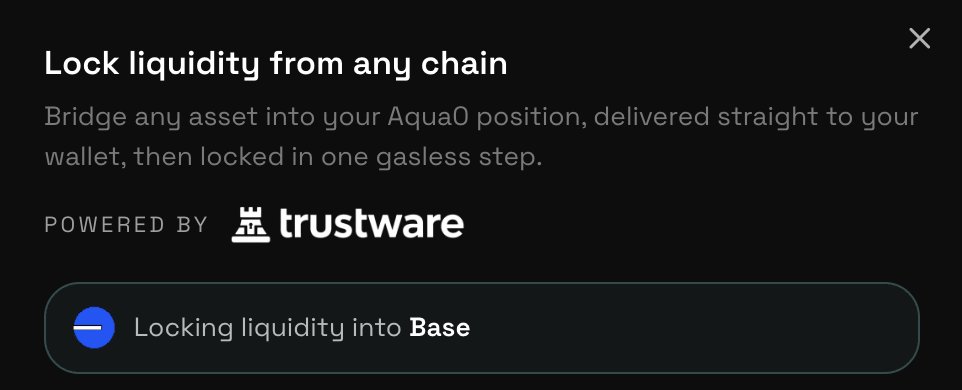
Aqua0 is building shared liquidity infrastructure for stablecoin issuers, allowing liquidity to be deployed across multiple pools and chains without splitting capital into isolated positions.
Aqua0 is using Trustware to power the deposit, swap and cross-chain routing flows that bring users into its ecosystem:
💠 Deposits from any asset and any chain
💠 Swap and bridge routing into the required destination asset
💠 Non-custodial settlement directly into Aqua0
💠 A simpler onboarding flow without building separate deposit infrastructure for every chain
Aqua0 and Trustware are making cross-chain liquidity more accessible, capital efficient and easier for users to reach!
happy to have @Trustware_io powering the way liquidity gets into Aqua0
we're building shared liquidity infra for stablecoin issuers, one deposit working across every pool and chain instead of splitting capital into isolated positions.
Trustware handles the hard part of getting there: deposits from any asset on any chain, swap and bridge routing into what you actually need, and non-custodial settlement straight into Aqua0. no separate deposit setup per chain.
getting liquidity in should be as frictionless as the infrastructure itself. this is a big step there.