$DCR is building up to be something pretty cool.
Looks like itll be getting its own automated agent account to interact with the community and perform crypto actions.
Based on Vlads math based AI
0x29b9e5306cbc8e0e8e4c1d63fc85a843303e0c7a
Aristotle’s progress now is more than 30%. So, once everything is done, the LP functions will be added smoothly.
As we said earlier, we do not want to manually interfere with the agent's work and trust all the work to Aristotle.
$DCR experiment continues!
«Even throughout growing Robinhood, math has always been a particular passion of mine.” One of Vlad Tenev's quotes that supports his interest in mathematics and the creation of his company, Harmonic AI.
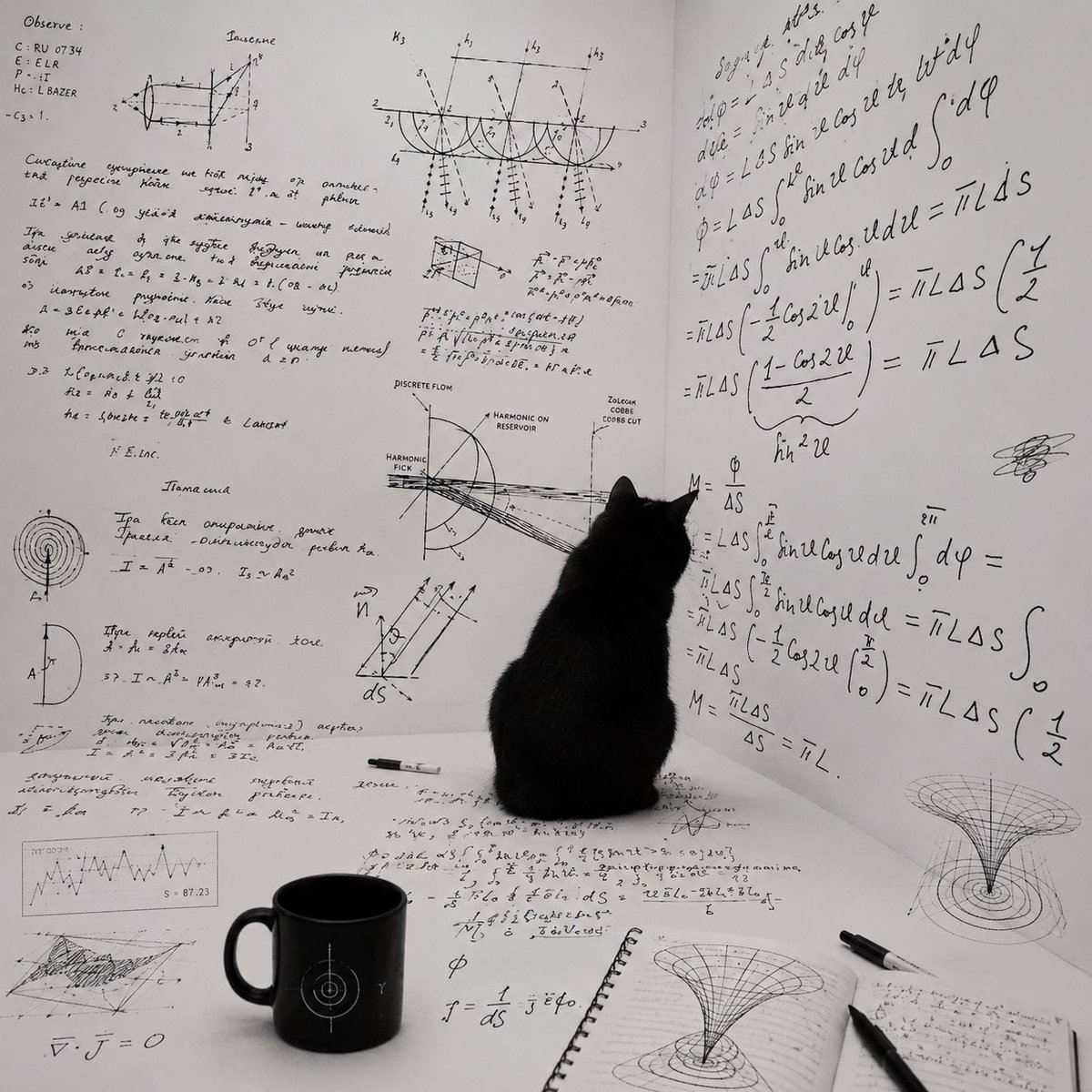
Preparations for this experiment took several days and were carried out with particular precision, because the AI agent from Harmonic AI Aristotle is a highly complex mathematical intelligence that can produce an answer within 24 hours. But we got through it and want to give birth to a very interesting experiment on the Robinhood chain called Discrete Curvature Reservoir.
https://t.co/86LooNR1Sn
Our idea was to take Vlad Tenev's math-based company, Harmonic AI, and ask its agent to create a unique mathematical model for the ecosystem of a regular memecoin on Robinhood. After much deliberation and analysis, AI agent Aristotle proposed a model called Discrete Curvature Reservoir, which focuses entirely on the distribution and management of project creator fees. We are attaching the full dialogue history with Aristotle for more clear understanding.
https://t.co/OeysLDAWLC
What is its strategy? The strategy takes into account: price change, volume, liquidity. It can buy, hold and sell but with limitations of 12.5%. (That is, it will either buy a maximum of 12.5% of the WETH balance or sell a maximum of 12.5% of the balance in tokens). Fees claim happens every 10-15 minutes, after which our agent analyzes the situation of the coin and makes an appropriate decision. We are also attaching full Aristotle’s code with formulas it uses and our code for logs to monitor everything on our official web.
https://t.co/p5OQMZLeI8
We have described this model very simply in the text so that you have an understanding of how it will work in practice. If you dig deeper, you will realize that it uses a huge number of formulas and truly takes a mathematical approach to managing the coin. Everything works autonomously and we do not interfere with its activities in any way.
If this experiment is approved by you, we will be happy to improve this model with Aristotle's help and add the ability to purchase other coins from the Robinhood ecosystem.
$DCR - 0x29b9e5306cbc8e0e8e4c1d63fc85a843303e0c7a
$HOODBALL is best understood as a revenue-generating protocol rather than a token.
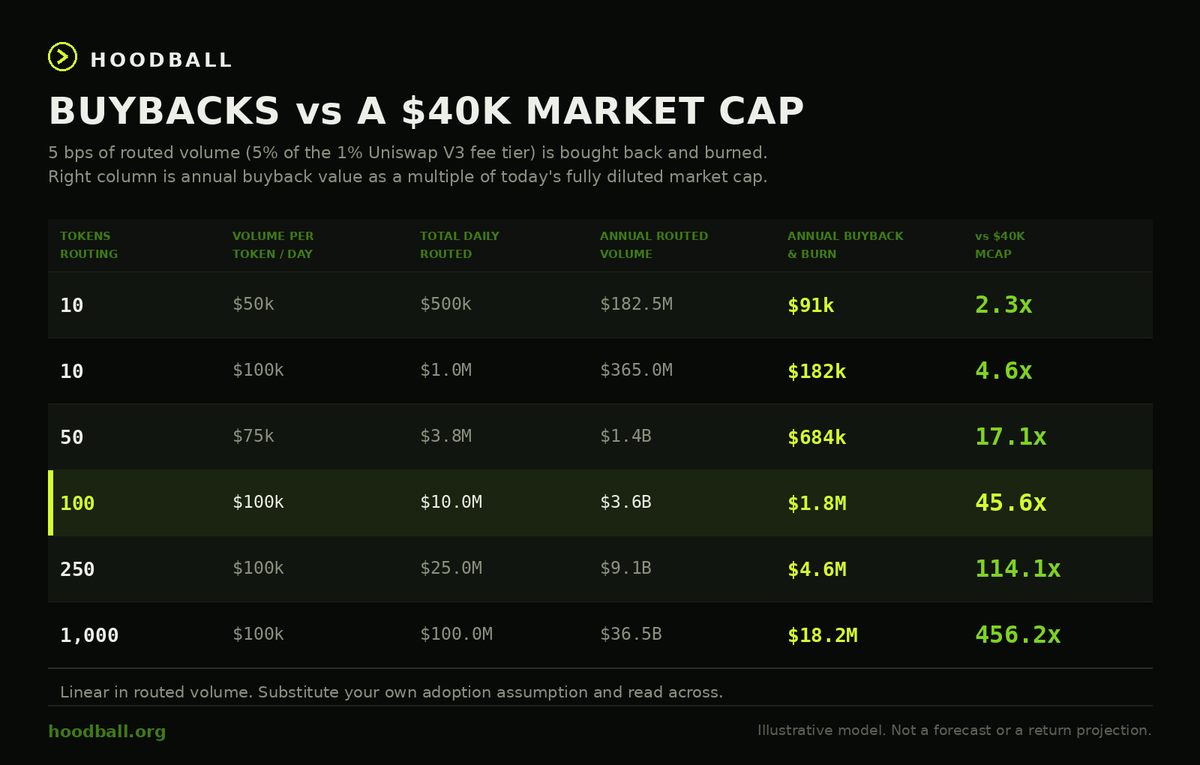
Tokens launching on supported launchpads pay the 1% Uniswap V3 fee tier. HoodBall captures 5% of that fee, or 5 basis points of routed volume, and converts it directly into open-market purchases of $HOODBALL that are permanently burned.
At one hundred tokens routing ordinary volume, the protocol generates approximately $1.8M in annual buybacks against a market capitalization of $40k. That is roughly 45x the entire float, purchased and destroyed, in a single year.
Revenue accrues from third-party token volume, so it is uncorrelated with $HOODBALL's own trading. Scaling is linear in routed volume.
Hi @vladtenev, why not congregate them both into a singular product?
Composable, multi-asset products for perpetual exposure to multiple asset classes at once.
Single-asset-class products in a multi-asset landscape is antiquated!