Rialo @RialoHQ and the Gauss Mechanism (Concise Summary)
Rialo is a blockchain designed around a modern state machine replication (SMR) model, with a strong focus on flexibility and long-term evolution. Its key innovation is the integration of Gauss, a mechanism that enables safe reconfiguration without requiring the system to stop.
Instead of relying on a single log like traditional systems, Gauss separates logs into two types:
Inner log: contains all entries ordered by consensus, including both transactions and internal coordination messages.
Outer log: contains only executable transactions, derived by filtering the inner log.
This design provides several advantages:
Clear separation between consensus and execution, reducing complexity.
Easier upgrades, allowing changes to validator sets or consensus algorithms without affecting execution logic.
Continuous operation during transitions, avoiding downtime.
Reconfiguration in Gauss happens in three phases:
Preparation: the new configuration gets ready.
Handover: a transition boundary is established between old and new configurations.
Shutdown: the old configuration safely exits.
As a result, Rialo can:
Upgrade with little to no downtime.
Maintain safety through quorum intersection.
Adapt system components over time with minimal risk.
In short, Rialo—powered by Gauss—turns blockchain upgrades from a risky, disruptive process into a routine, safe, and seamless operation.
. @RialoHQ take: Private credit is starting to show cracks — and it highlights a major challenge for DeFi when dealing with real-world assets (RWAs).
Blackstone’s BCRED (~$82B) saw $3.7B in redemption requests in Q1 2026 (~8% NAV).
BlackRock’s HLEND had to gate $580M in withdrawals.
Blue Owl recorded ~15% NAV redemptions in late 2025.
Some funds are reporting ~9% default rates.
This isn’t a crisis yet. Private credit (~$2T) is still small relative to the $130T bond market.
But confidence is weakening.
Many people argue the solution is to bring private credit onchain:
Encode covenants in smart contracts
Transparent redemption rules
Automated liquidation triggers
This solves the rules problem.
But it doesn’t solve the truth problem.
A smart contract can say:
“Liquidate if collateral ratio < 1.2x.”
But who determines the collateral ratio?
To answer that, you need:
borrower financials
collateral valuations
payment performance
covenant calculations
If the fund manager is the one feeding data onchain, then blockchain is just a wrapper around the same system.
Immutable rules.
Unverifiable inputs.
That’s not trustless — it’s just trust with extra steps.
This is the real gap in RWAs: the verification gap.
For onchain private credit to truly work, we need a new infrastructure layer:
The Determination Layer
1️⃣ Smart contracts pull data directly from ERPs, bank APIs, Stripe dashboards, and accounting systems.
2️⃣ Confidential compute to evaluate covenants while keeping financial data private but results verifiable.
3️⃣ Programmable covenant logic to support complex and bespoke deal structures.
Tokenization is not the hard part.
Verification is.
Without solving this, DeFi risks becoming exit liquidity for assets Wall Street has already repriced.
The future of RWAs isn’t just about the tokenization layer.
It’s about the determination layer — where verifiable truth about off-chain assets gets produced.
That’s the layer Rialo believes the RWA stack is missing today.
. @RialoHQ builds a private computation layer (REX) that runs alongside the public execution environment.The result:
• Encrypted inputs
• Confidential execution
• Verifiable outputs
• No data leakageThis unlocks:
Institutional-grade private DeFi
KYC-enabled apps without exposing PII
Secure Web2 integrations
Financial markets without frontrunningPrivacy isn’t a feature add-on.
It’s a prerequisite for real-world adoption.Rialo isn’t just building another blockchain.
It’s building internet-native infrastructure that is both verifiable and confidential.Web3 only scales when privacy becomes native.
– @RialoHQ = Blockchain Built for Welfare
Most chains optimize for TPS.
Rialo optimizes for system welfare.
Lower costs.
Better reliability.
Aligned incentives.
By integrating oracles, automation, and execution natively, Rialo removes rent-seeking middle layers.
More value stays with users and devs.
That’s real infrastructure.
A strategic move from @RialoHQ ahead of Mainnet:
👉 Keplr Wallet integration.
Keplr isn’t just a wallet — it’s a trusted gateway that enables secure, familiar, and efficient access to decentralized applications.
For a project aiming to become a Real-World
Blockchain, prioritizing user experience at the infrastructure level is a smart and necessary step.
Mainnet launch + Keplr integration =
🔐 Security
🔄 Seamless UX
🌐 Ready for real-world adoption
This is a project worth following closely.
Rialo makes DeFi automation native- no keepers required.
Keeper networks exist because most chains can’t act on their own.
They rely on offchain monitoring and external execution.
@RialoHQ removes that entire dependency.
Conditions live onchain.
Execution logic lives onchain.
Validators enforce both.
Liquidations trigger the moment risk thresholds are crossed.
Funding updates run automatically as market conditions change.
Risk controls activate without delays or coordination.
No offchain bots.
No incentive games.
No execution races during volatility.
On @RialoHQ , automation isn’t a service layer.
It’s protocol law, enforced by the chain itself.
* @RialoHQ arrives at a time when the technology is finally ready.
Rialo doesn’t just optimize speed or transaction fees.
It expands the scope of what blockchains can truly do, bringing them closer to Web3’s original promise: automated systems, no intermediaries, and execution that reacts to real-world events.
With Rialo:
RWAs can interact directly with real-world data
Prediction markets can settle in real time without relying on fragile oracles
Smart contracts become event-driven, without the need for bots to trigger execution
DeFi connects directly to Web2 and live market data
No oracles in the traditional sense — native web calls with onchain verification
AI agents can operate with verifiable execution and clearly defined permissions
This is no longer just a “good idea on paper.”
This is an architecture built to run in the real world.
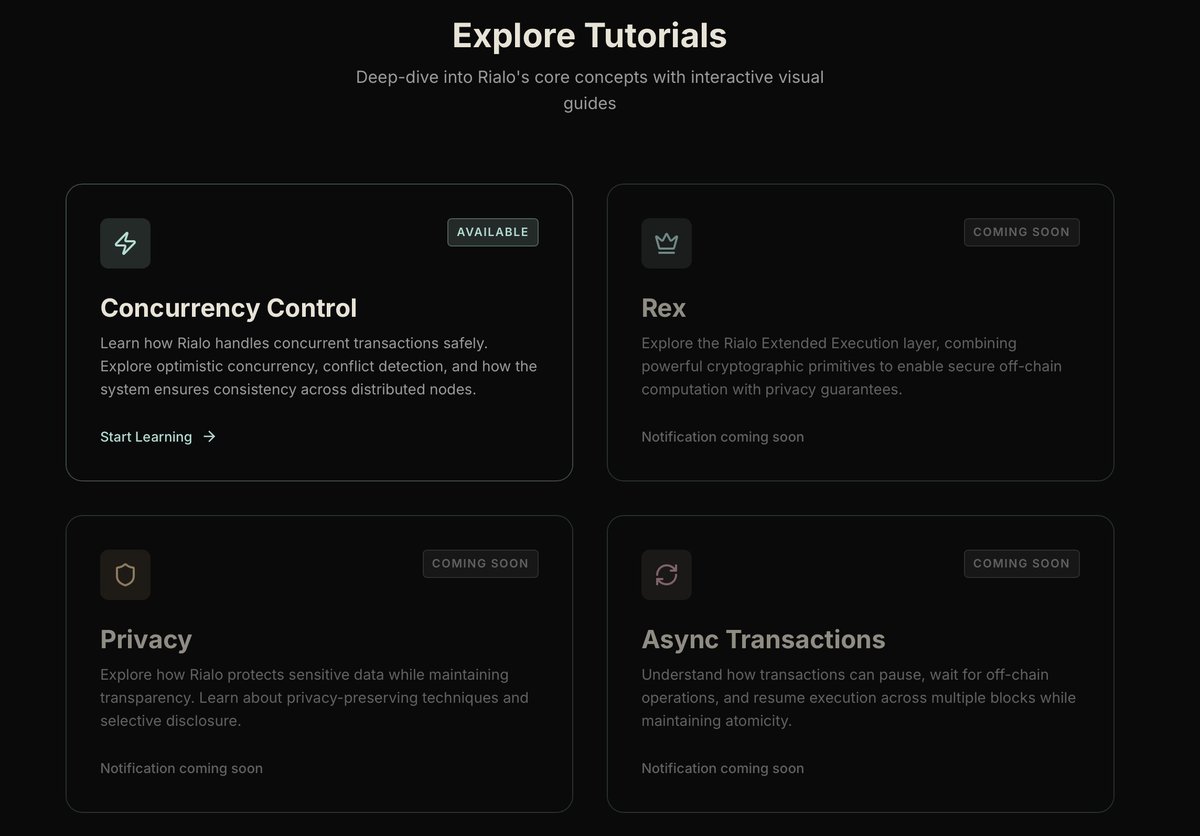
> @RialoHQ has released documentation that makes it easy for us to understand and learn. I
t’s genuinely impressive — highly intuitive, hands-on, and focused on real experience rather than dry theory.
Very bullish on Rialo.
> @RialoHQ has released documentation that makes it easy for us to understand and learn. I
t’s genuinely impressive — highly intuitive, hands-on, and focused on real experience rather than dry theory.
Very bullish on Rialo.
Documentation only tells half the story. Experience the rest.
We are excited to start showing https://t.co/QkvgPU9VDz, a dedicated and interactive showcase of the engineering that powers Rialo.
From immersive walkthroughs to live technical demos, see exactly how we’re redefining the industry standard.
Dive in at https://t.co/QkvgPU9VDz
How @RialoHQ Builds Privacy Into the Protocol ⏬
Rialo treats privacy as a protocol-native primitive, not an optional add-on. Instead of pushing confidentiality to application layers or external services, Rialo integrates confidential computation directly into the base layer.
At the heart of this design is Rialo Extended Computation (REX), Rialo’s private execution environment.
▶️With REX:
- Transactions are encrypted using a network-provided public key
- Decryption occurs only inside the private execution environment
- Sensitive inputs are never written onchain
- All confidential data is erased immediately after execution
When a Rialo transaction retrieves sensitive offchain data such as financial records or authentication credentialsthat data never leaves REX.
This architecture allows Rialo applications to process confidential information securely while preserving the trust guarantees of public blockchains.
🪱 WORM – When Burned ETH Doesn’t Disappear, It Evolves @EIP7503 :
Worm is not just another NFT collection.
It is an Ethereum protocol upgrade proposal — EIP-7503 — built around a radical idea:
👉 Privately minting from burned ETH using zero-knowledge proofs.
Instead of treating burned ETH as value that vanishes forever, Worm challenges a core assumption of Ethereum:
What if burned ETH could still generate value — without compromising privacy or network security?
📜 What is EIP-7503?
> A proposal that leverages burned ETH
> Enables private minting
Powered by zero-knowledge proofs (ZKPs) to ensure:
Privacy
> Verifiability
>No disruption to Ethereum’s existing burn mechanism
Worm serves as the first experimental layer exploring this concept.
🖼 Worm NFT Collection Details
Supply: 7,503 NFTs
Mint Price: FREE MINT
Chain: Ethereum
Standard: @EIP7503
🚀 $WORM ICO – Among the First Native Launches
The $WORM ICO will be among the earliest launches to utilize native infrastructure built around EIP-7503.
This means:
No half-baked forks
No patched-together layers
A direct experiment grounded in Ethereum’s core philosophy
🧠 Why Worm Matters
Bridges NFTs, EIPs, Zero-Knowledge, and Tokenomics
Reframes the value of burned ETH
Free mint — not free vision
Built for Ethereum OGs, researchers, and builders
🪱 Worm doesn’t promise a moon.
Worm asks a deeper question about Ethereum’s next evolutionary step.
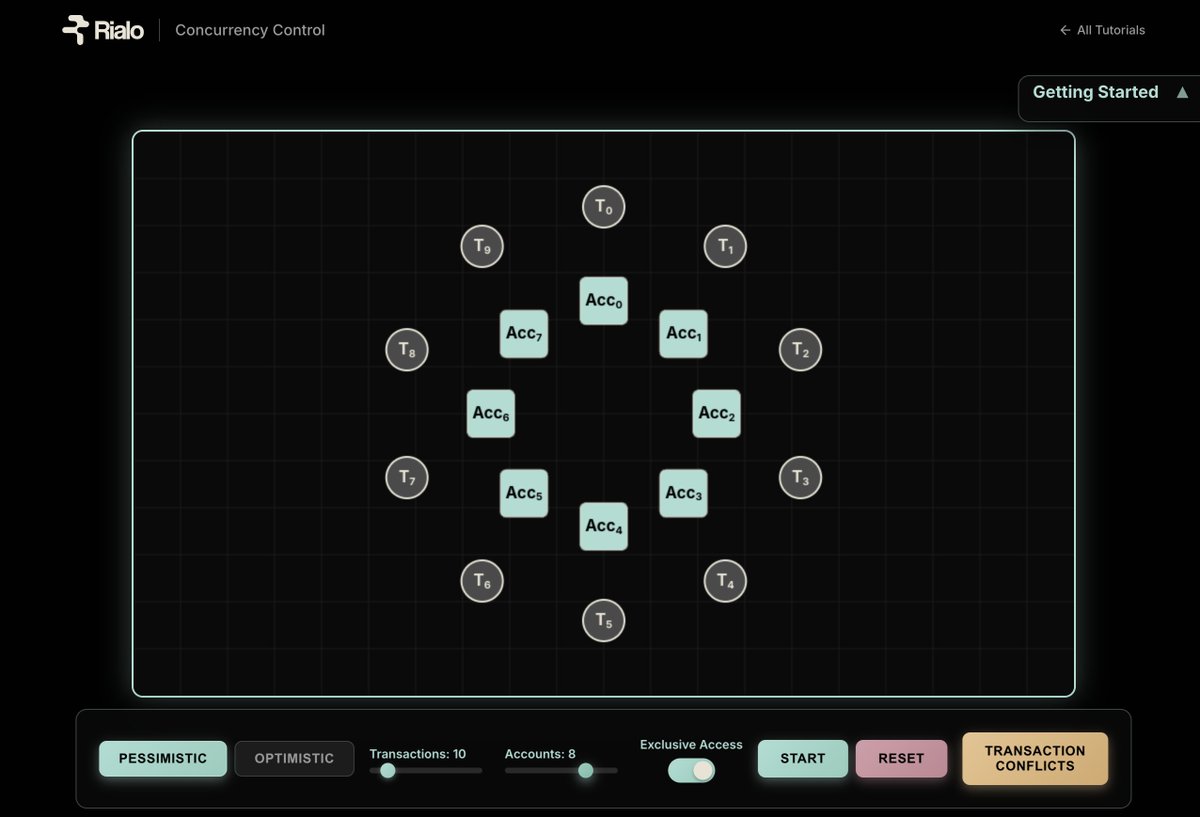
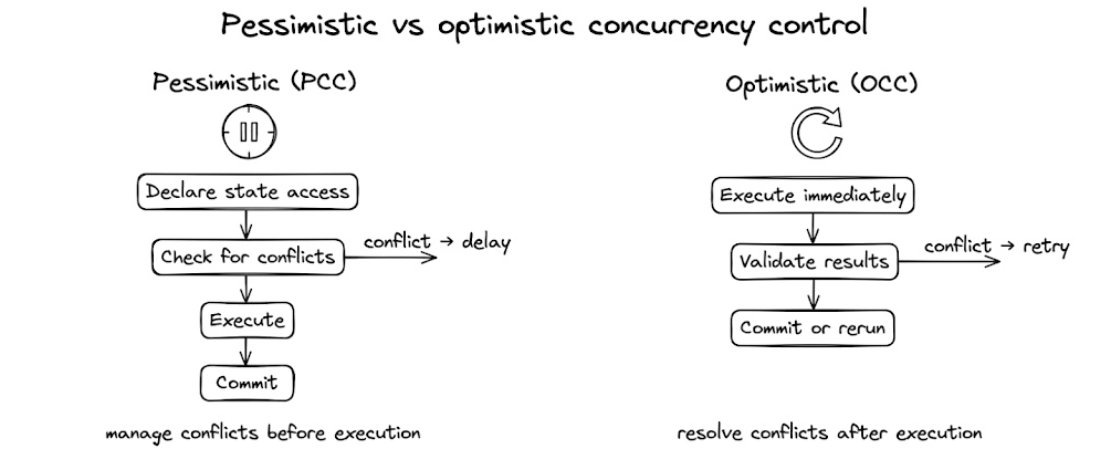
💠Why Parallel Execution Is No Longer Optional for Next-Generation Blockchains @RialoHQ :
For years, blockchains have accepted sequential execution as a necessary trade-off for correctness. But hardware has changed. Modern CPUs no longer gain performance by increasing clock speed—they gain it by adding more cores. If a blockchain still executes transactions on a single thread, it is wasting most of the available compute power.
Parallel execution enables:
✅Higher throughput (TPS)
✅Lower transaction latency
✅Reduced transaction fees
✅A viable path to mass adoption
However, parallelism is not trivial. Blockchains cannot afford incorrect results, and this is where concurrency control becomes indispensable.
Privacy isn't just a tech, add-on, or feature.
It’s a way of life as fundamental as your home.
As life moves online, privacy becomes the condition for peace in a digital world.
Here’s an excerpt from our Privacy Roundtable yesterday 👇
It is truly unfortunate to see the recent news of Ledger users facing the stress of the Global-e data breach.
This situation proves a critical, if painful, point: true security must extend far beyond the hardware itself to protect the people behind the devices.
Even if your device is secure, your data remains a systemic liability if it resides in a centralized, plaintext database.