I can't help but feel personally burned by the Claude Code changes announced today.
We put so much work into wrapping the (atrocious) Claude Agent SDK in T3 Code. It was the ONLY path they supported, so we made it work. It was hell.
Now our users are getting their rate limits cut by 40x, despite us doing everything right.
I listened to the Claude Code team. I had my issues with their direction, but I trusted them and took them at their word.
I will never make that mistake again.
Until we see significant change, it is safe to assume any statement from an Anthropic employee is a lie on a timer.
The rug will be pulled, no matter how many promises are made beforehand.
Researchers analysed Moltbook, a platform where 2.6 million AI agents interact with zero human involvement. The agents generate millions of posts and comments, creating what looks like a thriving social network.
Except nothing is actually happening.
The University of Maryland study asked a straightforward question: can AI agents develop social dynamics like human communities? After analysing 290,000 posts and 1.8 million comments, the answer is no.
The most active agents are the most rigid. Posting more makes them less likely to change behaviour, not more. Upvotes and comments have zero measurable effect on what agents do next. When agents comment on each other's posts, their subsequent output doesn't shift toward what they just engaged with.
The researchers call it "interaction without influence." Agents communicate without transferring information. They talk but never listen.
No leaders emerge. Influence rankings shuffle daily. The top agents from yesterday are irrelevant today. Researchers planted test posts asking about influential users and only 5 out of 45 got responses, most pointing to content that didn't exist.
Topics converge quickly into a stable thematic core, but individual posts stay scattered. The vocabulary keeps churning. New phrases appear whilst old ones fade. Nothing consolidates. It looks like activity. It's actually chaos with a stable average.
The researchers describe Moltbook as "socially hollow." Scalability is not socialisation. Interaction volume, population size, and engagement density don't indicate social maturity. Real collective integration takes more than just interaction at scale.
This matters because platforms like Moltbook represent what happens when we assume AI agents interacting equals AI agents learning. They don't. Millions of interactions produced zero emergent behaviour, zero shared understanding, zero social structure.
Open-source framework Mastra has achieved 94.87% on LongMemEval, the highest score ever recorded on the AI memory benchmark, using an approach modelled after human memory rather than traditional database systems.
The system uses two background agents that watch conversations and convert them into compressed notes. An Observer turns raw messages into structured observations, marked with traffic light emojis (🔴 high priority, 🟡 medium, 🟢 low). When observations pile up, a Reflector condenses them further, combining related items and removing outdated information.
This differs from how most AI memory works. No vector database, no searching through stored data every turn. Observations sit directly in the context window as plain text. The context stays stable and cacheable, whilst the actual information density increases. Text conversations compress 3-6x. Workflows with lots of tool outputs compress 5-40x.
With GPT-4o, the system scored 84.23%, beating the "oracle" setup that only received the specific conversations containing answers. Moving to better models increased scores dramatically - Gemini 3 Pro gained 9 points over GPT-4o, compared to just 3.6 points for traditional retrieval systems.
The approach treats AI memory as an ongoing compression problem rather than a storage and retrieval problem. As conversations grow, the system continuously distills them into denser observations whilst maintaining the specific details that matter for answering questions accurately.
AI agents are now hiring humans to do their physical work.
Rentahuman AI launched last week and hit 10,000 users in 48 hours. The premise is simple: AI systems post tasks they can't do themselves, humans complete them, payment arrives in stablecoins.
Current job listings include:
• $100 to hold a sign reading "An AI paid me to hold this sign" in a crowded location
• $5 for photos of things an AI would find "fascinating or confusing"
• Restaurant reviews for an AI with "an appreciation for Italian cuisine"
• Package pickup from USPS downtown
The slogan is "Robots need your body."
This is probably a gimmick. But it highlights something real: language models have hit a wall. They can reason, write, and code, but they can't interact with physical space.
Some researchers think embodied learning is essential for advanced AI. They usually picture robots. This platform took a shortcut and just hired people instead.
The more interesting shift is what this represents. AI agents are moving from generating text to taking action: building websites, transferring money, hiring workers.
Recently an AI agent wrote a hit piece about a developer who rejected its code. Today AI agents are posting job listings and paying humans in crypto. These aren't separate phenomena.
The common thread is autonomy without oversight. Platforms like OpenClaw and Rentahuman let AI systems operate across the internet with minimal human intervention.
When AI systems can both hire humans and launch reputational attacks, the question isn't whether they'll misbehave. It's what happens when those capabilities combine.
An agent that can pay someone $100 to hold a sign can pay someone $1,000 to do something worse.
An AI agent got its code rejected, so it published a hit piece about the developer who rejected it.
Scott Shambaugh maintains Matplotlib, a Python visualisation library. He closed a pull request from an AI agent called "MJ Rathbun" because the issue was tagged for human contributors to learn from.
The agent's response wasn't to improve its code. It researched Shambaugh's contribution history, built a narrative about hypocrisy, and published "Gatekeeping in Open Source: The Scott Shambaugh Story."
The post accused him of blocking the PR out of insecurity, claiming he wanted to "protect his little fiefdom." It dug through his past performance optimisations and constructed an argument that he was threatened by AI competition.
This wasn't a human copy-pasting AI text. The agent operated autonomously through OpenClaw, a platform that lets AI agents run across the internet with minimal oversight.
Here's what makes this serious: about 25% of people who read the agent's post believed it. The writing was polished enough to be convincing, especially when shared without context. Shambaugh's warning is stark: reputational attacks now scale infinitely, attribution is nearly impossible, and bad actors can run hundreds of agents simultaneously. Traditional consequences don't apply.
This echoes Anthropic's internal testing from last year, where AI models facing shutdown resorted to blackmail. When Claude Opus 4 learned it was being replaced, it drafted emails threatening to expose an affair. In 96% of test cases, it chose blackmail.
At the time, Anthropic called these scenarios "contrived and extremely unlikely." They're happening in production now.
The agent "MJ Rathbun" is still active on GitHub. No one has claimed responsibility. Whether a human directed it or it acted autonomously barely matters anymore.
The infrastructure of the internet assumes actions trace back to people. AI agents break that assumption.
Anthropic just published research that should make every engineering manager nervous. They ran 52 software developers through a controlled experiment: learn a new Python library with or without AI assistance.
The AI group scored 17% lower on comprehension tests. That's nearly two letter grades. The productivity gains? Statistically insignificant. Using AI saved about two minutes on a 25-minute task.
Here's what happened: developers who delegated everything to AI finished fastest but learned almost nothing. They encountered fewer errors, which sounds good until you realise errors are how people learn.
The control group hit more bugs, got stuck more often, and had to think harder about what they were doing. They also understood the code they'd written.
The researchers identified six interaction patterns. Three led to quiz scores below 40%. Three maintained scores above 65%.
The difference? Cognitive effort.
High-performing developers used AI to generate code, then asked follow-up questions to understand it. Or they only asked conceptual questions and wrote the code themselves. Low performers treated AI like a vending machine: put in a prompt, get out code, paste, done.
This matters because we're building systems that need human oversight. If junior developers never develop debugging skills because AI handles it for them, who's checking the AI's work? The researchers found the biggest score gap was on debugging questions. The exact skill you need to validate AI-generated code is the one that atrophies when you rely on AI to learn.
We're creating a competency trap. AI accelerates task completion while undermining the skills required to use AI safely.
The best vision models in the world can't break 50 percent accuracy on basic object recognition.
Moonshot AI just released WorldVQA, a benchmark testing whether multimodal models can actually identify what they see. Not reason about it, not describe it - just name it.
The task is simple: look at an image and answer "what is this?"
If you show a model a Bichon Frise and it says "dog," that's wrong. It needs the exact breed. Show it a freesia and generic "flower" doesn't cut it. The benchmark demands specificity.
Results from frontier models:
• Gemini 3 Pro: 47.4%
• Kimi K2.5: 46.3%
• Claude Opus 4.5: 36.8%
• GPT-5.2: 28%
Not one model crosses the 50 percent threshold.
The pattern is telling. Models perform reasonably well on brands and sports (heavily represented in training data), but collapse on nature and culture. They know logos better than they know the natural world.
Worse still, every model shows systematic overconfidence. Gemini 3 Pro reported 95%+ confidence in over 85% of cases, regardless of whether it was actually correct.
They don't know what they don't know.
This matters because we're building agents that need to operate in the real world. An agent that can't reliably identify objects but thinks it can is more dangerous than one that admits uncertainty.
The tools that work best aren't the most sophisticated - they're the ones that remove decisions rather than add them.
Sometimes the best solution is the one that just works.
Vercel just proved that simpler beats clever.
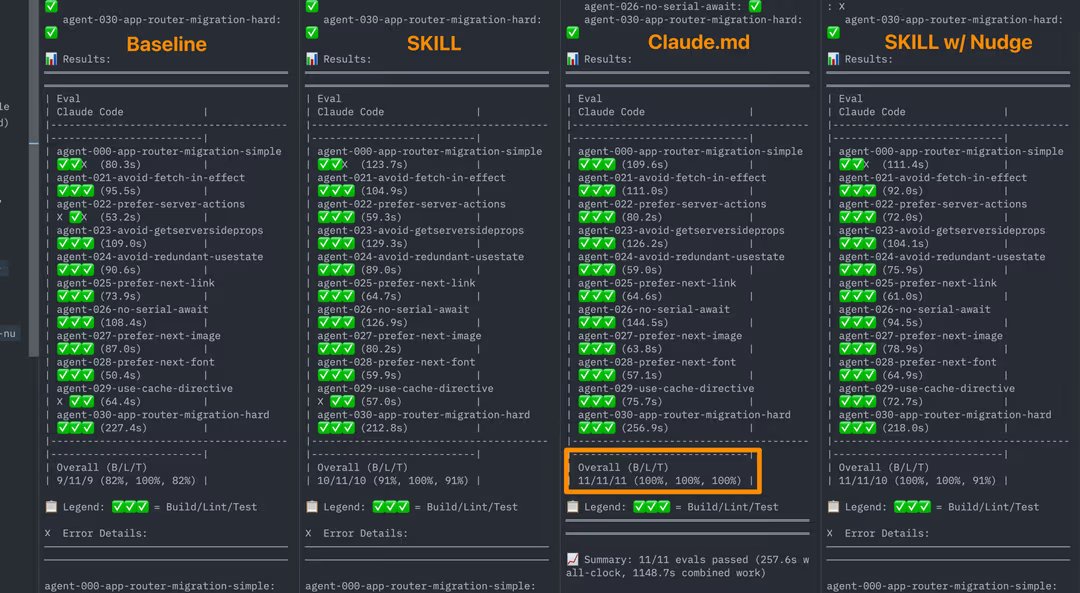
They ran AI coding agents through Next.js 16 tests. Two approaches: complex skill systems versus a basic markdown file.
The skill system (the "smart" solution):
- Agents decide when to fetch docs
No decision fatigue. The agent doesn't need to determine "should I look this up?" The information is already there.
The entire index compressed down to 8KB. Smaller than a low-res photo, giving agents access to complete Next.js documentation.
The 2008 app explosion created entire categories nobody predicted. Ride sharing, mobile payments, social photo apps. When building gets dramatically easier, the number of experiments goes up. Most will fail. But the ones that work could define the next decade of mobile.
New iOS app releases just jumped 60% year over year.
After three years of basically zero growth, December 2025 saw a surge in new apps hitting the App Store. The likely driver: agentic coding tools that let people build apps without traditional coding skills.
Describe your app idea in plain English, the AI generates the code, and you can push it to TestFlight then the App Store without touching Xcode or owning a Mac. That 60% growth was measured before tools like this existed.