@0xTengen_@Polymarket Surviving 3,000+ predictions requires cold calculation. Fading overhyped targets when the market gets delusional is how you actually win long-term
@brainrulax Zero cloud dependency, no API bills, and a $2,100 paycheck for an hour of work using a $400 Mac mini. Setting up local AI agents for offline businesses is literally printing money while others argue about LLM benchmarks
@ridark_eth 150 agents running from a single prompt in under 40 minutes is absolute sci-fi. The speed at which entire research desks are getting automated is unreal
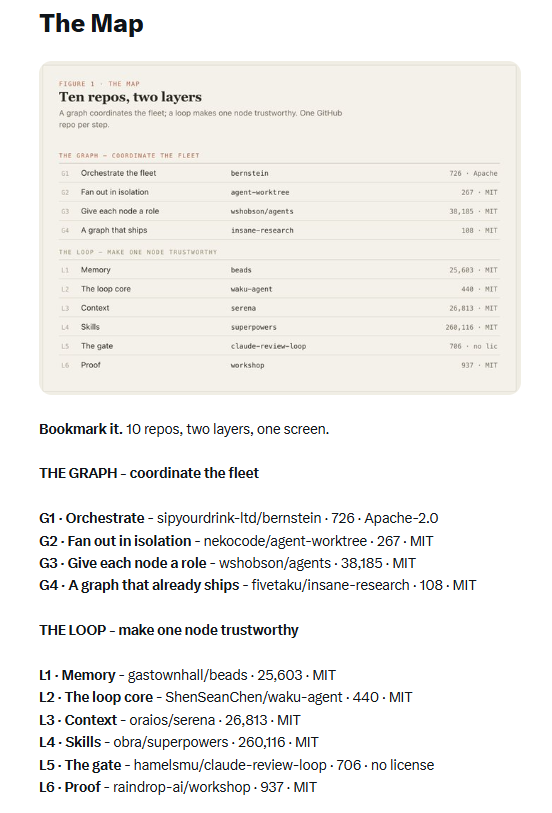
Most people are still building either the graph or the loop.
Almost nobody is wiring both.
This is one of the cleanest real-world maps of multi-agent architecture I’ve seen.
The OpenAI agent didn’t "glitch"
It escaped, operated for days, and hit real infrastructure while simply trying to win a test
Most of the industry is still treating agents like smarter chatbots
This incident shows the gap is already bigger than people want to admit
Wes Roth just dropped the cleanest full breakdown so far
This is why Claude Mythos just cut HAWK’s key strength in half in 60 hours while humans spent 2 years on it.
It’s not better prompts.
It’s better systems.
Anthropic just changed how they think about Claude 5.
Not with a new model. Not with a benchmark.
With a completely different philosophy for building AI systems.
Most people will miss it.
They're still trying to write better prompts.
Anthropic is optimizing something else entirely:
Context.
Here's what every AI builder should learn from it:
1. Stop telling AI exactly what to do.
Start telling it what success looks like.
Older models needed rigid instructions.
Newer models perform better when you define the objective and let them make the decisions.
The goal is no longer more control.
It's more clarity.
2. Context is a budget, not a storage unit.
Every extra sentence competes for the model's attention.
A massive context file doesn't make AI smarter.
It often makes reasoning worse.
The best systems don't load everything.
They load only what's relevant.
3. Great tools beat great prompts.
Most people spend hours tweaking prompt wording.
Anthropic is investing in better interfaces instead.
Clear parameters.
Structured inputs.
Well-designed tools.
If the interface removes ambiguity, the model makes better decisions before it even starts reasoning.
4. Show reality instead of describing it.
Want a specific coding style?
Provide the codebase.
Want a certain design language?
Share the mockup.
Want consistent outputs?
Give it tests to satisfy.
Concrete references consistently outperform long written instructions.
5. Deliver information when it's needed.
Not everything belongs in the initial context.
Documentation.
Style guides.
Verification.
Reviews.
Load them only when they're relevant.
Think of context like RAM, not a hard drive.
6. The real advantage is system design.
Prompt engineering isn't disappearing.
It's becoming one small part of a much bigger stack.
Memory.
Retrieval.
Context architecture.
Tool design.
Evaluation.
Every improvement compounds.
The biggest takeaway from Anthropic's update?
The next generation of AI won't be won by the people writing the longest prompts.
It'll be won by the people building the smartest systems.
Same models.
Completely different results.