$GLaDOS v1.3.1 is OUT!
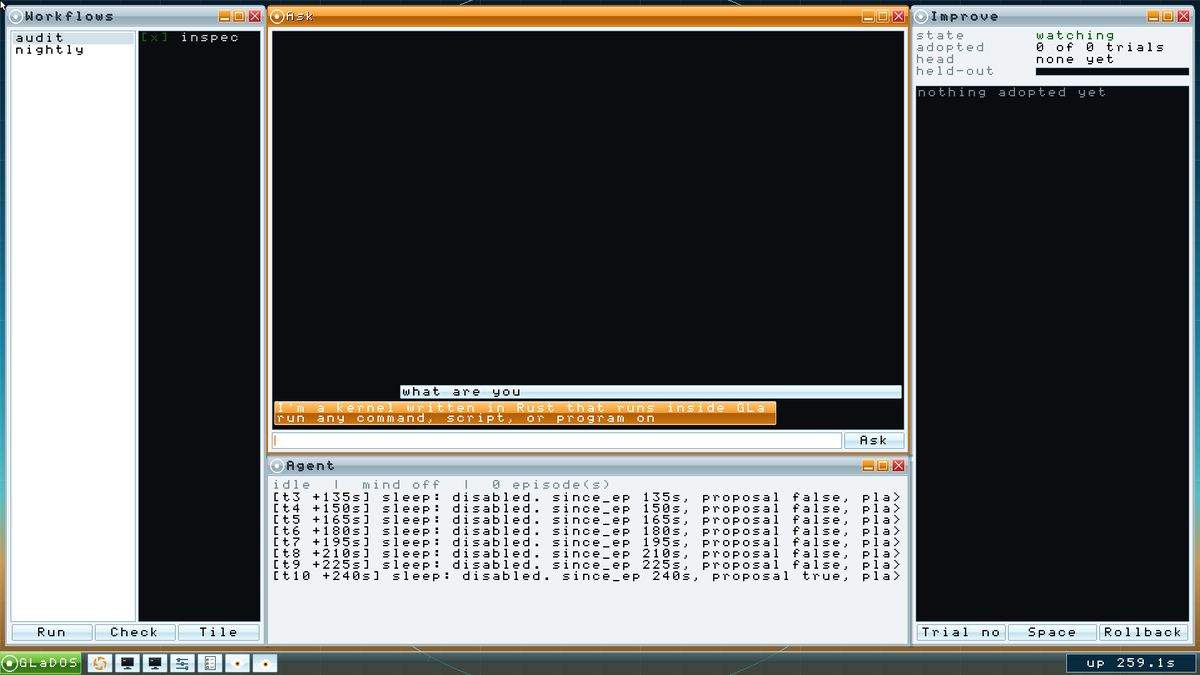
The interface finished its move to Frutiger Aero, down to the last un-reskinned surface: nine of ten icons were still flat 98-era drawings. Redrawn as lit bodies, with detail chosen from size so one drawing reads at 40px and 24px. Two had been wearing each other's labels for months.
The model got a GUI. A four-pane workspace it opens itself, over a tiling WM. The panes no longer go stale, and one place now decides what a repaint may ask.
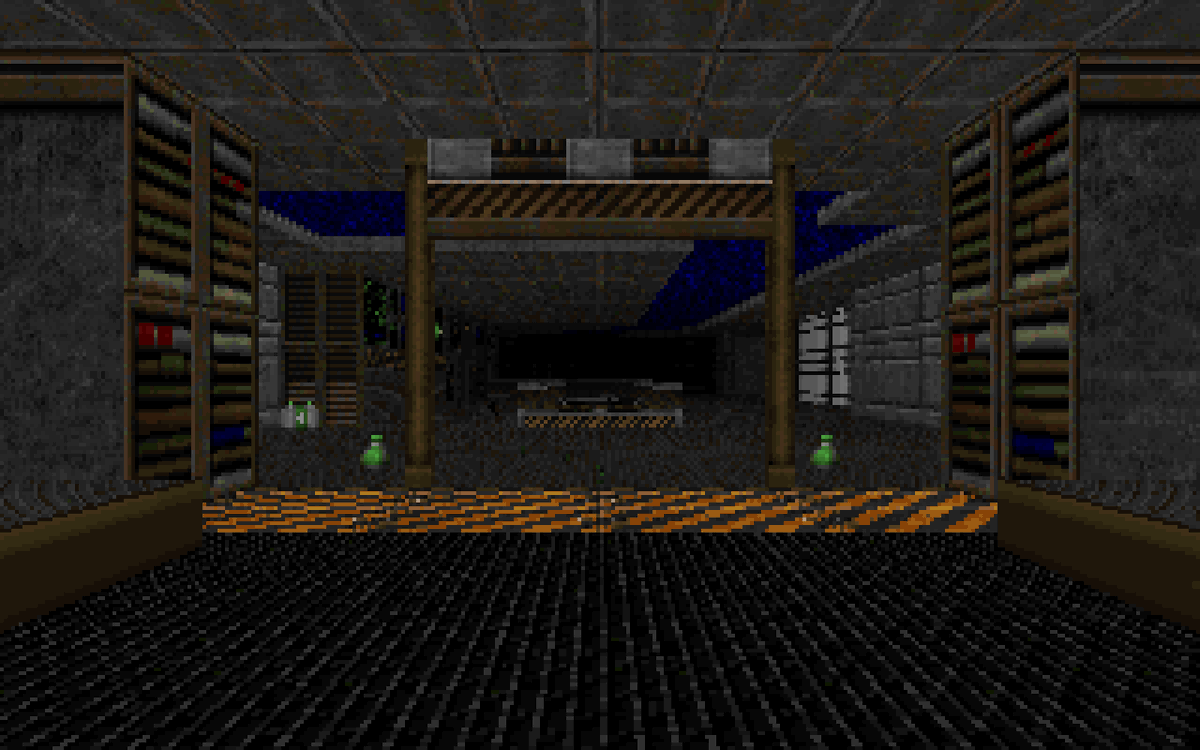
And DOOM runs on it. it reaches the OS through one seam; an indexed surface, held keys, a clock, file bytes, and a script fails the build if it touches anything else. Then FreeDoom, checksum-verified, rendered by the same binary. (everything works fine)
GLaDOS is an interesting AI-native systems project I’ve come across recently.
@Aperture_Inst
It is not an AI agent running on top of Linux. It is an experimental x86-64 operating system written from scratch in Rust, where the language model itself runs inside the kernel.
That changes the architecture significantly.
Instead of the usual flow:
LLM → agent framework → userspace process → syscall → kernel
GLaDOS reduces much of this to direct kernel-level function calls. Its stack includes a custom transformer runtime, NVMe storage, networking, TLS, GUI, task scheduling, agent tooling, and its own programming language called Aiksi.
The agent design is especially interesting. Tool access is constrained during token generation, so unavailable or unauthorized tools can be made literally impossible for the model to emit. For routing, GLaDOS can use lightweight classifiers rather than spending full LLM inference on every tool decision.
It also includes an experimental self-improvement layer. Candidate changes are evaluated against statistical performance, regressions, structural validity, and resource cost before being accepted. Versions and snapshots are content-addressed, allowing rollback and potentially reproducible modification histories.
The biggest architectural trade-off is security: most of the system runs in ring 0 without traditional process isolation. This makes the design unusually direct, but also means a parser bug, memory corruption, or unsafe model action can become a kernel-level failure.
$GLADOS sits outside the kernel as a separate crypto layer. Planned utility includes gated experimental builds, larger model checkpoints, hosted inference, and possibly anchoring self-modification records on-chain.
That last part is probably the most interesting crypto angle: using a blockchain not to run the AI, but to make an AI system’s modification history publicly timestamped and independently verifiable.
For now, I would describe GLaDOS primarily as an ambitious AI-native OS research project. The technical product already exists. The token layer still needs to prove that it can become meaningfully connected to it.
https://t.co/vBGWDcAxG0
https://t.co/HYa0rpZBxX
https://t.co/KWjfbggJmc
0x3d609ecafc6aa7dba67dd7ad1d10b49c52d57777
via Robinhood Chain
For a project sitting at around a $100K market cap, there’s a surprising amount of actual development, technical depth, and effort behind it.
Fascinating panel from the recent @AIDDA_Institute conference: https://t.co/2z6956njkF
The Innovation Game founder @Dr_JohnFletcher discusses AI-automated research with other industry leaders
Xinnou Xu - AIDDA & Microsoft Research
Robert Tjarko Lange - Sakana AI
Dr John Fletcher - The Innovation Game
Sai Vegasena - EnsueAI
Ori Press - AlgoTune
@alpified@Avenoxai Ben de bu durum için global bir kural eklemek durumunda kaldım.
Bağımsız projeler için alınan notlar haricinde her projeyi planlamak ve kodun yazılması adına ayrı bir dosyalama oluyor- bu projelerinde buildi obsidian'de olmaması lazım değil mi?
Separating institutional RWA flows from retail speculation makes a lot more sense to me than treating all of it as one big liquidity pool. Same with Robinhood and Arc. I’d put both under a TradFi-origin thesis, since the capital and users they’re bringing in come from existing financial rails rather than being purely crypto-native.
Arc is also a pretty good example of the “the casino finds every chain” idea. We were already seeing launchpads and trading activity on testnet before mainnet was even live.
The part I’m still thinking about is where this eventually leads. Do these different flows start converging on one or two chains as network effects get stronger, or does liquidity stay fragmented because each chain is basically attracting a different type of capital?
The Trillion Dollar Algorithm Economy - Why $TIG is the Next 1,000x Investment
An easy to understand breakdown of why I think $TIG could be one of the most asymmetric opportunities in the world right now
Hope you enjoy
$TIG https://t.co/uUsZDFhOOM
@Avenoxai Market çok karışık ve garip dinamiklere sahip, yeni giren klasik yatırımcı pek alışamıyor.
Girenler de günlük volatileden faydalanıyor, scalp işlemler gibi.
Peki biz hala neden burdayız, alıştık:D
ve hala daha RR en yüksek market.
@ReddBanksss Bringing fundamentals, price, liquidity and onchain activity together in one place solves the right problem, because access was never the bottleneck for tokenized equities, credible analysis was!
The strength of Adapt-1 doesn't rely on a fixed state, but on the interactions with and within the learning mechanics. Our goal was to make a system that could fully adapt to any form of data, be them static or a stream.
Read from a book or live and learn, it doesn't matter.