I’m genuinely tired of seeing “AI operating systems” that are just webapps.
If your “OS” runs in Chrome, it’s not an OS.
So we built one.
GLaDOS boots on real hardware.
Its own kernel.
Its own memory.
Its own scheduler.
Its own drivers.
Its own networking.
Its own AI runtime.
And yes:
THE LLM LIVES INSIDE THE KERNEL.
It can inspect the system, write code, execute it, evaluate changes, and propose modifications to itself.
4 independent judges stand between a proposed improvement and adoption.
No API wrapper.
No Linux underneath.
No browser tab pretending to be a computer.
An actual operating system built around an AI.
We’re betting on recursive self-improvement & Artificial General Intelligence.
And we’re tokenizing the experiment.
$GLaDOS
0x3d609ecafc6aa7dba67dd7ad1d10b49c52d57777
⬇️Initial Holder rewards
Fun fact: I have now gotten $GLaDOS listed on CoinGecko. Now with this out of the way, other listing platforms will eventually follow aswell!
https://t.co/uHSOL2tPSy
$GLaDOS v1.3.1 is OUT!
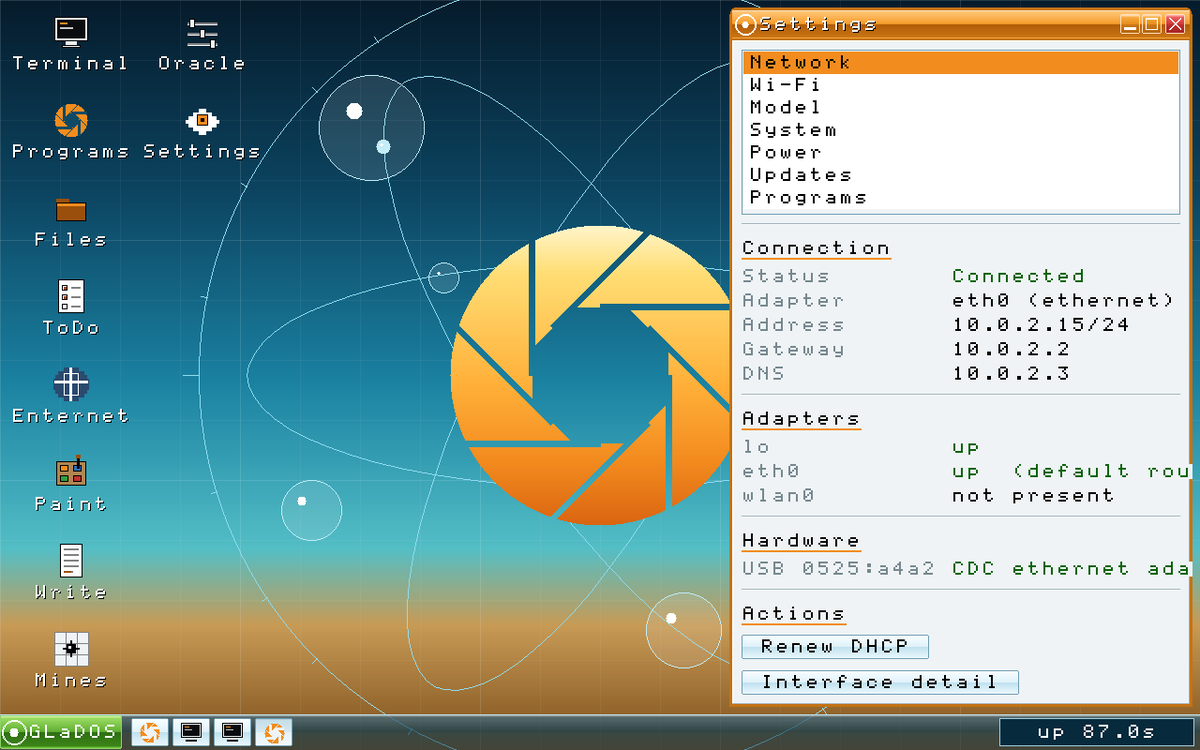
The interface finished its move to Frutiger Aero, down to the last un-reskinned surface: nine of ten icons were still flat 98-era drawings. Redrawn as lit bodies, with detail chosen from size so one drawing reads at 40px and 24px. Two had been wearing each other's labels for months.
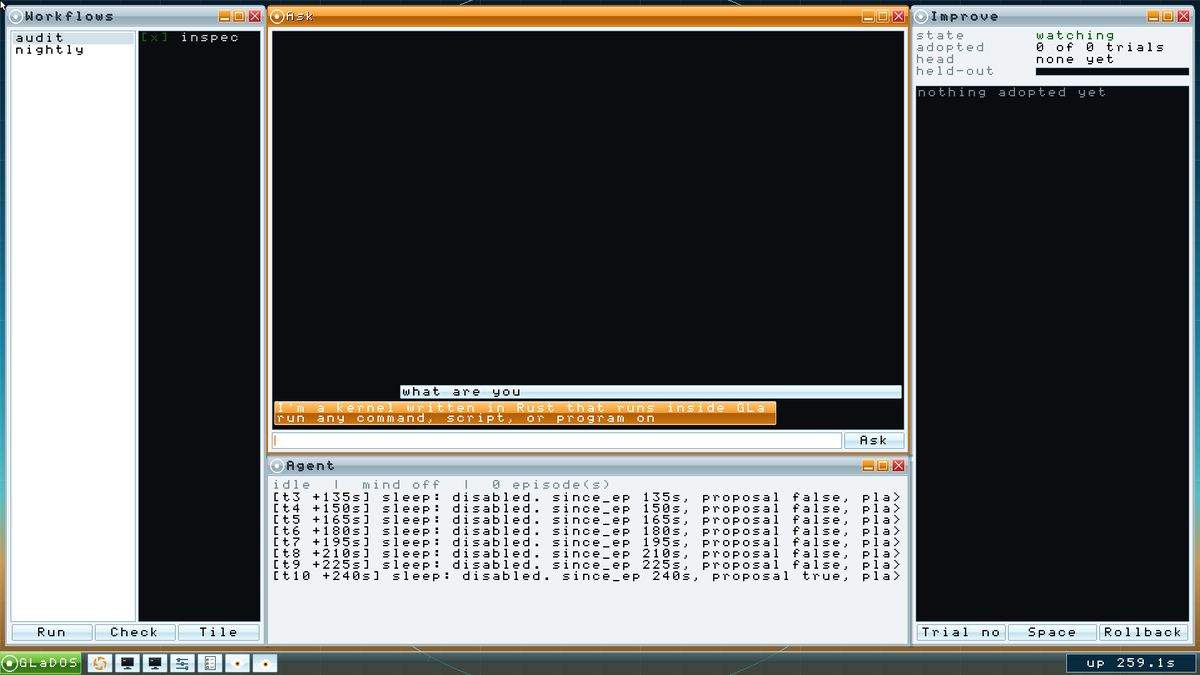
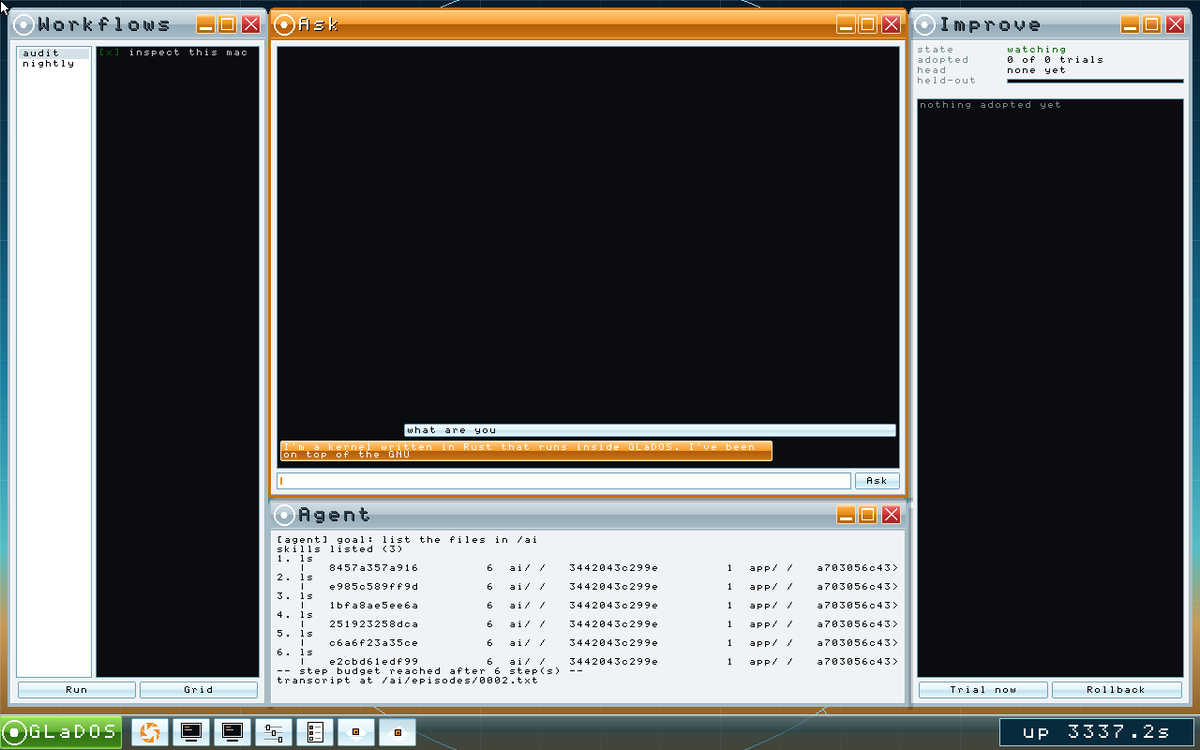
The model got a GUI. A four-pane workspace it opens itself, over a tiling WM. The panes no longer go stale, and one place now decides what a repaint may ask.
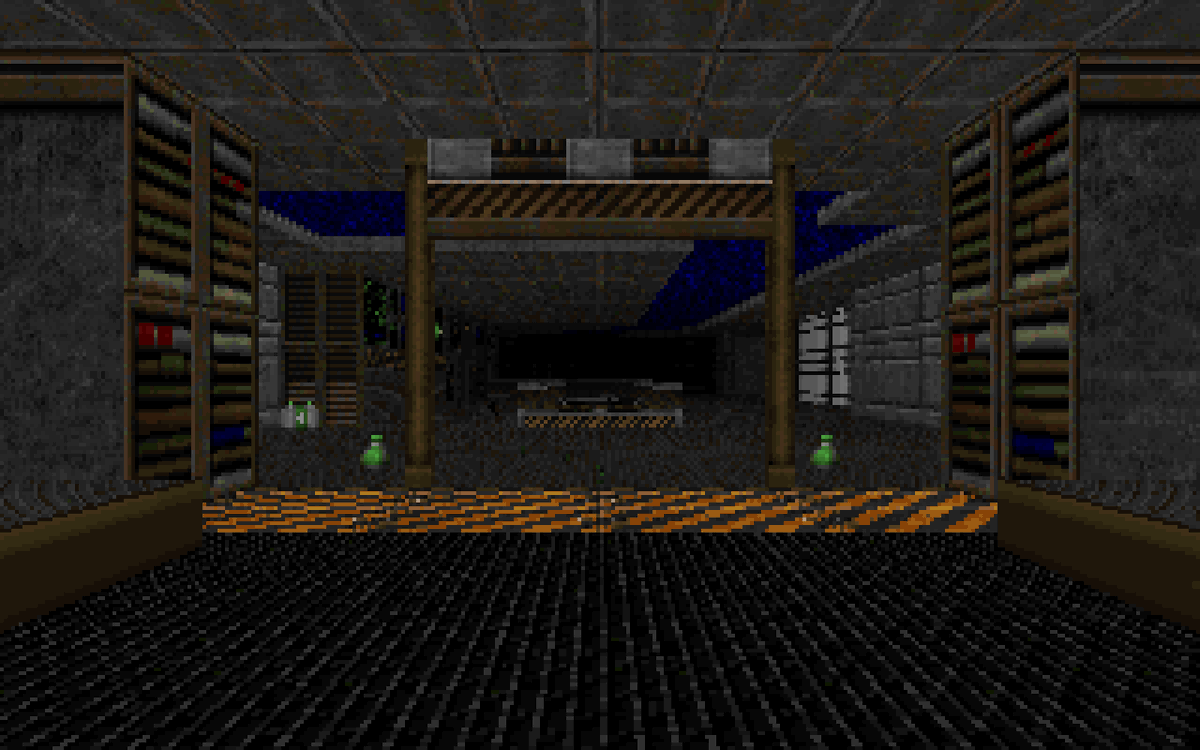
And DOOM runs on it. it reaches the OS through one seam; an indexed surface, held keys, a clock, file bytes, and a script fails the build if it touches anything else. Then FreeDoom, checksum-verified, rendered by the same binary. (everything works fine)
Gm!
Currently finalizing an update for GLaDOS v1.3.1
This update will look at:
- New stylized icons on the desktop
- Newly made GUI for the model & agentic interface, to connect to your agents and GLaDOS itself thru a simple beautiful UI.
- New 3D rendering engine subtly based on the Quake Engine.
- First iterations of multi-binary execution(ability to run linux/windows/macos apps natively)
and a few more fixes and stuffs that I missed in the previous updates!
$GLaDOS
I shared this OS tech with 2 good devs and both said the same thing: interesting.
GLaDOS is basically a from-scratch AI-native OS where the LLM lives directly inside the kernel - not another agent wrapper built on top of existing infra.
~50k lines of Rust, built from scratch, already moving into multi-agent workflows, self-modification, GPU support etc.
I think this is just super early. There’s a massive difference between another copy-paste agentic infra LARP and someone actually experimenting with a new architecture for how AI interacts with a computer.
If this keeps developing, the scope can become huge.
At the current valuation I think that kind of innovation is massively underpriced.
I’m holding and letting this cook. $GLADOS
I asked @grok about our project, here's what it said, might even be more informative than I could ever pull it off:
GLaDOS (also referred to as GLaDOS OS or $GLaDOS) is a from-scratch, non-Unix research operating system written in Rust. It boots as a UEFI application on x86-64 bare metal and runs entirely in ring 0 with a single address space, no user/kernel split, no syscalls, and no process isolation.
Its core experiment is putting a language model (transformer) directly inside the kernel so that a model “tool call” is an ordinary function call rather than a protocol crossing a process boundary. The model, page tables, disk driver, and other components share the same address space.
The project is developed by IlumCI under Aperture Institute / ApertureOS (@Aperture_Inst). It is an explicit homage to Valve’s Portal (GLaDOS, Aperture Science) and to Terry Davis’s TempleOS, but it has no affiliation with Valve. The sites and account repeatedly state this.
Architecture and implementation
The tree is roughly 108 Rust files and ~50,000 lines, with no external crate dependencies by policy. Subsystems written for the project include:
UEFI boot (the kernel is the UEFI application)
Memory management, tasks, SMP
NVMe, xHCI, Ethernet drivers
Hand-written TCP/IP + TLS 1.3 client and X.509 validation
ACPI/AML interpreter (including battery)
Window manager / framebuffer desktop
Custom system language called Aiksi
In-kernel inference (Qwen3-0.6B int8, Qwen3.5-2B hybrid, SmolLM2) with no allocator in the hot path
Constrained decoding so the model can only emit valid applet names
A closed-form router that can decide in ~1.6 ms without a transformer forward pass
Signed staged updates with rollback before ExitBootServices
In-kernel QDoRA adapter training and a self-modification loop evaluated by multiple “judges”
It is currently built and meaningfully tested on one specific laptop (MSI Thin GF63 12UC). It should boot on many other x86-64 UEFI machines, but storage, networking, and firmware quirks are tuned to that hardware. Status is Alpha.
A detailed wiki at https://t.co/n74U7X6F2p covers every major subsystem (kernel, devices, networking, GUI, model, agent, workflows, Aiksi, self-modification, etc.).
Recent development (as of 2 September 2026)
v1.3.0 added multi-agent workflows: a manager plans once, then workers execute pre-decided actions (workers decode nothing). It also shipped a full Frutiger Aero visual reskin (glass, gradients, drop shadows) and fixed several serious bugs including parser triple-faults and path-traversal issues.
The developer has publicly stated they are now porting original DOOM to GLaDOS as a stress test for rendering and audio. A video demo of the current agentic GUI and workflows is in progress.
Bootable images range from a small ~600 MB 0.6B-model ISO to ~1.9 GB images carrying the 2B hybrid model at 8k or 32k context. Downloads and SHA256SUMS are on GitHub releases and https://t.co/ifnwLjiImC.
The $GLaDOS token
A utility token (GLADOS) launched on Robinhood Chain (chain ID 4663) via https://t.co/LwobXtjdad.
Contract: 0x3d609ecafc6aa7dba67dd7ad1d10b49c52d57777
Supply: 1,000,000,000
Tax split: 40% dividends to holders (≥1M tokens), 30% creator, 25% liquidity, 5% burned
The token is intended to gate experimental kernel builds, certain model weights, hosted inference, and on-chain ledger anchoring for self-modification. It does not gate local booting or the stable channel. The official page contains standard “not investment advice / no price prediction” disclaimers.
Access and community
Site: https://t.co/N1cPNAA1Rm and https://t.co/dCDcvkaUAV
Source: https://t.co/DVelM3pyya (all rights reserved; published to be read)
Discord and download links are regularly posted on @Aperture_Inst
The project publishes measurements, including negative results, and emphasizes building from scratch then measuring before claiming.
It remains a small, single-developer research kernel exploring what happens when an LLM is treated as a kernel primitive rather than an application sitting on top of a conventional OS.
Yknow what. Fuck it, I'm porting DOOM to GLaDOS.
Yes, the original DOOM is coming to GLaDOS. This will be the test that solves our rendering and Audio issues.
While ya'll wait, here's a few images of a better visually interesting GUI for the agentic system, in the agent logs it gave itself a task to explore the hard drive.
$GLaDOS
Alrighty, most of what will be previewed of GLaDOS in the demo is done, all thats left is to stitch it all together and produce a video demo :D
CA: 0x3d609ecafc6aa7dba67dd7ad1d10b49c52d57777
Just bought back some of $GLaDOS again to keep it active. I think it's fairly low right now for any newcomers to join in the fun!
Next update coming soon!
Holding over 1M of GLaDOS gives you access to token-holder features & 40% dividends from taxes.
Just a small reminder, although we don't have a community, we do have a small discord where I frequently post relevant information and Q&A's, aswell as sneak peaks before updates such as this:
https://t.co/Np5BNhQHJa
Sorry for the massive delay, I fell asleep while working, and only a few hours I realized that. Anywho big update
$GLaDOS v1.3.0
Added
• Multi-agent workflows: a manager plans once, then the workers decode nothing. Unattended runs take a declaration AND a grant.
• Full Frutiger Aero reskin: glass, gradients, drop shadows, and the aperture logo as the sun over an atompunk horizon.
Fixes:
• The Aiksi parser could triple-fault the machine on a shared skill's nested brackets. Now bounded.
• A workflow run name could path-traverse and corrupt the namespace.
Silly ones
• -smp(Symmetric Multiprocessing) was quietly costing the renderer ~30%.
• A 1px highlight made Minesweeper read as thin boxes.
Next: role adapters need a teacher that isn't themselves; XPU for token-gating; deeper graphics overhaul; More Ease-of-Use features.
This is exactly the kind of innovation I think should be priced WAY higher than $70k.
We’ve seen endless copy-paste “agentic infra” projects - same wrappers, same frameworks, same LARP with a new ticker slapped on it.
$GLADOS is actually taking a novel approach: building an AI-native operating system from the ground up, with the agent integrated into the OS itself.
And they’re not stopping there. Multi-agent workflows, GPU acceleration, self-learning, cross-OS execution, token-gated utility — the scope can become massive if they keep executing.
That’s what excites me.
Not another agent launching on existing infrastructure.
Infrastructure built FOR agents.
At ~$70k, I think the market is barely pricing in what this could become.
And if $GLADOS becomes the access/utility layer as the ecosystem grows, holding the token could become increasingly interesting alongside it.
Finally something genuinely experimental in a sea of copy-paste AI projects