🎓 As #DeFi grows, the need for skilled #engineers has never been greater. Excited to see #TokenEngineering
Academy leading the way with #TEFundamentals. Perfect for anyone looking to solve the challenges in DeFi and #Crypto!
The Hidden Dilemma of Digital Marketing Exposed!
Let’s acknowledge that digital advertising has become the cornerstone of 21st-century marketing.
However, beneath the surface lies a dilemma: the hidden world of ad fraud and manipulative metrics.
Here’s a glimpse of what’s happening.👇
The essence of advertising is simple: "Get exposure for your brand"
Every successful campaign hinges on a few key metrics:
◢ Click-Through Rate (CTR):
This metric indicates how well your ads capture attention. A high CTR means more users are clicking through to your landing page. But beware—a high CTR without conversions could just mean users are curious, not committed.
◢ Conversion Rate (CR):
Here’s where the rubber meets the road. CR focuses on the campaign’s end goal—whether it’s a purchase, sign-up, or other action. A strong CR shows that users aren't just clicking, but are actually taking meaningful actions.
◢ Cost Per Click (CPC):
CPC helps you gauge the cost-effectiveness of your campaign. However, high CPCs can inflate costs without delivering real results, especially if those clicks aren’t translating into conversions.
◢ Return on Ad Spend (ROAS):
In my opinion, this is the most important metric, as ROAS measures the revenue your ads generate. A low ROAS is a clear red flag, signaling inefficiencies like high CPC or low conversions. If your ads aren't making money, it’s time to reevaluate.
◢ Impressions:
Impressions track how many times your ad is displayed to users. While it’s a key factor for brand awareness campaigns, high impressions without engagement can indicate poor targeting or irrelevant content.
But here’s the hidden dilemma of digital marketing—Ad Fraud.
Advertisers understand the importance of these metrics, and bad actors have built a profitable system around manipulating them. Over the years, ad fraud has become a niche industry of its own, leveraging scale with low risk.
Common tactics include:
⁕ Bot traffic
⁕ Click farms
⁕ Ad stacking
⁕ Domain spoofing
But how dangerous is this hidden dilemma for the growth of brands?
A staggering $84 billion in global ad spend was lost to fraud, and experts predict this could reach $172 billion by 2028, shaking trust in the entire digital ecosystem.
Fortunately, innovative solutions like @verasitytech are developing patented proof of view technology to verify ad impressions via blockchain, which could revolutionize the industry by ensuring transparency and eliminating fraudulent activity.
In 2023, the UAE spent around $1.8 billion on digital ads. @Vera_Views, a product of @verasitytech, is establishing its HQ in Dubai as part of the UAE’s NextGen FDI initiative.
This initiative will create a safer ad ecosystem by allowing us to verify views and eliminate harmful content.
As adoption grows, I believe @verasitytech could be the breakthrough the digital ad space needs.
Pay close attention.
That's a wrap.
Vitalik: An Ethereum Story is a feature documentary chronicling @VitalikButerin and Ethereum’s community of builders as they fight for an open internet accessible to all
Mint your onchain ticket to stream the film
https://t.co/p8HXBoY3DA
The future of the peer-to-peer digital economy cannot be left to the authoritarian whims of @GaryGensler.
Today, @PatrickMcHenry and I are requesting answers from the SEC on their position that airdrops are securities transactions.
Doing your own research is the most powerful Edge in Crypto.
But most people suck at research.
Here are my Crypto research frameworks to make it easy:
(so you don't have to rely on influencers)
Risk management is the most important skill in Crypto.
If you don’t manage your risks, the market will manage it for you.
20 smart rules to lower your risks (and increase profits):
DeFi will be the backbone of ALL finance
A common misconception is that DeFi is only useful when there is “collateral,” and it’s not beneficial for people seeking “loans.”
This is not the case. Protocols like Aave can actually serve as the backbone for all credit extensions in the real world, anywhere globally.
The concept of collateral is present in all credit transactions. In DeFi, we are primarily accustomed to crypto collaterals or tokenized assets. In traditional finance (TradFi), collateral ranges from mortgage-backed credit to credit extensions based on credit scores, where consumers' future cash flows are used as collateral.
The key to using Aave for every loan issued globally is tokenization.
This means real-world credit would be tokenized and then used as collateral to unlock more liquidity, funding similar loans in the real world.
Of course, all loans should be credit-rated, and not all tokenized credit can be used in Aave’s Blue Chip main market (though some will be). However, there will be other markets on Aave where these types of credit will be a good fit.
Eventually, Aave could become the backbone for all credit extensions, empowering finance and credit extension in the most democratic and neutral way.
Similarly, Maker could be used for global savings, providing access to savings for every single person on the planet.
Uniswap could be used to exchange all forms of value, including tokenized credit.
This is how DeFi will “eat” finance and, ultimately, the world.
My comments on @maxresnick's @bankless interview
"Is the Ethereum Roadmap Off Track?"
------
🔹Decentralizing Sequencers🔹
> Max believes that if L2s were serious they would actually prioritize decentralizing their sequencers and that achieving it is trivial given we have all of the pieces required for that (consensus) live across...every L1.
This is one of the few items I'm willing to push back on, but only slightly.
I like PoA/rotator models as a middle ground between fully decentralized consensus because it lets L2s operate without the performance overhead of full consensus and will avoid introducing the misaligned incentives of L2s being fully formed blockchains themselves (increasing the likelihood that they become L1s).
Models like @megaeth come to mind, where they will have a rotating set of sequencers based on time of day (e.g. A server in US takes the leader during US hours)
------
🔹"Users are the lifeblood of Ethereum"🔹
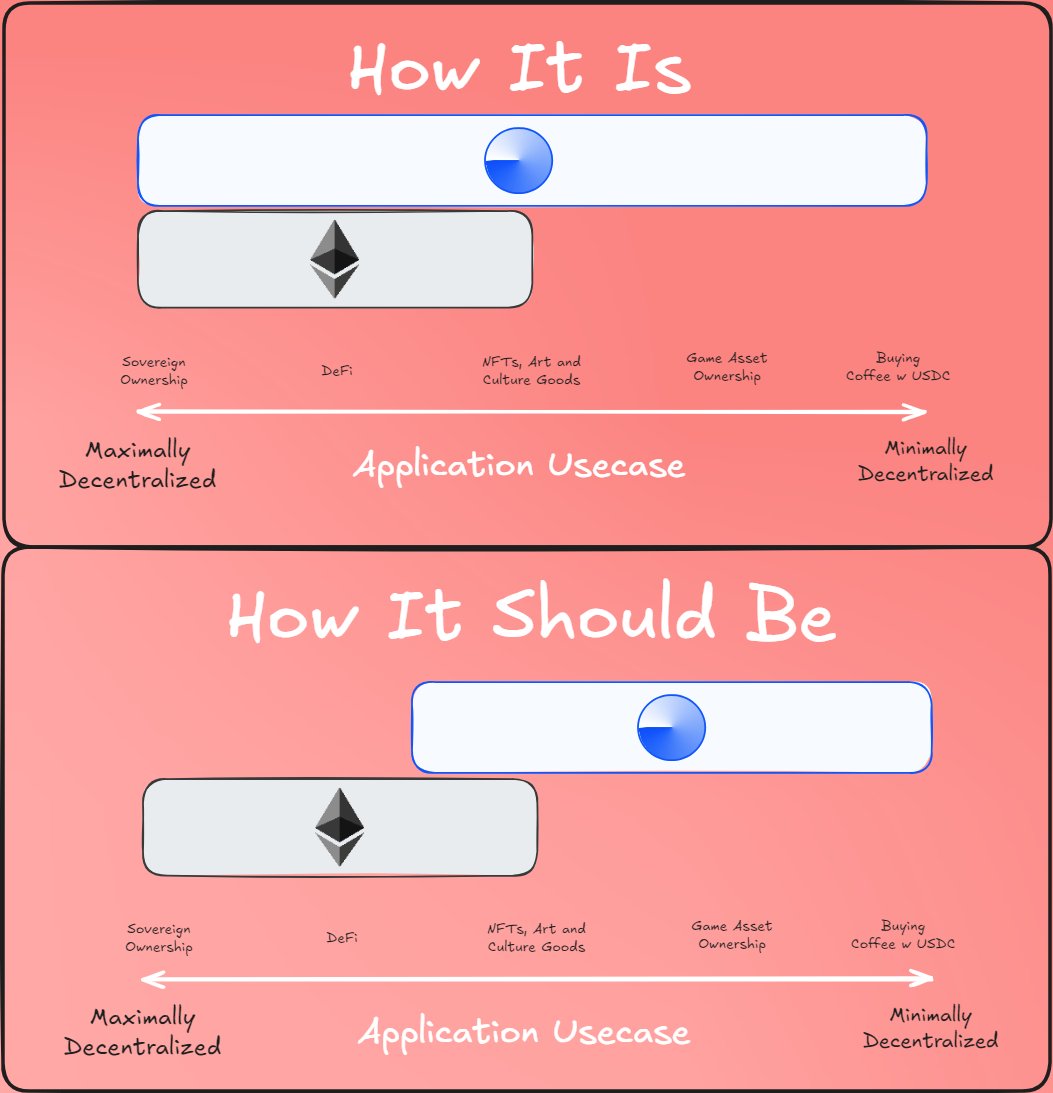
> Max notes that the current problem right now is that users are being taken from mainnet for same-usecases and are thus parasitic (s/o @KyleSamani ). He frames the world as a spectrum of applications requiring various properties (decentralization, permissionlessness, etc) and that the problem right now is the complete overlap between Ethereum and L2s for any given application. His perfect world is DeFi on Ethereum - additive applications (paying for coffee) on L2s.
I completely agree here, and to visualize made a graphic of the current paradigm vs how it would be in a symbiotic world.
Of course you'd always have overlap to the discretion of users but the main idea is to align incentives and up L1 performance to the point where users would know Ethereum preserves strong decentralization properties and thus should be used for high-value transactions while L2s increased UX and lack of decentralization would be sufficient for lower-value ones.
I maintain that "moneyness" gained from L2s does not outweigh the loss in execution on mainnet and the largest ETH problem to-date is still messaging: https://t.co/ejq8ZTKea9
s/o @eawosikaa my other messaging warrior
------
🔹Based Rollups🔹
> Max dubs Based constructions the more "aligned" version of L2s because they user Ethereum for sequencing and forgo (some) execution rewards and because improvements to mainnet would benefit both Based Rollup UX as well as L1 capacity (block times being front of mind).
He also proposes the idea of "Super Based" rollups which include user protections in the block as opposed to maximized for block builder rewards. Had Ethereum started with Based then it would be in a much better place because of aligned incentives and ecosystem direction.
Couldn't be more in-line with my own thoughts, and he went on to note that it's unfortunate they came along late in the game because the incentives aren't there to convert existing constructions to Based (which I've commented on previously: https://t.co/ctRSNyq9Zu). Teams are pushing for it, but it might be too late.
Becoming a Max stan.
I'd also like to add that Gwenyth Taiko is a based construction with a property that I think would make an L2 truly an Ethereum Network Extension™️: atomic composability with L1 contracts.
------
🔹"Are L2s Ethereum?"🔹
------
🔹Optimistic vs ZK🔹
> Max notes that ZK is the superior tech but Optimistic has taken not only marketshare because it was ready early, but commandeered some of the Ethereum roadmap because of it's prominence. He think EF should come back to center and work to put efforts into improving the alignment between mainnet and ZK.
Also notes that ZK helps in the area where it's needed (bandwidth) vs where Optimistic helps (execution).
I have less strong opinions here as I've also thought ZK was the better tech but knew it had research overhead still to be done. I will note that he calls out ZK state diffs being posted to mainnet and while you make up on bandwidth there they are also lossy in that you lose intra-batch history. (e.g. A->B, B->C is seen as A->C)
------
🔹Ethereum Needs to 100x Throughput🔹
> Max specifically calls out targeting a "100x" improvement in Ethereum through various proposals such as shorter block times, Multiple Concurrent Proposers, etc so that it is brought to parity with the remainder of the blockchain landscape.
I thought this was another good opportunity for a visual and showing what "100x" looks like in the context of a chain like Solana.
Here is what the data throughput is of Bitcoin, Ethereum, Solana and 100x Eth look like today:
You can see that even with a 100x improvement (that Vitalik is skeptical can be achieved while preserving Ethereum values) it's still multiples behind Solana. I don't think the endeavor should be perceived as out of the question given all the synergies it pulls forward.
------
🔹Other Notes🔹
> He comments that the roadmap has been somewhat commandeered by Optimistic teams in favor of ZK, despite it being superior tech, and that it should return to center.
>He's increasingly skeptical that Arbitrum and Base will maneuver in favor of Ethereum broadly because of their corporate gov structure and what they would have to give up (e.g. user fees).
> He also noted Base somewhat gouging their customers on fees above and beyond their rent to mainnet relative to other L2s
> He predicts that L2 tokens will lose value and as a reaction to that teams will scramble to eat away at ETH value prop within their ecosystem to give value to their own token. It's all about incentives.
> In the end he emphasized that Etheruem is full of good people building for good, but perhaps have just strayed from the best way to achieve their collective goal.
------
FIN.
------
All in all it was a great listen from a non-typical perspective and I recommend a listen. He largely aligns with my overall thoughts on direction and am hopeful Ethereum heeds at least a few items.
I loved one particular quote so much I want to end on it:
"I don't think people expected the Ethereum endgame to be a cheap undifferentiated DA layer with a bunch of powerful companies building on top of it harvesting as much rent as they can from that monopoly"
Oof.
❇️ Introducing Blockchain Pages on Dune — your Source of Truth for all key metrics and insights for any blockchain👇
Explore your favorite blockchain's:
- Onchain data
- Popular community dashboards
- Top creators
and more,
all in one place.
https://t.co/T6BCo6fK05
Simple, yet filled with a lot of fun in #Crypto Confidential.
"Essential reading for anyone playing—or thinking of playing—in the crypto #sandbox." - Kirkus Reviews
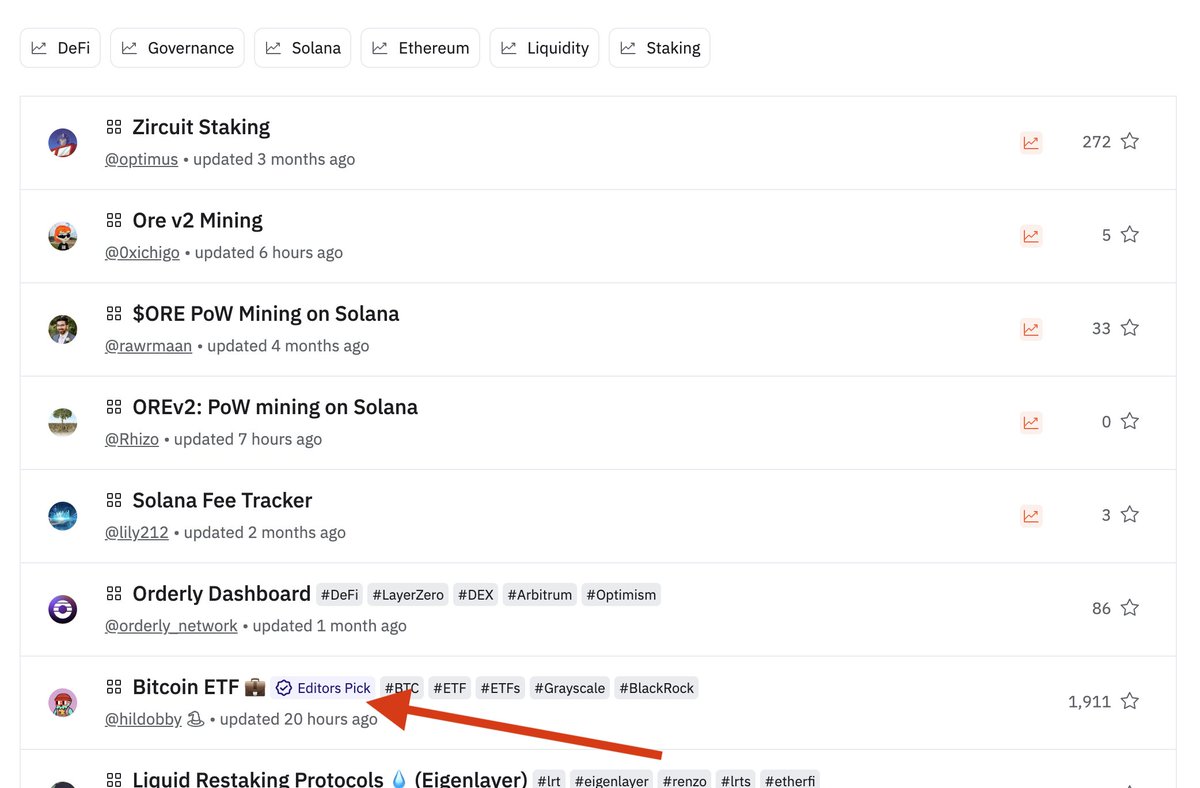
We’ve launched the Editor's Pick tag to help you find the best content on Dune. 🌟
Dashboards flagged with this tag are handpicked by our team for their high quality. Look out for it on the Discover pages and dashboard pages. 🤌
Today, we're sharing our key takeaways from EthCC!
Check out today's #TokenEngineeringReads to discover the four main areas of token engineering success – and challenges!
Read more: https://t.co/c3VoV32QDY
🧵 @akrtws
DYK #TEFundamentals is the only existing free bachelor-level education program offering a deep dive into #TokenEngineering? Even universities haven't caught up to this cutting-edge discipline yet!
Enroll now to Module 1 to start your TE journey 👇
https://t.co/hf4QefMosd
1/ What's next for #DeFi?🤔
I researched roadmaps of 25 major protocols to find out.
A lot is coming up: protocol-owned-stablecoins, new tokenomics, decentralization plans, The End Game for Maker and more.
These are the top 7 trends coming for DeFi 🧵