My new favorite, Astral Realm, made with Fable 5.2, rendered in @threejs
2hrs, 2M tokens, a LOT of iterations, everything besides the character is procedural. Even I was surprised how well it turned out
Would you move into a world like this?
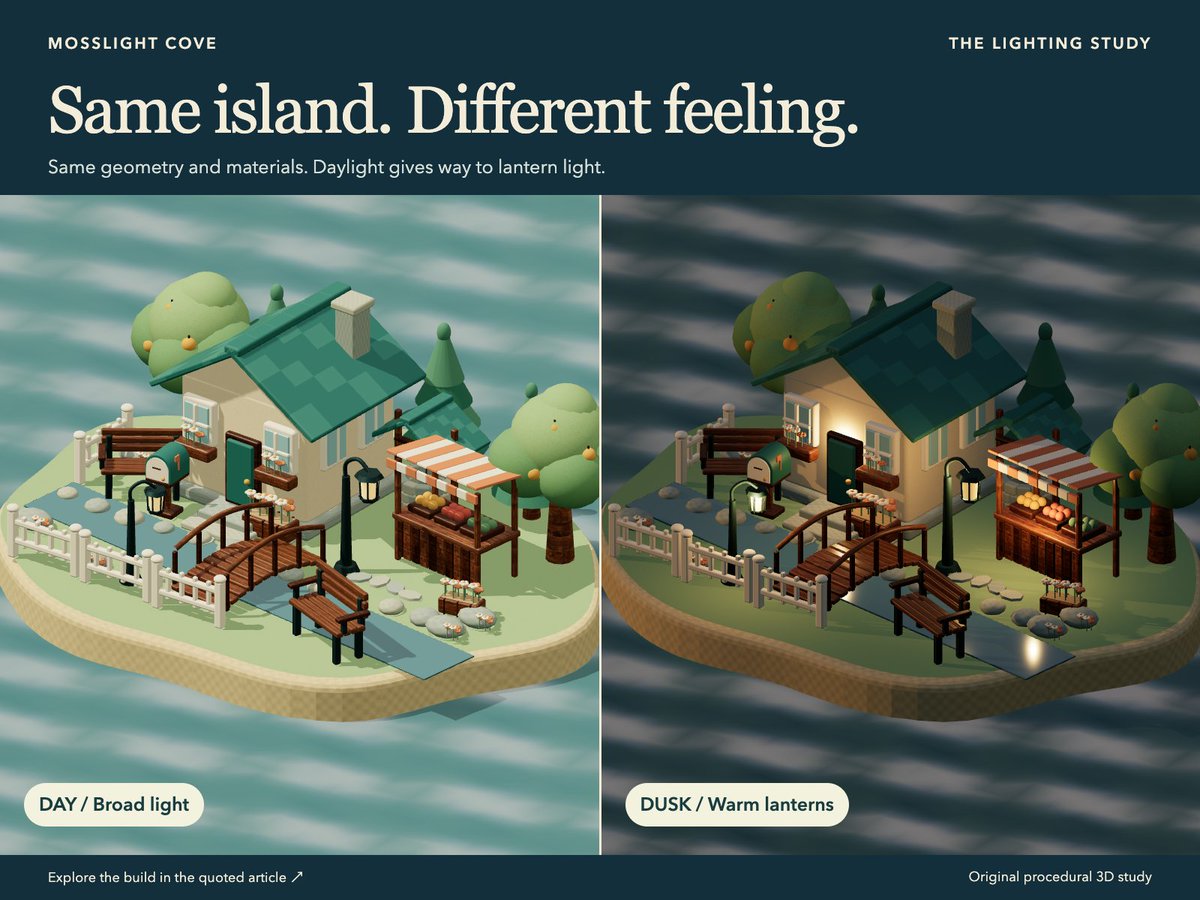
A tiny orchard village. A teal-roof cottage. A market beside the water.
I broke the build into 12 asset families, shared design rules and copyable prompts.
The full guide is in the quoted article.
Same village. Different hour.
Daylight makes you notice the little market.
Dusk makes you imagine walking home.
No new models or materials here—just a different lighting setup.
The quoted guide breaks down the asset kit behind both views.
Day or dusk?
Tripo generated the product model. Three.js handles the display slab, lighting and camera moves.
The soundtrack was composed separately for this film.
One idea → a 3D concept asset → a product showcase.
Can Tripo handle a product instead of a character?
I described a retro mini synth: cobalt-blue body, orange controls, ivory keys and walnut sides.
Then turned the generated asset into a short product film.
Sound on. Original synth loop added in post. 🎛️
Look closely at the keys, knobs, screw recesses and rear panel.
The clay view separates geometry from painted detail.
Actual asset: 50,561 triangles + an 8K color texture.
This is a product concept, not an engineered or working instrument.
Tripo generated the character from the image. Three.js handles the display stage, lighting and camera.
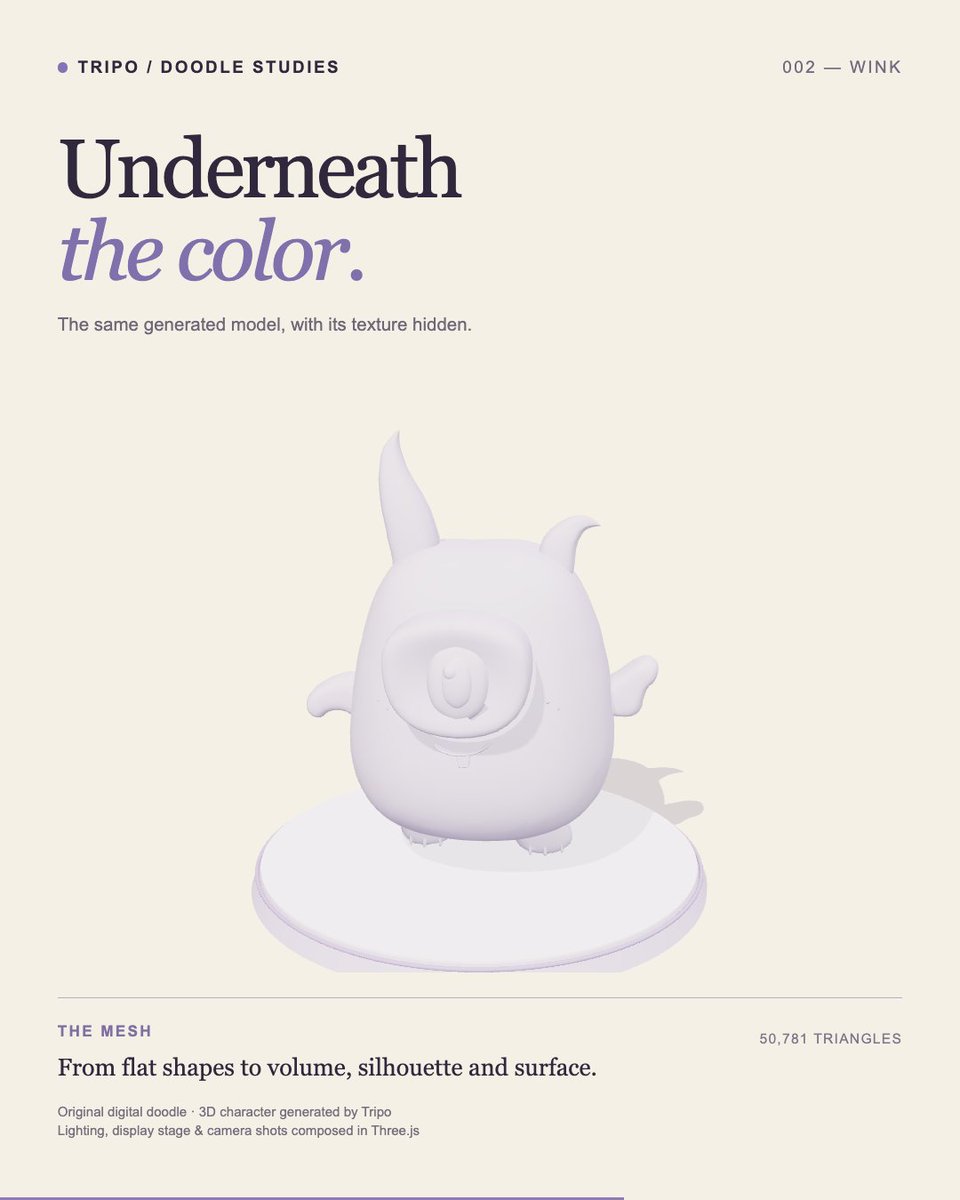
The clay + wireframe shots show the generated mesh with its color texture hidden.
A small experiment in turning an original doodle into a 3D asset.
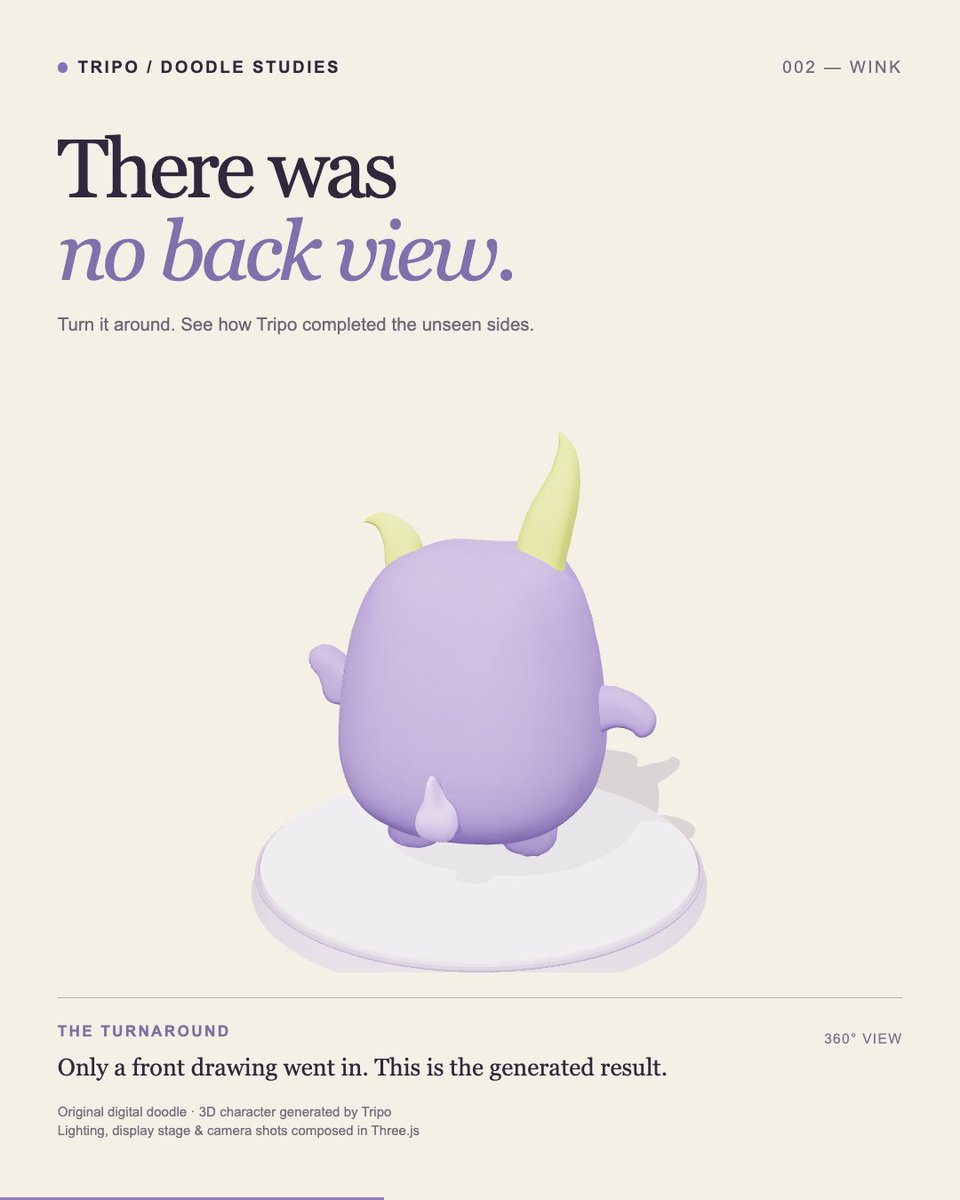
This little monster only existed from the front.
I made an original digital doodle, gave that one image to Tripo, then turned the result around. 👁️
Doodle → 3D → the side you never drew.
Here’s the input and the result. ↓
The one eye, uneven horns, tiny tooth and belly patch are recognizable in the result.
The back is Tripo’s interpretation: I supplied no side or rear reference.
Actual GLB: 50,781 triangles + an 8K color texture.
Turn it around before judging it.
The clay + wireframe reveal shows the generated mesh underneath.
Tripo made the character. I used Three.js for the scene, lighting and camera shots.
The scene and lighting changed too. This comparison shows how this project evolved.
My first capybara was spheres and rounded boxes.
Then I gave Tripo the same character idea. 🍊
V1: code-built prototype.
V2: Tripo-generated character.
Here’s the before/after—and what actually changed. ↓
The biggest change was the character itself:
• More recognizable face and ears
• Defined paws and toes
• Detailed fur surface
• A textured yuzu + leaf
Tripo P2 output: 45,726 triangles and an 8K color texture.
That gave me much more to work with.
Today, we’re announcing Univer 1.4 and introducing Space.
With Univer SDK, build your own spaces with file management and document, spreadsheet, and slide editing.
Build an agent-native workspace. Build apps for your business.
Here’s a closer look. 🧵
Introducing Ling-3.2-flash, Ant Ling's native multimodal model: 560B total / 25B active parameters.
Stronger complex visual understanding, long-horizon multimodal agents, 3D understanding & interaction, and medical intelligence.
Outscores Opus 5 (max) in release evaluations:
- OmniDocBench1.5: 92.21 vs 90.56
- ZEROBench(Sub): 43.71 vs 39.52
- Vision2Web: 85.86 vs 80.20