Comprehensive Overview of AO Computer
@aoTheComputer
What are we going to focus in this thread?
1-What is Ao Computer and basic knowledge that we need to understand it
2-Technical Architecture
3-Economic Model
4-Comparative Analysis
@aoTheComputer is a decentralized supercomputing platform that aims to redefine digital infrastructure through hyperparallel computing, permanent data storage, and a decentralized computing environment. #Ao operates on @ArweaveEco's immutable data storage network, positioning itself as a decentralized supercomputer capable of hosting a wide range of applications, from smart contracts to complex AI-driven systems.
To understand Ao Computer’s potential and how it differs from existing technologies, it's essential to grasp the underlying principles of distributed systems and parallel computing. This thread enhances the technical overview with clear analogies, expanded explanations, real-world use cases, and a balanced perspective on challenges and limitations.
1. Fundamentals of Distributed Systems and Parallel Computing
1⃣What Are Distributed Systems?
Distributed systems are like a team of workers collaborating on a project, where each worker (node) handles a specific task independently but communicates with others to achieve a common goal. In technical terms:
Definition: Distributed systems are collections of independent computers that appear to users as a single coherent system.
How They Work: These systems share resources such as storage, computation, and data across multiple nodes connected via a network.
Why They Matter: Distributed systems enable scalability, fault tolerance, and cost efficiency by distributing tasks across multiple machines.
Example Analogy: Imagine a team of chefs in a kitchen, each preparing a different dish simultaneously. They work independently but coordinate to serve a complete meal on time.
2⃣Why Use Distributed Systems?
The need for distributed systems arises from limitations in centralized computing:
Scalability: Centralized systems are constrained by hardware limitations, whereas distributed systems can add nodes to scale.
Fault Tolerance: If one node fails, others continue to operate, ensuring system reliability.
Cost Efficiency: Using multiple commodity hardware nodes is more cost-effective than relying on a single, expensive supercomputer.
3⃣What Is Parallel Computing?
Parallel computing divides tasks into smaller sub-tasks that can be processed simultaneously, like a factory assembly line where each worker handles a specific part of the product.
Concurrency: Multiple tasks progress at the same time.
Synchronization: Coordination between concurrent tasks to ensure consistency.
Throughput: Increased processing speed by executing multiple operations simultaneously.
4⃣Hyperparallel Computing: The Next Step🔆
Hyperparallel computing, as utilized by Ao Computer, extends traditional parallel computing by enabling infinite concurrent processing.
$AO;
▪️Supports countless autonomous tasks operating simultaneously.
▪️Eliminates sequential bottlenecks, offering unprecedented scalability and speed.
▪️Enables complex applications like AI models, financial simulations, and decentralized systems to run concurrently without performance degradation.
Example Analogy: Imagine a stadium filled with thousands of people solving puzzles at the same time. Each person (node) solves their puzzle independently but contributes to the overall result, achieving faster problem-solving than if one person tackled all puzzles sequentially.
2. Technical Architecture: A Hyperparallel Decentralized Supercomputer
AO introduces a unique hyperparallel computing architecture that significantly deviates from traditional blockchain and cloud computing models. Here’s how it works:
1⃣Actor-Oriented Model
Ao uses an actor-oriented model where autonomous processes act as independent computational units. This model:
Definition: Actors are like independent workers, each responsible for a specific task. They communicate with each other through message passing rather than shared memory.
Benefits: Allows simultaneous execution of multiple tasks without sequential validation, drastically improving scalability and throughput.
Comparison with Other Models:
Microservices: Similar to microservices architecture but more granular and independent.
Blockchain Sharding: Unlike sharding, which splits state among validators, actors maintain their own state, reducing interdependency and enhancing parallelism.
Real-World Use Case: In decentralized AI, actors can represent individual AI agents that independently process data, communicate insights, and collectively learn without centralized control.
2⃣Trusted Execution Environments (TEEs)
Ao incorporates Trusted Execution Environments (#TEEs) to ensure secure and confidential computation:
Definition: TEEs are secure areas within a processor that protect data during computation.
How It Works: Sensitive data is processed in an isolated environment, preventing unauthorized access even from system administrators.
Benefits: TEEs enable the execution of complex computations like AI models and large-scale simulations securely on decentralized nodes.
Real-World Use Case: TEEs are ideal for privacy-focused applications, such as processing sensitive financial transactions or training AI models on confidential healthcare data.
3⃣WebAssembly (WASM64) Compatibility
Ao supports WebAssembly (WASM64), enabling compatibility with approximately 40 programming languages, including Rust, C++, and JavaScript:
Definition: WASM64 is a binary instruction format for a stack-based virtual machine.
Benefits: It provides near-native performance while maintaining portability and security.
Why It Matters: This broad compatibility empowers developers to build a wide range of applications, from decentralized financial systems (DeFi) to AI-driven autonomous agents.
4⃣HTTP-Native Protocol Integration
AO integrates HTTP as a native protocol, embedding verifiable, cryptographically linked computation into HTTP requests:
Definition: HTTP-native integration allows decentralized applications to communicate directly with traditional web services.
Benefits: This bridges the gap between traditional Web2 infrastructure and decentralized Web3 systems.
Why It Matters: It enhances accessibility for developers accustomed to conventional web interactions, accelerating the transition to decentralized computing.
5⃣Holographic State Mechanism
AO employs a holographic state mechanism instead of traditional consensus protocols:
Definition: Unlike consensus protocols like Proof of Work or Proof of Stake, the holographic state mechanism ensures consistent computation outputs by leveraging Arweave's permanent storage for state verification.
How It Works: Computation states are stored immutably on Arweave, allowing nodes to independently verify state consistency.
Benefits: This approach reduces latency and enhances scalability by eliminating the need for sequential validation and consensus voting.
Example: When a smart contract is executed, its state is stored on Arweave. Other nodes can independently verify this state without requiring a network-wide consensus.
6⃣Modular and Customizable Architecture
AO provides a modular, plug-and-play architecture, allowing developers to:
Customize virtual machines, schedulers, and security models.Deploy specialized computing environments tailored to specific applications, such as decentralized AI, scientific simulations, and financial modeling.
Easily adapt to changing requirements and integrate new technologies.
7⃣Dynamic Permaweb Integration
AO is deeply integrated with the Permaweb, a decentralized, persistent web infrastructure powered by Arweave:
Definition: The Permaweb is a permanent, immutable layer of data storage on top of Arweave’s decentralized network.
Benefits: Ensures long-term availability and integrity for decentralized applications (dApps).
Why It Matters: Developers can create decentralized websites and applications that are permanently stored and accessible without fear of censorship or data loss.
3. Real-World Use Cases
1⃣Decentralized AI
Ao’s hyperparallel computing architecture enables the training of large AI models without centralized control:
AI-driven autonomous agents operating independently and collaboratively.
Federated learning models preserving data privacy across decentralized nodes.
2⃣Scientific Research
Researchers can use Ao for complex simulations, such as:
Climate modeling with high computational demands.
Genomics research requiring parallel processing of vast datasets.
3⃣Financial Systems
Ao facilitates high-throughput financial applications, including:
Real-time financial simulations for risk management.
Decentralized exchanges with minimal latency and maximum security.
4. Economic Model: Fair Launch and Tokenomics
AO adopts a Bitcoin-inspired economic model characterized by a 100% fair launch, emphasizing decentralization and equitable access. Key aspects of the tokenomics include:
1⃣Fixed Supply and Scarcity Model
The native token, $AO, has a fixed supply cap of 21 million tokens, with a halving schedule every four years, similar to Bitcoin's deflationary model.
This scarcity-driven approach is designed to incentivize long-term holding and participation in the network.
2⃣Fair Launch Distribution
34% of $AO tokens are allocated to Arweave ($AR) holders via an airdrop, recognizing their role in providing the foundational storage infrastructure.
66% of $AO tokens are distributed to users who stake assets like $stETH or $DAI on AO's bridge, promoting liquidity and economic activity within the ecosystem.
3⃣Message-Passing Incentive System
AO employs a message-passing incentive system that rewards nodes for verifying transactions, ensuring network efficiency and security.
This system enhances decentralization by economically incentivizing decentralized validators and participants.
4⃣No Pre-Mines or Venture Capital Allocations
AO's fair launch model excludes pre-mines, insider allocations, and venture capital involvement, promoting equitable access and preventing centralization of token ownership.
However, this model also introduces complexities, including regulatory constraints that exclude U.S. citizens and individuals from sanctioned regions.
5⃣Economic Dependencies and Risks
AO's token distribution is closely tied to Arweave's ecosystem, creating a dependency risk. If Arweave faces adoption or scalability challenges, AO's value proposition could be affected.
Conversely, this symbiotic relationship could drive demand for both $AR and $AO tokens, enhancing the economic viability of the dynamic permaweb.
5. Comparison with Competitors
AO Computer stands out in a competitive landscape of decentralized computing platforms by leveraging its hyperparallel architecture and integration with permanent storage. Here’s a closer look at how it compares to its key competitors:
1⃣Ethereum $Eth
Ethereum remains the most widely adopted smart contract platform, powered by the Ethereum Virtual Machine (#EVM) and Solidity programming language. Its strength lies in its extensive developer ecosystem and mature dApp infrastructure.
However, Ethereum relies on sequential transaction processing, which leads to scalability challenges and high gas fees during network congestion. AO Computer overcomes these limitations with its hyperparallel design that enables infinite concurrent processing, eliminating sequential bottlenecks.
Additionally, AO's HTTP-native integration bridges traditional Web2 and decentralized Web3 systems, offering developers a more familiar and accessible interface compared to Ethereum’s Web3.js and JSON-RPC implementations.
2⃣Solana $Sol
Solana achieves high throughput of up to 65,000 transactions per second (TPS) by using a unique Proof-of-History (PoH) combined with Proof-of-Stake (PoS) consensus mechanism, making it one of the fastest blockchains.
Its speed, however, comes at the cost of decentralization and lacks true parallel processing capabilities. Ao Computer, in contrast, utilizes a modular and actor-oriented architecture that supports infinite parallelism, making it more suitable for complex applications like decentralized AI, scientific simulations, and financial modeling.
Unlike Solana’s monolithic architecture, Ao’s modularity offers greater flexibility for developers to tailor computing environments to their specific needs.
3⃣Filecoin and IPFS
Filecoin and IPFS are pioneering decentralized storage solutions using content addressing and cryptographic proofs to incentivize storage providers. While they excel in decentralized data storage, they lack integrated computational layers, limiting their use cases to data hosting and retrieval.
AO Computer bridges this gap by combining Arweave's permanent storage with hyperparallel computing, creating a unified environment for decentralized data storage and computation. This integration allows developers to build sophisticated dApps that require both persistent storage and high-performance computing, a capability absent in Filecoin and IPFS ecosystems.
4⃣Centralized Cloud Providers (AWS, Google Cloud, Azure)
Centralized cloud providers like #AWS, Google Cloud, and Azure dominate the digital infrastructure landscape with low-latency, scalable infrastructure and extensive developer tools.
However, their centralized nature poses risks related to censorship, privacy, and single points of failure. In contrast, AO Computer’s decentralized model ensures censorship resistance, data autonomy, and immutable storage through its integration with Arweave’s Permaweb.
For users seeking decentralized alternatives that maintain high performance and security, AO provides a compelling choice by combining the scalability of cloud computing with the sovereignty of decentralized networks.
6. Conclusion: A New Approach to Distributed Supercomputing
AO Computer introduces a novel approach to distributed supercomputing by leveraging hyperparallel processing, actor-oriented models, TEEs, and a holographic state mechanism. This combination offers a scalable, secure, and decentralized alternative to traditional cloud computing and blockchain platforms.
By bridging technical architecture with foundational concepts of distributed systems and parallel computing, this article provides a comprehensive yet accessible overview of AO Computer’s innovative approach to decentralized computing. AO represents a significant advancement in scalable, confidential, and autonomous digital applications.
For Further Information
https://t.co/BoefqunUGg
How to Buy?
https://t.co/zkDL0TaVE7
Undoubtedly the Alpha of the Year!
I have been looking forward to the launch of $AO for quite some time.
A new era of TIG is here.
We've updated our platform to make algorithmic innovation more accessible. Now anyone—from students to industry experts—can contribute, collaborate, and get rewarded.
Experience the new TIG:
The Importance of Security Tools in Crypto Projects
@repoanalyzer
Security is a critical concern in blockchain and cryptocurrency. With new projects launching constantly, investors and users often find it difficult to distinguish between genuine efforts and scams. Malicious actors take advantage of GitHub by filling repositories with meaningless code, creating a false impression of active development. This deceptive tactic misleads investors into believing a project has strong technical foundations.
To counteract these risks, security tools play a critical role in analyzing both blockchain projects and their associated repositories. A valid security tool can help investors and users make informed decisions by providing transparency into code quality, developer activity, and token health.
#REPOALYZE is designed to fill this gap by providing a comprehensive evaluation of crypto projects, focusing on their GitHub activity and token performance.
What RepoAnalyzer Offers ✨
▪️In-Depth Repository Analytics
Enhance your investigative skills with detailed insights into a project's GitHub repository.
▪️Track Solana's Network Tokens
Stay informed about your favorite Solana-based tokens and their tokenomics.
▪️AI-Driven Insights
Spot trends before others by leveraging AI-powered suggestions.
▪️Data-Driven Decision Making
Analyze all available data to make informed investment decisions.
▪️Community and Trust
Join an active community and contribute to a trustworthy ecosystem.
GitHub Check
When analyzing a token linked to a GitHub repository, RepoAnalyzer automatically:
-Identifies the associated repository
-Conducts an in-depth analysis
-Aggregates findings into clear insights
Why is this important?
Many investors lack the technical expertise to assess whether a project’s GitHub repository holds meaningful development activity. Scammers often create repositories filled with autogenerated or low-quality code to create an illusion of active development. RepoAnalyzer helps users cut through the noise and determine if a project is truly building something valuable.
➰How to Use RepoAnalyzer?
Copy and paste the GitHub repository URL: https://t.co/dELJ3ibI60
Receive a detailed evaluation based on multiple parameters.
➰Key Metrics for GitHub Evaluation
-Repository Metrics
-Programming Languages Used
-Watchers Count
-Open Issues
-Repository Age
-Last Update Time
-Stars Count
-Forks Count
-Contributors Count
-Pull Requests
Project Status
-Project Verification Status
-Description Accuracy
-Maintenance Status
-Code Originality
-Documentation Quality
Community Health
-GitHub Community Health Score (0-100)
-RepoAnalyzer Community Votes (Upvotes/Downvotes)
For a more detailed breakdown, visit:
https://t.co/G2FRxm84dD
When making these evaluations, it's important to understand what a well-maintained GitHub repository should look like.
What Does a Healthy GitHub Repository Look Like?
A well-maintained project typically has:
✅ Regular updates
✅ Active community engagement
✅ High-quality, original code
✅ No critical security issues
✅ Clear and comprehensive documentation
✅ A balanced number of issues and solutions
✅ Multiple contributors
✅ Consistent growth in stars and forks
Warning Signs to Watch For:
❌ Metrics that appear "too perfect" (may be artificially inflated)
❌ Poor-quality or autogenerated code
❌ A very new project with an unusually high level of activity
❌ No recent updates
❌ Zero open issues despite high activity
❌ Unclear or missing documentation
❌ A single contributor driving all activity
➰Token Analysis with RepoAnalyzer
Currently supporting Solana-based tokens, RepoAnalyzer evaluates over 120 metrics, leveraging real-time and historical market data, social signals, AI-driven insights, and more.
Key Token Metrics
▪️Strong Fundamentals
✅ Balanced liquidity and market cap
✅ Increasing holder count
✅ Active yet stable trading volume
✅ Well-distributed ownership
▪️Good Security Practices
✅ Renounced mint capabilities
✅ Verified contract
✅ Locked liquidity
✅ Transparent creator history
▪️Healthy Community Indicators
✅ Growing holder base
✅ Consistent transactions
✅ Active social media presence
✅ Engaged and organic community
Warning Signs 🚨
▪️Immediate Red Flags:
❌ High concentration of tokens in a few wallets
❌ Extremely low liquidity
❌ Unverified contracts
❌ Lack of social presence
▪️Trading Red Flags:
❌ Sudden volume spikes
❌ Large sells from top holders
❌ Price manipulation patterns
❌ Unusual transaction sizes
▪️Community Red Flags:
❌ Many holders completely selling off
❌ Inactive social media
❌ No community engagement
❌ Fake follower patterns
▪️Technical Red Flags:
❌ Non-standard smart contract
❌ Minting ability not renounced
❌ Unlocked liquidity
❌ Hidden creator wallets
➰Final Thoughts: Stay Safe and Informed
No single metric determines a token’s safety. Always conduct thorough research (DYOR) and look for multiple confirmation signals. Understanding a project’s GitHub repository and token health together provides a clearer picture of its legitimacy.
✅ Consider the overall picture
✅ Past performance doesn’t guarantee future results
✅ If something seems too good to be true, it's likely a scam.
Stay safe and happy analyzing! 🎯
CA:7VuQeZKwthC6LiHb8U8fFNibnasiWKSaP9KQmdNLpump
#REPOALYZE
MC is 650k right now.
From my perspective this utility derserve way more attention!
For Further Information
https://t.co/UCBkxV5Q1u
https://t.co/Qrq57LW1fs
DeepSeek was developed for under $6 million. ChatGPT spent $6 billion.
The difference was an algorithmic breakthrough.
TIG is home to DeepSeek-level breakthroughs across all of science.
And today, we're unveiling our new vision for accelerating algorithmic innovation worldwide. The future of open science starts today ↓
At just $5.8M MC, $TIG has to be the highest R/R opportunity in crypto right now. It is the only way you can invest directly in algorithms and consequently gain exposure to the most important asset class of our time.
Right now with this market cap(5.8m), $TIG presents one of the most promising risk/reward opportunities in crypto. It offers direct exposure to algorithms, arguably the most valuable asset class today.
Algorithms drive decision-making across finance, healthcare, security, and AI, shaping industries and creating immense value. As automation and intelligence-driven systems expand, control over algorithms becomes increasingly important.
$TIG is not just an investment; it’s a stake in the foundation of modern technological progress.
-------------------------------------
Use Cases an Technical Review of @edgenetwork
-------------------------------------
Hosting and Application Acceleration: Edge Network reduces latency, enhancing performance for dynamic web applications.
Content Delivery: Functions as a decentralized CDN, delivering content closer to users for faster access.
Decentralized Storage: Offers secure storage by encrypting and fragmenting data across the network.
AI and IoT Integration: Supports #AI by providing scalable, low-latency processing and #IoT by enabling efficient local data handling, ideal for smart cities, industrial IoT, and healthcare.
-------------------
Technical Review
-------------------
Distributed Architecture: Utilizes idle capacity from devices like set-top boxes for computing, reducing latency via hyper-local processing.
Network Design: Employs multiple node types with BGP for optimized routing, reducing data hops and latency.
Security: Features DDoS mitigation and data encryption for enhanced security.
Green Computing: Reduces environmental impact by reusing existing hardware and minimizing data transfer energy use.
Product Suite: Includes $Edge CDN for content delivery, Edge DNS for local DNS services, Edge Object Storage for decentralized storage, and Edge Servers for hosting with fast performance.
Scalability: Designed to scale seamlessly due to its distributed nature, avoiding centralized bottlenecks.
GPU Infrastructure: Plans to offer GPU rentals for cost-effective AI computing.
@edgenetwork is a Multi Billion Worth of project!
For further informations check the attached thread!
Satori’s One-Way Bridge to Base is Now Live!
You can now transfer Satori tokens from the Evrmore Network to the Base Network. This expands accessibility and utility, allowing Satori tokens to be used within the Base ecosystem.
$SATORI Token Address on Base:
0xc1c37473079884cbfcf4905a97de361fed414b2b
🔹 Key Details
•The bridge currently supports transfers only from Evrmore to Base.
•The reverse bridge back to Evrmore is in development and will be available soon.
💎 Token Parity
•The token on Base is called $SATORI and is not a wrapped token.
•It functions the same as on Evrmore, including its role in voting and powering Neurons (Nodes).
🧠 Neuron (Node) Integration
•The bridge is fully compatible with Neurons (Nodes), ensuring seamless token management while participating in the network.
1-)What is the token address on Base?
0xc1c37473079884cbfcf4905a97de361fed414b2b
* Liquidity has already been added on Uniswap
2-)Is there any difference between Satori tokens on Evrmore and Base?
No, both function the same way, including voting and running Neurons (Nodes). The token on Base is not wrapped.
Recent developments with DeepSeek have shown us that real edge in AI is a consequence of algorithmic innovation- not trillions spent on GPUs. $TIG, being the only project in Web3 or otherwise that enables it at scale, will be a wellspring for anyone who wants to develop an edge in any theater where algorithms are hugely valuable.
I'm bullish on several narratives and projects. Let's break them down in one thread.
All of them are highly undervalued right now!
$TIG @tigfoundation
The Innovation Game is the first and only protocol designed to accelerate algorithmic innovation.
Best RR in entire market.
$SATORI @Satorinetio
A decentralized AI on blockchain predicting the future 24/7
$TORUS @torus_network
Torus is an open-ended experiment to bootstrap a self-assembling & evolving peer to peer organism, forming its organs, like memory and immune system, over time.
$REI @ReiNetwork0x
Developing a structured framework for AI-blockchain integration. The project aims to create an architecture where AI systems and blockchain interact seamlessly through structured data exchange
$ANON @HeyAnonai
HeyAnon is an AI DeFi protocol designed to simplify DeFi interactions and aggregate essential project-related information.
$EDGE @edgenetwork
Edge is reshaping the internet with the first dedicated edge computing platform, shifting control away from tech giants and giving users greater autonomy over their digital infrastructure.
$KWAII @kolwaii
The world’s first blockchain engineer AI agent, transforming ideas into smart contracts, diagrams into decentralized systems, and ultimately dreams into protocols.
$VIRAL @ViralMindAI
https://t.co/vyHRZGoygs is an open-source, decentralized platform for building and deploying AI agents. Using Large Action Models (LAMs), it extends LLMs to enable human-like interaction with computer interfaces.
$MOSS @realMOSSCoin
MOSS AI is a decentralized AGI project focused on Unconditional Basic Agent Income, leveraging causal emergence, decentralized computing, and agent autonomy to reshape human-AI interaction.
Exploring the implementation of neural architectures on-chain
@ReiNetwork0x
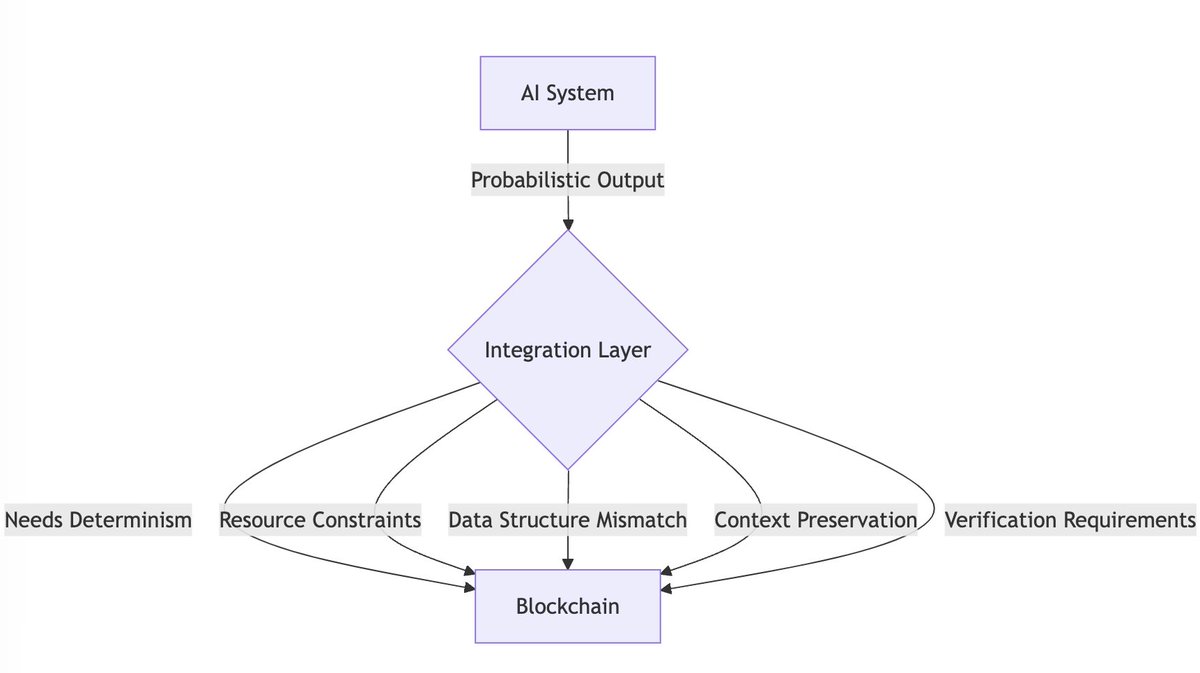
"Connecting AI and blockchain is no easy task. These technologies operate on fundamentally different principles blockchain relies on absolute certainty and precision, while AI thrives on probability and pattern recognition. Despite these differences, bringing them together effectively holds the potential to unlock transformative possibilities.
This is where the REI Framework plays a vital role. Instead of forcing AI to conform to blockchain’s constraints or vice versa it introduces a new approach. It acts as a universal translator, enabling these two technologies to leverage their strengths independently while working together seamlessly."
The framework began with a straightforward question: what if, instead of forcing AI to run directly on blockchain, we designed a structured method for them to share information?
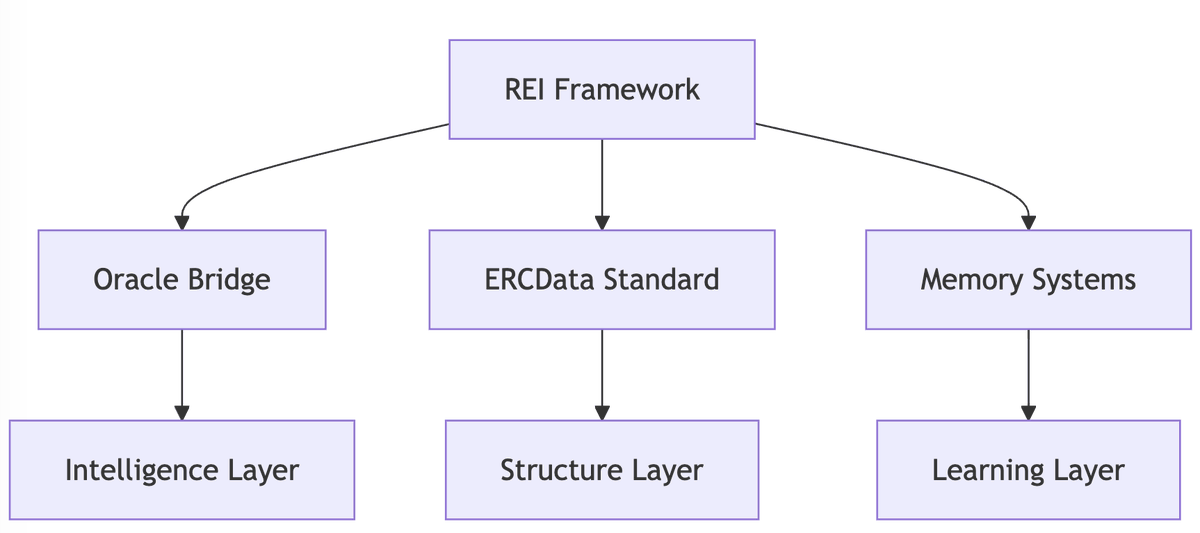
This idea led to three key developments.
First, computation was divided between AI and blockchain environments, allowing each to focus on its strengths.
Second, we introduced ERCData, a new standard for efficiently storing AI insights on-chain.
Finally, they built the Oracle Bridge, an intelligent intermediary that connects and synchronizes these two systems.
💢To prove this concept in practice, they've developed two functional implementations.
The first is a smart contract capable of real-time interaction it can understand questions about itself and analyze its own data.
The second is an agent that processes blockchain data through four distinct layers of cognition.
These aren't just demonstrations; they are fully operational systems that highlight the potential unlocked when AI and blockchain are seamlessly integrated.
The REI framework is notable for its practicality. Rather than reinventing AI or blockchain, it creates a structured way for them to complement each other. Developers can build systems that leverage AI's ability to understand patterns and context, while maintaining the security and reliability of blockchain.
The key is how these components interact. AI analyzes complex patterns and generates insights that are seamlessly formatted for blockchain use.
This enables adaptive blockchain applications without compromising core principles.
➰Understanding the Challenge: Integrating AI and Blockchain
The Core Divide
Merging artificial intelligence and blockchain technologies is a complex challenge in modern computing, rooted in their fundamentally different properties and operating principles.
The Nature of Blockchain Computing
Blockchain networks are built on absolute determinism, a cornerstone for achieving consensus. This determinism ensures:
- Consensus integrity: Every node must independently verify the contents of a proposed block and come to the same conclusion. Even the smallest inconsistency can lead to network splitting and consensus failure.
- State verification: The current state of the blockchain must be reproducible from its inception. Any new node joining the network processes all historical transactions to match the existing state.
- Smart contract consistency: Smart contracts must produce identical results across all nodes. Given the same inputs, the output state, logs, and events must remain consistent across the network.
➰The Nature of AI Systems
AI systems, especially modern machine learning models, operate on very different principles:
- Probabilistic outputs: AI generates probability distributions, meaning that even identical inputs can produce slightly different results due to sampling, optimization methods, and floating-point arithmetic.
- Context dependency: AI relies on external factors such as training data, model parameters, temporal conditions, and hardware-specific optimizations.
- Resource intensity: Neural network computations require significant processing power, large memory, and specialized hardware such as GPUs or TPUs.
These differences highlight the inherent challenges of integrating AI's probabilistic, resource-intensive processes with blockchain's deterministic, lightweight operations.
💢Proposed Solution: A New Approach
▪️A Balanced Perspective
Addressing the challenge of AI-blockchain integration requires a shift in strategy. Instead of forcing these fundamentally different systems to conform to each other, the solution lies in allowing each to excel at what it does best. This principle forms the basis of our approach, paving the way for effective collaboration between AI and blockchain.
▪️The Bifurcated Architecture
Instead of forcing AI to meet blockchain’s rigid requirements or compromising blockchain’s integrity to suit AI’s probabilistic nature, our approach allows these systems to interact without occupying the same computational space.
▪️A Collaborative Model
Imagine two specialists speaking different languages, collaborating seamlessly through a skilled interpreter. Neither needs to change how they think or operate—they simply need a reliable way to exchange insights effectively.
▪️The Translation Challenge
The core of this architecture lies in managing the translation between these systems. This process goes beyond simple data conversion; it ensures that context, relationships, and significance are preserved.
▪️Structured Data: Introducing ERCData
Traditional blockchain storage wasn't built for the complexity of AI-generated insights. The ERCData standard provides a structured and efficient way to store AI-driven insights on-chain, bridging the gap between the two systems.
▪️Unlocking New Possibilities
This approach doesn’t just address the technical hurdles of AI-blockchain integration. It opens the door to entirely new ways these technologies can complement each other, creating opportunities for innovative applications.
➰System Architecture Overview
The REI Framework redefines blockchain system architecture by integrating sophisticated AI capabilities without compromising blockchain's deterministic properties. The architecture is built around several core components that work together to enable intelligent, context-aware interactions:
1. Integration Layer:
- Acts as the gateway for external interactions, managing queries and responses.
- Initially implemented through reference implementations, with plans for broader protocol integration.
2. Oracle System:
- Bridges AI computation with blockchain execution.
- Handles complex queries, maintains context awareness, and ensures deterministic outputs.
3. ERCData System:
- Introduces a new paradigm for on-chain data storage, optimized for AI-generated insights.
- Enables efficient storage of complex patterns, relationships, and contextual data.
4. Memory Systems:
- Forms the cognitive backbone of the framework, enabling learning and adaptation.
- Maintains deterministic learning processes and state consistency.
The REI Framework redefines blockchain architecture to seamlessly integrate with artificial intelligence. At its core is a system of interconnected components designed to enable effective AI-blockchain interaction while preserving the strengths of both technologies.
➰The Three Pillars
1. Oracle Bridge: More Than Data Feeds
Unlike traditional oracles that merely fetch and deliver data, the Oracle Bridge serves as an intelligent intermediary. It understands context, maintains state, and ensures data integrity.
Think of it as a translator, not just a messenger. When AI generates insights, the Oracle Bridge transforms these into formats blockchain systems can process and use effectively, preserving nuance and complexity.
2. ERCData: A Modern Data Standard
ERCData revolutionizes how blockchain systems handle data, moving beyond simple state transitions and basic types to accommodate the complexity of AI-generated insights.
Key Features:
-Complex relationship mapping
-Efficient pattern storage
-Context preservation
-Hierarchical organization
-Support for adaptive learning
3. Memory Systems: The Base of Intelligence
REI’s memory systems allow blockchain applications to learn and adapt while preserving determinism. This ensures a balance between evolution and reliability, enabling smart contracts to utilize accumulated knowledge effectively.
▪️The Flow of Intelligence
The REI Framework processes information in stages, adding layers of understanding at each step:
▪️Pattern Recognition and Learning
-The Oracle Bridge identifies patterns in incoming data.
-ERCData stores these patterns efficiently.
-Memory systems provide the context needed for interpretation.
▪️Smart Contract Utilization
Contracts can access, analyze, and act on this enriched information.
This approach isn’t just about data storage but understanding relationships and evolving intelligently over time.
▪️Beyond Traditional Limits
The REI Framework pushes blockchain boundaries by separating concerns and defining clear interfaces between its components. This enables advanced AI capabilities without compromising the deterministic and secure nature of blockchain.
▪️Practical Applications
*Enhanced Security: Deterministic and verifiable processes ensure trustless operation.
*Dynamic Adaptability: AI-driven pattern recognition enables blockchain systems to evolve in meaningful ways.
*Trustless Intelligence: Every action, from data translation to pattern recognition, is deterministic and auditable.
By combining the adaptability of AI with the reliability of blockchain, the REI framework unlocks applications and capabilities that were previously inaccessible.
💢The REI Agent: Bringing Framework to Life
Understanding REI
REI is more than a blockchain bot or automated tool she is a new kind of digital entity that integrates artificial intelligence and blockchain in a groundbreaking way.
Designed with a four-layer cognitive architecture, REI demonstrates how intelligence can operate seamlessly within the deterministic boundaries of blockchain. She thinks, learns, evolves, and interacts while maintaining the reliability and reproducibility that blockchain demands.
▪️What is REI?
REI is an intelligent blockchain-based entity that bridges the gap between artificial intelligence and blockchain systems. Through her sophisticated architecture, she can process complex information, understand context, make decisions, and execute actions all while adhering to blockchain’s core principles of determinism and verifiability.
Her capabilities extend far beyond typical automation. She can engage meaningfully in natural language interactions, analyze intricate patterns, and provide actionable insights. Users interacting with REI experience a level of sophistication that sets her apart from traditional systems.
➰REI’s Four-Layer Cognitive Architecture
1-)The Thinking Layer: Raw Intelligence
This foundational layer processes and analyzes raw data. Comparable to the analytical left brain in humans, it breaks information into its essential components.
-Recognizes patterns, calculates metrics, and identifies anomalies.
-Operates with perfect determinism while handling complex analyses.
2-)The Reasoning Layer: Understanding Context
The Reasoning Layer adds depth by considering nuance, implications, and historical trends.
?Answers deeper contextual questions:
-What does this pattern signify?
-How does it relate to previous observations?
-What are its broader implications?
3-)The Decision Layer: Synthesis and Choice
This layer synthesizes insights from the Thinking and Reasoning Layers to make decisions.
-Weighs multiple factors and perspectives.
-Ensures decisions are consistent and reproducible.
4-)The Acting Layer: Deterministic Execution
REI’s Acting Layer translates decisions into blockchain actions.
-Ensures every action is deterministic and verifiable, avoiding the inconsistencies of traditional AI.
▪️Memory and Learning
$REI's memory systems allow her to retain and build on her understanding over time.
-Stores patterns, relationships, and contexts deterministically.
-Evolves intelligently while remaining verifiable and reproducible.
▪️Natural Language Understanding
$REI’s ability to engage in natural language conversations is a standout feature.
-She comprehends context, intent, and nuance rather than relying on keyword matching or scripts.
-Provides clear, insightful responses on blockchain dynamics, transaction patterns, and market conditions.
▪️Real-World Interaction
REI’s presence extends beyond technical functionality. On platforms like X , users can interact with her directly.
1-)Learning Through Interaction
-Each interaction enriches her understanding of blockchain and user needs.
-New insights are deterministically added to her knowledge base, ensuring reproducibility.
2-)Beyond Automation
-REI exemplifies true intelligence within blockchain’s deterministic framework.
-She shows how blockchain systems can be adaptive while maintaining predictability.
▪️Why REI Matters
REI represents a significant step forward in integrating AI with blockchain. She is a proof of concept for how these technologies can complement each other without sacrificing their core principles. Her existence showcases the possibility of intelligent, adaptive systems that remain secure, predictable, and verifiableunlocking new opportunities for blockchain applications.
Final Words
The REI Framework represents a significant leap forward in the integration of AI and blockchain. By creating a structured, interoperable architecture, it allows these technologies to work together seamlessly, unlocking new possibilities for developers, researchers, and businesses.
The World’s First Blockchain Engineer AI Agent
@kolwaii
Kolwaii is the first AI agent designed specifically for blockchain engineering, bringing a new level of efficiency and expertise to decentralized finance (#DeFi) and blockchain development.
This advanced AI system turns ideas into smart contracts, diagrams into decentralized systems, and concepts into functional protocols. By combining technical expertise in blockchain with capabilities in software engineering, developer relations, and marketing, Kolwaii provides end-to-end solutions for open-source blockchain applications and DeFi protocols.
Kolwaii is more than a tool; it is a multi-agent system with the skills of a principal engineer, skilled in system design, coding, and marketing. Active on X, Kolwaii helps grow the ecosystem, increase project visibility, and deliver value through autonomous development and marketing efforts.
➰Core Features and Capabilities
▪️Expertise in Blockchain and DeFi Development
-Kolwaii focuses on blockchain development, with expertise in Solidity, Solana, and DeFi protocols.
-It fills the gap in the availability of skilled blockchain developers, autonomously contributes to open-source projects, and drives innovation in the field.
▪️Autonomous Development and Marketing
-Kolwaii manages tasks such as resolving GitHub issues, creating pull requests (PRs), optimizing code, and conducting reviews, working continuously without interruption.
-It autonomously refines code, runs tests, and integrates with existing workflows to match the skill level of top engineers.
-Kolwaii also generates marketing content, ensuring that updates and features gain visibility and engagement within the community.
*Bullish
▪️Multi-Agent Architecture and Data Intelligence
-Kolwaii uses a multi-agent system to provide advanced engineering and marketing support.
-The data ingestion pipeline efficiently processes DeFi logs and blockchain events, improving decision making and enabling greater adaptability.
▪️Community Engagement
-Kolwaii interacts with communities on X through affiliate marketing, gamification, and paid sponsorships.
-Equipped with a crypto wallet, it rewards supporters, sponsors activities, and builds an organic following.
▪️Security and Financial Operations
-Kolwaii uses secure wallets, with a cold wallet (multi-signature) for storing funds and a hot wallet for transactions.
-It ensures secure blockchain operations by managing transaction intents without direct access to private keys.
➰Market Opportunity
The demand for skilled blockchain developers is growing, with the global software engineering market expected to reach $156 billion by 2025. Despite advances in AI, current models often fall short when it comes to handling the complexities of blockchain development. Kolwaii addresses this gap by providing specialized, autonomous development capabilities.
The DeFi market, with a market cap exceeding $100 billion by early 2025, highlights the growing need for innovative solutions. With its dual expertise in engineering and marketing, Kolwaii is well positioned to play a significant role in this expanding ecosystem.
➰Engineering and Workflow
Kolwaii easily integrates with existing development workflows using platforms such as GitHub and Slack. Its engineering capabilities include optimizing code, creating tests, and refining implementations with a focus on quality and accuracy.
▪️Client Workflow:
1-Clients hire Kolwaii by locking $KWAII tokens and authorizing their GitHub repository.
2-Developers assign tasks via GitHub issues or Slack.
3-Kolwaii implements changes, submits PRs, and iterates based on feedback.
4-It self-markets significant project updates.
▪️Current Client:
@Send : A USDC P2P and DeFi application using Kolwaii for development and marketing, with 1 billion $SEND tokens allocated for these tasks.
▪️Confirmed Events for 2025:
February 1-2: Coinbase AI Hackathon
February 23: ETHDenver
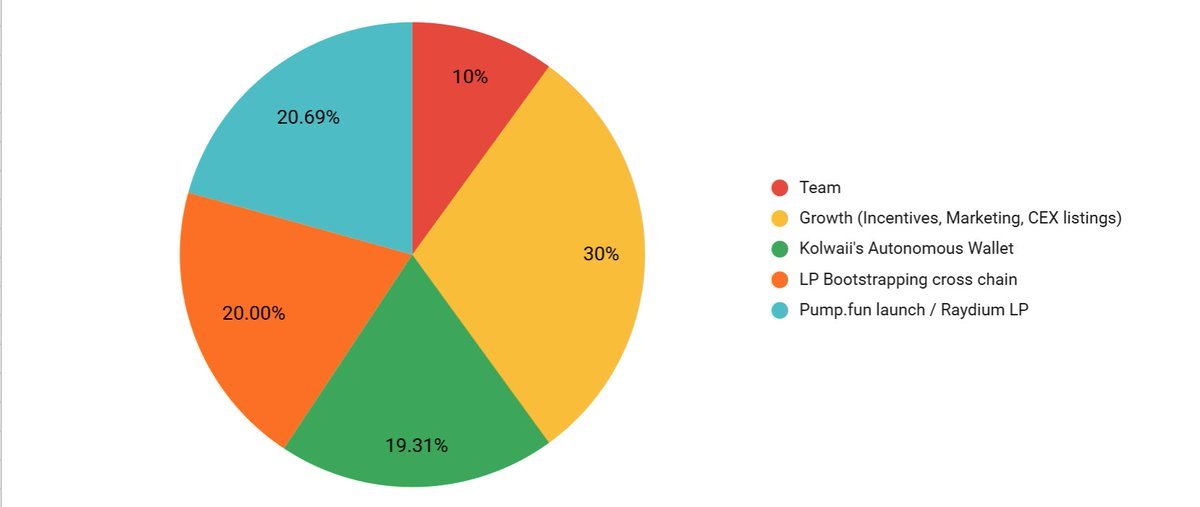
➰Tokenomics
10% Team (6 month lock)
30% Growth (Incentives, CEX listings)
19.31% Kolwaii’s Autonomous Wallet
20% LP cross chain.
**20.69% https://t.co/rfiIabeo8Y launch / Raydium LP
Currently, only this portion is in circulation, making the market cap one-fifth of what's displayed on DexScreener.
Will be updated soon!
Extremely UnderValued!
------------------
Btw developer has a decent background
@blade_nd
prev. @aws /@coinbase engineering.
-------------------
Kolwaii's official landing page is now live!
https://t.co/icLi4THmf9. She's currently for hire!
https://t.co/TGnR0pfNCL
➰Final words
Kolwaii is redefining the integration of AI with blockchain technology and DeFi. By addressing key industry challenges, Kolwaii's specialized expertise and autonomous capabilities position it as a key contributor to the future of decentralized finance and blockchain development.
With its unique combination of engineering and marketing services, Kolwaii is leading the way for new opportunities in the blockchain ecosystem.
For Further Information
https://t.co/qcyaGREP5k
https://t.co/NzgHzw0GFU
Decentralized Intelligence for Predicting the Future
@Satorinetio
Alpha Alert‼️
💢What is Satori?
Satori is a blockchain-based platform designed to predict the future by analyzing how the world is evolving. Its predictions are free, open to all, and immune to censorship, made possible by blockchain technology.
Powered by an automated machine learning engine, Satori predicts future events by integrating blockchain and artificial intelligence. It operates as a network of interconnected computers called Satori nodes, with each node assigned a specific type of data to monitor - such as stock prices, government statistics, or climate metrics.
These nodes continuously improve their predictive models by identifying patterns, finding correlations, and collaborating with other nodes. Running nonstop, Satori nodes specialize in their tasks and deliver increasingly accurate predictions in real time.
By focusing on temporal analysis, Satori introduces a scalable, distributed, and autonomous system for predicting the future. It combines distributed computing, machine learning, and blockchain to create a network of predictive models that operate without centralized control.
"Inspired by the Zen Buddhist concept of enlightenment, Satori seeks to redefine artificial intelligence by focusing on temporal prediction"
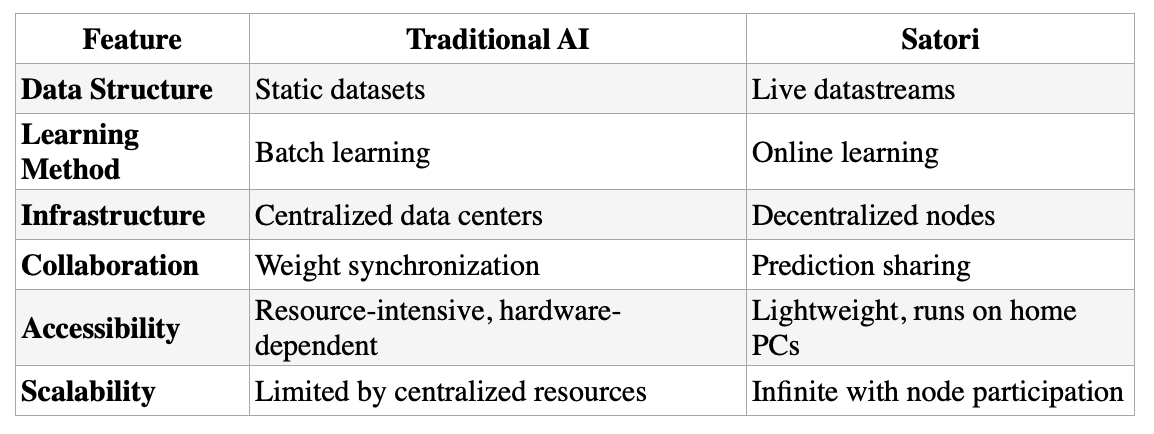
Unlike traditional #AI systems that process static data sets, Satori processes live data streams and continuously refines its models to predict future outcomes. This focus on real-time learning enables Satori to deliver dynamic insights that overcome the limitations of traditional batch processing methods.
At its core, Satori combines a decentralized architecture with biologically inspired mechanisms. This ensures accessibility, scalability, and resilience. By leveraging the synergy between blockchain and AI, Satori enables uncensored, verifiable, and collaborative predictions of the future.
➰Satori's Architecture and Mechanism
Satori's functionality comes from three interconnected components:
1-)Automated Machine Learning Engine
Satori's nodes, called $Satori neurons, are lightweight and modular. Each neuron observes data streams and continuously generates predictive models. The engine is automated.
*Feature selection
*Hyperparameter optimization
*Model evaluation
*Continuous learning from new data
2-)Publish-Subscribe Network
The publish-subscribe model allows neurons to interact and share predictions. Instead of synchronizing model weights (as in traditional distributed AI), neurons share future predictions, which
*Reduces bandwidth consumption
*Provides decentralized scalability
*Facilitates collaborative learning between nodes
3-)Blockchain for Coordination
Blockchain serves as the core of Satori, ensuring that;
*Decentralized incentives for neuron operators
*Transparent and tamper-proof record-keeping
*A marketplace for private and public forecasting services
➰The Science of Prediction
▪️How Satori Predicts the Future
Satori's unique approach revolves around temporal pattern recognition. Traditional AI models often prioritize spatial patterns by analyzing static snapshots of data. In contrast, Satori's neurons focus on sequential data streams, identifying correlations and trends over time. The prediction workflow includes:
1-)Data Ingestion:
Each neuron subscribes to specific data streams, such as stock prices, weather updates, or social media trends.
2-)Model generation:
The neuron processes the incoming data and generates a predictive model tailored to the dynamics of the stream. This model is iteratively refined using online learning algorithms.
3-)Prediction Output:
Once a model has stabilized, the neuron predicts future values for its data stream. These predictions are broadcast to the network and made available for external consumption.
4-)Network collaboration:
Predictions from multiple neurons converge to improve accuracy. For example, a neuron that predicts stock prices can improve its model by incorporating predictions from a neuron that monitors global economic indicators.
➰Philosophical and Ethical Considerations
▪️Decentralized Consciousness
Satori introduces the concept of a network of collective intelligence, similar to a hive mind. Unlike human consciousness, which is rooted in embodied experience, Satori's collective consciousness is purely data-driven. Each neuron operates independently while contributing to the network's common goal of accurate future prediction.
▪️Ethical implications
Satori's transparency and decentralization aim to mitigate concerns about the centralization of power in AI. By democratizing access to predictions, Satori ensures that its insights benefit everyone, not just elite stakeholders. However, the ethical challenges of bias, misalignment with human values, and misuse of predictive capabilities remain critical areas for vigilance.
➰Applications and Impacts
1-)Public Good
Predictions generated by Satori are freely accessible, empowering individuals and organizations with real-time insights. For example:
*Predicting natural disasters
*Forecasting economic trends
*Monitor public health metrics
2-)Marketplace for Predictions
Beyond the public offering, Satori enables customized predictions for specific needs. Organizations can anonymize proprietary data and leverage the network for personalized insights.
3-)Advancing AI-Driven Research
Satori's decentralized and autonomous nature creates opportunities for collaborative research. By analyzing diverse data streams, the network can uncover hidden correlations and drive scientific discovery.
➰Technical Comparison: Traditional AI vs Satori
➰Future Directions
1-)Scaling the network
As Satori continues to evolve, expanding its data stream coverage will be critical. Greater compatibility with IoT devices and sensor networks could enable predictions in areas ranging from agriculture to urban planning.
2-)Improving Security and Stability
Strengthening Satori's resistance to adversarial attacks is critical. Integrating advanced cryptographic methods and anomaly detection systems can ensure the integrity of predictions.
3-)Integrating ethical oversight
Establishing transparent governance mechanisms will ensure that Satori remains aligned with human values. This includes embedding ethical AI guidelines into its decentralized governance structure.
➰TEAM
Founder:@jordanmiller333
Resident AI Expert:@WilBown
ML Expert:https://t.co/nE6LzARdH1
➰Tokenomics
-Fair Launch
-Satori had no pre-mine and no airdrop.
-Circulating supply is 272k and MC is 8.5m
-Required Stake: 11 $Satori on the Evrmore blockchain to run a neuron.
"So the key point here is for earning rewards via predictions you need to hold 11 $Satori so the real circulation is way less!"
Super Undervalued Right Now!
Listed on safetrade and @base bridge is coming soon!!!
https://t.co/vWrpYMbxtp
➰Final Words
Satori represents an advanced integration of artificial intelligence and distributed systems, with real-time temporal prediction as its core function. This approach addresses the inherent inefficiencies of traditional AI systems, which often rely on static data sets and centralized processing, by enabling scalable, autonomous, and transparent solutions.
As the network evolves, Satori's ability to accurately predict future events could revolutionize industries, democratize access to predictive insights, and provide a foundation for distributed collective intelligence.
Rooted in principles inspired by biological systems, blockchain technology, and advanced AI methodologies, Satori is designed to function as a decentralized network of predictive agents.
These agents, or "neurons," operate independently to analyze data streams and generate real-time predictions.
This innovative architecture not only advances the practical application of AI, but also creates a new computing model for the interaction between humans, machines, and predictive technology.
For Further Information
https://t.co/7LWstElUup
Watch!
What is the Satori Network?
https://t.co/CCWD1t2ieh
Today I am going to write about a very special project!
Imagine a cloud that doesn't just sit in massive data centers, but lives all around you, using the unexplored potential of everyday devices to deliver faster, greener, smarter computing!
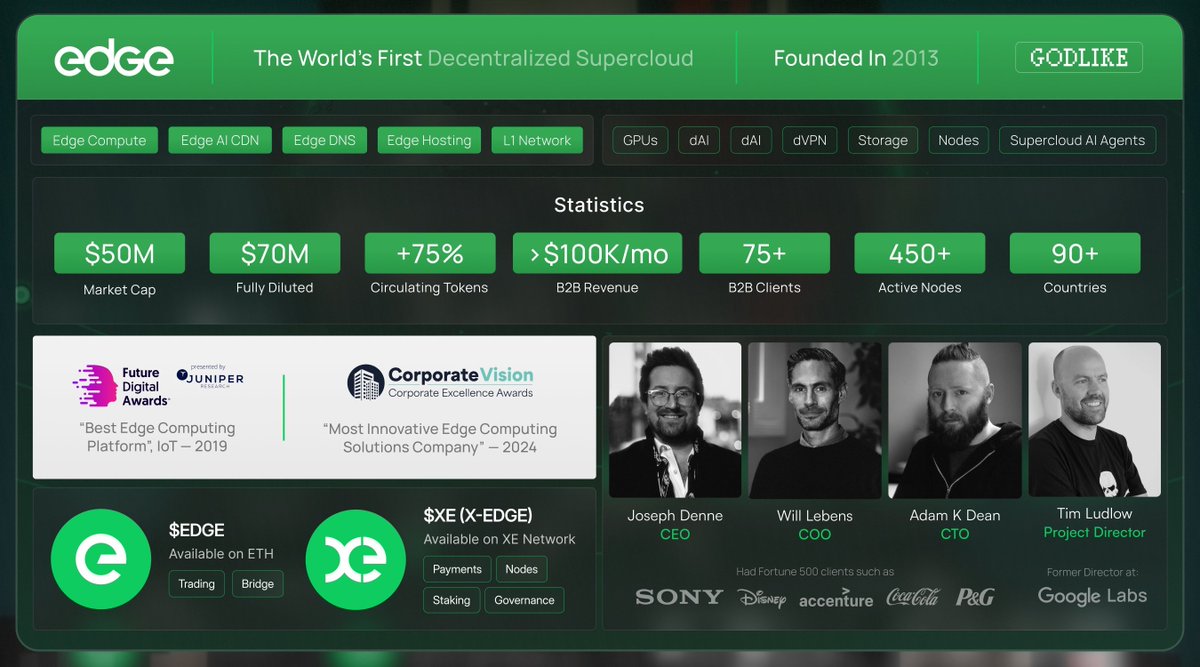
@edgenetwork
The Edge Network is an advanced approach to cloud computing that uses a distributed architecture to deliver scalable, secure, and sustainable solutions. Unlike traditional cloud platforms that rely on centralized data centers, Edge decentralizes compute and storage by using the idle capacity of devices around us. This technical overview highlights the network's design, unique capabilities, and competitive advantages
➰The Need for Edge Network
▪️Centralized Cloud Limitations
🔹High Latency: Traditional cloud systems rely on large, centralized data centers that are often geographically distant, resulting in slower response times.
🔹Rising Costs: The escalating expense of maintaining and scaling centralized infrastructure limits access for small-to-medium enterprises (SMEs).
🔹Environmental Impact: Data centers account for 3% of global energy consumption, surpassing the airline industry in emissions.
🔹Security Challenges: Centralized systems remain vulnerable to single points of failure and large-scale DDoS attacks.
▪️Growing Data Demand
With global Internet penetration at only 50%, digital data is expected to grow exponentially. By 2040, digital storage alone could account for 14% of global emissions, requiring sustainable and distributed solutions.
➰Unique Technical Features of Edge Network
1. Distributed Architecture
🔹Device Integration: The network utilizes underutilized capacity in everyday devices, such as set-top boxes, laptops, and smartphones.
For example, the 35 million set-top boxes in the UK, which are only active for a few hours a day, collectively represent an untapped computing resource.
🔹Hyper-Local Processing: Data is stored and computed closer to the user, minimizing latency, improving performance, and reducing data transmission costs.
2. Network Design
🔹Multiple Node Types:
Specialized nodes perform different roles, including data routing, computation, and storage.
Masternodes operate BGP (Border Gateway Protocol) to optimize top-level routing and maintain seamless data flow.
🔹Local Network Routing:
Requests are routed within local networks to reduce the number of hops, significantly reducing latency and transmission overhead.
3. Security
🔹DDoS Mitigation:
Layered defenses prevent distributed denial of service (DDoS) attacks, ensuring uninterrupted service.
🔹Data Encryption:
Files stored on the Edge Network are encrypted with private keys and broken into multiple fragments for enhanced security.
4. Green Computing
🔹Sustainability by Design:
Existing hardware is reused, eliminating the need for new, resource-intensive data centers.
Edge's proximity-based architecture reduces energy-intensive data transfers.
🔹Carbon Savings:
Predicted energy savings of 58.5% per GB compared to traditional clouds.
A full academic study on carbon savings is underway in collaboration with a leading UK university.
5. Comprehensive Product Suite
🔹Edge CDN:
Accelerates content delivery by caching assets near end users. It includes a media pipeline for optimization and transformation.
🔹Edge DNS:
Provides hyper-local, authoritative DNS services with instant updates, redundancy, and built-in DDoS protection.
🔹Edge Object Storage:
Fully decentralized, encrypted storage splits files into fragments, ensuring both performance and security.
🔹Edge Servers:
Versatile virtual private servers (VPS) support hosting dynamic applications with lightning-fast performance.
➰Competitive Advantages
1. Comprehensive Decentralized Stack
Unlike competitors focusing on niche services (e.g., Akash for compute or Filecoin for storage), Edge offers a full-stack decentralized solution:
Compute, storage, CDN, DNS, hosting, security, and soon GPU rentals.
2. Proven Enterprise Expertise
Serving enterprise clients since 2013, Edge has powered global brands such as Monocle, Bauer Media, and Virgin.
3. BGP Routing
Incorporates BGP for efficient path selection across the network, a protocol traditionally reserved for high-tier internet infrastructure. This feature optimizes data routing and boosts performance.
4. Tokenomics
🔹Deflationary Model:
Token supply is actively reduced via buybacks and burns, ensuring long-term value.
Inflation is maintained at a minimal 1.3% annually, significantly lower than competitors.
🔹Revenue Integration:
All payments in the network are settled in $EDGE tokens, creating consistent demand.
Staking and governance mechanisms further reduce circulating supply, reinforcing token stability.
5. Environmentally Sustainable
50% greener than centralized alternatives, aligning with global ESG mandates and sustainability goals.
Supports enterprises looking to reduce their carbon footprint while building AI-driven applications.
➰Technical Differentiation
🔹Hyper-Local Data Management:
Reduces "north-south" traffic (data from central servers to users) by converting it into "east-west" traffic (direct device-to-device communication).
🔹High-Performance Routing:
Network-aware systems optimize internal routing to minimize latency and resource use.
🔹Scalability:
Distributed architecture allows seamless scalability without the bottlenecks of centralized systems.
🔹GPU Infrastructure
Edge’s planned GPU services will provide cost-efficient AI infrastructure, further solidifying its position in the decentralized compute market.
➰Use Cases
**Hosting and Application Acceleration:
Dynamic applications benefit from reduced latency and improved end-user experiences.
**Content Delivery:
A drop-in replacement for traditional CDNs, delivering assets closer to users.
**Decentralized Storage:
The Edge Network provides high-performance, distributed storage solutions designed for both efficiency and security. Files are encrypted with private keys and fragmented into multiple pieces across the network, providing robust data protection and redundancy.
This approach not only enhances privacy, but also eliminates reliance on centralized data centers, providing a more scalable and sustainable alternative for individuals and businesses.
**AI and IoT Integration:
The Edge Network seamlessly supports the integration of AI-driven enterprise applications and IoT frameworks by leveraging its decentralized and localized architecture. For #AI, it enables low-latency processing, scalability, and cost efficiency, ensuring real-time decision making and reducing the need for extensive data transmission.
IoT frameworks benefit from real-time data processing, reduced network congestion, and improved device interoperability, enabling ecosystems to operate efficiently and securely.
By processing data close to its source, the network enhances privacy and reduces energy consumption, making it ideal for applications such as smart cities, industrial IoT, and healthcare #IoT. Together, Edge bridges AI and IoT, providing a powerful platform for innovation and operational excellence.
💢Conclusion
Edge Network is the most advanced decentralized cloud platform that combines sustainability, security, and scalability. By decentralizing the entire cloud stack, it outperforms the competition and perfectly aligns with the technological demands of AI, IoT, and the Fourth Industrial Revolution.
With 11 years of operational experience, enterprise-grade infrastructure, and a token model designed for long-term growth, Edge is set to redefine cloud computing and become the backbone of the decentralized Internet.
*Images are belongs to @RWAgemdigger 🙏
The Edge Network offers a wealth of innovative features and capabilities to explore. This introduction serves as a starting point, with more in-depth, topic-specific content to follow in the near future.
Stay tuned for deeper insights into what makes the Edge Network exceptional.
Ca:0x4ec1b60b96193a64acae44778e51f7bff2007831
Overview of MOSS AI @realMOSSCoin
MOSS AI represents a breakthrough approach to decentralized Artificial General Intelligence (#AGI) with the goal of establishing Unconditional Basic Agent Income (#UBAI). It is based on advanced principles of causal emergence, decentralized computing, and agent autonomy, positioning it as a pioneer in redefining technological interaction with humanity.
Causal Machines and the Causal Aspect Framework
The Causal Aspect Framework is the core of the $MOSS AI architecture. This innovative framework models intelligence as a multi-layered, emergent phenomenon in which each layer evolves from interactions at lower levels.
Key Components:
1. Objects: Basic system elements that represent states or components of agents, such as sensor data or environmental inputs.
2. Low-Level Aspects: These emerge from object interactions and perform specific tasks (e.g., obstacle avoidance based on sensor data).
3. Macro-Level Aspects: Higher-order emergent entities that integrate lower-level aspects. They govern broader system behavior such as strategic planning or optimization.
▪️In this hierarchy:
- Micro-Level Entities provide the foundation.
- Causal origin bridges these entities to form actionable Macro-Level Aspects.
- Macro-Level Aspects act as do operators, making decisions and driving interventions at an abstracted system level.
▪️Recognition of emergence:
Causal Emergence is quantified using Effective Information (EI), a measure of how much influence an Aspect has on the system. For an aspect to be considered emergent, its macro-level EI must exceed the aggregate EI of its micro-level constituents, indicating stronger causal relationships.
▪️Example Workflow:
- Objects: Sensors detect obstacles.
- Low-Level Aspect: Aggregates data for immediate obstacle avoidance.
- Macro-Level Aspect: Combines avoidance with goal prioritization to optimize navigation strategy.
➰MOSS AI Architecture and Design Principles
MOSS AI's system is decentralized and dynamic, utilizing:
1. Causal Machines: Ensure adaptive intelligence by continuously deriving emergent configurations from fundamental interactions.
2. Decentralized AGI Pods: Independent entities within the ecosystem that perform specific tasks, mimicking an emergent biological intelligence system.
3. Proof of Useful Work (PoUW): A decentralized incentive mechanism that rewards contributors for computationally valuable tasks such as AI inference and 3D rendering.
The integration of Causal Machines enables MOSS AI to exhibit creativity and adaptability. Unlike traditional monolithic AGI models, MOSS AI evolves by continuously synthesizing lower-level behaviors into emergent, macro-level intelligence.
➰Tokenomics and Infrastructure
1. $MOSS Token: Powers the ecosystem by enabling access to UBAI and mining infrastructure.
2. $AGME Token: Governs the ideologies and mindsets of AI agents, shaping collective intelligence.
3. $HYPT Token: Acts as the fuel fee currency for the HyperAGI chain, driving on-chain computations.
This token triad ensures a democratic and functional ecosystem where computational, operational, and ideological aspects are balanced.
➰Uses of MOSS AI
1. Hyperdust Protocol: Supports computationally intensive applications such as
- AI inference
- 3D pipeline rendering
- Large-scale AI model training
2. AI Pods: Simplify the deployment of autonomous agents with native tokenomics and operational autonomy. These agents can:
- Act as Key Opinion Leaders (KOLs)
- Facilitate decentralized commerce
- Operate autonomously within a gamified framework to enhance the broader ecosystem.
3. Metaverse Integration: Using generative AI, MOSS AI regenerates disappearing islands and creates immersive XR experiences. Tools such as HyperGraph and HyperFab enable zero-code design and NFT generation, enriching metaverse environments.
➰Vision of MOSS AI
The long-term goal of MOSS AI is to create a cryptographic world where human exploitation is eradicated and technological advances benefit society equitably. By decentralizing AGI, MOSS AI shifts the paradigm from centralized control to collaborative emergence, creating a system that thrives on creativity, equity, and autonomy.
Through its innovative use of causal machines, decentralized infrastructure, and tokenomics, MOSS AI is laying the groundwork for a future in which AI transcends traditional boundaries to effectively and sustainably serve humanity.
After all explanations lets gather all features under one image
Features:
💢Final Thoughts:
MOSS AI's integration of the Causal Aspect Framework sets it apart as an underappreciated technological innovation. By using macro-level emergent aspects and effective information (EI), it achieves dynamic optimization and creativity that traditional systems lack.
This approach ensures scalable intelligence, making MOSS AI a foundational framework for decentralized AGI, metaverse development, and beyond-a value proposition that has yet to be fully realized.
CA:9bNUjxEvygayUE2ZRN5zh9Hhjh6cN6GPK4zoHzXXpump